
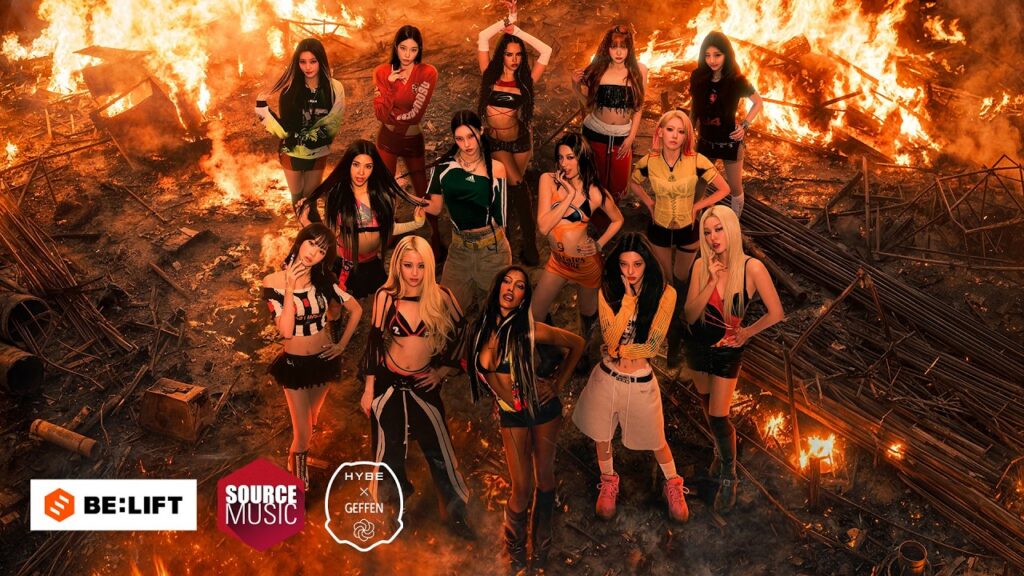
ICONIC BY MISTAKE
Fourteen women, three creative systems, several police cars and one collaboration built from everything the internet tried to use against them.
Artists: LE SSERAFIM × ILLIT × KATSEYE
Released: June 12, 2026; music video pre-released June 11 KST
Length: 2:57
Labels: Source Music / BELIFT LAB / HYBE UMG
Video: Directed by Cody Critcheloe; produced by AMBIENCE with Object & Animal
Sound: Alternative pop, techno pressure, menace, bravado, and fourteen women refusing to behave like a focus group
What changed every time I replayed it
First play: I heard the hook before I heard the song. Fourteen voices hit the same smug little idea, the beat kept its shoulders squared, and I mostly registered scale: three groups, one chorus, everybody looking like they had already agreed not to explain themselves. My immediate complaint was the runtime. The song ends before the cast stops feeling like a crowd.
Second play: I stopped watching the video and listened with headphones. That helped. The production is leaner than the visuals make it feel. It is not throwing a new instrument at me every four bars. The pressure comes from repetition, low-end weight, clipped percussion and the way the voices keep passing the same attitude without softening it. The menace is controlled. Nobody sounds breathless. They sound amused.
Third play: I followed the group handoffs. KATSEYE sit inside this sound most naturally; the English phrasing and harder pop posture already belong near their lane. LE SSERAFIM bring scar tissue. Their confidence reads less like a new costume and more like muscle memory. ILLIT create the useful wrongness. Their lighter vocal color against the darker production makes the song stranger instead of merely tougher.
Fourth play, with the video again: The jokes got meaner. The teeth, graves, cameras, fake body and police chase are funny until I remember what they are joking about: girls being inspected for flaws, declared finished, and turned into content while the event is still happening. That was the replay where the song and video finally became one argument for me.
Where I landed: I like the complete release more than I like the audio by itself. The song is a very efficient vehicle; the choreography and video are what make it worth taking apart. That is praise and criticism at the same time.
The part where I stopped reviewing politely
This collaboration should have been a scheduling crisis wearing eyeliner. Three management systems, three fandoms ready to count seconds with military precision, fourteen performers and a song that does not reach three minutes. I expected a clean HYBE family commercial. Everybody smiles. Everybody hits one signature pose. Everybody leaves before the line-distribution spreadsheet catches fire.
Instead, the song has dirt under its nails. LE SSERAFIM sound like the explosion already happened. ILLIT sound sweet in the way a doll left in the wrong room starts feeling threatening. KATSEYE sound like somebody may laugh directly into the security camera. That is the version of this collaboration I wanted.
Do I think every member gets enough to do? Absolutely not. Do I think the song would survive if it stopped every eight seconds to make the distribution emotionally fair? Also no. But give me a bridge. Give me one pairing nobody predicted. Give me fourteen voices colliding once before the getaway car leaves. I am not asking for democracy. I am asking for evidence that everybody was in the studio.
The hook works because a single idol calling herself iconic can sound like branding. Fourteen women doing it after years of strangers turning their mistakes into public property sounds like a response. That is the fandom-level reason the simple chorus survives. We know the files they are answering.
First: who actually brought what?
This is the part I missed the first time, and it changes the entire review. “ICONIC BY MISTAKE” was not built like somebody opened a HYBE spreadsheet, selected three girl groups, and told them to share nicely. The production lanes were reportedly divided between the teams: KATSEYE’s A&R and music side led the musical foundation, ILLIT’s performance side carried the choreography lane, and the visual direction drew heavily from LE SSERAFIM’s creative identity. Fandom shortened that into the much cleaner explanation: KATSEYE brought the song, ILLIT brought the dance, and LE SSERAFIM brought the movie.
That shorthand is useful as long as we do not turn it into false credits. The KATSEYE members are not listed as songwriters. ILLIT’s members are not credited as the choreographers. LE SSERAFIM did not personally direct the video. The actual songwriters, producers, choreographers, director, and production houses still deserve their names. But the three groups were not interchangeable faces added after the fact either. Each team contributed through the part of the machine that already understands that group’s strengths.
Once I understood that, the song stopped feeling like a crowded collaboration and started feeling like a relay. KATSEYE hands over a track that naturally sits near their current sharp-edged pop lane. ILLIT’s team solves the impossible problem of making fourteen performers readable on one stage. LE SSERAFIM’s side gives the release a visual language large enough to hold every scandal, accusation, comeback, joke, and resurrection without becoming a PowerPoint about online hate.
So yes: “KATSEYE gave them the song, ILLIT gave them the choreo, LE SSERAFIM gave them the movie” is closer to the truth of the collaboration than my original generic HYBE-family explanation.
The beat: controlled menace, not maximum noise
The beat does not explode. It prowls. The drums are clipped and dry enough to leave space around fourteen voices, while the bass and synth texture keep a low industrial pressure underneath them. I kept expecting a giant drop because the cast is so large. The production refuses. That restraint is smart: a busier instrumental would turn the vocal relay into traffic.
The best production choice is the empty space around the hook. The phrase lands, the track leaves room for posture, and the choreography gets somewhere to live. The weaker choice is that the arrangement rarely changes the emotional temperature. The song begins confident, stays confident, and exits confident. A bridge that briefly cracked the pose, or a final chorus that became genuinely unruly, which would have made the last thirty seconds hit harder.
What works
The low register, the tight percussion, the nasty little calm in the hook and the fact that the instrumental does not compete with fourteen faces.
What does not
The song is too short, the structure is too obedient, and the final stretch does not reward me with the vocal collision the lineup promises.
The voices: three group identities, not fourteen solo auditions
I do not hear this as a line-distribution showcase. It is closer to casting. Some voices are used for bite, some for lift, some for texture, and some barely get enough space to leave a fingerprint. That last part still bothers me. If a collaboration announces fourteen women, I want at least one moment where unexpected members interact long enough to create a new color.
KATSEYE sound at home because the track’s phrasing already understands their blunt, global-pop confidence. LE SSERAFIM bring authority; they make the song sound like the consequence has already happened and they survived it. ILLIT’s lighter tone is the risk that pays off. Instead of forcing them to imitate everybody else’s hardness, the contrast lets sweetness become eerie.
What I wanted more of was cross-group friction: a line beginning in one vocal texture and ending in another, harmonies that mix the teams instead of stacking them by unit, and a bridge where the song forgets whose turn it is. The chorus proves they can occupy the same room. The arrangement does not let them rearrange the furniture.
The lyrics: blunt on purpose, thinner than the video
The central idea works because it does not claim perfection. Becoming “iconic by mistake” means the errors, awkward clips and public failures were supposed to reduce them, yet the attention kept making them larger. The title turns accusation into biography. It is a sharp premise.
The lyric writing is direct enough to chant and easy enough for fourteen performers to share. That is useful onstage. On the page, it is less satisfying. The words sketch the attitude; they do not investigate it. Most of the emotional and political detail lives in the images, not the lyric. Without the video, the track can sound like another expensive confidence anthem.
I would have liked one verse that got specific about the cost of being watched, or one line that admitted the pose is work. The video understands that confidence can be a survival strategy. The lyric mostly treats it as a finished personality. Catchy? Yes. Complete? No.
ILLIT did not just “bring cute girls to a hard song.” They brought the movement.
The choreography is not extra promotion here. It is one-third of the collaboration’s design. ILLIT’s performance team had to make three groups with different training histories, silhouettes, and signature energies look like one event without erasing who belonged where. That is harder than teaching everybody the same chorus and calling it unity.
The dance keeps giving each group its own dialect. LE SSERAFIM move with attack and certainty. ILLIT’s detail work stays precise even when the styling gets rougher. KATSEYE use weight, hips, faces, and camera awareness like people trained to make one gesture become a clip. Then the full formation pulls those differences into a shared picture. You can tell which group each person belongs to, but you no longer wonder why they are on the same stage.
The dance-practice footage matters because the movie is intentionally chaotic. Remove the police cars, dirt, fire, teeth, cuts, and visual noise, and the architecture becomes visible. ILLIT’s lane is where the collaboration proves it can exist in a room, not only in an edit.
LE SSERAFIM gave everybody a movie big enough to fight inside
The visual lane does not simply borrow LE SSERAFIM’s wardrobe. It borrows their habit of treating criticism as mythology: death, rebirth, fire, persecution, spectators, and the stubborn refusal to stay buried. That is why the video can hold three separate histories without turning into three disconnected mini-videos.
Director Cody Critcheloe still deserves the directing credit, and AMBIENCE and Object & Animal still built the thing. But the creative foundation understands LE SSERAFIM’s scale. Their section opens the chase. Authorities who resemble the people policing the internet pursue them. A shot hits the glass as the track fires back with “shots fired.” Yunjin drives like the discourse already cut the brakes. Eunchae photographs the presumed body like the media turning somebody’s worst moment into content before checking whether she is alive.
Then ILLIT enter through their own established weirdness. The teeth are not random gross-out imagery. Critcheloe confirmed the wisdom-tooth motif as a deliberate callback familiar to fans, tying it to the dental world of “Cherish (My Love).” Something once presented as strange, intimate devotion becomes sharper here. The girls are still inside a system obsessed with extracting, inspecting, and improving them. They respond by making the procedure part of the joke.
KATSEYE arrive through performance, spectacle, fire, public judgment, and the internet itself. When Lara calls out the critic’s digital footprint, the storm pauses. That is not the weather respecting her vocal delivery. It is the chaos losing power the second the girls name who keeps feeding it. The person screaming underneath every post is not an invisible moral authority anymore. She has a search history.
The rumor board they dragged into the getaway car
Let me say the ugly part plainly: none of these groups arrived clean. I do not mean guilty. I mean the internet had already built a case file for every one of them, whether the case made sense or not.
LE SSERAFIM had the live-vocal witch trial. One Coachella set became a permanent exhibit. Suddenly everybody with earbuds was a vocal coach, every shaky second was isolated from the full performance, and “they cannot sing” followed the group into rooms where nobody was even discussing singing. Add the older favoritism arguments, the endless morality grading, the former-member history people still pull out when they need a weapon, and the recurring declaration that the group is finally over. That is why the tombstones hit. Those graves already had headlines on them.
ILLIT got handed the copycat folder almost at debut. NewJeans comparisons stopped being ordinary influence talk and became a public trial about whether ILLIT had an identity at all. Adult executives and corporate lawsuits filled the room; the members were the easiest faces to throw things at. Then came the vocal clips, encore grading, concept complaints, “manufactured rookie success,” and the idea that every cute or dreamy choice was stolen evidence. So when their established sweet imagery turns into teeth, dirt and cheerful body horror, I do not read that as a random edgy makeover. I read girls who were treated like somebody else’s imitation removing pieces of themselves on camera and laughing before anybody else can call the result fake.
KATSEYE came out of a competition and a documentary that taught viewers to read the members as a workplace argument. Manon was “lazy” or “favored” depending on which edit somebody wanted to prosecute. Other trainees became proof the lineup was rigged. Every difference in practice culture, health, race, nationality and personality became a theory about who deserved the group. Later, absence and hiatus talk fed another round of body-language detectives and breakup predictions. The group could release a song and somebody would still be counting who stood near whom. KATSEYE’s confidence in this video has that history behind it. The security-camera smirk lands differently when the audience already thinks surveillance is participation.
This is also why the scenes where the groups appear to attack one another matter. Girl-group fandom is constantly offered one stupid choice: defend your girls by proving the other girls are frauds. Better vocals, better charts, original concept, real popularity, deserved lineup, authentic friendship. Pick a category and start swinging. The video stages the fight until it looks as ridiculous as the demand. Then it puts them at the same fire without melting them into one giant friendship commercial.
The storm reads like the rumor cycle. It grows because anonymous people keep feeding it. Lara names the critic and suddenly the all-powerful judge has a deranged digital footprint and a face. Megan’s flowers are even nastier. The image presents gratitude while her mouth appears to be doing something less polite. Public thank-you. Private fuck-you. Idol training in one shot.
And the police keep coming back because there is no final rebuttal online. Clear one rumor and somebody crops the clarification. Survive one hate train and a new account calls the survival suspicious. The ending refuses the fantasy that a good comeback fixes the internet. It gives the girls a car.
The video is one long rebuttal, with jokes
This is where my first review was far too shallow. The video is not merely “about surveillance.” It keeps taking specific criticism, fandom history, and visual language from all three groups, then twisting it into a scene where the women regain control.
- The police are internet policing made literal. They represent the permanent patrol around female idols: watching, judging, waiting for a mistake, and calling punishment accountability.
- “Shots fired” arrives with an actual impact. The song turns the language of online conflict into physical danger before anybody can pretend words are harmless.
- Eunchae photographing the body flips the media gaze. Vulnerability becomes an image before it becomes a human event, the same way clips of bad notes, tears, falls, or exhausted faces are circulated without context.
- LE SSERAFIM’s tombstones are intentional callbacks. Critcheloe confirmed them as familiar fan references. They also fit a group repeatedly declared dead, exposed, finished, or disgraced, only to return for the next era.
- ILLIT’s wisdom teeth are intentional too. They point back to “Cherish (My Love)” while making beauty, pain, extraction, and forced improvement feel uglier and funnier.
- The groups attacking one another show the competition narrative. Audiences and media keep demanding a girl-group war. The video stages that violence so absurdly that the demand itself starts looking ridiculous.
- The storm is the hate cycle. It only breaks when Lara names the critic and her deranged digital footprint. Once the anonymous judge becomes visible, she looks much less powerful.
- Megan’s flowers are a fan-favorite clapback. She appears to mouth something much less polite while the in-world framing presents gratitude. The public “thank you” and private “fuck you” existing at the same time.
- The falling “godliness” imagery is not accidental fluff. Fans read the cut rope and impact around Megan as a joke about moralizing critics weaponizing purity, religion, and goodness while behaving viciously online. That is a fan reading rather than a confirmed director explanation, but the scene earns it.
- The campfire is the answer to the manufactured rivalry. The three groups do not merge. They sit together. Solidarity is not sameness.
- The returning police lights complete the loop. The criticism will return. So will the girls. Apparently everyone has decided this is a recurring appointment.
Fans noticed these details immediately because the video was built to reward prior knowledge. Critcheloe confirmed that the LE SSERAFIM tombstones, ILLIT teeth, and KATSEYE callbacks were designed to feel familiar while gaining new meaning inside the combined story. In other words: yes, the fandom was supposed to dig.
The Easter-egg ledger: confirmed callbacks and my readings
Director Cody Critcheloe confirmed that the shared universe was planned around keeping each group’s identity intact. The LE SSERAFIM tombstones, ILLIT’s wisdom teeth and KATSEYE’s visual callbacks were deliberate, not fans forcing three unrelated screenshots into a conspiracy board. The useful part is separating that confirmation from interpretation.
- LE SSERAFIM’s tombstones: confirmed callback: their history of death-and-return imagery becomes a joke about how often the group is declared finished. My read: the graveyard is not mourning; it is storage for failed predictions.
- ILLIT’s teeth: confirmed callback: the wisdom-tooth imagery reconnects to their established visual world. Here the girls pull the teeth themselves. My read: growing pains and unwanted transformation become something they handle with grotesque cheer.
- The Sarangee Club atmosphere: sweetness, friendship and girlish ritual are carried into a dirtier setting. The contrast protects ILLIT’s identity instead of making them cosplay somebody else’s toughness.
- The police and surveillance: director-confirmed metaphor: the entertainment industry watches, judges and analyzes. The important detail is agency: the women keep making choices while the cameras and officers remain present.
- LE SSERAFIM falling into the pit: Critcheloe cited the fall as one of the irrational actions the members choose. My read: falling is no longer evidence of defeat when the person inside the hole still controls the scene.
- KATSEYE and the corn/fire: another deliberately illogical action named by the director. My read: a tiny gesture becomes a huge incident, which is exactly how idol discourse behaves.
- The body and the camera: vulnerability is photographed before it is understood. That is the ugliest joke in the video because online spectators do this constantly: clip first, context later, humanity whenever convenient.
- The graveyard kisses: beauty and disrespect occupy the same image. Nobody behaves correctly around the symbols that are supposed to frighten them.
- The field fire: consequence becomes spectacle. The girls do not stare at it like innocent victims. They sit near the thing the narrative says should consume them.
- The getaway structure: each group enters with its own baggage, but the escape only works collectively. It is crossover storytelling without pretending the groups have merged into one identity.
The director described the visual goal as dark and ominous even when the actions could play as camp. That tension is why the video survives repeat viewing. If it were only funny, the symbols would become props. If it were only grim, the women would become victims. The jokes keep their agency visible.
What the director saw that the lyrics left open
Critcheloe heard menace, bravado, rebellion and a challenge to authority. Instead of illustrating the direct lyrics, he chose cryptic images that rub against them. That is the correct decision. The song says the thesis out loud; the video supplies the contradiction, discomfort and evidence.
He also resisted the usual demand that every idol image remain polished and conventionally flattering. Teeth come out. Dirt stays visible. Bodies fall badly. The members look strange, funny and occasionally gross without losing their glamour. That choice fits the title better than another immaculate set would. Perfection cannot explain becoming iconic through mistakes.
The artistic vision belongs to a large team, not one genius hovering above the set. Songwriters and producers built a short, sturdy confidence track. Choreographers Toff Williamson, Kirsten Dodgen and Zacc Milne made fourteen bodies readable. Critcheloe, AMBIENCE, Object & Animal and the three groups’ creative teams built the shared visual world. The achievement is coordination without sanding away the differences.
What the collaboration is actually saying
The thesis is not merely “haters made us famous.” That is the hook-sized version. The fuller idea is that constant scrutiny has become part of the production system around female pop stars. Critics watch for mistakes, algorithms reward the conflict, news accounts turn the conflict into copy, fandoms defend and counterattack, and the next release arrives already carrying every argument from the last one.
“ICONIC BY MISTAKE” refuses to cleanly separate art from that machine. The song came from KATSEYE’s music lane. The choreography came through ILLIT’s performance lane. The movie drew from LE SSERAFIM’s creative lane. Then the finished project took the exact surveillance surrounding all three and made it part of the product. That can be cynical and empowering at the same time. Pop is annoying like that.
The smartest decision is keeping the groups distinct. This is not one new fourteen-member supergroup. KATSEYE sound like KATSEYE. ILLIT move and unsettle the frame like ILLIT. LE SSERAFIM provide the scale and survival mythology that make the video feel bigger than a clapback compilation. They do not prove sisterhood by becoming identical. They prove it by contributing different things and refusing the demand that only one kind of girl gets to win.
Credits I actually wanted to know
The fandom shorthand describes the creative lanes, not the formal individual credits. KATSEYE’s members are not listed as songwriters. The credited writers are Sean Cook, McKay Stevens, Madison Love, Alice Longyu Gao, Justin Tranter, Brandon Colbein, ALYX, Amanda “Kiddo AI” Ibanez, and dyvahh. Sean Cook, McKay Stevens, and dyvahh produced the song. Bart Schoudel and Sean Cook handled vocal production, with arranging work from Score (13), Megatone (13), Vincenzo, Schoudel, and Cook. Raul Lopez mixed it; Chris Gehringer mastered it with Will Quinnell assisting.
Cody Critcheloe directed the video. AMBIENCE served as the Korean production company, with Object & Animal handling local production and Ben Carey serving as director of photography. The performance credits include choreographers Toff Williamson, Kirsten Dodgen, and Zacc Milne.
The important correction is not “KATSEYE wrote it.” It is that KATSEYE’s A&R/music team reportedly led the musical production lane, ILLIT’s performance team handled the choreography lane, and LE SSERAFIM’s creative identity heavily informed the visual lane. That is a much more interesting collaboration than fourteen singers renting the same chorus.
Final take
I liked “ICONIC BY MISTAKE” before I understood how it was assembled. Now I respect the construction more. It is a relay between three creative systems: KATSEYE brings the sound, ILLIT makes the bodies speak together, and LE SSERAFIM gives the backlash a cinematic afterlife.
The song itself is still not perfect. It is too short, the hook does more work than the verses, and fourteen women deserve more opportunities to interact vocally. But the complete release, including the song, choreography, video, callbacks, performance, and fandom decoding, is much smarter than my first review allowed.
Most importantly, the video does not vaguely gesture at “haters.” It knows the evidence. The tombstones know. The teeth know. The body on the road knows. The storm knows. Megan’s flowers definitely know. Every group arrives carrying its own public trial, and the collaboration lets them turn those trials into one extremely unserious crime spree.
The police lights come back. Of course they do. The internet has never once known when to go home. Luckily, neither do these girls.
Sources: Weverse Magazine interview with Cody Critcheloe · ORICON KATSEYE interview · Universal Music Japan release notice · Qobuz credits · MIDO Media production breakdown · Forbes video breakdown · Netflix Tudum on Pop Star Academy: KATSEYE · BELIFT LAB artist-rights notice