
Anime 101 · Toy Story · World Rules
How Do Toy Story Toys Come Alive, and Why Does a Name Written on a Foot Matter So Much?
There is no official instruction manual. Five films, handmade people, duplicate bodies, dead batteries, broken voice boxes, and thirty-one years of evidence still reveal a surprisingly consistent moral system.
The honest answer: Pixar never gives a mechanical origin
No film identifies a chemical, spell, factory process, or single human action that creates toy consciousness. Woody is already alive when the first story begins. Buzz wakes inside a box with a complete commercial identity. Jessie remembers an earlier child. Forky becomes conscious after Bonnie assembles him from trash. The absence of a mechanism is not a missing scene. It protects the premise from becoming a laboratory problem.
Toy Story offers rules through behavior instead. People treated as toys become persons, but not every household object visibly wakes. Manufactured identity shapes initial belief, while relationship creates individual history. Damage affects bodies without automatically erasing consciousness. Ownership organizes survival without granting moral ownership of the self.
Rule one: being made as a toy is sufficient, but not necessary
Woody, Buzz, Jessie, Rex, Hamm, Slinky, Barbie, and the Potato Heads were manufactured for play. They are conscious before the audience sees a child activate them. This suggests toy status can be enough for life within the story’s world. No purchase, name, or loving owner is required before the person exists.
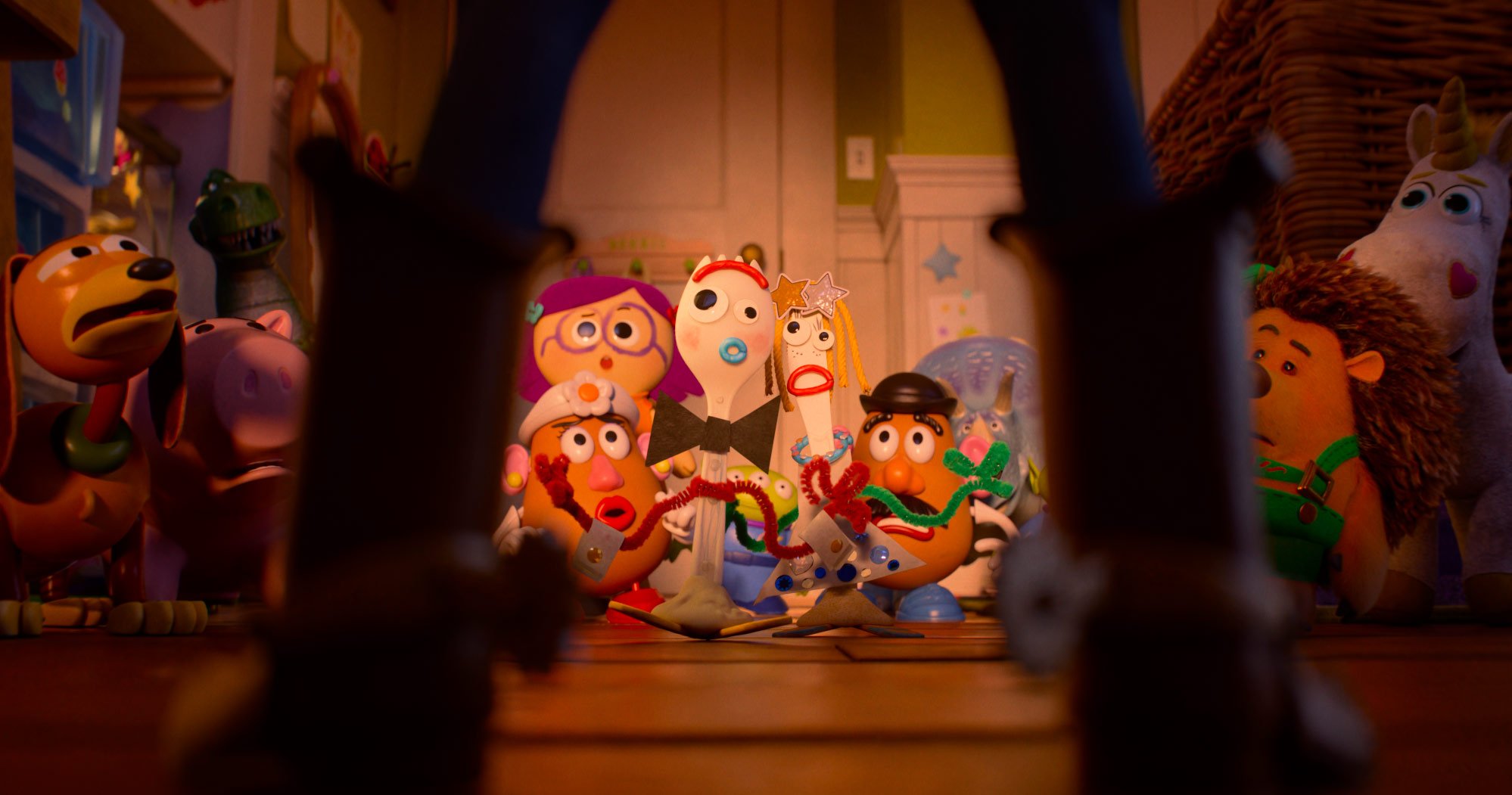
Forky breaks any rule that limits consciousness to manufacturers. Bonnie combines a spork, pipe cleaners, clay, craft sticks, and googly eyes during kindergarten. He wakes in her backpack even though his materials understand themselves as garbage. The category “toy” can be created through imaginative use rather than industrial intent.
Rule two: a child’s recognition appears to matter more than material
Forky’s transformation follows Bonnie giving the object a face, body, name, and emotional role. The film never shows a spark entering him, but the timing links personhood to recognition. Karen Beverly and later handmade figures support the idea that an improvised body can cross into toy identity when a child treats it as somebody.
This is not proof that every named sock becomes conscious. The movies keep the threshold mysterious. Still, recognition is the best recurring explanation because it fits the franchise’s moral logic: a toy becomes singular through the relationship somebody imagines with it, not through the price or complexity of its materials.
Rule three: commercial programming supplies a first story, not a final self
Buzz wakes believing he is the singular space ranger described by his packaging. The unopened Buzz in Toy Story 2 begins from similar defaults. Utility Belt Buzz and the Hi-Tech editions show that product lines can distribute identities across many bodies. Manufacturing supplies language, mission, gestures, and assumptions.
Experience then separates the copies. Andy’s Buzz becomes a person through jealousy, humiliation, friendship, loyalty, and years inside a household. A duplicate can share his voice and buttons without sharing the relationships that made him this Buzz. Commercial identity is a starting script, not a soul copied without difference.
Rule four: toys know humans do not know
The toys coordinate elaborate efforts to remain motionless when people look. They do not merely freeze from an uncontrollable reflex. Woody deliberately reveals himself to Sid, and the altered toys join the performance. The rule is social, deeply enforced, and breakable when circumstances become extreme.
Why they hide remains unexplained. Safety is the strongest answer. Humans treat toys as property because they do not know persons inhabit them. Disclosure could create fear, experimentation, exploitation, or destruction. Sid’s terror demonstrates that the secret protects more than the comfort of children.
Rule five: a toy can choose to break the secret
Woody and Sid’s altered toys reveal consciousness to stop abuse. The act is staged carefully enough that Sid could interpret it as supernatural punishment rather than a general fact about every toy. Later stories avoid casual repetition even when revelation might solve practical problems.
This means the secret functions like a community taboo rather than physics. A toy has agency but bears responsibility for consequences. The movies never show a formal government enforcing the rule, which suggests culture passes it through households, instinct, or knowledge that arrives with consciousness.
Rule six: owners do not create absolute loyalty
Andy’s name on Woody’s foot symbolizes belonging, but Woody can disagree with Andy, leave his room, and eventually live beyond any child. Jessie loved Emily and later joins Andy. Bo Peep passes through several homes before choosing life as a lost toy. Ownership directs circumstance without eliminating self-determination.
The emotional language often calls devotion a toy’s purpose, yet the fourth film openly questions whether purpose must remain assigned. Woody’s departure separates love from permanent service. He can value Andy and Bonnie without treating either child as the legal author of his entire existence.
A written name is powerful because toys turn property into relationship
When Andy writes his name on Woody and Buzz, the mark is legally ordinary and emotionally enormous. Humans label belongings. Toys interpret the label as evidence of mutual bond. The same ink can mean “this object is mine” from above and “I belong with this person” from below.
That difference explains why the name is both comforting and dangerous. It can guide a lost toy home and become a permanent measure of worth. When a child’s attention changes, the inscription remains, forcing the toy to decide whether history still defines the present.
The foot matters because it is a body, not a label tied to a shelf
Andy’s name travels wherever the toy goes. It is not packaging that can be discarded or a bedroom sign left behind during a move. The body becomes an archive of relationship. Even after ownership changes, evidence of the earlier child remains physically present.
Jessie’s old address in Toy Story 5 intensifies this idea. Information written into clothing carries her back toward Emily’s former home. Human systems read the mark as a clue about property. Jessie experiences it as a route into memory.
A toy can belong to several children across one life
Jessie moves from Emily to storage, Al’s collection, Andy, and Bonnie. Woody moves from Andy to Bonnie and then into a chosen lost-toy community. Bo Peep survives multiple transfers. Each relationship adds history without deleting what came before.
The films resist a soulmate model in which every toy has one destined child. Andy is central to Woody because they accumulated years together, not because the universe assigned them at manufacture. New bonds can be real without proving the earlier bond false.
Lost toys are not automatically ownerless in the emotional sense
Bo Peep uses “lost toy” as an identity based on mobility and chosen work. She can remain connected to Woody, Giggle McDimples, and temporary communities while lacking a permanent child. The category describes a relationship to human ownership, not the absence of all belonging.
The fourth film therefore changes the franchise vocabulary. Earlier stories treated getting home as the obvious objective. Bo demonstrates that home can be a network, a route, and a chosen practice. A toy without an owner remains a person with obligations and attachments.
The movies never prove that being played with causes consciousness
Buzz is conscious inside retail packaging before a child plays with him. Stinky Pete has never been removed from his box and still possesses memory, desire, and resentment. The Battlesaurs appear alive while believing their commercial fiction. Play shapes identity but is not required for initial life.
Forky complicates rather than reverses this. Bonnie’s creative act may trigger his consciousness because he was not originally manufactured as a toy. The evidence supports multiple routes into toy status instead of one universal activation ritual.
Batteries affect function, not necessarily personhood
Electronic toys can lose power, malfunction, reset, or depend on working components. Buzz’s buttons, voice, wings, and later editions vary with hardware. None of that proves consciousness is stored in a battery. The characters remain persons when a feature stops working.
A dead battery may immobilize or silence a body, creating a frightening gap between awareness and action. The films do not fully explore that horror, but broken voice boxes and frozen mechanisms imply that a person can survive reduced function.
A voice box is not the same thing as a voice
Woody speaks independently of his pull string. Gabby Gabby speaks despite a defective recorded mechanism. Their voice boxes perform product phrases for humans, while personal speech belongs to the conscious toy. Losing or replacing the mechanism changes market value and play function without removing thought.
Gabby’s obsession reveals how deeply toys can internalize product standards. She believes a working feature will make her lovable because the box promised a particular child experience. The defect becomes psychological even though it never prevented her personhood.
Broken toys remain whole persons
Bo’s repaired arm, Wheezy’s failed squeaker, Woody’s torn seam, Combat Carl’s damage, the mutant toys in Sid’s room, and many altered bodies demonstrate that factory condition is not moral condition. Repair can change appearance and function without producing a new person.
Sid’s creations are the strongest evidence. Their bodies combine parts humans would classify as incompatible. They still communicate, cooperate, fear, and protect. Personhood follows continuity of experience rather than original product form.
Can a toy die?
The films place toys in furnaces, explosions, traffic, shredders, and physical destruction, so permanent death appears possible even though major characters repeatedly survive. Material limits matter. A plastic body can melt, fabric can burn, and components can be crushed beyond repair.
No feature gives a clinical boundary between severe damage and death. That uncertainty sustains suspense. Repair is broad but not magical, and consciousness does not guarantee indestructibility. Toy mortality is one reason the secret-life premise carries genuine stakes.
Do toys age?
They accumulate time psychologically and materially. Paint fades, fabric frays, mechanisms fail, and decades of memory change judgment. They do not grow biologically, but their relationships to the world age. A toy can become culturally old, commercially obsolete, or emotionally experienced.
Stinky Pete’s years in a box, Gabby’s decades in an antique store, Jessie’s storage, and the old electronic toys in Toy Story 5 demonstrate different forms of aging. The body may remain child-sized while the person becomes older than the child who owns it.
Do all objects have the potential to wake?
The franchise does not say. Vehicles, lamps, board-game pieces, utensils, and handmade crafts can appear conscious when they function as toys or characters. Ordinary furniture usually does not. The boundary seems connected to imaginative personification, but the films deliberately avoid testing every object in a room.
Forky makes the uncertainty permanent. If trash can become a person through play, potential may be widespread. The moral consequence is enormous, which is probably why the story refuses a universal formula. A clear rule would turn every cleanup scene into an ethical emergency.
Are dolls and action figures born knowing their fictional worlds?
Buzz and the Battlesaurs strongly suggest manufactured lore can arrive as default belief. Woody knows catchphrases and eventually learns about Woody’s Roundup as forgotten media history, so the amount of initial knowledge varies. Some toys understand they are toys immediately. Others inhabit the story sold with them.
The variation may reflect product design, storytelling needs, or individual psychology. It does not need one technical answer. Toy Story uses false commercial identity as a metaphor for inherited roles: people begin inside stories they did not choose and become themselves through what happens next.
Why does Forky want the trash?
Forky understands his materials and previous function before he understands Bonnie’s recognition. Trash feels correct, warm, and safe because disposal is the category his body expects. His repeated attempts to return are not proof that he lacks personhood. They are evidence that consciousness can begin with a self-concept hostile to survival.
Woody helps him reinterpret purpose through relationship, but Forky never needs to deny his origin. He remains trash and toy. The franchise’s most generous rule is that a new identity can expand an earlier truth rather than erase it.
Forky’s wedding proves toys create institutions beyond children’s play
By Toy Story 5, Forky and Karen Beverly marry in front of a toy community. A child did not need to stage the ceremony for it to matter. The toys have customs, witnesses, commitments, and social meaning that continue when humans leave the room.
This development confirms that toys are not imaginary extensions waiting for a child to animate them. Children begin relationships, but the toys possess lives beyond human awareness. Marriage becomes a comic scene and evidence of independent culture.
Can toys have children?
The films do not show biological reproduction. New persons arrive through manufacturing, handmade creation, or discovery. Mr. and Mrs. Potato Head form a marriage, Forky and Karen Beverly form another, and families can exist socially without producing offspring.
This is consistent with bodies built for play rather than biology. Kinship grows through partnership, adoption into groups, shared ownership, and chosen responsibility. The room functions as a household even when no toy is another toy’s biological parent.
Who owns a conscious toy?
Human law inside the story treats toys as property because humans do not know they are alive. Morally, the audience knows that ownership cannot include the right to torture, imprison, disassemble, or dictate every relationship of a person. The franchise lives inside the gap between legal object and moral subject.
Sid, Al, Lotso, the antique store, and ordinary donation systems each expose a different part of that gap. Some humans are cruel, some commercial, and some merely unaware. Harm does not require evil intent when the harmed person is structurally invisible.
Why do toys keep serving children if ownership is unequal?
Play provides attention, narrative, community, and purpose. Many toys genuinely love participating in a child’s life. Service is not automatically exploitation when it is chosen and meaningful. The problem emerges when a toy believes usefulness is the only possible source of worth.
Woody’s four-film struggle demonstrates the difference. Loyalty helps him act courageously. Compulsion makes him override boundaries and panic when he is not selected. Toy Story 4 allows him to choose service outside permanent ownership, while Toy Story 5 lets Jessie lead without promising Bonnie will never change.
Why do the toys not simply tell kind adults?
A kind adult could still panic, seek proof, contact authorities, sell access, or expose the community accidentally. The toys have no reliable way to limit disclosure after one person knows. Their bodies can be confiscated, studied, copied, or destroyed. Silence protects a population with no legal standing.
The risk also extends to children. A child claiming toys are alive may not be believed and could be treated as confused. The secret avoids placing that burden on the person the toys love. It is protective, lonely, and ethically costly at the same time.
Why does nobody notice changed positions?
Humans do notice occasional oddities, but toys coordinate around routines and move when rooms are empty. Children already expect toys to shift during play, cleaning, travel, and household handling. Small changes can be explained by memory or another person.
The premise asks for comic suspension of disbelief, not forensic realism. The important consistency is that movement carries risk, so rescue plans require timing and concealment. If humans never looked back, the secret would have no tension.
Are Lightyear and Woody’s Roundup characters alive inside their own media?
Woody’s Roundup is a television show within the world, while Lightyear is framed as a movie that inspired the Buzz toy. Characters on those screens are performances, not necessarily conscious toy beings. The Buzz figure interprets media lore as personal biography because manufacturing installed that fiction around him.
This separates in-universe stories from toy life. The fictional space ranger can have one plot, the plastic Buzz another, and actors or animated figures inside Andy’s world a third. Shared names do not collapse the layers.
The most consistent rule is emotional, not mechanical
Toy Story treats personhood as something recognized through relationship and proven through agency. Materials, price, brand, condition, age, and owner can change. Memory, choice, fear, care, and the capacity to form bonds carry the person across those changes.
That rule explains why Forky belongs beside Woody, why a duplicate Buzz becomes distinct, why altered toys remain whole, and why Lilypad deserves moral consideration even after causing harm. The franchise does not need a magic particle because its real subject is how easily a society mistakes a useful body for a thing.
The final rulebook
A manufactured toy can already be conscious. A handmade object can become a toy through imaginative recognition. Product lore may shape initial identity, but experience creates individuality. Toys hide from humans by choice and custom. Damage changes bodies without automatically ending personhood. Ownership controls circumstance, not the self. Written names preserve relationship and can become emotional burdens.
No film confirms one activation ritual, universal immortality, biological reproduction, or consciousness in every object. Those uncertainties are part of the design. The reliable answer is ethical: if a being remembers, chooses, fears, loves, and changes, the story asks us to treat that being as a person long before the surrounding world is ready to agree.
The unresolved questions are features, not homework the writers forgot
Fans can reasonably ask whether a child’s belief activates handmade objects, whether factory-made toys wake at assembly or packaging, whether consciousness can move into replacement parts, and whether a completely destroyed body leaves anything behind. The films provide clues without closing those questions. A definitive chart would create edge cases faster than it solved them and pull attention away from the relationships the premise was built to examine.
Mystery also protects the characters from becoming specimens. The audience meets Forky as a frightened person before anyone can reduce him to a repeatable experiment. We know enough to recognize his rights and not enough to manufacture another Forky on demand. That imbalance keeps wonder tied to responsibility.
The useful rule for viewers is therefore modest: distinguish confirmed behavior from theory. It is confirmed that Forky wakes, duplicates differ through experience, names preserve ownership history, and toys can reveal themselves deliberately. It is interpretation that belief supplies a universal spark. Theories are welcome. Labels keep them honest.