
Memory, Sorrow, and Thorn · Canonical Character Profile
Hove
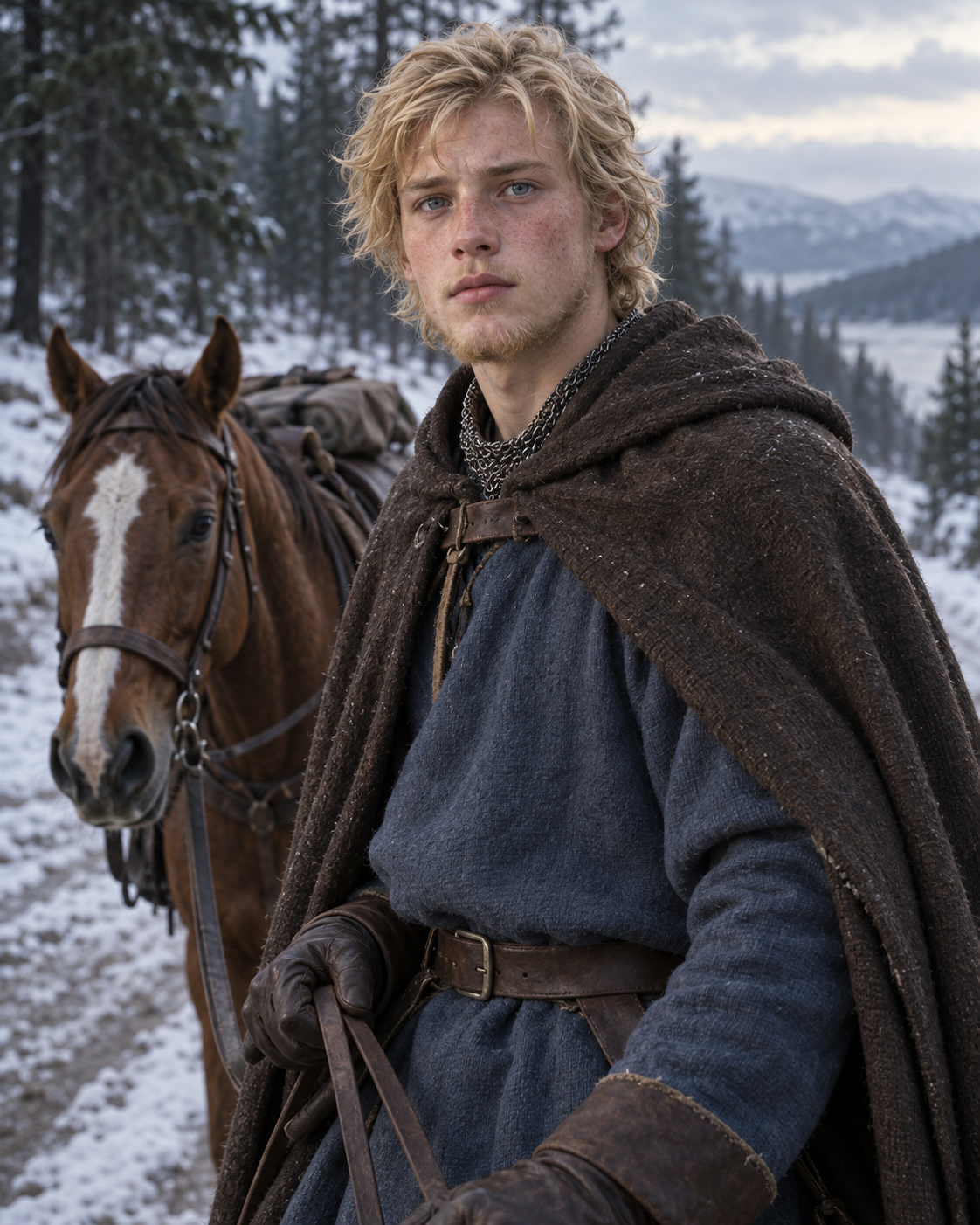
Hove is a young Rimmersman riding with Duke Isgrimnur when the road north becomes an ambush at Saint Hoderund’s. He dies in the opening charge, is carried back by Einskaldir and Sludig, and is buried beneath a cairn because northern kinship refuses to leave him to the wolves. Then his riderless horse is given to Simon. Hove’s page is brief in chronology but enormous in consequence: one young man’s death becomes another young man’s passage forward.
At a Glance
The young rider whose empty saddle carries the story onward
- Name
- Hove
- People
- Rimmersman
- Allegiance
- Duke Isgrimnur’s traveling company
- Family connection
- Kin through the wife of Isgrimnur’s son Isorn
- Appearance
- Young, with a thin yellow beard
- Death
- Killed in the opening attack at Saint Hoderund’s
- Burial
- A stone cairn ordered by Isgrimnur
Before the Charge
He enters the record already inside a web of duty and family
Hove travels north with Duke Isgrimnur after the duke finally secures permission to leave the Hayholt. The company is not wandering. Isgrimnur is trying to reach his snowbound country while political suspicion, impossible weather, and the danger surrounding King Elias tighten behind him.
The book does not give Hove an introductory speech, private ambition, or ornamental biography. It gives him something more structurally important: a place in the company and a recognized place in the northern family network. Hove is kin through the wife of Isgrimnur’s son Isorn.
That relationship is not presented as close domestic intimacy. Isgrimnur has to explain the line when the burial is discussed. But Rimmersman custom counts it. Hove is not disposable labor riding behind a famous duke. He belongs to the human chain the duke carries responsibility for.
The evidence also insists on his youth. His thin yellow beard and later snow-pale face make him look painfully young, and Isgrimnur judges Simon only a year or two younger. The comparison matters. Hove is old enough to ride armed with grown soldiers and young enough that his death makes the threshold between boyhood and manhood look terrifyingly thin.
Saint Hoderund’s
A warning buys the company seconds, not safety
As Isgrimnur’s party approaches the abbey of Saint Hoderund, a black-robed monk runs out to warn them. An arrow cuts the warning short. The ambushers are already positioned, and their leader wears a helmet shaped like a snarling hound.
Brother Scenesefa’s intervention gives the Rimmersmen enough time to brace. It does not turn the trap into a fair fight. Hove dies in the first charge. Einskaldir is wounded, kills his attacker, and another member of the company later dies as well.
The attackers flee on prepared horses rather than hold the field. Isgrimnur pursues until a steel-dark storm rises with unnatural speed from a relatively clear Maia sky. The violence of the weather makes the road dangerous, throws at least one horse, and forces the duke to abandon the chase.
Hove’s death therefore belongs to a scene of layered interference: a murdered warning, a planned assault, ready escape mounts, and weather that protects the fleeing force. The book does not name the individual who kills him. It does make clear that this is an organized ambush, not a romantic duel or the clean battlefield death fantasy likes to award its young soldiers.
No One Left Behind
Einskaldir and Sludig go back for him while the storm closes the road
Wounded Einskaldir returns to the ruined abbey with fair-haired, more cautious Sludig. Their decision is practical, dangerous, and profoundly communal: Hove’s body will not remain where he fell.
They come back to camp with Hove laid across a mount. They also bring a bound red-haired boy found searching the abbey—Simon, exhausted, dirty, and suddenly alone after losing Binabik.
The arrival places two young bodies beside each other, one dead and one still capable of answering questions. The contrast is not subtle, but it is not cheap. Simon’s survival does not erase Hove. Hove’s corpse is the reason the company must stop, identify obligation, and decide what a living stranger will receive.
Einskaldir and Sludig deserve their own credit in this sequence. Retrieval converts battlefield loss into a body that can be mourned and buried. They cannot undo the charge, but they can refuse the final humiliation of abandonment.
The text does not tell us whether Hove was especially close to either man, who first proposed returning, or what was said over the body. A good profile should not manufacture a brotherhood speech where the book gives action. Going back is the receipt.
The Stone Cairn
Northern custom draws the boundary between a casualty and carrion
Hove’s face is snow-pale, and the thin yellow beard emphasizes how young he was. Isgrimnur explains the kinship through Isorn’s wife and orders a cairn raised over him.
The burial is shaped by conditions. The company cannot carry every dead man indefinitely through hostile country and worsening weather. Stones become the available architecture of care.
Isgrimnur’s reasoning is blunt: leaving Hove exposed would surrender him to wolves. That image strips away ceremonial softness. The cairn is not decorative grief. It is a physical barrier between the young man and a landscape that will otherwise consume him without distinction.
Kinship here works as an ethic of obligation rather than a genealogy hobby. Hove’s relationship may be indirect, but it is close enough by northern custom for Isgrimnur to claim responsibility. The duke cannot save him, and he cannot take him home. He can make sure the road does not have the last word about what Hove was worth.
The series repeatedly asks how memory survives destruction. Hove’s answer is elemental: companions retrieve the body, a lord names the relationship, hands gather stones, and a cairn marks that someone belonged to someone.
The Riderless Horse
Hove’s absence becomes part of Simon’s escape route
After questioning Simon, Isgrimnur accepts enough of the boy’s carefully edited story to offer him protection to Naglimund. He gives Simon a saddle blanket and Hove’s spare horse.
The horse is practical aid, but it is not narratively neutral. Simon can join the company because a place has opened through death. He is only a year or two younger than Hove. One youth lies beneath stone while the other takes the road using equipment the dead rider no longer needs.
This is not a mystical inheritance, and the text does not suggest Hove chose Simon or transferred a heroic destiny to him. The power lies in the ordinary logistics. Wars and journeys continue by reallocating the possessions of people who did not survive them.
For Simon, the horse arrives at a crucial stage in his growing independence. He recognizes Isgrimnur as safer than the forces hunting Josua but still withholds dangerous truth. The duke’s company gives him mobility and cover without restoring the sheltered life he lost.
Hove never meets Simon alive on the page. Even so, their stories touch through age, body, and transport. The riderless horse becomes the hinge. Simon rides toward Naglimund, and the reader should feel the shape of the missing rider beneath that forward motion.
Connections
The family and companions who keep a short life from becoming an anonymous death
Duke Isgrimnur
Commands Hove’s company, recognizes the kinship obligation, orders the cairn, and gives Hove’s spare horse to Simon.
Isorn
Isgrimnur’s son; Hove is kin through Isorn’s wife.
Einskaldir
Returns wounded to the abbey and helps recover Hove’s body.
Sludig
Accompanies Einskaldir on the recovery and brings Hove back to camp.
Simon
A year or two younger than Hove; found alive during the recovery and later given Hove’s spare horse.
Brother Scenesefa
Warns the approaching company before being shot, giving Hove and the others a chance to brace for the ambush.
Why Hove Matters
He is the cost hidden inside the phrase “Simon joins the company”
A summary could reduce Hove to a sentence: young soldier dies, Simon gets his horse. That would preserve event order and erase almost everything the scene is doing.
Hove gives Isgrimnur’s journey a named personal cost. He shows that northern kinship extends beyond the innermost household. His recovery shows what comradeship looks like without a speech. His cairn makes memory into physical labor. His horse makes survival morally complicated without blaming the survivor.
Most importantly, he prevents Simon’s rescue from feeling frictionless. Simon does not simply acquire a convenient mount because the plot needs faster travel. He steps into space made vacant by someone nearly his own age.
Hove remains a supporting casualty, not a secretly central hero. Giving him a full profile does not require pretending the text supplied a childhood, romance, temperament, or battle record. It requires following the consequences of the facts it did supply until the young man beneath the cairn is visible again.
On the Record
Book 1 only, evidence-bounded, and no invented warrior legend
This is Hove’s one canonical full-spoiler profile. His travel with Isgrimnur, death at Saint Hoderund’s, recovery, burial, and the transfer of his spare horse occur in Book 1. No direct Hove receipt appears in the owned Book 2, Book 3, or Book 4 reading record, so his directory membership is correctly limited to the franchise and Book 1 views.
The record confirms that Hove is a young Rimmersman in Isgrimnur’s company; kin through the wife of Isgrimnur’s son Isorn; visibly young, with a thin yellow beard and a snow-pale face after death; killed in the opening ambush; recovered by Einskaldir and Sludig; buried under a cairn by Isgrimnur’s order; and owner of the spare horse later given to Simon. It does not confirm his exact age, eye color, hairstyle, parents, birthplace, private beliefs, personality, dialogue, killer, weapon, or final thoughts.
Visual state: approved editorial reconstruction. CVM depicts Hove alive as a striking older teenage Rimmersman around sixteen or seventeen with a tall still-slim rider’s build, pale gray-blue eyes, youthful freckled wind-reddened skin, wind-tossed yellow-blond hair, and the canonically required thin sparse yellow beard. His faded slate-blue wool, rough brown riding cloak, restrained mail, worn gloves, reins, ordinary horse, and snowy road are reconstruction. Preserve this exact face, adolescent baseline, body, coloring, hair, beard geometry, clothing, and horse logic across every future image. Any ambush, recovery, or cairn art must remain restrained, non-gory, and must not invent a final act. The same canonical attachment powers featured image, hero, directory card, and social metadata.