
Memory, Sorrow, and Thorn · Canonical Character Profile
Hjeldin the Mad King
Hjeldin is one of the Hayholt’s six remembered kings: son of Fingil, heir to Minneyar, patron of the lost scholar Nisses, and the ruler who dies by leaping from the haunted spire that keeps his name. He is barely present as a living man and absolutely everywhere as an inheritance.
At a Glance
The dead king whose name becomes a room the living keep entering
- Name
- Hjeldin
- Title
- King of the Hayholt; remembered as the Mad King
- Dynasty
- Rimmersman line
- Father
- Fingil the Bloody King
- Counselor
- Nisses, priest and author of Du Svardenvyrd
- Sword
- Minneyar, later passed to Ikferdig
- Death
- Leaps from the haunted spire associated with him
- Status
- Dead; historical figure
The Second Rimmersman King
Hjeldin inherits a conquered castle, a murderous dynasty, and a sword already carrying memory
The old Six Kings rhyme places Hjeldin after Fingil, the Bloody King who conquered Asu’a and made the Sithi stronghold into a mortal seat.
Hjeldin is Fingil’s son. That relationship puts him inside the first human ruling dynasty of the Hayholt, but the surviving record does not describe his childhood, mother, siblings, accession, spouse, children, court, laws, wars, or length of reign.
He also inherits Minneyar. The sword begins as the iron keel of King Elvrit’s dragon-ship, forged by Dverning smiths and stolen through the murder of its maker. Elvrit names it “Year of Memory.” Its path runs through Fingil to Hjeldin and then Ikferdig.
That succession matters. Hjeldin is not simply a king who happened to own a famous blade. He stands in a chain of conquest, oath-breaking, inheritance, and remembered violence that the later League of the Scroll must reconstruct when the Three Swords become urgent again.
The text does not preserve a confirmed scene of Hjeldin wielding Minneyar. It does not say he loved it, feared it, used it in battle, or understood its deeper properties.
The Mad King’s Fall
The rhyme remembers the leap; it does not give us permission to diagnose the man
Hjeldin’s remembered epithet is “the Mad King.” The nursery history says he dies after leaping from the haunted spire.
The Hayholt’s architecture makes the story physical. From Green Angel Tower, Simon can look toward neighboring Hjeldin’s Tower and imagine the old king staring back toward the Sithi spire before crossing the throne-room roof and falling to his death.
The leap is confirmed as transmitted history within the novel. The reason is not.
No surviving receipt establishes whether Hjeldin experienced illness, supernatural influence, grief, terror, coercion, guilt, political crisis, or something else. “Mad” is the culture’s label, not a modern clinical diagnosis and not a complete explanation.
The word “haunted” belongs to the tower’s reputation. It does not prove Hjeldin saw a ghost, became one, or was driven by the later power that uses the building.
His death also should not be staged as a theatrical villain’s plunge. The record gives an outcome and a location, not his final expression, clothing, weather, witnesses, last words, or state of mind.
That lack is part of the profile. Hjeldin survives through a child’s rhyme and a tower name because history has compressed a human life into one frightening sentence.
Nisses and Du Svardenvyrd
His counselor leaves the intellectual map that later generations desperately need
Nisses is identified as Hjeldin’s priest and counselor.
He writes the famous lost work Du Svardenvyrd, translated as “The Spell of the Swords” or “The Weird of the Swords.” Both Nisses and Hjeldin die in the tower later bearing the king’s name.
The book’s silhouettes and prophecy eventually help the companions connect Memory, Sorrow, and Thorn to the unnatural winter and Ineluki’s design.
That makes Hjeldin’s court an early home of knowledge that outlives its ruler, but it does not prove Hjeldin authored, dictated, understood, endorsed, suppressed, or even read every part of Nisses’s work.
“Counselor” establishes access and official relationship. It does not tell us whether the two men were friends, rivals, spiritual intimates, political collaborators, or prisoners of the same crisis.
Their shared end inside the tower invites theories. The profile will not promote those theories to canon.
Nisses’s surviving intellectual shadow also complicates the epithet “Mad.” Hjeldin’s court was not remembered only for disorder; it contained a scholar whose work becomes indispensable centuries later.
Hjeldin’s Tower
The building keeps the king’s name while other powers move in
By Simon’s time, Hjeldin’s Tower is a charged vertical map of the royal household.
Miriamele’s window lies below the upper turret. Elias and Pryrates use the tower. Pryrates receives chambers there, and Isgrimnur hears reports of lights and unholy noises. On All Fools’ night, Caleb claims a fiery serpent coils around the tower and breaks into sparks while an unknown voice booms.
Later, Elias says the tower remains locked even to the king and treats Pryrates as necessary to the work being done there.
None of those events proves Hjeldin’s agency.
The tower’s old reputation makes it narratively perfect for new horrors, but Pryrates, Elias, the Norns, and the Storm King belong to the current conspiracy. A dead ruler’s name on the masonry is not a confession.
This distinction matters because fandom summaries often collapse place, legend, and cause. Hjeldin died there. Nisses died there. Pryrates later works there. Caleb later sees something there. Those are connected facts, not one automatically solved mechanism.
The building functions as an inheritance machine: royal residence below, forbidden work above, old death beneath every new decision.
Minneyar After Hjeldin
The sword passes on, but its trail burns down to uncertainty
After Hjeldin’s death, Minneyar passes to Ikferdig the Burned King.
Ikferdig’s encounter with the fire-drake Shurakai leaves the weapon’s fate unresolved for generations. It may have remained hidden within the Hayholt or been destroyed by dragonfire.
The later search for Memory therefore uses Hjeldin as a point in a succession chain, not as the answer to the sword’s final hiding place.
The record does not say Hjeldin chose Ikferdig as heir, personally transferred the sword, concealed instructions, or knew where it would ultimately rest.
What survives is sequence: Elvrit, Fingil, Hjeldin, Ikferdig. In a series obsessed with damaged memory, even a king can become one link in an archival problem.
Connections
The conqueror, counselor, successor, sword, and tower around Hjeldin
Fingil the Bloody King
Hjeldin’s father and predecessor, the Rimmersman conqueror who takes Asu’a.
Nisses
His priest and counselor, author of the lost Du Svardenvyrd.
Ikferdig the Burned King
Later bearer of Minneyar, whose dragon-haunted death obscures the sword’s location.
Minneyar
The sword called Memory, inherited through Hjeldin’s royal line.
Hjeldin’s Tower
The haunted spire associated with Hjeldin’s death and later occupied by the present conspiracy.
Simon
The castle boy who learns Hjeldin through rhyme, statue, architecture, and the sword mystery.
Why Hjeldin Matters
He demonstrates how Osten Ard turns history into architecture without making architecture omniscient
Hjeldin matters because the series refuses to keep its past safely past.
His name is sung by children, carved into the royal sequence, attached to a tower, tied to a lost book, and embedded in Minneyar’s chain of custody.
Yet the surviving information remains fragmentary. We know more about what later people do with his memory than about the living king himself.
That imbalance is not a flaw to patch with invented lore. It is the point. The Hayholt is crowded with names whose stories have been reduced, politicized, ritualized, or misunderstood.
Hjeldin also teaches an essential evidence rule for this fandom hub: proximity is not causation. The old king’s tower becomes Pryrates’s workplace, but that does not make Hjeldin the author of Pryrates’s crimes.
His profile can therefore be complete without pretending his biography is complete. It organizes every confirmed relationship and leaves the sealed doors sealed.
Character Image Continuity
A compelling historical king, not a generic wild-eyed “madman”
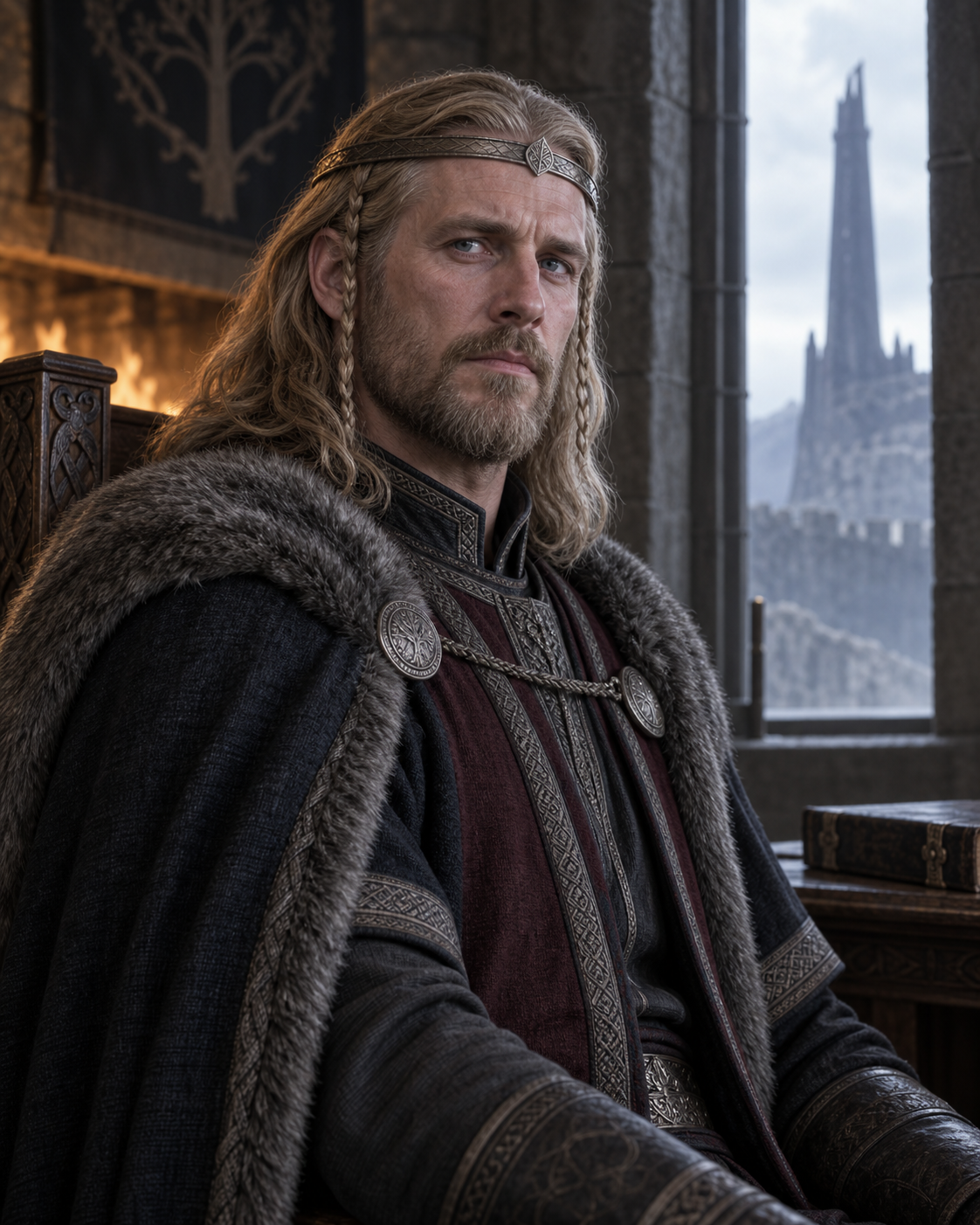
Visual state: approved editorial reconstruction. Hjeldin now has one permanent living historical identity, and this profile is published.
CVM depicts Hjeldin as a devastatingly handsome Rimmersman king around forty with a tall powerful court-contained build, pale blue-gray eyes, weathered fair skin, shoulder-length pale ash-blond hair with two restrained temple braids, and a close ash-blond beard. Charcoal-blue, iron-gray, muted-burgundy, fur, old-silver court layers, and a narrow hammered circlet establish distinct historical royal styling; the tower remains contextual architecture rather than proof of supernatural agency.
Canon supplies no face, hair, eye color, exact age, height, build, beard, crown, clothing, armor, injuries, or expression. It also supplies no visual symptom that should be used to caricature mental illness.
Preserve this exact face, age, body, coloring, braid map, beard, circlet, and charcoal/burgundy/silver costume logic across every later historical scene. Do not clone Fingil, Ikferdig, Elias, or Simon. Do not give Hjeldin Sorrow, Bright-Nail, or Thorn. Minneyar remains absent until the sword receives its own approved identity.
The same canonical attachment powers featured image, hero, directory card, and social metadata. This face, age, royal costume logic, and historical period must continue across Six Kings imagery, Minneyar history, Nisses scenes, and tower retrospectives without converting later tower horrors into Hjeldin’s agency.
On the Record
Historical evidence, transmitted memory, and explicit unknowns
This is Hjeldin’s one canonical, full-spoiler character profile. His evidence is concentrated in The Dragonbone Chair through Simon’s Hayholt history, the Six Kings rhyme, the tower, Gelöe and Binabik’s identification of Nisses’s lost book, and the reconstructed succession of Minneyar.
The record confirms Hjeldin is Fingil’s son, a Rimmersman king of the Hayholt, remembered as the Mad King, bearer of Minneyar before Ikferdig, and ruler associated with Nisses. It confirms transmitted history says he leaps to his death from the haunted spire and that both king and counselor die in the tower bearing Hjeldin’s name.
The record does not confirm Hjeldin’s appearance, exact dates, reign length, family beyond Fingil, policies, battles, private beliefs, diagnosis, reason for the leap, final words, relationship dynamic with Nisses, knowledge of the sword prophecy, or supernatural afterlife.
Later lights, noises, fire, voices, locked rooms, and conspiracy inside Hjeldin’s Tower are not credited to Hjeldin without evidence.
Status: dead; historical figure.
Visual state: approved editorial reconstruction. The portrait preserves Hjeldin as a living historical ruler rather than illustrating his leap or caricaturing a diagnosis the text never supplies. Every physical feature, garment, circlet, room detail, chair, manuscript, pose, and lighting choice is CVM reconstruction. The same canonical attachment powers featured image, hero, directory card, and social metadata.