
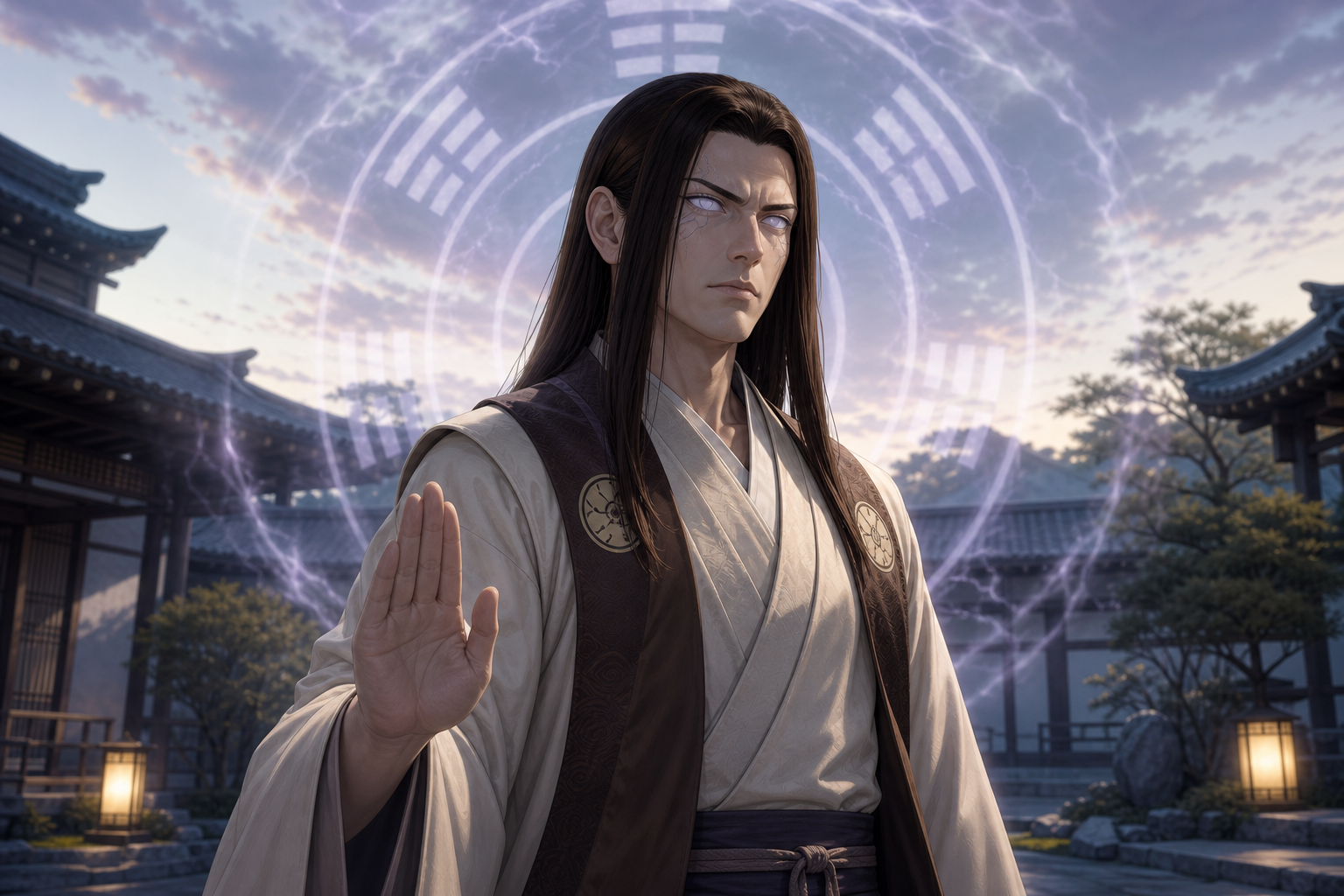
Naruto · Complete Character Profile
Hiashi Hyūga
He is a master of the Byakugan, the head of Konoha’s proudest clan, and a father who learns far too late that protecting a family name is not the same as protecting the people carrying it.
The bottom line
Hiashi Hyūga’s complete Naruto profile covers Hizashi, Neji, Hinata, Hanabi, the branch seal, Byakugan, Gentle Fist, war, reform and accountability.
Hiashi becomes a better man, but Naruto fans should stop confusing late tenderness with retroactive innocence. He leads a clan that brands branch children, evaluates daughters as assets and accepts a structure where his twin’s body can settle an international dispute. Hizashi’s final choice has agency. The system narrowing that choice still belongs on Hiashi’s ledger.
His growth matters precisely because the earlier harm is real. He apologizes to Neji Hyūga, teaches him techniques once reserved for the main house, fights beside him and changes his relationship with Hinata Hyūga. By the New Era, he is an affectionate grandfather. That is repair. Repair is conduct over time, not a coupon erasing the receipt.
Hiashi Hyūga essential file
The first character data gives Hiashi a 29.5 total across eight shinobi statistics, including a perfect hand-seal score and elite taijutsu. The later profile raises his taijutsu to five. Databook numbers are not cross-series physics, but they confirm the narrative claim: Hiashi is a working combat master, not an aristocrat hiding behind a title.
Verified record: dates, dimensions, rank and databook shape
Hiashi first appears in the manga in chapter 78 and in the television anime in episode 46. His birthday is January 8, his blood type is B and his Konoha registration number is 005159. He is listed as 41 to 42 during Part I and 46 in Part II. The Part I profile gives him a height of 176.5 centimeters and a weight of 66.4 kilograms. Part II lists 59.6 kilograms. New Era material gives him a shorter 165-centimeter height, a visible aging change rather than a reason to pretend character sheets never move.
His formal rank is jōnin, his occupation is Hyūga clan head and his wartime assignment is the Allied Shinobi Forces First Division. The record names his father as the Hyūga Elder, Hizashi as his twin brother, Neji as his nephew, Hinata and Hanabi as his daughters, Boruto and Himawari as grandchildren, and Kawaki as an adoptive grandson in the New Era family structure. The anime shows a wife and mother for his daughters, but it does not supply her with a canonical personal name. I am not naming a woman the franchise left unnamed just to make a table look fuller.
No reliable complete mission ledger, Academy graduation age or chūnin promotion age is available in the reference shelf used here. The first databook stat line totals 29.5: ninjutsu 3.5, taijutsu 4.5, genjutsu 2, intelligence 3, strength 3.5, speed 4, stamina 4 and hand seals 5. The second totals 30, with taijutsu rising to 5 while the other listed values stay the same. These numbers describe a close-combat master with exceptional seal proficiency. They do not make him omniscient, emotionally wise or politically innocent.
Name and design: the man whose eyes see everything except the cost nearest him
Hyūga is often glossed through “toward the sun,” while Hiashi can carry readings related to day or spreading fire. Name analysis should remain controlled. Kishimoto uses family sound patterns and visual associations, but a dictionary is not a secret confession from the character.
Hiashi’s long dark hair, pale Byakugan eyes, formal robes and severe expression establish authority before he speaks. He resembles his twin Hizashi so closely that their bodies can be exchanged in the political logic of the Hyūga Affair. The design makes the horror visible: two nearly identical brothers receive radically different legal value because one is born moments earlier.
His clothing and posture stay composed even during violence. That restraint mirrors Gentle Fist, which causes internal damage through precise contact. Hiashi’s parenting works the same way at its worst. The household may look orderly while the injury happens inside the children.
Appearance chronology: formal robes, pale eyes and the body of a shrinking patriarch
Hiashi’s pale Byakugan eyes, long dark-brown hair and severe facial structure place him immediately inside the Hyūga main family. In Part I, his clothing uses formal layered robes with armor elements and the controlled presentation of a clan head who expects a room to organize itself around him. The design does not need a crown. Posture, sleeves and the absence of wasted motion perform authority.
Part II keeps the recognizable long hair and formal Hyūga silhouette while age sharpens his face. During war, the pale eyes stop being private clan iconography and become battlefield infrastructure. Hiashi reads distant movement, chakra circulation and enemy formations while using Gentle Fist at a scale large enough to defend other divisions. The visual idea is deliciously uncomfortable: the clan built an oppressive internal hierarchy to protect those eyes, then the entire alliance depends on what those eyes can do.
New Era Hiashi is shorter, older and visibly softer in ordinary family scenes. That physical change matters because Boruto-era comedy often places his formerly terrifying dignity beside gift shopping, back pain and grandparent enthusiasm. Aging does not erase the man who branded Neji or discarded Hinata as heir. It gives the story room to show that domination was never his only possible personality. Warmth was available. He learned to permit it late.
The Hyūga clan protects the Byakugan by controlling Hyūga bodies
The clan divides itself into main and branch houses. Branch members receive a cursed seal that allows the main family to punish them and protects the Byakugan after death. The official Naruto column describes Neji as branded on Hinata’s third birthday and bound to protect the main bloodline. This is not fan exaggeration. The franchise itself calls the system a cage.
Hiashi inherits leadership rather than designing the structure from nothing. Inheritance explains his position. It does not remove responsibility once he enforces or benefits from it. Leaders are judged partly by what they receive and mostly by what they continue after understanding the harm.
The clan’s logic treats ocular power as collective property. Branch bodies become security infrastructure. Main-family daughters become succession candidates. Affection may exist, but institution sets the terms. Hiashi’s arc is the slow realization that a bloodline preserved through coercion has confused survival with domination.
Hiashi and Hizashi: one birth order creates a leader and a sacrifice
Hiashi and Hizashi are twins. Hiashi is born first and becomes main-family heir. Hizashi enters the branch. The difference in birth timing produces different rights, obligations and futures despite near-identical talent. Hizashi’s resentment is therefore not petty jealousy. It is a rational response to structural subordination.
Hiashi witnesses that resentment and can activate the branch seal’s punishment. The image Neji carries of his father writhing under main-house control shapes the boy’s fatalism. A later explanation of love cannot erase what the child saw adults authorize.
The brothers still love one another. That emotional truth makes the system worse, not better. Clan law weaponizes family closeness by making Hizashi the available substitute when Hiashi’s life becomes diplomatically inconvenient.
The Hyūga Affair: Hizashi chooses, but the menu was built by coercion
A Kumogakure head ninja attempts to abduct young Hinata and obtain the Byakugan. Hiashi kills him while rescuing his daughter. Kumo then demands Hiashi’s body, threatening renewed war. Konoha and the Hyūga produce Hizashi as the substitute because the branch seal will destroy the eye’s secret after death.
The official Naruto retrospective emphasizes Hizashi’s choice. He decides to protect Neji, his brother, family and village rather than die merely as a branch obligation. That agency belongs to him and should not be stolen by calling every sacrifice mindless coercion.
Agency does not sanitize the options. Hizashi chooses inside a world where his body is already marked, his status is subordinate and political peace requires a corpse. Hiashi survives because clan architecture makes his twin interchangeable for diplomatic purposes. The moral record must hold both truths: Hizashi chooses love, and the institution has prepared him to be expendable.
Hiashi’s later grief is sincere. His willingness to die himself also matters. Yet a leader’s private sorrow cannot substitute for dismantling the structure that made the exchange possible.
Hiashi and Neji: an apology begins repair; access proves whether repair moved
Neji grows up believing his father was forced to die for the main house. After Naruto defeats him in the Chūnin Exams, Hiashi visits the hospital, explains Hizashi’s final letter and apologizes. The official column records the scene as a turning point allowing Neji to reconsider fate.
The explanation gives Neji missing truth. It also asks a traumatized child to reinterpret a death without changing the system that marked his forehead. Hiashi’s bow and apology matter because powerful adults rarely submit themselves to the harmed child. They remain insufficient if treated as the entire remedy.
Later Hiashi trains Neji in the complete Hyūga fighting style, including knowledge traditionally restricted from the branch. That conduct is a stronger receipt. He recognizes talent, removes an information barrier and fights beside his nephew. Reform becomes more credible when access changes.
Neji’s death during the war reopens the clan’s central wound. He chooses to protect Hinata and Naruto. The story frames the choice as freedom. RaeRae’s objection is not that Neji lacks agency. The objection is that the franchise repeats branch-family sacrifice so closely to the old pattern and then hurries past the political discomfort.
Hiashi and Hinata: he mistakes temperament for incapacity
Hiashi judges Hinata too hesitant and weak to lead the clan. He removes her from succession focus, trains Hanabi and tells Kurenai that the clan has little need for the elder daughter. That rejection affects Hinata’s confidence long before viewers meet her.
His assessment is not fabricated from nothing. Hinata struggles in sparring, dislikes hurting Hanabi and freezes under pressure. The failure is what he concludes from those traits. A child’s gentleness becomes proof she is unsuitable rather than information about how she needs to be taught.
Hinata later develops courage through Team 8, Naruto’s example, Neji’s changed relationship and her own repeated choices. Hiashi begins recognizing her growth. During the war he fights beside her and sees skills that exceed the daughter he dismissed.
Recognition is welcome. Parenting accountability remains. Hinata succeeds partly despite the emotional environment he created, not simply because his severity forged her. “Look how strong she became” cannot be used as a defense for making the child feel disposable.
Hiashi and Hanabi: chosen heir is another form of conditional pressure
Hanabi Hyūga shows greater technical promise at a younger age, so Hiashi intensifies her training and treats her as the likely successor. Fandom sometimes reads this as uncomplicated favoritism. The child receives approval, but the approval is tied to continued performance.
Hanabi learns that beating her sister changes family hierarchy. She is not responsible for building that test. Hiashi is. Preparing a successor is part of his role. Turning sisters into categories of usefulness is the harmful method.
Adult Hanabi becomes firm without reproducing all his severity. Her evaluation of Boruto’s claimed Byakugan is honest, competent and free of humiliation. That difference is a quiet judgment on the parenting she received: standards can survive after cruelty is removed.
Complete ability shelf: Gentle Fist mastery without fan-made omnipotence
Byakugan
Hiashi can perceive the chakra network, tenketsu, long-distance targets and a broad field around himself with the Byakugan’s known blind spot. The eye supports tracking, analysis and precise combat. It does not automatically reveal every deception or guarantee emotional insight.
Gentle Fist
Hiashi injects chakra through close-range strikes to damage internal systems and disrupt chakra flow. He kills the Kumo intruder with a decisive strike during the abduction attempt. His mastery is supported by the databook’s top-tier taijutsu scores.
Eight Trigrams Palms Revolving Heaven
Rotation releases chakra while the user spins, creating a defense that can repel attackers across a large radius. During Konoha Crush, Hiashi uses an expanded form against multiple invaders. In the war, he combines defense with Neji and other Hyūga fighters against Ten-Tails attacks.
Vacuum Palm and battlefield scale
Hiashi uses ranged chakra force through Vacuum Palm applications and can buffet enormous threats. These techniques extend Gentle Fist logic beyond fingertip contact while retaining precision and chakra control.
Limits
Byakugan has a blind spot, large techniques consume chakra and close-range skill still depends on position, awareness and an intact body. Hiashi is elite, not exempt from the series’ escalation. A clan master cannot personally solve every war front.
Part I chronology: the exam, the bow, the invasion and Neji’s training
Hiashi first enters through Kurenai’s memory of Hinata and Neji’s preliminary match, then appears in person with Hanabi during Neji’s finals match. He recognizes that Neji taught himself techniques the main family treats as restricted knowledge. Talent makes the injustice impossible to hide. The boy supposedly born to serve is outperforming the heirs while carrying a seal the clan head personally placed on his forehead.
After Naruto defeats Neji and cracks his certainty about fate, Hiashi tells him the circumstances of Hizashi’s death. Neji does not instantly believe a story delivered by the man who benefited from it. Hiashi bows and apologizes. In the anime, Hizashi’s letter supports the explanation. The bow is real accountability because a patriarch lowers himself before the nephew his system harmed. It is also only the beginning. A beautiful apology with unchanged access would be emotional theater.
During the Konoha Crush, Hiashi activates the Byakugan and uses Eight Trigrams Palms Revolving Heaven to defeat surrounding Sound and Sand invaders. He announces that the Hyūga are Konoha’s strongest clan. The scene proves combat authority and exposes the contradiction underneath it. Konoha receives elite defense from a family system that disciplines branch bodies through pain and seals their eyes in death. The village celebrates the output without auditing the labor arrangement.
After the Sasuke Recovery Mission, Neji survives severe injuries and returns to the estate. Hiashi begins training him directly in the broader Hyūga fighting system, including knowledge normally withheld from the branch house. Hinata brings tea while they spar, and the three occupy the same domestic space without the earlier threat hanging over every breath. That is a stronger repair receipt than a single speech. Knowledge moves across the caste line. Neji is treated as a student whose ability deserves investment, not a security asset whose genius must remain contained.
Konoha Crush: clan power protects the village that protects clan hierarchy
During Orochimaru’s invasion, Hiashi defends Konoha and uses large-scale rotation against Sound and Sand attackers. The sequence establishes why the Hyūga are called powerful. Their close-range art can become area defense in a master’s hands.
The political contradiction is sharp. Hiashi risks himself for a village whose leadership accepted Hizashi’s body as a peace settlement. Public duty and institutional betrayal coexist. Naruto’s adults often protect systems that have harmed them because civilians and children live inside those systems too.
His defense is heroic. Heroism does not settle the branch-family question. A man can save a street in the morning and preserve an unjust household rule at night. Character profiles should be able to hold more than one moral fact at once.
Byakugan and Gentle Fist mechanics: extraordinary sight still has limits
The Byakugan gives Hiashi near-complete vision around himself, long-range sight, the ability to see through many obstructions and detailed perception of the chakra pathway system and tenketsu. A small blind spot remains near the upper back. Range and clarity are impressive, but the eye does not read motives, repair institutions or make every tactical conclusion automatically correct. Seeing a chakra point is not the same skill as understanding a daughter.
Gentle Fist sends chakra through the hands into an opponent’s pathway system and can damage internal organs with little visible surface injury. Eight Trigrams Sixty-Four Palms closes a sequence of chakra points while controlling the opponent inside a defined field. Revolving Heaven releases chakra from the body while spinning, creating a rotating defense that can repel attacks from multiple directions. Vacuum Palm projects force at range, and Vacuum Wall Palm combines paired strikes with another Hyūga user. Palm Bottom is a compact close-range blow. The main family’s curse-seal technique belongs on the ability shelf too because Hiashi uses it to punish Hizashi. Calling it administrative tradition would be cowardly. It is pain delivered through inherited authority.
His first two databook sheets give taijutsu the highest combat progression, moving from 4.5 to 5, with hand seals already at 5. Ninjutsu stays 3.5, speed and stamina 4, strength 3.5, intelligence 3 and genjutsu 2. That distribution fits a master whose danger comes from accuracy, timing and anatomical access rather than giant elemental spectacle. It also preserves limits. He can be overwhelmed by scale, caught in mass warfare, injured and aged. The Byakugan does not grant the plot permission to forget consequence.
The Fourth War puts main and branch fighters on the same battlefield
Hiashi joins the Allied Shinobi Forces and fights beside Hinata, Neji and other clan members. Anime material shows him organizing the clan before deployment, while the manga places Hyūga vision and defense inside the alliance’s response to the Ten-Tails.
He also confronts the reanimated Hizashi. The brothers’ renewed fight turns old hierarchy into literal combat. Edo Tensei removes Hizashi’s control again, conscripting his body after death. Hiashi cannot solve that violation with a family speech. He must survive the encounter while remembering the first system that treated the same body as usable.
When Neji dies protecting Naruto and Hinata, Hiashi witnesses another branch descendant choose sacrifice. The act has agency and love. The repetition should still disturb us. A clan claiming reform must build a future where branch bodies are no longer the reliable shield placed between danger and the main family.
Pain and war consequences: absence, return and the brother he has to fight twice
Hiashi is away with Hanabi during Pain’s assault, leaving Kō responsible for Hinata’s protection. The anime frames the absence through political work involving allied clans. When father and daughter return, they find a destroyed village and learn that Naruto saved it after Hinata risked her life to stand beside him. Hiashi’s pride in her arrives after years of treating her temperament as failure. It is welcome. It is also late enough to sting.
Before the Fourth War, the anime has Hiashi choose Neji to lead Hyūga forces. He explains that Hinata’s remaining lack of confidence, not her main-family status, drives the decision. That choice suggests movement toward competence-based responsibility, though the clan head still controls who is evaluated and how. Reform conducted entirely from the top can improve lives while leaving the top intact.
In the First Division, Hiashi sees revived shinobi mixed among the White Zetsu army and recognizes Hizashi. The brothers fight because Impure World Reincarnation converts the dead into enemy labor. Hizashi bitterly describes the collision as fate. Hiashi answers that Neji and Hinata are fighting beside one another as comrades, not as branch property shielding the main house. His claim is emotionally sincere. The battlefield gives it proof through conduct the old estate did not allow.
Then Neji dies protecting Naruto and Hinata. No reform speech can remove that consequence. The manga presents his action as chosen love and comradeship, but the image of a branch-family son dying in protection of main-family blood lands inside a structure built around exactly that expectation. Hiashi’s later grief and change matter. They do not give the institution a retroactive innocence certificate.
Did Hiashi actually change the Hyūga clan?
The story shows meaningful softening: Hiashi apologizes to Neji, trains him in formerly restricted arts, respects Hinata’s growth and becomes affectionate with his grandchildren. Supplementary and New Era material suggest a more unified family culture. Those are real changes.
The record is less explicit about formal abolition of the branch seal, governance rules, compensation or the status of every branch member. Fans often fill that gap with “the clan was fixed.” That conclusion may be emotionally satisfying, but a complete profile separates observed family reconciliation from undocumented constitutional reform.
Hiashi’s personal conduct improves more clearly than the institution is legislated on-page. That distinction does not make growth fake. It tells us where the franchise stopped writing. A leader can begin reform through changed access and relationships. Systemic repair requires rules that survive after his mood and lifetime.
Relationship atlas: every bond passes through the clan
Hizashi Hyūga
Twin brother, branch counterpart and the life exchanged for Hiashi’s. Love and hierarchy remain inseparable until death.
Neji Hyūga
Nephew harmed by branch fate. Hiashi moves from authority and withheld truth toward apology, training and battlefield partnership.
Hinata Hyūga
Elder daughter dismissed as unsuitable, then later recognized. Her growth does not excuse the rejection that shaped it.
Hanabi Hyūga
Younger daughter and successor candidate. Hiashi gives elite training while making approval depend on performance.
Boruto and Himawari
Grandchildren who receive warmth his daughters rarely saw. Affection demonstrates change while highlighting the earlier absence.
The Hyūga clan
Institution, inheritance and responsibility. His legacy depends on whether members become family before they become assets.
Blank Period and New Era: father-in-law, grandfather and comedy with receipts
The Last: Naruto the Movie places Hiashi inside the crisis surrounding Hinata, Hanabi, the moon and Toneri. His concern for both daughters is no longer filtered through heir evaluation. He asks that the moon not simply be destroyed while believing they may be there. Family has become the first calculation, not clan utility.
By the New Era, Hiashi openly dotes on Boruto and Himawari. When Boruto believes he has awakened the Byakugan, Naruto brings him to the Hyūga estate. Hiashi explains clan history and prepares to test the claim, while Hanabi takes the spar because Grandpa apparently cannot be trusted to remember that a child is not an enemy unit. Later tea with Naruto becomes an intergenerational parenting conversation rather than a negotiation between clan heads.
Naruto Shinden: Parent and Child Day leans into the comedy. Hiashi buys too many gifts, strains his back, becomes devastated that his collectible card is merely rare and briefly chases a dangerous mission to improve his status. He misidentifies an innocent worker in heavy mist because he attacks before reading the obvious uniform, which is a perfect little joke about a man with miraculous eyesight making a basic judgment error. He eventually learns that favorite foods are a better gift than prestige theater.
The grandfather material does not redeem him by cuteness. It demonstrates that hierarchy once suppressed a warmer personality Kurenai says was always present. That makes his growth lovely and his earlier choices worse, not better. The story is not asking whether he can smile. It is asking what would have happened if Hinata, Hanabi, Hizashi and Neji had received that version of him when they needed it.
Original Japanese performance: Eizō Tsuda
Eizō Tsuda is Hiashi’s original Japanese performer. CVM Sekai credits the originating performance and ignores the English-dub shelf. Hiashi’s material moves through severity, grief, authority, apology, battlefield command and late-life warmth.
This production pass verifies the credit and contexts without pretending a cast list is an audio review. Specific claims about delivery, breath or timing require lawful listening to the relevant Japanese scenes. Refusing to invent criticism is part of the editorial standard, not a missing paragraph.
Filial duty, hierarchy and the ethics of inherited leadership
A Confucian lens explains why clan continuity, elder authority and family duty carry such weight. Healthy reciprocity requires leaders to protect the people who serve the family. The branch system breaks that reciprocity by demanding loyalty while legally encoding disposability.
A Buddhist lens sees attachment to status and bloodline. Hiashi clings to an ideal heir, a protected ocular secret and a hierarchy meant to defeat uncertainty. The attachment causes suffering for Hinata, Hanabi, Hizashi and Neji. Growth begins when he loosens ownership and shares knowledge.
A political lens calls the cursed seal what it is: coercive security technology placed on human bodies. Strategic necessity can explain why frightened clans build controls. Explanation is not moral approval. The reform question remains whether safety can be created without enslaving relatives.
A masculinity lens sees a father trained to express care through standards, defense and provision while withholding tenderness. His grandfather era is sweeter because he finally permits affection to become visible. The tragedy is that his daughters needed that man decades earlier.
Manga, anime, film, novel, OVA and game boundaries
The manga supplies the central record: Hyūga family history, the kidnapping crisis, Hizashi’s death, Neji’s exam confrontation, Hiashi’s apology, the Konoha Crush, wartime service and the consequences surrounding Neji. The anime expands Hinata and Hanabi’s training, creates rescue and clan-meeting material, moves some domestic scenes and gives Hiashi additional chances to verbalize changing priorities. Those scenes belong to anime continuity and are labeled as such.
The Last: Naruto the Movie and its novelization carry his Blank Period family role. Naruto the Movie: Blood Prison uses him briefly among Konoha villagers in Naruto’s memory. The OVA Hidden Leaf Village Grand Sports Festival! includes him, and Finally a Clash! Jōnin vs. Genin!! Indiscriminate Grand Melee Tournament Meeting!! places him behind Hanabi before the event. These are franchise appearances, not hidden manga chapters.
Game appearances include cameos in Naruto: Ultimate Ninja 2, Ultimate Ninja 3, Naruto Shippūden: Ultimate Ninja 4, Ultimate Ninja 5 and Ultimate Ninja Storm 4. He is playable in Ultimate Ninja Blazing, Naruto: Shinobi Collection, Shinobi Collection Shippū Ranbu and Ultimate Ninja Online. Game mechanics can translate Revolving Heaven and Gentle Fist into a usable kit. They do not establish new main-continuity feats simply because a health bar permits them.
The New Era anime and Naruto Shinden: Parent and Child Day provide the grandfather material. That shelf is valuable because it gives behavioral evidence after the war. It should not be used to overwrite earlier abuse with a montage of presents. Continuity labels preserve both truths: this is the same man, and the later version behaves differently.
Eight fandom shortcuts that let Hiashi off too easily
- “Hizashi chose, so the system is innocent.” His agency is real. The coercive structure narrowing the options is also real.
- “Hiashi had no choice.” He inherits pressure, but leadership still carries responsibility for what continues.
- “Hinata was weak, so his parenting was justified.” Assessment does not require emotional abandonment.
- “Hanabi was simply the favorite.” Approval tied to winning is pressure, not uncomplicated safety.
- “The apology fixes Neji.” Truth matters; changed access and long-term conduct are stronger repair receipts.
- “Neji’s sacrifice proves the branch system noble.” Personal love cannot justify institutionalized expendability.
- “Grandpa Hiashi erases old Hiashi.” Later warmth proves growth and makes the earlier withholding more visible.
- “The Hyūga are fully reformed.” Family reconciliation is shown more clearly than formal institutional abolition.
The final verdict: he learns to see people after a lifetime of seeing chakra
Hiashi Hyūga is a powerful example of why mastery and wisdom cannot be treated as synonyms. He can map chakra inside a body, kill with one strike and defend an army. He still spends years failing to see what conditional love and branch hierarchy do to the people closest to him.
His repair is meaningful because he changes conduct: apology, instruction, respect, partnership and affection. His accountability remains meaningful because people died before the lesson landed. Naruto does not need him to be secretly innocent. It needs him to become less harmful while admitting the institution was never neutral.
The Byakugan promises vision. Hiashi’s real character arc begins when vision stops being enough and understanding becomes duty.
Sources and canon boundary
Manga chronology controls this profile. Anime staging, databook material, novels, films, games, and later appearances are labeled instead of being blended into one false continuity.
Primary franchise references: Naruto Official and VIZ Media Naruto. CVM Sekai’s conclusions about the Hyūga hierarchy, Hizashi, Neji, Hinata, the Caged Bird Seal, war, family repair, accountability, and legacy are editorial analysis, not invented creator quotations.