
Memory, Sorrow, and Thorn · Canonical Character Profile
Heanfar
Heanfar is identified by the owned Book 1 character appendix as an innkeeper’s boy associated with the Naglimund cast. That is a narrow receipt, but it is not an invitation to erase him—or to manufacture a tavern subplot because fandom prefers named swords to named labor.
At a Glance
The named inn worker whose one-line record keeps ordinary Naglimund labor visible
- Name
- Heanfar
- Role
- Innkeeper’s boy
- Book
- The Dragonbone Chair
- Scope grouping
- Naglimund and its survivors
- Named workplace
- Unrecorded
- Age
- Unrecorded; “boy” is a role or age signal, not a precise number
- Known actions and dialogue
- No independently searchable foreground passage recovered
- Status
- Unknown
What “Innkeeper’s Boy” Confirms
A service role is a biography receipt, not permission to assign an entire tavern
The owned edition identifies Heanfar as an innkeeper’s boy. The phrase places him inside hospitality labor and under or alongside an innkeeper. It may indicate youth, junior status, employment, household position, or several of those at once.
It does not name the innkeeper. It does not identify a parent, employer, wage, room, town street, task list, or working conditions. Heanfar may carry food, stable animals, clean rooms, fetch drink, relay messages, manage fires, or do none of those specific tasks in the passage that generated the appendix entry. Those are plausible duties, not verified acts.
“Boy” cannot safely become an exact age. Medieval and pseudo-medieval labor language can mark status as much as childhood. The art brief should remain age-appropriate and youthful without assigning fourteen, sixteen, eighteen, or any other number.
The title also should not be rewritten as “son of the innkeeper.” Employment and kinship are different. The appendix supplies the former only.
A clean profile preserves the small fact at full strength: Heanfar is named, and his social role is work.
Naglimund Context
The fortress story contains kitchens, stables, beds, drink, and workers before it becomes a casualty map
Heanfar is reconciled within the Naglimund and survivor grouping of the Book 1 manifest. That association places his record near the fortress community without proving he stood in any particular council, siege position, inn, or evacuation.
Naglimund functions as more than Josua’s military stronghold. Refugees arrive. Messengers, servants, craftspeople, cooks, healers, stable workers, soldiers, nobles, and children create a temporary society under pressure. Hospitality becomes infrastructure when roads fail and the kingdom fractures.
An inn worker belongs to that social world. Food, shelter, rumor, and movement pass through establishments that high politics treats as background. Heanfar’s name reminds the hub that resistance is not composed entirely of princes and named knights.
The later catastrophe creates a status problem. Naglimund suffers siege, supernatural assault, deaths, flight, and scattered survivors. None of that allows us to declare Heanfar dead. Group association is not a death certificate. The canonical status remains unknown until a direct receipt resolves it.
Likewise, survival cannot be assumed because an appendix lists him. Character appendices describe participants; they do not guarantee end states.
Service Labor and Narrative Visibility
The boy at the inn matters precisely because epic fantasy usually lets the tray walk without a name
Epic fantasy loves the room where plans are made. It pays less attention to the person who heated the room, carried the drink, changed the rushes, found a blanket, or cleaned the consequences after the important people left.
Heanfar’s role sits inside that imbalance. His name does not make him secretly royal. It makes labor visible for one beat.
That visibility should not be romanticized. Inn work can mean long hours, physical strain, exposure to drunken guests, unstable payment, and little control over danger moving through the door. The book-specific receipt does not enumerate Heanfar’s experience, so these remain contextual possibilities rather than personal claims.
Nor should service become personality. We do not know whether Heanfar is cheerful, resentful, frightened, ambitious, loyal, funny, observant, or bored. A role explains what the appendix records, not who the entire person was.
The best fandom treatment lets a minor worker keep the dignity of being known and the honesty of not being fully recoverable.
Name Boundaries
Heanfar is not Heahferth, and one similar cluster of letters does not merge two lives
Book 1 also records Heahferth, Baron of Woodsall. The names are visually similar enough to invite directory mistakes, especially when lists are built quickly or searched from memory.
The roles separate them. Heanfar is an innkeeper’s boy. Heahferth is a baron. They require distinct slugs, profiles, metadata, art, directory cards, and status records.
Neither person should inherit the other’s title, location, relationships, or fate. A spelling correction must be supported by the owned edition rather than performed because one form looks more familiar.
This is a practical reason complete registries need stable post IDs. Names can resemble one another. Identity cannot depend on title parsing or a developer remembering which vowel belonged to which man.
Connections
The fortress community and neighboring workers around Heanfar’s small canonical record
Naglimund
The community grouping through which Heanfar is reconciled; no exact workplace or siege scene is assigned.
Josua
The prince whose stronghold becomes a refuge and resistance center; no direct meeting with Heanfar is recorded.
Gutrun
A leading caretaker and organizer among refugees; no direct working relationship with Heanfar is confirmed.
Lucuman
A separately named Naglimund stable-worker whose labor role must not be merged with Heanfar’s.
Heahferth
The Baron of Woodsall, a distinct person despite the similar name.
Naglimund’s displaced people
The civilians and workers whose survival needs turn hospitality and supply into political infrastructure.
Character Image Continuity
Young, attractive, and specific—without dressing a blank record as a secret prince
Visual state: approved editorial reconstruction. Heanfar now has one permanent living identity, and this profile is published rather than left as an imageless appendix stub.
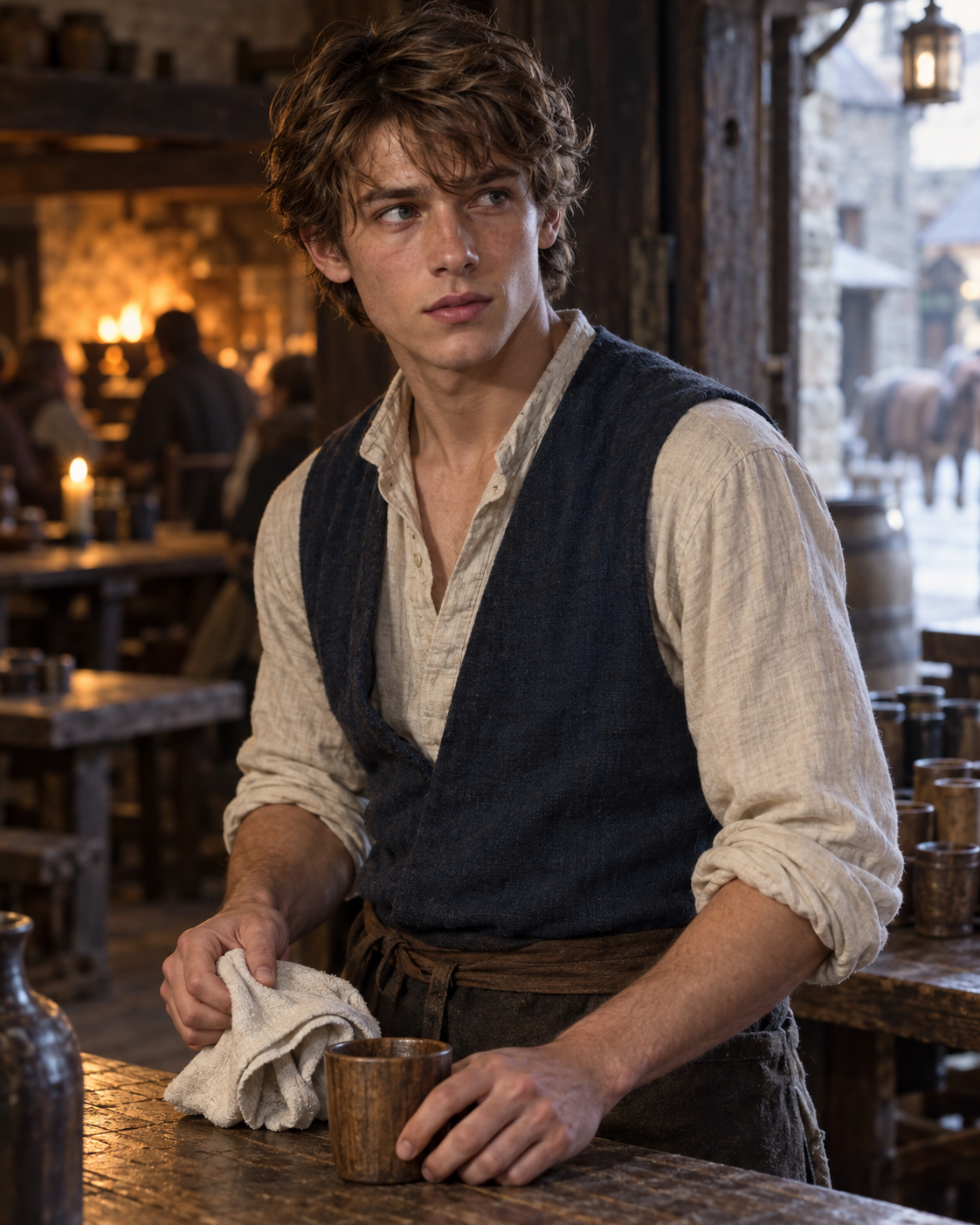
CVM depicts Heanfar as a beautiful young man around eighteen, clearly a late-adolescent or young adult rather than a child, with a lean wiry working build, warm gray-blue eyes, fair hearth-flushed skin, tousled dark honey-brown hair, and a clean-shaven face. His cream linen, faded deep-blue wool vest, dark work apron, folded cloth, plain wooden cup, and warm service room signal labor without aristocratic silk, polished armor, or a romance-cover transformation that erases work.
Useful visual signals may include practical clothing and a hospitality setting, but exact garments, colors, apron, tray, mug, stable, hearth, inn sign, and building remain interpretive. The caption must not present them as textual facts.
The face must be distinct from every approved younger male character, especially Simon, Jeremias, Sangfugol, and the fortress workers. Heanfar is not a disposable background clone.
Art must not depict him during Naglimund’s fall, wounded, dead, fleeing, fighting, or surviving unless direct evidence is recovered. A living work portrait is the safest first identity.
The same canonical attachment powers featured image, hero, character card, and social image. Preserve this exact face, age baseline, body, coloring, hair, clothing, and grounded working presence in every future scene; age progression should occur only if later-volume evidence places him there.
Why Heanfar Matters
Completeness is tested by the minor worker, not the prince everybody remembers
No fandom directory forgets Simon, Miriamele, Binabik, or Josua. The real test is whether the ecosystem preserves Heanfar without pretending he received a major arc.
His record expands Naglimund horizontally. The stronghold contains economic and service relationships alongside banners and command. Somebody works where travelers sleep and eat. That person has a name.
The profile also models honest uncertainty. We can explain the role, social context, narrative visibility problem, similar-name risk, status boundary, and art requirements without writing imaginary dialogue. That is not less detailed than fandom. It is more disciplined.
Heanfar’s page will grow if sequential rereading recovers a foreground appearance or if later volumes name his fate. Until then, the one canonical profile keeps every verified fact accessible and every unverified claim visibly out.
What the Profile Will Not Borrow
Nearby characters cannot donate scenes merely because Heanfar’s own passage is hard to recover
Heanfar does not inherit Lucuman’s stable work, Jeremias’s squire service, Sangfugol’s music, or any unnamed servant’s actions. He does not become the innkeeper, the innkeeper’s son, or the owner of a conveniently imagined tavern.
The Naglimund grouping cannot donate a political allegiance beyond presence in the community. It cannot prove that Heanfar joined Josua’s cause voluntarily, understood the supernatural threat, attended a council, fought on the walls, or escaped with the survivors.
Future cross-links should say “associated context,” not “friend,” “coworker,” or “witness,” unless sequential rereading recovers the relationship. That discipline prevents a sparse profile from becoming a magnet for everybody else’s facts.
The result may feel less cinematic than a fabricated rescue scene. It is also the version that remains trustworthy when the next receipt appears.
On the Record
An owned-edition appendix identity with a deliberately narrow Book 1 biography
This is Heanfar’s one canonical, full-spoiler profile across Memory, Sorrow, and Thorn.
The owned Book 1 character appendix identifies Heanfar as an innkeeper’s boy. The reconciled manifest places him with the Naglimund and survivor cast. A direct foreground passage was not independently recovered through the current searchable Kindle interface.
The record confirms Heanfar’s name, occupational or household role, Book 1 membership, and Naglimund grouping.
The record does not confirm exact age, appearance, family, employer, inn name, location within Naglimund, duties, dialogue, personality, friendships, political allegiance, siege actions, escape, survival, death, burial, or later-volume presence.
Status: unknown.
Visual state: approved editorial reconstruction. The portrait preserves Heanfar as a living young worker rather than inventing a Naglimund siege outcome. Every physical feature, garment, prop, workplace detail, pose, and lighting choice is CVM reconstruction. The same canonical attachment powers featured image, hero, directory card, and social metadata.