
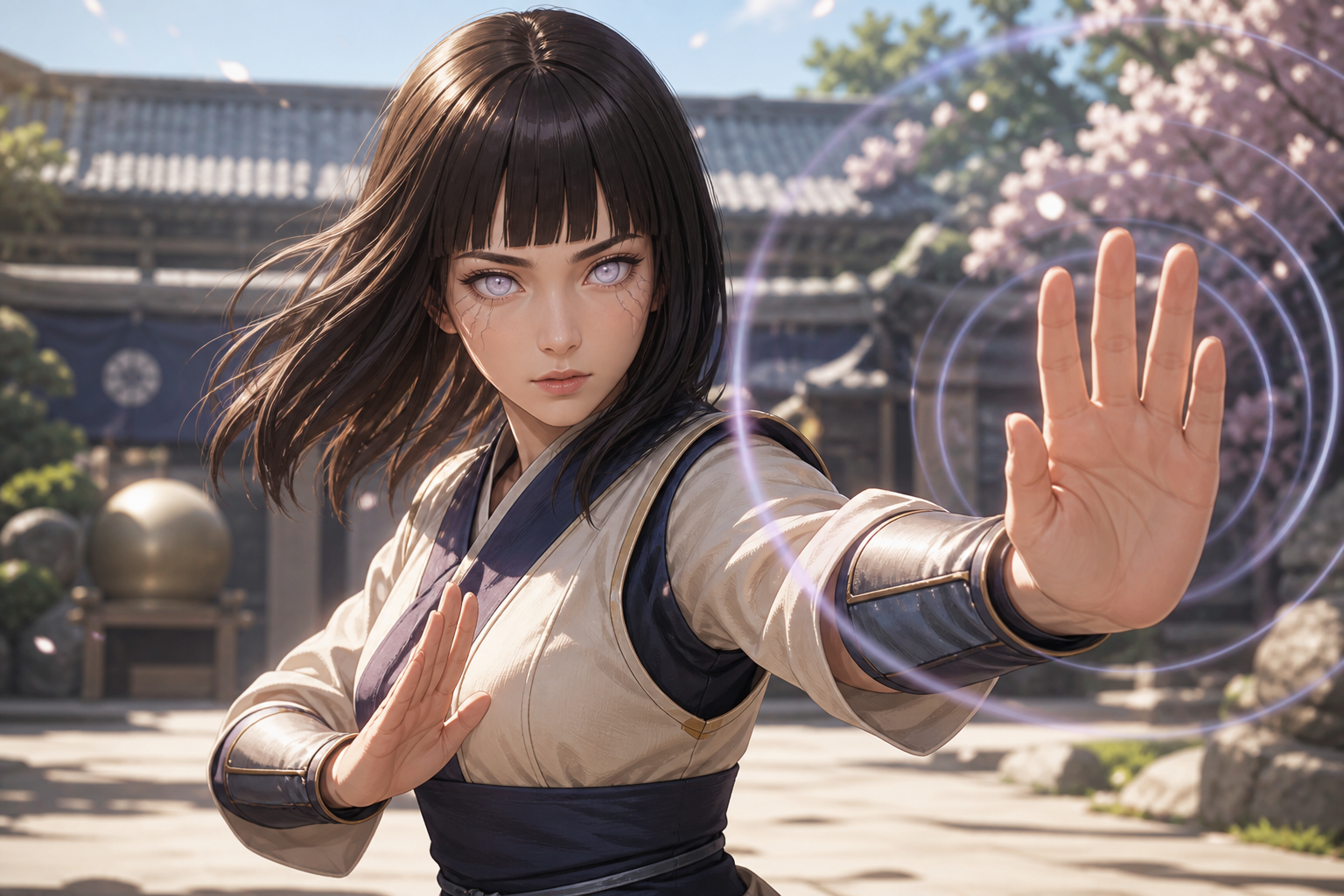
Naruto · Complete Character Profile
Hanabi Hyūga
The Hyūga call her the gifted second daughter. That sounds flattering until you remember the compliment arrives because adults turned two sisters into a succession exam and called the winner family leadership.
The bottom line
Hanabi Hyūga’s complete Naruto profile covers the Byakugan, succession, Hinata, Hiashi, The Last, Team 15, family pressure and New Era leadership.
Hanabi is the child who “wins” the Hyūga comparison and receives the burden hidden inside the prize. She is younger, technically gifted and trained as a possible heir after Hinata Hyūga is judged inadequate. None of that makes Hanabi the villain in her sister’s pain. Both girls are children inside a household that turns ability into affection, rank and future ownership.
Her best adult material shows a different use of authority. Hanabi tests Boruto honestly, leads young kunoichi, jokes with family and can be affectionate without surrendering discipline. The record is split between manga canon, The Last and anime-expanded New Era work, so this profile labels those boundaries instead of blending everything into one smooth fake biography.
Hanabi Hyūga essential file
The published Part I data does not give Hanabi a ninja registration number or a full mission ledger. That is a record boundary, not an invitation to invent adult statistics. Later material changes her height and position, while the cleanest public official episode record confirms her adult role as Boruto’s aunt and a qualified Byakugan examiner.
Verified record: age, dimensions, rank and the blanks that stay blank
Hanabi first appears in manga chapter 78 and anime episode 46. Her birthday is March 27, her blood type is A and she is seven during Part I. The Part I profile gives her a height of 132.4 centimeters and a weight of 28.9 kilograms. She grows to 150 centimeters during the Blank Period and 170 centimeters in the New Era. Those measurements make the timeline visible: the child compared against Hinata becomes an adult instructor with a life beyond the succession match.
The record identifies her as the Hyūga heiress and lists her Blank Period ninja rank as genin. New Era anime material places her in command of Team 15, but the accessible character record does not supply a clean canonical promotion trail explaining every rank between those points. It also does not provide a registration number, Academy graduation age, chūnin promotion age, complete mission ledger or numerical databook stat grid. I am not borrowing somebody else’s numbers because the fact box looks lonely.
Her family record includes Hiashi as father, Hinata as sister, Hizashi as uncle, Neji as cousin, Boruto and Himawari as nephew and niece, and Kawaki as an adoptive nephew within the New Era household. The anime includes her mother, but the woman remains canonically unnamed. The favorite-food shelf lists bananas and milk, least favorite food as mitsuba and her childhood hobby as training with Hiashi. Those details are small, but they keep the heiress from being reduced to a Byakugan delivery system.
Name and design: fireworks inside a house obsessed with control
Hanabi means “fireworks,” an image of sudden brightness, public display and beauty that cannot be held in one shape. The name fits a child whose talent becomes visible early, but the symbolism should not be pushed into prophecy. Her family chooses the name before anyone knows what kind of adult she will become.
Part I Hanabi has dark hair, pale Byakugan eyes and formal Hyūga clothing. Her appearance visually pairs her with Hinata while her posture and training scenes signal greater confidence. The comparison is intentional. Kishimoto wants viewers to understand why Hiashi reads one daughter as a stronger successor, even while the story slowly teaches us that the father’s measurement is too narrow.
The Last ages her into a young teenager and makes her eyes literal plot targets. Adult Hanabi wears a more practical shinobi design, keeps the clan’s visual language and carries herself with less stiffness than the child watched by her father. Design becomes a quiet character arc: the same eyes remain, but the person using them has more room.
Appearance chronology: three eras and no single permanent version of the heiress
Child Hanabi has long dark hair, pale Hyūga eyes, a sleeveless blue top over mesh, blue shorts and shinobi sandals. The manga treats her hair as black while the anime often colors it dark brown with a lilac cast in the eyes. Her resemblance to Hiashi is part of the visual argument. She looks like the daughter the clan expects to continue him.
Part II concept art shortens her hair into an uneven bob and gives her a tan vest, wristbands and a modified combat outfit. During the Pain-era anime material, she also wears a pale yellow kimono with violet patterning, a red-orange obi and a flower hair clip. Kishimoto created a post-time-skip design, yet Hinata’s Infinite Tsukuyomi dream used Hanabi’s Part I look in the manga. The anime corrects that visual continuity error. That distinction belongs in a complete appearance shelf because adaptation sometimes repairs the page instead of merely expanding it.
In The Last, her hair has grown long again and is tied low with ribbons, paired with a tan kimono-style top and matching skirt. Adult Hanabi becomes taller and keeps an extremely long ponytail with shorter face-framing pieces. Her yellow blouse, red skirt and white obi blend formal Hyūga tradition with a warmer, more personal presence. The New Era design can enter a classroom, family dinner or fight without changing costumes to prove she belongs. That flexibility is the visual freedom child Hanabi never had.
The Hyūga house is a family and a political machine
The Hyūga clan divides itself between main and branch families, protects the Byakugan as strategic property and uses a cursed seal to control branch members. Hanabi is born into the main family, which grants status and safety from the branch seal. Privilege does not mean freedom. Main-family children are evaluated as heirs, trained under political pressure and taught that family affection can follow usefulness.
Hinata’s childhood shows the system’s punishment for failing the preferred standard. Hanabi’s childhood shows the punishment for meeting it. One daughter is removed from succession. The other is intensified as a candidate. Neither chose to make sparring performance a referendum on who deserves the future.
A profile that calls Hanabi “lucky” because Hiashi favors her misses the institution. Favor tied to performance is conditional. The child learns that love, clan survival and political duty may all depend on continuing to win. That is a quieter wound than public rejection, but quiet does not mean harmless.
The succession match makes sisterhood answer to a scoreboard
Hanabi is five years younger than Hinata. Hiashi still judges her more promising and uses a match between the sisters to evaluate succession. Hanabi wins. The result confirms technical talent. It does not prove she is wiser, morally better or more deserving of parental care.
The scene is commonly discussed as if the sisters volunteered for a sports rivalry. They did not design the institution, select the stakes or define what losing would mean. Hiashi and the clan elders create the frame. Hanabi performs inside it. Hinata’s hesitation and gentleness become evidence against her, while Hanabi’s sharper execution becomes evidence for leadership.
This is where fandom often turns cruel. Supporting Hinata does not require hating a seven-year-old. Admiring Hanabi’s talent does not require approving the system that rewards it. The real antagonist in the succession match is the belief that one child must be diminished for another to be prepared.
Hanabi and Hinata: sisters after the institution tried to make them categories
Hinata begins as the designated heir and Hanabi becomes the replacement candidate. That chronology creates distance, but later material allows genuine affection to remain. Hanabi watches Hinata’s romantic confusion, participates in family events and becomes aunt to Boruto and Himawari. The relationship survives the role the clan assigned them.
Hanabi should not be rewritten as Hinata’s secret bully. The harshest childhood pressure comes from Hiashi’s judgment and the clan structure. Nor should the sisters be smoothed into a perfect bond without consequence. Growing up as comparison objects affects what they can say, how safe vulnerability feels and who is expected to occupy authority.
Adult warmth becomes meaningful because it is not guaranteed. The sisters build a family relationship after succession stops defining every interaction. Hinata chooses a household outside the Hyūga compound. Hanabi remains closely tied to clan and shinobi work. Difference no longer has to mean defeat.
Hanabi and Hiashi: excellent training does not cancel conditional parenting
Hiashi Hyūga recognizes Hanabi’s talent and trains her intensely. That instruction helps create a formidable Gentle Fist user. It also comes from the same father who dismisses Hinata as unsuitable and allows the clan’s hierarchy to shape both daughters.
Later Hiashi becomes warmer, especially as a grandfather. The change matters, but retrospection cannot turn childhood policy into wisdom. Hanabi’s skill is partly a product of his teaching. Her emotional restraint is also formed under his gaze. Parents do not get to claim only the achievements produced by pressure and disown the damage.
Hanabi’s adult confidence suggests she has metabolized the training without remaining frozen in her father’s severity. She can evaluate Boruto firmly and still treat him as family. That combination is one of the clearest receipts that inheritance can be edited instead of merely repeated.
Part I and Part II chronology: watching Hinata rewrite the lesson
Much of Hanabi’s childhood interior life is anime expansion. She admires Hinata, wants more time with her and watches clan duties keep her older sister at a distance. She sees Neji attack Hinata during training and watches Hiashi activate Hizashi’s curse seal when rage turns toward the main house. Their grandfather explains that the clan uses extreme measures to protect its secrets and that each person has a fixed path. That is not neutral family history. It is ideology delivered to a little girl before she has language for coercion.
Hiashi eventually makes the sisters spar for succession. Hinata finds an opening but hesitates to hurt Hanabi. Hanabi counters and wins, then feels the pain of having injured the sister she admires. Adults read the result as proof of fitness. The girls experience it as intimacy forced through a scoreboard. Hanabi receives the heir position and Hiashi’s full training regimen. Congratulations, baby girl. Your prize is becoming the next child crushed under performance.
During the Chūnin Exams, Hanabi learns that Hinata was badly hurt by Neji and visits her in the hospital. Hinata’s refusal to abandon her own path surprises her. Watching Naruto defeat Neji exposes family history Hanabi did not know, including the kidnapping crisis and Hizashi’s death. After the invasion, she sees Neji help Hinata train and hears a branch-family prodigy reject the destiny he once repeated. The clan’s youngest intended leader is watching the people labeled failures build a new ethical map without waiting for permission.
Part II anime material shows Hanabi struggling with Revolving Heaven, observing Hinata’s continued growth and returning with Hiashi after Pain destroys Konoha. Hinata’s choice to stand before Pain confirms that gentleness did not mean incapacity. Hanabi does not need to become less talented to respect her sister. She needs the institution to stop treating their strengths as mutually exclusive job applications.
The Byakugan is perception, anatomy and clan property all at once
The Byakugan grants broad visual range, near-complete field awareness, long-distance focus and the ability to see chakra pathways and tenketsu. These qualities make it useful for scouting, diagnosis, tracking and Gentle Fist combat. Range and precision vary by user and era, so the eye should not be described as a universal surveillance god.
Hanabi’s early talent means she can activate and use the Byakugan effectively at a young age. The Last proves how politically valuable those eyes remain by making them the target of abduction and extraction. Her body is treated as access to clan power. The plot does not merely endanger a girl. It reenacts the Hyūga obsession with eyes as assets other people may own.
Perception also works symbolically. The clan that can see chakra inside a body remains remarkably bad at seeing the emotional harm inside its own house. Hanabi’s growth becomes interesting when technical sight is paired with better relational judgment than the adults who trained her.
Gentle Fist: the name sounds polite because the damage happens inside
Gentle Fist channels chakra through precise strikes into an opponent’s chakra network and internal organs. The method rewards Byakugan vision, close-range accuracy, balance and control. Hanabi’s training makes her dangerous without requiring theatrical weapons.
The style’s “gentle” label refers to external motion, not harmlessness. A small contact can disrupt chakra or damage internal systems. That contrast fits Hanabi’s childhood presentation. She appears quiet and obedient while carrying a method built to make invisible injury decisive.
Adult anime material expands her demonstrated combinations and leadership-level competence. Games give her additional named moves and spectacle. Those shelves should remain labeled. A game combo is evidence of adaptation design, not automatic manga canon.
Complete technique shelf: precision, perception and honest continuity labels
Hanabi’s Byakugan grants the Hyūga field of vision that approaches 360 degrees while retaining a small blind spot, along with long-range sight, the ability to see through many objects and perception of the chakra pathway system. Hiashi describes her eyes as unusually strong for her age, near Neji’s level, and Toneri calls their quality pure enough to use in awakening the Tenseigan. His judgment is part of the kidnapping plot, not proof that Hanabi carries a secret second dōjutsu herself.
Gentle Fist sends chakra through her palms and fingers into an opponent’s network, damaging organs and closing tenketsu with little need for bruising spectacle. In New Era anime combat, Hanabi evades Boruto and his shadow clones, controls distance and ends the test without treating a nephew like a war criminal. The anime also shows Eight Trigrams Palms Revolving Heaven, Eight Trigrams Vacuum Palm and Gentle Fist Palm Bottom. These are anime-demonstrated techniques. The sparse manga record does not provide a separate giant catalogue hiding off panel.
Her childhood win over Hinata needs context. Hanabi is gifted, technically sharp and willing to strike. Hinata sees an opening first but hesitates because the opponent is her little sister. The result still counts, and so does the emotional condition that shaped it. Talent is not fake because love affected the match. The match is not a pure measurement because love affected it.
Hanabi’s limits remain ordinary human limits inside an elite bloodline art. Byakugan sight can miss through its blind spot. Precision requires attention. Gentle Fist works best when she reaches the opponent. Adult authority divides her focus between clan obligations, teaching and family. The franchise gives her control, not omnipotence. A complete profile should resist both insults: she is not merely Hinata’s spare, and she is not a hidden goddess the plot was too scared to unleash.
The Last makes Hanabi’s stolen eyes the engine of somebody else’s plan
In The Last, Toneri Ōtsutsuki abducts Hanabi and takes her Byakugan. Her eyes support his plan and become part of the conflict drawing Hinata, Naruto and the rescue team forward. Hanabi spends much of the movie as victim and objective rather than active agent. That narrative choice deserves honest criticism.
The event still reveals important stakes. The Hyūga have long treated ocular power as something bloodlines must guard. Toneri performs the external version of the same ownership logic by removing the eyes from the person and using them as components. Hanabi’s body becomes a resource because powerful men believe lineage grants entitlement.
Rescue and restoration matter, but recovery cannot be reduced to “she got them back.” Abduction, surgical violation and loss of bodily autonomy are severe experiences even when an adventure film moves quickly. The movie gives Hanabi limited interior time, so a profile should not invent a detailed trauma diagnosis. It should refuse to pretend the violence was merely a plot key.
Adult Hanabi has more personality because she finally has room to spend it
New Era material presents Hanabi as confident, playful with family and professionally serious. Official Boruto episode 9 places her in a direct evaluation role when Boruto claims he has awakened the Byakugan. She spars with him, examines the evidence and tells him honestly that the eye is not active.
The scene is small but excellent. Hanabi does not flatter her nephew, humiliate him or turn the test into a succession crisis. She provides a qualified answer. That is what healthy authority looks like: affection does not corrupt the standard, and the standard does not require cruelty.
Her relationships with Boruto and Himawari also show a Hyūga adult participating in family life outside rigid main-house ceremony. The clan’s future is no longer defined only by who inherits a seat. Kinship can include aunt, teacher, examiner and ally.
Team 15 lets Hanabi teach girls without making them copies of her
In the Boruto anime, Hanabi leads Team 15, including Wasabi Izuno, Namida Suzumeno and initially Sumire Kakei. This is adaptation-specific adult work rather than a major manga biography thread. It still matters because it places Hanabi on the other side of childhood training.
Her students have different temperaments and abilities. Leadership therefore requires more than transmitting Gentle Fist. Hanabi must evaluate confidence, teamwork, fear and professional growth across young kunoichi who do not belong to her clan. The assignment broadens her beyond Hyūga succession.
The creative lens is satisfying. A girl measured against her sister becomes a teacher responsible for preventing comparison from swallowing individual development. The anime does not always explore that parallel deeply enough, but the structure is there and worth naming.
New Era work: Boruto, Himawari, Team 15 and a life with actual hobbies
When Boruto claims he awakened the Byakugan, Hanabi takes the sparring test in Hiashi’s place because she worries about her father’s back and his inability to hold back. She handles Boruto’s clones cleanly, confirms the eye did not appear and then comforts him rather than mocking the claim. She tells him to work hard and ask for help after trying for himself. That is strict care without the childhood cruelty of treating failure as disposability.
Team 15 gives her Sumire Kakei, Namida Suzumeno and Wasabi Izuno. Hanabi welcomes them, supervises early missions and expects discipline when they put themselves at unnecessary risk. She presses Namida to develop Water Release instead of letting one specialized scream become an entire career. The instruction can be harsh, but it aims toward independent skill rather than producing a smaller copy of the teacher.
The Byakuya Gang protest puts Hanabi and other shinobi into crowd control after genjutsu manipulates villagers. Later arcs keep Team 15 within the New Era mission network even as personnel and leadership arrangements shift. Hanabi’s value is not that she personally resolves every crisis. She becomes part of the boring, necessary layer between Academy graduation and children surviving long enough to become adults.
Family comedy supplies the rest. She gushes over Boruto and Himawari after scolding Hiashi for doing the same thing, takes pride in cooking, collects enough Extreme: Shinobi Picture Scrolls to explain the rarity system and joins the family chaos of Parent and Child Day. The fashionable, extravagant woman described in the Blank Period finally has room to be unserious. That is not filler. Peace without personality is just a ceasefire with nicer lighting.
Relationship atlas: the people beyond the succession chart
Hinata Hyūga
Older sister, former rival by institutional design and later adult family. Their bond becomes strongest when inheritance stops demanding a winner.
Hiashi Hyūga
Father, trainer and source of conditional pressure. His later warmth matters without retroactively cleaning his parenting.
Neji Hyūga
Cousin from the branch family whose life exposes the hierarchy protecting Hanabi. Any discussion of her privilege must remember what his seal cost.
Boruto Uzumaki
Nephew and student for one important test. Hanabi gives him truth instead of either indulgence or humiliation.
Himawari Uzumaki
Niece and another child carrying Hyūga potential without being raised in the same succession machinery.
Team 15
Anime students who turn Hanabi’s adult skill into mentorship outside the clan.
Original Japanese performance: Kiyomi Asai
Kiyomi Asai is Hanabi’s original Japanese performer across Naruto material and The Last, with the official Storm 4 character page also crediting her for The Last version. CVM Sekai keeps the originating performance in focus and does not add an English-dub sidebar.
This production pass verifies the credit and performance contexts without inventing vocal observations from text. Childhood reserve, film danger and adult playfulness create a useful range for later scene-based criticism. Exact claims about pitch, timing or breath belong after lawful listening, not after reading a cast list.
Succession, filial duty and the difference between seeing and understanding
A Confucian lens reveals both the value and danger of lineage duty. Hanabi receives training, family history and responsibility. Reciprocity requires the household to protect her development in return. When elders turn children into rankings, hierarchy keeps the duty and loses the care.
A Buddhist lens notices attachment to status. Hiashi and the clan cling to the idea that one ideal heir can secure continuity. That attachment generates suffering for both daughters and reinforces the branch system harming Neji. Hanabi’s adult life becomes healthier as identity expands beyond the heir label.
A feminist lens rejects the “two sisters fighting over worth” shortcut. Their conflict is structured by male-led clan governance, yet neither girl is only a victim. Hinata develops her own courage. Hanabi develops authority and skill. Sisterhood survives when the comparison stops being the only language available.
A fandom-industry lens explains why Hanabi’s adult material lives largely in anime and film. She is recognizable, powerful and connected to central characters, but not positioned as a primary manga lead. Adaptations use that available space. The result is valuable material with a clear continuity label.
Manga, anime, film, novel, OVA and game boundaries
The manga gives Hanabi a narrow but important role in the Hyūga succession story and family scenes. The television anime builds most of her childhood perspective, training struggle, bond with Hinata, adult teaching work and New Era personality. Those additions are labeled as anime continuity instead of being backfilled into the manga because fans wish Kishimoto had done more.
The Last: Naruto the Movie is her largest feature role. Toneri’s forces kidnap her, remove her Byakugan and use those eyes to awaken the Tenseigan. Naruto, Hinata, Sakura, Sai and Shikamaru pursue the rescue. Sakura and Sai recover Hanabi, and Hinata later returns her eyes. The story uses Hanabi’s body as a plot resource, but the restoration and sisterly contact keep her from ending as disposable hardware. The novelization belongs to the same feature narrative. Konoha Hiden: The Perfect Day for a Wedding places her at Naruto and Hinata’s wedding while the family holds Neji’s portrait.
The OVA Finally a Clash! Jōnin vs. Genin!! Indiscriminate Grand Melee Tournament Meeting!! includes her. Playable game appearances include Naruto: Ultimate Ninja 3, Naruto Shippūden: Ultimate Ninja 4, Ultimate Ninja 5, Ultimate Ninja Storm 4, Naruto Mobile, Naruto x Boruto: Ninja Voltage, Ultimate Ninja Storm Connections, Shinobi Collection, Shippū Ranbu and Ultimate Ninja Online. Games turn Gentle Fist into selectable mechanics. They do not automatically promote every move animation into manga canon.
New Era anime episodes and Naruto Shinden: Parent and Child Day provide most adult family and teaching evidence. That shelf is not optional fluff when discussing who Hanabi becomes. It is also not permission to pretend the original manga gave her a full arc. The honest conclusion is sharper: later media finally does character work the central serial left mostly undone.
Eight fandom shortcuts that fail Hanabi
- “She stole Hinata’s inheritance.” Hiashi and the clan control succession. A seven-year-old does not seize the institution.
- “She is stronger, so Hiashi was right.” Technical skill does not justify conditional parenting or branch-family oppression.
- “Hanabi hates Hinata.” Later family material shows affection; childhood distance exists inside forced comparison.
- “She has no personality.” Her manga space is small, while film and anime give her reserve, confidence, humor and mentorship.
- “The Byakugan theft only matters to the romance plot.” Hanabi suffers abduction and bodily violation even when the movie under-centers her recovery.
- “Adult Hanabi is automatically clan head.” Leadership assumptions require care because the record does not publish a simple universal succession notice.
- “Every Boruto feat is manga canon.” Team 15 and much adult action belong specifically to anime continuity.
- “She proves Hinata was weak.” The sisters develop different strengths under different pressures. One life is not evidence against the other.
The final verdict: the replacement heir becomes a person outside the replacement
Hanabi Hyūga matters because she shows the other side of conditional family approval. Hinata is hurt by being judged insufficient. Hanabi is shaped by being judged useful. The clan’s compliment becomes a career path before the child can define success for herself.
Her adult record is strongest when she uses authority differently. She tests Boruto without shaming him, mentors girls outside her bloodline and participates in a family where affection is not announced through succession matches. The reform is incomplete and adaptation-heavy, but the direction is visible.
Hanabi means fireworks. Her best future is not becoming the brightest object in the Hyūga house. It is helping build a house where sisters, students and children do not need to explode before adults admit they can be seen.
Sources and canon boundary
Manga chronology controls this profile. Anime staging, databook material, novels, films, games, and later franchise appearances are labeled instead of being blended into one false continuity.
Primary franchise references: Naruto Official and VIZ Media Naruto. CVM Sekai’s conclusions about Hyūga succession, Hinata, clan hierarchy, training, The Last, Boruto-era leadership, family repair, and accountability are editorial analysis, not invented creator quotations.