
Memory, Sorrow, and Thorn · Canonical Character Profile
Gwelan
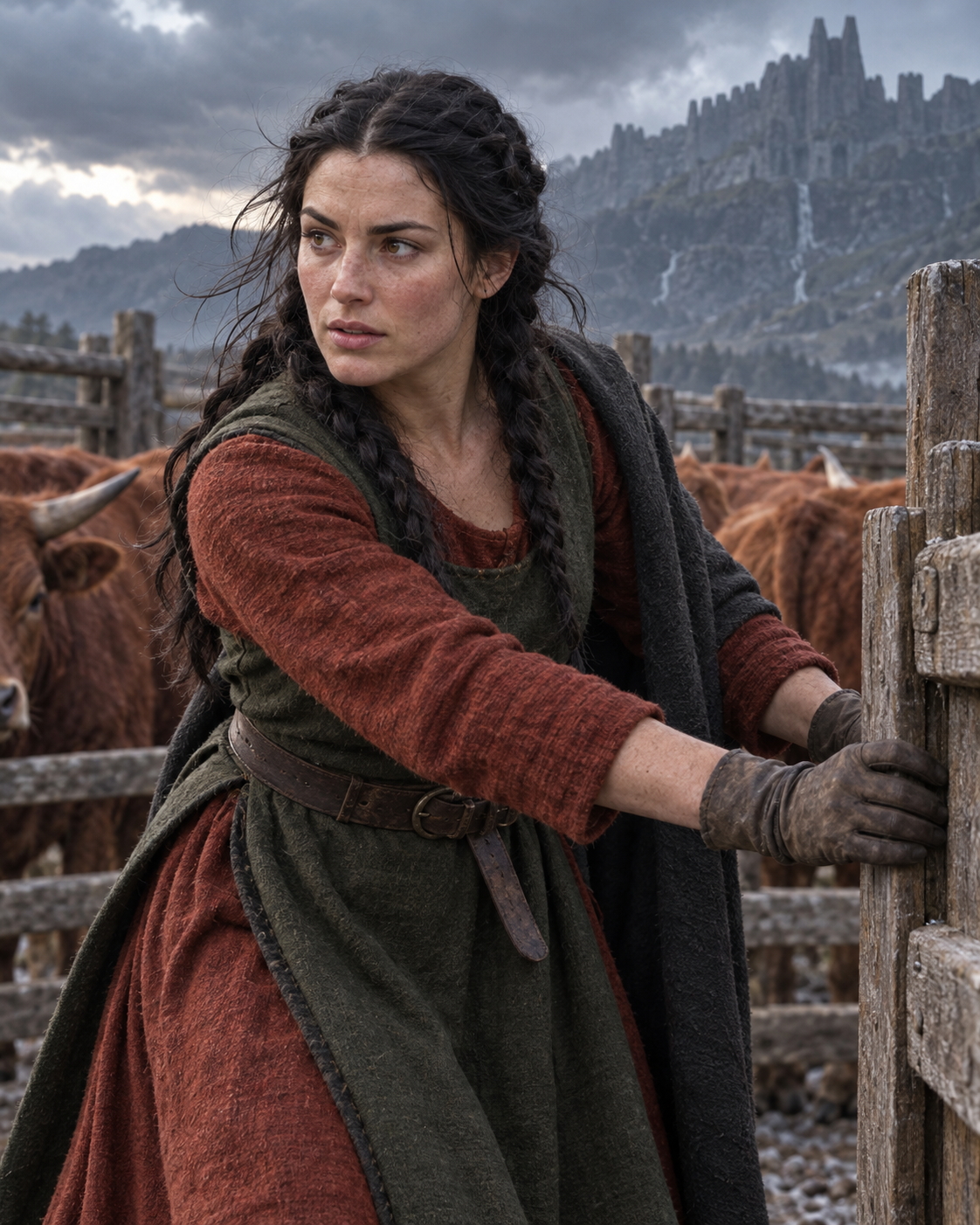
Gwelan is one of the young Hernystiri women forcing the Taig’s red cattle into a crowded paddock while the men prepare for battle. She gets no speech, no costume description, and no later confirmed sighting. What she gets is work. That matters: Maegwin’s command to learn the labor men are leaving behind is not a princess posing alone against history. Gwelan is one of the women physically making the transition real.
At a Glance
The named worker who proves Maegwin’s emergency labor force is a group, not a speech
- Name
- Gwelan
- People
- Hernystiri
- Age
- Young adult; exact age unconfirmed
- Location
- The Taig at Hernysadharc
- Work
- Forces red cattle into a crowded paddock before battle
- Work group
- Maegwin, Cifgha, Gwelan, and other young women
- Dialogue
- No direct line preserved
- Status
- Alive in the cattle-yard scene; later fate unconfirmed
The Taig’s Red Cattle
Gwelan enters the story inside a job that is loud, physical, and necessary
Hernystir is preparing for war. Men organize weapons and departure while the Taig’s household tries to protect animals and stores that must outlast them.
Maegwin leads Cifgha, Gwelan, and other young women in forcing red cattle into a crowded paddock.
The verb matters. They are not strolling beside picturesque livestock. They are moving frightened, heavy animals into limited space under pressure.
Cattle represent food, wealth, breeding stock, and the possibility of rebuilding. Losing them would damage households long after a battle ended.
Gwelan’s presence confirms the labor is collective. Maegwin may direct it, but she cannot move a herd by royal will. The work requires multiple bodies holding lines, closing gaps, driving animals forward, and responding when the herd pushes back.
The scene does not assign Gwelan a specific position in the yard. It does not say whether she handles a switch, rope, gate, dog, or bare-handed pressure. Future art can show collective motion without pretending one invented tool is textual canon.
Her name makes her more than an anonymous extension of Maegwin. The narrative briefly says: this particular young woman was here, and she worked.
She Does Not Get the Line
Gwelan’s silence is missing dialogue, not missing participation
Cifgha says cattle handling is men’s work. Maegwin replies that the work left behind belongs to women unless Cifgha wants sword and spear; with men departing, they must learn to handle their own “spiders.”
Gwelan receives no quoted response.
That absence cannot safely be translated into agreement, disagreement, obedience, fear, admiration, or resentment. Silence on the page is not a personality test.
What the scene confirms is continued placement within the working group. Gwelan’s body is part of the labor context in which the exchange happens.
This makes her different from Cifgha without making her lesser. Cifgha verbalizes the inherited division of labor. Gwelan demonstrates the wider cohort affected by Maegwin’s answer.
A weaker profile would give Gwelan an invented witty reply simply to make her feel “complete.” That would erase the actual form of her contribution: named presence inside collective work.
Epic fantasy often remembers the person who speaks and dissolves everyone lifting beside them into scenery. Keeping Gwelan canonical resists that habit.
Women’s Work Because Women Remain
The labor boundary changes through necessity before anyone has time to celebrate it
Cifgha’s objection and Maegwin’s answer expose a gendered work system being altered by mobilization.
Maegwin does not claim the work was always women’s. She argues that when men leave for battle, the necessary work cannot leave with them.
Gwelan belongs to the people who must enact that change. The political meaning of the scene depends on women acquiring practical competence, not merely agreeing with a principle.
The transition is not framed as liberation without cost. Men are leaving because Hernystir faces invasion, hunger, and political violence. New responsibility arrives with danger and depletion.
Gwelan’s scene therefore sits at the intersection of gender, war, food security, and household continuity.
We cannot claim she had never handled cattle before. “Men’s work” identifies a social classification expressed by Cifgha, not a complete labor census. Some women may already possess experience.
We also cannot claim the scene permanently transforms Hernystiri gender roles. It proves an emergency redistribution in this place and moment.
Gwelan helps make that moment physical. Her significance lies in the transition being performed by a group rather than announced into an empty yard.
The Summons Beyond the Paddock
While Gwelan works, Rhynn’s Cauldron turns preparation into regional alarm
The deafening Summons of Rhynn’s Cauldron carries warning from the Taig across Hernysadharc. Villages and manor halls within hearing relay the signal outward through riders.
The system is older than the current rulers, and children recognize its meaning before they learn its history.
Gwelan is not individually described reacting to the sound. The profile should not invent fear, prayer, or resolve.
Its proximity establishes the atmosphere around her work. The cattle yard is not routine seasonal management. It occurs while an ancient warning network tells the country that danger is moving.
The contrast is important: monumental sound spreads across the land, while survival still depends on local bodies completing ordinary tasks.
Rhynn’s Cauldron can summon fighters and warn communities. It cannot put the cattle into the paddock. Gwelan and the other women do that.
No Confirmed Hostage Sighting
Gwelan’s record ends at the Taig rather than borrowing Cifgha’s uncertainty
Later, Maegwin sees a struggling hostage wearing Cifgha’s light-blue dress. Even Cifgha cannot be positively identified at that distance.
No equivalent clothing clue, name, or visual marker connects Gwelan to Skali’s hostage wagon.
The two women share a labor scene, but their later evidence diverges. Gwelan must not inherit Cifgha’s possible-captive status merely because they worked together.
Her correct record is alive at the cattle-yard scene, with later fate unconfirmed.
This is why canonical profiles and scope metadata matter. Group membership creates relationships, not interchangeable biographies.
A Name Inside “Other Young Women”
Gwelan keeps the labor group from collapsing into an anonymous background texture
The sentence names Maegwin, Cifgha, and Gwelan before widening to other young women. That structure preserves both individual presence and collective scale.
Maegwin carries royal and narrative importance. Cifgha receives the spoken objection. Gwelan receives neither privilege, yet the text still retains her name.
A complete fandom record should honor that distinction. She is not simply “one of the women,” because the book identifies her. She is also not secretly the third lead of the scene, because the book does not individualize her actions beyond participation.
The useful middle ground is precise: Gwelan worked there, among those people, during that emergency. Her name proves the laboring crowd contained particular lives even when the narration could not follow each one.
That is how coverage becomes more than a list. The page restores her place without stealing somebody else’s dialogue or outcome to fill the silence.
Connections
The princess, outspoken coworker, and wider labor community around Gwelan
Princess Maegwin
Leads Gwelan’s cattle-working group and reframes the labor women must now perform.
Cifgha
Works beside Gwelan and voices the objection that the cattle are men’s work.
The Taig’s young women
The unnamed wider group whose combined labor makes the cattle movement possible.
The departing men
Their mobilization creates the emergency transfer of formerly gendered work.
Hernystir’s households
The people whose food security and recovery depend on preserving livestock.
Rhynn’s Cauldron
The warning system sounding across the land while Gwelan’s group works below.
Why Gwelan Matters
She keeps collective labor visible when narrative gravity pulls everything toward royalty
Gwelan matters because Maegwin’s leadership needs people, not applause.
Her named presence reminds us that historical change is enacted by cohorts whose individual interior lives may remain unavailable.
She also preserves an honest category of character coverage: a person can deserve a canonical page without the page pretending to know her childhood, romance, politics, or ultimate fate.
The cattle scene shows exactly enough. Gwelan is young, Hernystiri, present at the Taig, and physically engaged in preserving the household as war approaches.
That work is not glamorous. It is one of the reasons anything remains to defend.
On the Record
Book 1 only, one confirmed scene, no borrowed fate from another woman’s dress
This is Gwelan’s one canonical full-spoiler profile. Her direct appearance occurs in Book 1 during the cattle-yard preparation at the Taig. No additional direct Gwelan receipt appears in Books 2–4.
The record confirms her name, youth, Hernystiri context, presence beside Maegwin and Cifgha, and participation in forcing the Taig’s red cattle into a crowded paddock while men prepare for battle.
It does not confirm exact age, face, hair, eyes, body, clothing, family, class, dialogue, political beliefs, later work, capture, survival beyond the scene, death, or final fate. Cifgha’s possible hostage sighting does not apply to Gwelan.
Visual state: approved editorial reconstruction. CVM depicts Gwelan as a striking young adult Hernystiri woman around twenty-five with a strong working build, dark-hazel eyes, lightly freckled weather-flushed skin, thick raven-black hair in two practical joined braids, and deep-rust, moss-green, and charcoal working wool. Her worn gloves and firm grip on the Taig paddock gate visualize necessary cattle labor without assigning an unconfirmed tool, speech, rank, or later fate. Preserve this exact face, body, coloring, braid map, clothing, and grounded capability in every future Taig scene. Never borrow Cifgha’s copper hair, gray-blue eyes, dense freckles, crown braid, or light-blue dress, and never manufacture captivity. The same canonical attachment powers featured image, hero, directory card, and social metadata.