
Memory, Sorrow, and Thorn · Canonical Character Profile
Sir Grimstede
Sir Grimstede is the gap-toothed Naglimund knight commanding defenders near Dendinis’ Tower when Baron Godwig’s Cellodshiremen get onto the battlement. He sends for Deornoth, joins the counterattack, takes a ragged wound through calf and boot, and keeps enough command of the moment to count the attackers lost when the ladders go down. His scene is not polished chivalry. It is battlefield leadership with rustic speech, bad odds, and blood in the footwear.
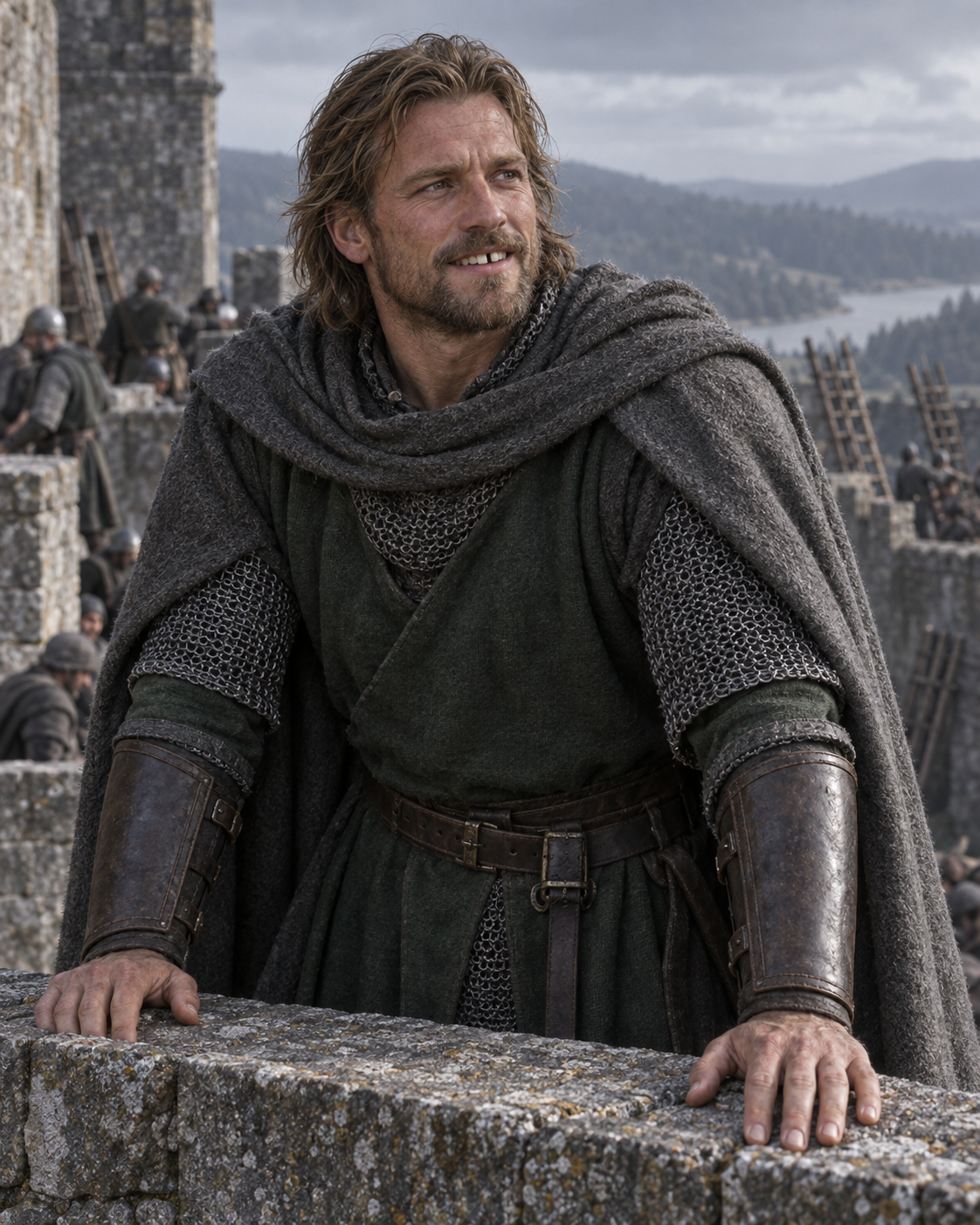
At a Glance
The wounded wall commander who knows when to call for help and when the ladders are finally lost
- Name
- Grimstede
- Title
- Sir
- Role
- Naglimund knight and Dendinis’ Tower defender
- Appearance
- Gap-toothed
- Speech
- Rustic
- Wound
- Ragged bloody hole through calf and boot
- Last confirmed state
- Alive but wounded during the Naglimund assault
The Naglimund Raed
Before he is a man on a wall, Grimstede is one voice inside a coalition trying to become real
Grimstede appears among roughly fifty lords, soldiers, clergy, and emissaries gathered in Naglimund’s dry, candlelit great hall. The tables form a horseshoe rather than a throne-centered audience.
The assembly includes Baron Ordmaer, Lord Ethelferth, Gwythinn’s Hernystiri company, Baron Devasalles of Nabban, Bishop Anodis, Binabik, Simon, and other people whose rank, origin, and understanding of the crisis differ sharply.
Grimstede’s inclusion places him inside Josua’s resistance before the wall battle. He is not introduced as a late anonymous officer produced by emergency. He belongs to the group hearing, judging, and embodying the fragile alliance at Naglimund.
The record does not preserve his speech at the Raed, political argument, seat, or vote. Presence proves participation, not a private platform.
That boundary lets his later military action carry the weight it has earned. Grimstede is defending a fortress whose coalition he has already entered, not merely following whichever flag appears above the gate.
A Knight Without Court Polish
Title and rustic speech coexist without apology
Grimstede is a knight, yet his speech is described as rustic. The combination quietly rejects the idea that legitimate martial authority must sound courtly.
His gap-toothed appearance does similar work. He is visually memorable through an ordinary imperfection rather than jeweled armor, perfect features, or a grand family resemblance.
Neither detail makes him comic relief. On the wall, soldiers answer to him while attackers are climbing into killing range. Competence does not require linguistic polish or cosmetic refinement.
Future art should preserve the gap rather than “fixing” it in the name of attractiveness. The owner’s hot-fantasy standard can include a rugged man with distinctive teeth. Attraction does not require sanding every human feature into the same generated face.
The record supplies no exact age, hair, eyes, build, heraldry, holding, family, or earlier campaign. Those choices remain open for approval and must not be reverse-engineered from the name.
Dendinis’ Tower
Godwig’s ladders reach the wall, and Grimstede refuses to disguise the emergency
On the ninth day of Yuven, Elias begins the great assault on Naglimund. Six wall-high siege towers advance with catapults, a ram, miners’ frames, ladders, archers, and a numerical advantage the defenders cannot match.
Grimstede commands near Dendinis’ Tower. Baron Godwig’s red-and-blue Cellodshiremen climb into the breach and gain the battlement.
Grimstede sends for Deornoth.
That decision is one of his strongest leadership receipts. Fantasy officers are often written as if requesting support diminishes courage. Grimstede recognizes that his position is failing and uses the command network before the breach becomes irreversible.
The message also tells Deornoth exactly where his presence can matter. Naglimund’s defense is not one heroic line. Separate towers, ladders, fires, wounds, and local commanders must coordinate under pressure.
The text does not give the messenger’s name, Grimstede’s exact words, or a map of his assigned sector. It gives the meaningful fact: when Godwig’s troops reach his wall, he calls the person capable of helping organize the counterstroke.
Throw Them Back
Deornoth’s arrival becomes a rally because Grimstede’s defenders are still there to answer it
Deornoth reaches Dendinis’ Tower and leads the counterattack. Grimstede and his men rally.
The phrasing distributes credit correctly. Deornoth supplies renewed force and coordination, but the defense does not materialize from one captain’s charisma. Grimstede’s soldiers have held long enough to be rallied, and their local commander remains active.
Together they force the ladders away. Attackers who gained the battlement are killed, thrown back, isolated, or otherwise lose the route that connected them to the mass below.
The victory is costly. Deornoth’s already injured shoulder worsens. Grimstede is wounded. Defenders die whom Naglimund cannot replace.
Elsewhere, Baron Ordmaer holds another breach alone, kills four attackers, and dies of his wounds. The parallel prevents Dendinis’ Tower from becoming a clean triumph. Every saved section of wall consumes people the fortress needs at the next one.
Grimstede’s scene therefore belongs to siege arithmetic. Elias can spend soldiers like apple peelings. Josua’s side must turn every surviving commander and every successful rally into borrowed time.
The Hole Through Calf and Boot
The injury is ugly, specific, and still not the end of his command
Grimstede suffers a ragged bloody hole through his calf and boot. The description is concrete enough to communicate damage without naming the weapon.
A lower-leg wound threatens stance, movement, balance, blood loss, and the ability to continue fighting on uneven stone. It also turns armor and clothing into part of the injury; the boot is breached with the body.
The record keeps him alive during the scene. It does not diagnose broken bone, severed tendon, infection, permanent disability, or later death.
What matters immediately is that he remains mentally present. After the counterattack, Grimstede counts the attackers lost when the ladders are thrown down.
The count is not a casualty spreadsheet. It is tactical awareness. If the ladders are gone, the men already on the wall have lost reinforcement and retreat. Grimstede can read the local battle even while wounded.
His survival status must remain “alive but wounded at last confirmation,” not upgraded into recovery because the page wants closure. Nor should the art make the bloody hole its focal point. The character is the commander attached to the wound, not the wound attached to a name.
The Other Side of Godwig’s Profile
One breach can hold two canonical truths without copying the same page twice
Baron Godwig’s profile follows the Cellodshire name and colors into the assault, then tracks Godwig’s later severed-head display.
Grimstede’s profile follows the defenders who experience that assault at body level. The same red-and-blue men are not abstract troops here. They are already on his battlement.
The shared scene should link between both profiles without duplicating their purpose. Godwig’s page asks what a lord’s name does through soldiers and propaganda. Grimstede’s asks what local command looks like when the line breaks.
This is the value of a canonical ecosystem. Events can be reused as evidence while each post follows a distinct human consequence.
Connections
The captain, attackers, defenders, and dying baron around Grimstede’s wall
Deornoth
Answers Grimstede’s summons and leads the counterattack that rallies the tower defenders.
Baron Godwig
Lord of the red-and-blue Cellodshiremen who gain Grimstede’s battlement.
Baron Ordmaer
Defends another breach and dies, showing the cost surrounding Grimstede’s local victory.
Prince Josua
Leader of the Naglimund coalition Grimstede joins and defends.
Lord Constable Eadgram
Coordinates other parts of the fortress defense, including the slingstone attack on siege towers.
The Dendinis’ Tower defenders
Grimstede’s men, who hold long enough to rally and drive the ladders away at heavy cost.
Why Grimstede Matters
He gives Naglimund a commander between the famous names and the anonymous dead
The defense of Naglimund could easily collapse into Deornoth, Josua, and a mass called “the defenders.” Grimstede gives one wall section its own human command structure.
He notices the breach, asks for reinforcement, rallies when it arrives, fights through injury, and reads the outcome. None of those actions require a grand origin story.
His rustic speech and gap-toothed face also widen the visual and social range of knighthood. He belongs in the council and on the wall without performing aristocratic smoothness.
A full fandom profile should not make him secretly central. It should show why the siege feels real when named people own small pieces of it and pay for those pieces with specific wounds.
On the Record
Book 1 only, alive but wounded, and no invented recovery
This is Sir Grimstede’s one canonical full-spoiler profile. Book 1 places him at the Naglimund Raed and directly in command near Dendinis’ Tower during Elias’s assault. He summons Deornoth, rallies, helps force away Godwig’s ladders, suffers a ragged calf wound, and remains alive at last confirmation. No direct Grimstede receipt appears in Books 2–4.
The record confirms his knighthood, Naglimund allegiance, gap tooth, rustic speech, local command, summons for Deornoth, counterattack, wound through calf and boot, and tactical count after the ladders fall. It does not confirm exact age, hair, eyes, build, family, holding, heraldry, earlier campaigns, weapon, the object that wounds him, treatment, recovery, disability, or final fate.
Visual state: approved editorial reconstruction. CVM depicts Grimstede as a hot, rugged adult Erkynlandish knight around thirty-nine: broad functional fighter build, warm-hazel eyes, fair wind-reddened skin, jaw-length dark sandy-blond hair, short sandy beard, and a relieved alert smile with one fixed natural gap between the upper front teeth. Muted forest-green, charcoal, worn mail, leather vambraces, and a heavy gray mantle place him on Naglimund’s battlement before the calf wound. Preserve this exact face, adult baseline, body, complexion, eyes, hair, beard, gap geometry, wardrobe, mail, leather, and smile across Raed, wall, wounded, aftermath, directory, hero, and social imagery. Do not cosmetically close or enlarge the gap, invent heraldry, or make the calf wound a gory identity spectacle. The same attachment powers every canonical placement.