
Memory, Sorrow, and Thorn · Canonical Character Profile
Chieftain Gormhbata
Gormhbata is the chieftain remembered as the target of Eoin-ec-Cluias’s legendary anger-song. Towser says the song was so mighty that golden bees descended and stung Gormhbata to death. The poet keeps the glory. The chieftain keeps the consequence. This profile restores the political title and the giant unanswered question: what happened before the song?
At a Glance
The ruler whose death survives because a poet’s reputation needed proof
- Name
- Gormhbata
- Title
- Chieftain
- Tradition
- Classified with Hernystiri legendary figures
- Adversary
- Poet Eoin-ec-Cluias
- Cause of death in the legend
- Stung by descending golden bees after Eoin’s anger-song
- Book 1 source
- Towser’s account in the Hayholt stable
- Narrative use
- Benchmark for a song with literally lethal consequences
- Status
- Dead within the legend
A Chieftain Without a Surviving Reign
The title confirms authority; the legend withholds everything he did with it
Gormhbata is not introduced as a warrior, tyrant, hero, king, or ordinary victim.
He is called a chieftain.
That title establishes political or communal authority. It suggests people, obligations, rivals, and a place within a social order even though none receive names.
The record does not identify the community Gormhbata led, the territory he controlled, how he gained authority, how long he held it, or whether his people considered him just.
It does not name a spouse, heir, household, war band, ally, enemy, law, feast, oath, or campaign.
Those absences matter because the legend naturally tempts readers to reverse-engineer guilt from punishment. If an anger-song kills him, surely he deserved it.
The text never says that.
Gormhbata may have committed a terrible wrong. He may also be the defeated authority inside a poet-centered story whose grievance once made sense to listeners but no longer survives in Towser’s shortened version.
The profile cannot acquit or condemn him. It can restore the title that proves Eoin’s target was not socially anonymous.
Eoin’s Anger-Song
Gormhbata is killed by a work whose words, charge, and audience have vanished
Towser says the poet Eoin-ec-Cluias made an anger-song so mighty that golden bees descended on Gormhbata.
“Anger-song” tells us the work carries deliberate fury. It does not reveal why.
No lyrics survive in the Book 1 telling. There is no title, refrain, meter, melody, performance site, named audience, patron, or instrument.
The record does not say whether Gormhbata heard the song. It does not show him trying to ban it, answer it, punish the poet, flee, repent, or perform a counter-song.
His perspective disappears at the exact place Eoin’s power becomes memorable.
That imbalance is common to legend. The person who acts gets motive and craft; the person struck becomes evidence that the action mattered.
A paired fandom treatment should not solve the imbalance by inventing Gormhbata’s biography. It should make the missing grievance visible.
The anger may have been righteous, personal, political, ritual, or legendary shorthand. Until another owned-text receipt clarifies it, all remain possibilities rather than facts.
Death by Golden Bees
Beauty and violence arrive in the same swarm, and the legend does not tell us how literal to be
The bees are golden.
That detail makes the image luminous before it becomes fatal. A single sting is ordinary danger; a descending mass becomes collective judgment.
Towser says they sting Gormhbata to death. The legendary outcome therefore gives him a definite status even though no ordinary historical death record survives.
The account does not specify where the bees come from, whether they are natural, divine, enchanted, metaphorical, or a poetic rendering of some human consequence.
It does not state how many, how long the attack lasts, whether anyone else is harmed, whether Gormhbata has guards, or whether his body is recovered.
Future event art must be honest about that evidence condition. Golden bees may surround an alive, alarmed chieftain in a visibly legendary treatment. The image should not become a forensic reconstruction of wounds the text never describes.
The visual beauty also should not erase the violence. Gormhbata dies. This is not whimsical nature magic fluttering around a costume.
Likewise, the violence should not become grotesque body horror. The story’s power lies in the impossible convergence of song, swarm, and political death—not in invented swelling and gore.
A Death That Makes the Poet Famous
Eoin’s legend is built from Gormhbata’s last moment, while Gormhbata’s own story disappears
Towser remembers Eoin because the song produced an unforgettable consequence.
Gormhbata functions as that consequence.
The poet receives profession, named work-form, agency, and a reputation for power. The chieftain receives title and death.
This does not make the legend illegitimate. It reveals its angle.
Oral and literary traditions often preserve extraordinary acts by compressing the people affected by them. A complete franchise hub should not repeat that compression without comment.
Gormhbata’s canonical page therefore has a different purpose from Eoin’s. It does not retell the poet’s artistry with the names swapped. It asks what can be said about the political figure whose absence makes the story clean.
The answer is bounded: he led in some capacity, became the target of an anger-song, and died in the golden-bee event according to Towser’s telling.
Everything else remains open.
Towser Tells It After “King Hemlock”
The dead chieftain becomes Towser’s evidence that Elias has confused criticism with execution
Gormhbata’s legend appears after Towser is expelled from the Hayholt court.
Towser performed “King Hemlock,” an old song whose poisoned prince and paranoid king resemble the present royal family closely enough to terrify powerful listeners. Guthwulf draws steel. Elias sends the jester away.
Drinking with Shem Horsegroom and Ruben the Bear, Towser insists that if he meant to harm the king, everyone would know. He invokes Eoin and Gormhbata as the standard.
The comparison is comic. It is also sharp political analysis.
Gormhbata dies in the legend. Elias hears an unwelcome song and behaves as though the same lethal force has been directed at him.
Towser’s joke shows how insecure power collapses representation and attack. A story that resembles the ruler becomes treason because recognition feels like injury.
Gormhbata is therefore used twice: first as Eoin’s legendary target, then as the historical corpse against which Towser measures a living king’s overreaction.
The profile should not claim Elias knows the legend personally or consciously identifies with Gormhbata. Towser makes the comparison for his stable-room audience.
Legend, Report, and Literal Truth
The chieftain is canonical; the mechanism remains a story told inside the story
Book 1 directly confirms Towser’s act of telling.
It confirms the names Eoin-ec-Cluias and Gormhbata, the titles poet and chieftain, the anger-song, the golden bees, and the reported death.
It does not move the main narration into the ancient event.
The safest status formulation is therefore “dead within the legend.” That is firmer than “unknown” and more honest than pretending the reader witnesses a magical execution firsthand.
Legendary evidence is not lesser worldbuilding. It is evidence of what characters remember and what comparisons carry meaning.
Towser expects a story about a song-killed chieftain to explain his point immediately. That expectation places Eoin and Gormhbata inside a shared cultural vocabulary.
The page can analyze that function while refusing to certify exact spell mechanics.
If later books, glossaries, or author material add a second receipt, the canonical profile should absorb it here rather than create another Gormhbata.
Connections
The poet, storyteller, listeners, and threatened king surrounding Gormhbata’s afterlife
Eoin-ec-Cluias
The legendary poet whose anger-song is said to bring the golden bees that kill Gormhbata.
Towser / Cruinh
Preserves the legend and uses Gormhbata’s death to distinguish lethal song from court criticism.
Shem Horsegroom
Listens as Towser processes expulsion through drink, complaint, and legendary comparison.
Ruben the Bear
The other stable-room companion present when Gormhbata’s name enters the main narrative.
Simon
Hears the exchange from the hayloft and learns how power reacts when songs tell recognizable truths.
King Elias
The living ruler whose response to “King Hemlock” prompts Towser to invoke the chieftain actually killed by a song in legend.
Character Image Continuity
A living chieftain first; the bees are an event, not his face
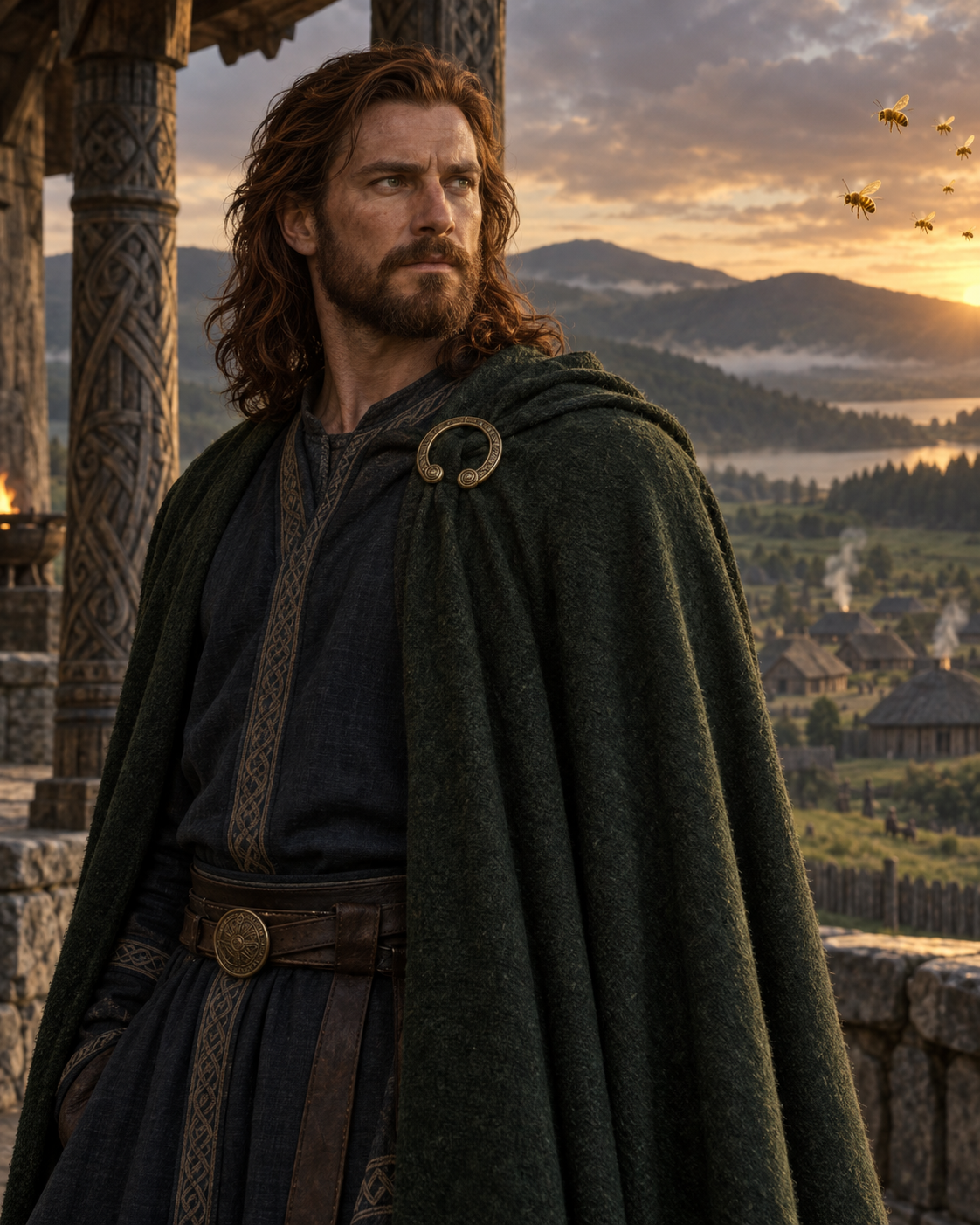
CVM’s approved legendary editorial-reconstruction identity establishes Gormhbata as a devastatingly handsome mature chieftain with a tall powerful build, weathered fair skin, moss-green eyes, shoulder-length dark-auburn hair, a close auburn beard, and deep forest-green and charcoal-blue authority layers.
That identity is disclosed as Hernystiri legendary interpretation. Canon supplies no exact age, face, skin, hair, eyes, body, clothing, jewelry, weapon, settlement, banner, family, or people.
His title should register through presence and context rather than a generic gold crown the text never gives him.
The canonical portrait shows Gormhbata alive and politically substantial. Golden bees remain a restrained omen at the frame’s edge; they do not replace character design.
Eoin needs a separate approved identity. Do not make the poet and chieftain variations of the same attractive man, and do not reuse Eoin’s hero with Gormhbata reduced to a silhouette.
Any death-scene art must remain non-graphic and visibly interpretive. No invented armor, magical shield, allergic collapse, curse markings, or final pose.
This one Gormhbata identity must power featured image, profile hero, directory card, social metadata, Eoin connections, and every story-within-story use.
Why Gormhbata Matters
He makes us notice how quickly a famous act can swallow the person it harms
Gormhbata’s evidence is tiny and exact.
He is a chieftain. Eoin directs an anger-song against him. Golden bees kill him in the legend. Towser uses the event to mock a king who cannot tolerate criticism.
That is enough for a canonical profile when the page respects its limits.
Gormhbata also tests the hub’s promise of completeness. It is easy to celebrate the poet with supernatural reputation. It takes better organization to preserve the target as a separate person whose motive, rule, and perspective remain missing rather than conveniently supplied.
The page does not claim secret innocence. It refuses automatic guilt.
On the Record
Book 1 legendary testimony, fully spoiled and status-corrected
This is Chieftain Gormhbata’s one canonical, full-spoiler character profile.
The owned Kindle edition confirms that Towser names Gormhbata as a chieftain and says the poet Eoin-ec-Cluias made an anger-song so mighty that golden bees descended and stung him to death.
Towser tells the legend in the Hayholt stable after Elias expels him for “King Hemlock.” Gormhbata’s death becomes the comparison proving that the jester’s critical song was not the same thing as a legendary lethal one.
The record does not confirm Gormhbata’s people beyond the legend’s Hernystiri classification, exact era, appearance, holding, family, rule, deeds, grievance with Eoin, awareness of the song, reaction, witnesses, burial, or whether the golden-bee mechanism occurred literally.
Status: dead within the reported legend.
The approved canonical attachment powers featured image, hero, directory card, and social metadata. The living chieftain remains the primary identity; any later bee-death scene must be non-graphic, explicitly legendary, and facially continuous.