
Memory, Sorrow, and Thorn · Canonical Character Profile
Freawaru
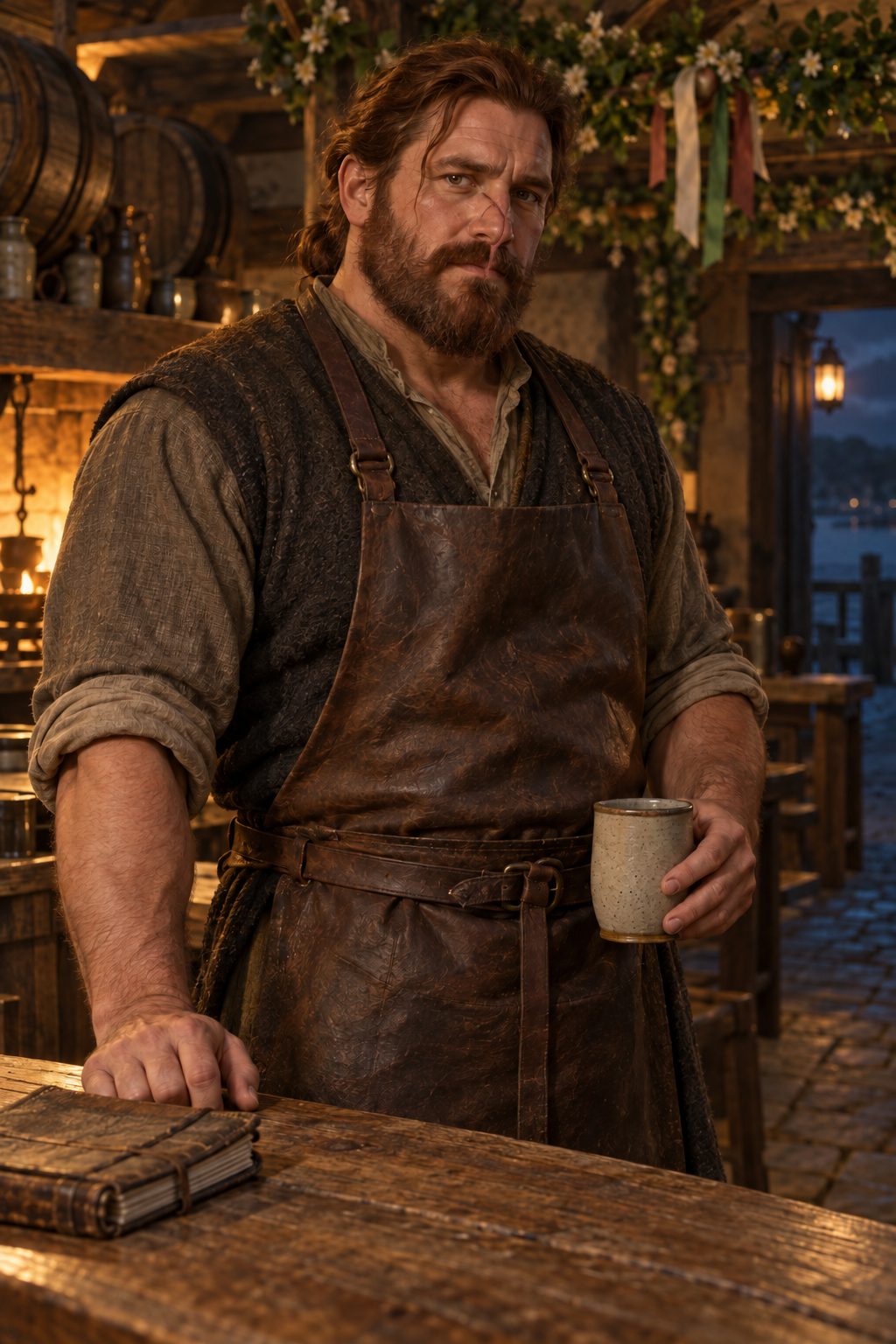
Freawaru owns the Dragon and Fisherman in the tiny village of Flett, where Cadrach eats, drinks, and tells stories on credit until Simon discovers who actually financed the meal. Barrel-chested, scarred, bearded, and strong enough to seize a desperate boy, Freawaru looks like the danger Simon feared outside. Then he says he would have hired him if Simon had simply asked. His scene is one ugly little knot of hospitality, suspicion, property, and a missed chance at ordinary help.
At a Glance
The innkeeper who offers credit, catches a suspected thief, and reveals the job Simon never requested
- Name
- Freawaru
- Occupation
- Innkeeper
- Inn
- The Dragon and Fisherman, Flett
- Appearance
- Barrel-chested and bearded
- Distinctive feature
- Deep scar across nose and upper lip
- Strength
- Bear-strong arms
- Last confirmed state
- Alive after Simon escapes into the Aldheorte
The Dragon and Fisherman
His inn is the warm doorway Simon cannot make himself enter honestly
Simon reaches Flett after escaping the Hayholt, crossing a world where ordinary people can become evidence against him without intending harm. He is hungry, filthy, frightened, and newly aware that a remembered red-haired stranger may attract royal attention.
The Dragon and Fisherman offers everything he wants: food, fire, work, and human company. Simon hides beyond the road instead because he does not know how to ask safely.
Belthainn celebrations make the distance hurt. Villagers carry a ribboned Maia-tree, sing older seasonal songs, and gather around shared custom. Simon nearly joins them. Their music opens homesickness for the scullions, chambermaids, his bed, the moat, Morgenes’s rooms, and even Rachel.
Freawaru belongs to that ordinary social world. He is not introduced as a noble, conspirator, prophet, or monster. He runs the place where local celebration, travelers, soldiers, food, drink, credit, and rumors meet.
That normality is precisely what makes him difficult for Simon. The boy is safer from obvious enemies than from the possibility that a respectable adult may ask the right question, recognize the wrong detail, or bring him to authorities.
Cadrach’s Tab
Hospitality operates through a ledger, and the friar knows how to stretch it
Outside the inn, Simon recognizes Brother Cadrach. The friar offers supper in repayment for earlier kindness, fills the meal with excellent stories, and restores some of Simon’s laughter.
Cadrach drinks on credit from Freawaru. That detail gives the innkeeper a history with his customer. This is not the first anonymous traveler to purchase one meal and disappear. Cadrach has enough standing, charm, repetition, or audacity for Freawaru to extend goods before payment.
Credit is a form of trust, but it is not limitless generosity. An innkeeper feeds people by keeping track of what is owed. Food, drink, beds, labor, and coin must eventually balance well enough for the establishment to survive.
When Cadrach’s arrangement collapses, Freawaru reacts from inside that economy. The problem is not merely that a funny monk has embarrassed him. A recurring trick has converted his hospitality into loss.
The record does not specify how much Cadrach owes, how often he has performed the trick, or whether Freawaru likes him. It confirms enough to show why the innkeeper does not greet the missing purse with detached amusement.
The Cut-Open Seagull Purse
Simon proves Cadrach stole from him and still looks like the accomplice left holding the bill
Cadrach produces a cut-open purse embroidered with a seagull. Simon recognizes it as his own, confirming that the friar stole it during their earlier meeting.
When Simon calls Cadrach a thief, Cadrach runs. Freawaru seizes the person who remains.
From Simon’s perspective, this is another betrayal. The adult who fed him used the boy’s own stolen property to finance the reunion and then abandoned him at the exact moment truth surfaced.
From Freawaru’s perspective, the scene resembles a repeated inn trick involving a customer who drinks on credit and a boy who appears connected to him. Freawaru does not have Simon’s history, the Hayholt theft, or narrator access. He has a debt, a fleeing friar, and the apparent partner still in reach.
His physicality makes the capture frightening. Freawaru is barrel-chested, bearded, scarred across nose and upper lip, and equipped with bear-strong arms. He can drag Simon where he intends to take him.
The scene does not make that force neutral. Simon is a hungry child in danger, and Freawaru’s grip blocks escape. It also does not make the innkeeper a sadist. He is trying to establish identity through people he trusts to recognize lawful trouble.
Deorhelm and Godstan
The innkeeper’s solution is identification, not private punishment
Freawaru drags Simon toward an adjoining cottage where Deorhelm and Godstan are lodging. The men are Erkynguard and expect to take the road at cockcrow.
Bringing Simon to them escalates the danger enormously. Royal soldiers may connect him to the Hayholt, Josua, or the search following Morgenes’s death. Simon cannot risk being identified even if he could persuade Freawaru that Cadrach acted alone.
Yet Freawaru’s chosen action has a recognizable civic logic. He does not announce that he will beat, rob, or hang Simon. He takes the suspected accomplice to known members of the king’s guard for identification.
The problem is that lawful process no longer feels safe from Simon’s position. He has just passed a hanged poacher whose broken sign declares the king’s ownership. Rescue, hunger, theft, and treason now occupy different points on the same system of punishment.
Freawaru therefore becomes dangerous without becoming personally monstrous. He connects a local property dispute to royal enforcement because that is what an ordinary innkeeper is supposed to do. Simon knows the state behind that enforcement may kill him.
“If You Had Asked”
The most painful offer in Flett arrives after trust has already collapsed
Freawaru tells Simon that he would have hired him if the boy had simply asked.
The statement transforms the earlier hiding place. Simon wanted ordinary work and food but could not bring himself to request either. The possibility was real. He may have been able to enter the village through labor rather than deception.
Freawaru’s offer is not pure rescue. It comes while he is physically detaining Simon and preparing to expose him to Erkynguard. The job that might have helped before the theft cannot now cancel suspicion.
Still, the line refuses Simon the comfort of believing every stranger would automatically reject him. His caution is necessary, but it also closes doors. Trauma does not produce flawless judgment; it teaches survival through overcorrection as well as insight.
For Freawaru, the remark reveals a labor need and a moral distinction. Asking for work would have been acceptable. Participating in a trick is not. He frames hunger as a problem that could enter the inn’s economy honestly.
The novel does not prove whether he would have paid fairly, offered a bed, or protected Simon from questions. It gives one unrealized possibility, not an alternate happy ending.
The Head-Butt
Simon turns Freawaru’s scarred face into the route back to the forest
Simon head-butts Freawaru and escapes into the Aldheorte. The maneuver is desperate rather than elegant. It uses surprise against a much stronger man.
The escape leaves Freawaru injured or shocked enough to lose his hold, though the record does not specify lasting damage. Simon then spends a cold, miserable night in the forest.
The outcome shows why “he could have just asked” cannot function as a simple moral. By the time Freawaru says it, Simon has seen Cadrach flee, feels a bear-strong grip, and knows royal guards wait in the next building. Flight is rational.
Both men act from partial information. Freawaru sees suspected fraud. Simon sees a chain leading back to Elias and Pryrates. The scene produces violence without requiring either participant to be the chapter’s central villain.
Connections
The thief, fugitive, and guards around Freawaru’s interrupted Belthainn
Simon
Hungry fugitive whom Freawaru might have hired, then captures as Cadrach’s suspected accomplice.
Cadrach
Drinks on Freawaru’s credit, uses Simon’s stolen purse, and runs when confronted.
Deorhelm
Erkynguard soldier known to Freawaru and intended to help identify Simon.
Godstan
Deorhelm’s traveling companion, lodging nearby before an early departure.
The people of Flett
Celebrate Belthainn around the inn while Simon watches ordinary belonging from the edge.
Why Freawaru Matters
He proves that ordinary help and ordinary danger can occupy the same pair of arms
Freawaru has one concentrated scene, but it catches the moral weather of Simon’s journey. The boy wants work, warmth, food, and community. The innkeeper might genuinely have supplied some of them.
The same innkeeper extends credit to Cadrach, interprets the failed payment as a recurring trick, seizes Simon, and turns toward royal identification. Hospitality and enforcement share one local institution.
That ambiguity keeps Flett from becoming a simple lesson about trusting strangers or avoiding them. Simon’s fear costs him a possible job. His fear also correctly recognizes that being brought before Erkynguard is intolerably dangerous.
Freawaru matters because he is neither secret savior nor roadside brute. He is a working adult protecting an inn, making a plausible mistake, and revealing how difficult honesty becomes when legitimate authority has become lethal to the person being asked to explain himself.
On the Record
Book 1 only, one dense encounter, and no invented innkeeper biography
This is Freawaru’s one canonical full-spoiler profile. His ownership of the Dragon and Fisherman, extension of credit to Cadrach, capture of Simon, job remark, attempted identification through Deorhelm and Godstan, and Simon’s escape all occur in Book 1. No direct Freawaru receipt appears in Books 2–4.
The record confirms that Freawaru is barrel-chested, bearded, scarred deeply across nose and upper lip, strong in the arms, willing to extend Cadrach credit, familiar with a recurring trick, prepared to hire a boy who asks, and connected to two lodging Erkynguard. It does not confirm his exact age, hair or eye color, family, ownership history, politics, military past, origin of the scar, wages, later reaction, or fate.
Visual state: approved editorial reconstruction. CVM depicts Freawaru as a devastatingly handsome rugged adult innkeeper around forty-one with a massive barrel chest, bear-strong arms, hazel eyes, thick dark-auburn hair and beard, and one deep healed scar crossing the nose and continuing through the upper lip/mustache line. His rolled working layers, leather apron, low stoneware cup, credit ledger, and Belthainn greenery preserve the Dragon and Fisherman’s grounded village scale without modern tavern cosplay or weapon invention. Any scene with Simon or Cadrach must preserve all approved identities. The same canonical attachment powers featured image, hero, directory card, and social metadata.