
Memory, Sorrow, and Thorn · Canonical Character Profile
Fiathna
Fiathna is King Lluth’s second recorded wife and Prince Gwythinn’s mother, a woman preserved almost entirely through the order in which other women occupied the queen’s place at Hernysadharc. Her biography is spare. Her position inside the royal family is not: she stands between Penemhwye, Maegwin’s mother, and young Queen Inahwen.
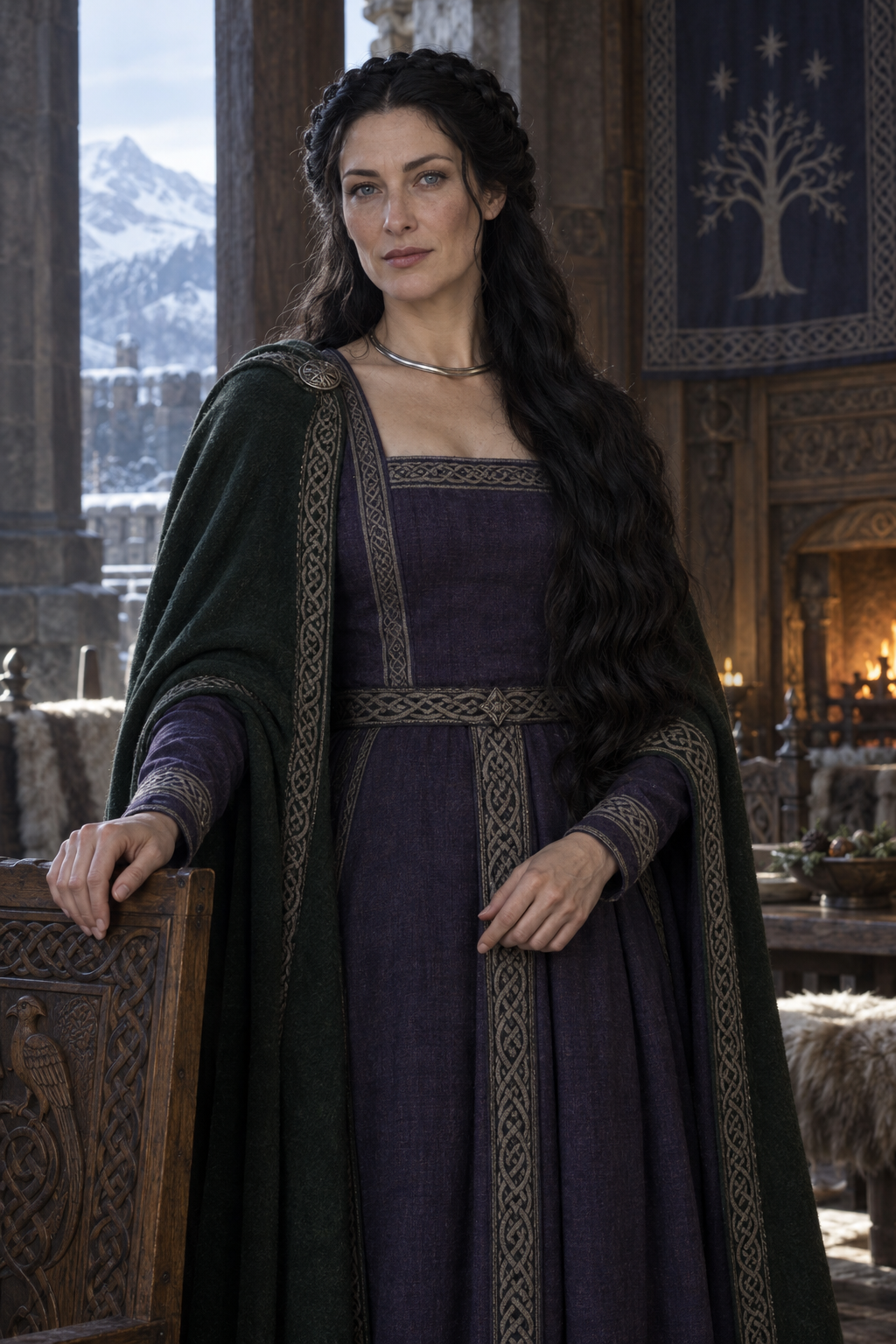
At a Glance
The second queen whose place in the family survives more clearly than her life story
- Name
- Fiathna
- Position
- King Lluth ubh-Llythinn’s second recorded wife
- Child
- Prince Gwythinn, Lluth’s son and heir
- Predecessor
- Penemhwye, Maegwin’s mother
- Successor
- Inahwen, Lluth’s third wife and current queen in Book 1
- Appearance
- Not described
- Status
- No longer current queen by Book 1; death or other outcome unconfirmed
- Evidence boundary
- No origin, personality, marriage date, relationship dynamics, cause of absence, or direct scene
Three Wives, One Royal Household
Fiathna’s confirmed biography is a place in sequence—and sequence carries political weight
Book 1 establishes a three-wife chronology around King Lluth.
Penemhwye is Maegwin’s mother and dies when Maegwin is four. Fiathna takes Penemhwye’s place and becomes the mother of Gwythinn. Inahwen is Lluth’s third wife and the queen present during the crisis at Hernysadharc.
That sequence is the firm spine of Fiathna’s profile.
It does not tell us when Lluth married her, how long the marriage lasted, whether she served publicly as queen, or why she is absent by the time Inahwen occupies the place.
“Second wife” and “third wife” establish marital order. They do not automatically establish widowhood after each transition. Fiathna may have died, but the reading record does not confirm death.
The honest status is therefore no longer the current wife or queen by Book 1, with final fate unconfirmed.
This may feel less tidy than a family tree demanding birth and death dates. It is more faithful. Dynastic archives often preserve women first as relational bridges—wife, mother, predecessor—while omitting the life between those labels.
Mother of the Heir
Gwythinn is Fiathna’s clearest surviving connection and the reason her place matters dynastically
Fiathna is Prince Gwythinn’s mother.
Gwythinn is Lluth’s younger child and male heir, five years younger than his half-sister Maegwin. By Book 1 he is a tall, handsome young warrior with sorrel-brown hair, a long mustache, a gold neck torque, and an impulsive political temper.
Those are Gwythinn’s facts, not Fiathna’s.
A future portrait may make mother and son plausibly related, but it cannot simply assign her his hair, height, coloring, facial structure, courage, anger, or cultural styling as though heredity were a receipt.
Fiathna’s maternity places her inside the succession. She is the woman through whom Lluth’s heir enters the household after Maegwin.
The text does not state that Lluth married Fiathna specifically to produce a son, that Maegwin’s sex caused the second marriage, or that Fiathna wielded power as the heir’s mother. Those are plausible dynastic patterns, not confirmed motives.
Nor does the record give a mother-son scene. We do not know whether Fiathna raised Gwythinn, died or departed while he was young, advised him, disciplined him, or shaped his view of Hernystir.
Her connection should remain emotionally important without manufacturing intimacy the novels never narrate.
Maegwin’s Family Memory
Fiathna enters through a daughter mapping the women who came after her own mother
The household chronology belongs to Maegwin’s perspective.
Maegwin remembers losing Penemhwye at four and never fully adjusts to the succession of women in the queen’s place. By the time of Book 1, Inahwen is only one year younger than Maegwin, making “stepmother” feel almost absurdly close to “peer.”
Fiathna stands between the remembered dead mother and the current young queen.
The record does not preserve Maegwin’s feelings about Fiathna with the clarity it gives her discomfort around Inahwen. We should not invent resentment, affection, rivalry, neglect, or maternal substitution.
Calling Fiathna someone who “took Penemhwye’s place” describes household sequence. It does not mean she replaced Penemhwye inside Maegwin’s emotions.
Her son Gwythinn becomes Maegwin’s beloved half-brother. That bond proves the siblings’ importance to each other, not a harmonious relationship between Maegwin and Fiathna.
The family structure matters because Maegwin’s later isolation grows inside repeated loss: mother, father, brother, realm, and her own confidence in what she perceives. Fiathna belongs to the earlier household history but cannot be made responsible for the tragedy that follows.
Before Inahwen
The current queen reveals what Fiathna’s label cannot tell us
Inahwen is Lluth’s third wife, golden-haired, good-hearted, lithe, and visibly frightened by the political pressure arriving with Guthwulf.
Her direct presence makes Fiathna’s absence sharper.
Inahwen monitors Lluth’s meals and participates in the domestic life of the Taig. Later she keeps vigil near the gravely wounded king. The narrative allows readers to watch her inhabit the queen’s place.
Fiathna receives no comparable scene. That does not mean she was less kind, less politically aware, less frightened, less capable, or less loved.
It means her life falls outside the present-tense window.
The two women should not be visually or editorially collapsed. A “generic Hernystiri queen” portrait reused between them would erase exactly the distinction canonical coverage is meant to preserve.
Future art must give Fiathna her own face and styling while remaining honest that the choices are interpretive.
The Archive’s Silence
Unknown is not an invitation to kill her for database convenience
Fiathna is no longer Lluth’s current wife by the time Inahwen is identified as his third.
The reason is not stated in the verified reading record.
A conventional genealogy might mark Fiathna “deceased” because remarriage in this setting often follows death. That would be an inference, not a fact.
Other possibilities—annulment, separation, repudiation, political displacement, religious withdrawal, disappearance, or exile—are also unsupported.
The correct status language must preserve both halves: her former marital position is confirmed; the cause and final condition are not.
This distinction affects filters, cards, prose, and future art. A Book 1 directory card should not display “Dead” merely because readers expect a second wife to have died before the third arrived.
It also affects scene illustration. Do not generate a deathbed, funeral, divorce, convent, exile, or ghost sequence for Fiathna without a textual receipt.
The profile earns trust by resisting closure.
Hernystir’s Women in the Dynastic Record
Names survive through marriage and maternity while governance happens around them
Fiathna’s thin record sits inside a larger pattern.
Penemhwye survives as Maegwin’s dead mother. Fiathna survives as Gwythinn’s mother. Inahwen appears directly as the young third wife caring for Lluth. Maegwin carries royal responsibility while doubting whether Eolair sees a woman or a title.
The series does not make these women interchangeable, but dynastic language repeatedly organizes them through proximity to king and heir.
A fandom hub can improve on a bare family-tree cell by keeping each canonical identity separate and showing what is known, what is inferred, and what has been lost.
For Fiathna, the most important editorial act is not expansion through fiction. It is refusing to let “second wife” be mistaken for a complete human description.
She had a life large enough to enter a royal marriage and become mother to Hernystir’s heir. The narration does not give us access to its texture.
That absence deserves a label, not a hallucination.
Connections
The husband, son, stepdaughter, predecessor, and successor that locate Fiathna
King Lluth ubh-Llythinn
Fiathna’s husband and the Hernystiri king whose three recorded marriages establish the household sequence.
Prince Gwythinn
Fiathna’s son, Lluth’s heir, and Maegwin’s beloved younger half-brother.
Princess Maegwin
Lluth’s elder daughter by Penemhwye and Gwythinn’s half-sister; no specific relationship with Fiathna is described.
Penemhwye
Lluth’s first recorded wife and Maegwin’s mother, whose place Fiathna takes after Penemhwye’s death.
Queen Inahwen
Lluth’s third wife and the current queen in Book 1; her position confirms Fiathna is no longer current.
Hernystir
The kingdom whose succession makes Fiathna’s motherhood politically consequential even when her biography remains sparse.
Why Fiathna Matters
Because complete coverage means preserving the women history reduces to transitions
Fiathna matters first because she is Gwythinn’s mother and a former wife of Lluth.
She also matters as a test of editorial discipline.
A weak archive omits her because she has no direct scene. A careless archive fills the silence with a death date, temperament, romance, or political scheme. A strong fandom profile does neither.
It shows how her marriage connects Maegwin’s childhood loss, Gwythinn’s place in the succession, and Inahwen’s uneasy present. It distinguishes each woman. It identifies the unknowns.
Fiathna’s profile is therefore less a conventional adventure biography than an organized record of dynastic placement and archival absence.
That is not “less than” a fandom wiki entry. It is more useful because readers can see exactly which facts the book provides and which popular assumptions remain unproven.
Character Image Continuity
A distinct adult Hernystiri woman, not a face borrowed from her son or neighboring queens
CVM’s approved editorial reconstruction gives Fiathna one breathtakingly beautiful adult identity during her lifetime, without using later absence to invent death, exile, repudiation, or tragedy.
The approved design presents her at the Taig around age thirty-five with a tall graceful strong build, slate-blue eyes, warm ivory lightly freckled skin, and abundant raven-black hair in a braided crown and heavy wave. Deep-heather purple, storm blue, dark green, muted silver, woven borders, and a simple neck torque establish royal Hernystiri presence. Every one of those exact visual choices remains disclosed rather than claimed as canon.
She remains visually distinct from Penemhwye, Inahwen, and Maegwin. A subtle strong-jaw family resemblance makes relation to Gwythinn plausible without duplicating his face or automatically assigning his described coloring.
Do not illustrate death, illness, exile, repudiation, or a specific wedding. Do not use a family-tree graphic as her featured identity.
Preserve this exact face, adult body, coloring, hair map, wardrobe, and calm royal authority across the directory card, hero, Lluth household imagery, Gwythinn context, Maegwin family-history sections, and any later visual callback.
On the Record
One Book 1 historical reference, precise family placement, unresolved fate
This is Fiathna’s one canonical, full-spoiler character profile. Her confirmed material appears in The Dragonbone Chair through the Hernysadharc household chronology.
The record confirms her name, her position as King Lluth’s second recorded wife, her placement after Penemhwye, and her maternity of Prince Gwythinn. It also confirms that Inahwen is Lluth’s third wife and current queen during the Book 1 action.
The record does not confirm Fiathna’s appearance, age, origin, parents, marriage date, title usage, personality, relationship with Lluth, relationship with Maegwin, manner of raising Gwythinn, politics, religious practice, cause of leaving the queen’s place, death, or final fate.
Status: no longer current queen by Book 1; whether dead or alive is unconfirmed.
Visual state: approved editorial reconstruction. One distinct living adult identity is now established, with the same canonical attachment powering featured image, hero, directory card, Open Graph image, and social preview. Her disappearance from the queen’s place and final fate remain unresolved in both prose and imagery.