
Memory, Sorrow, and Thorn · Canonical Character Profile
Father Helfcene
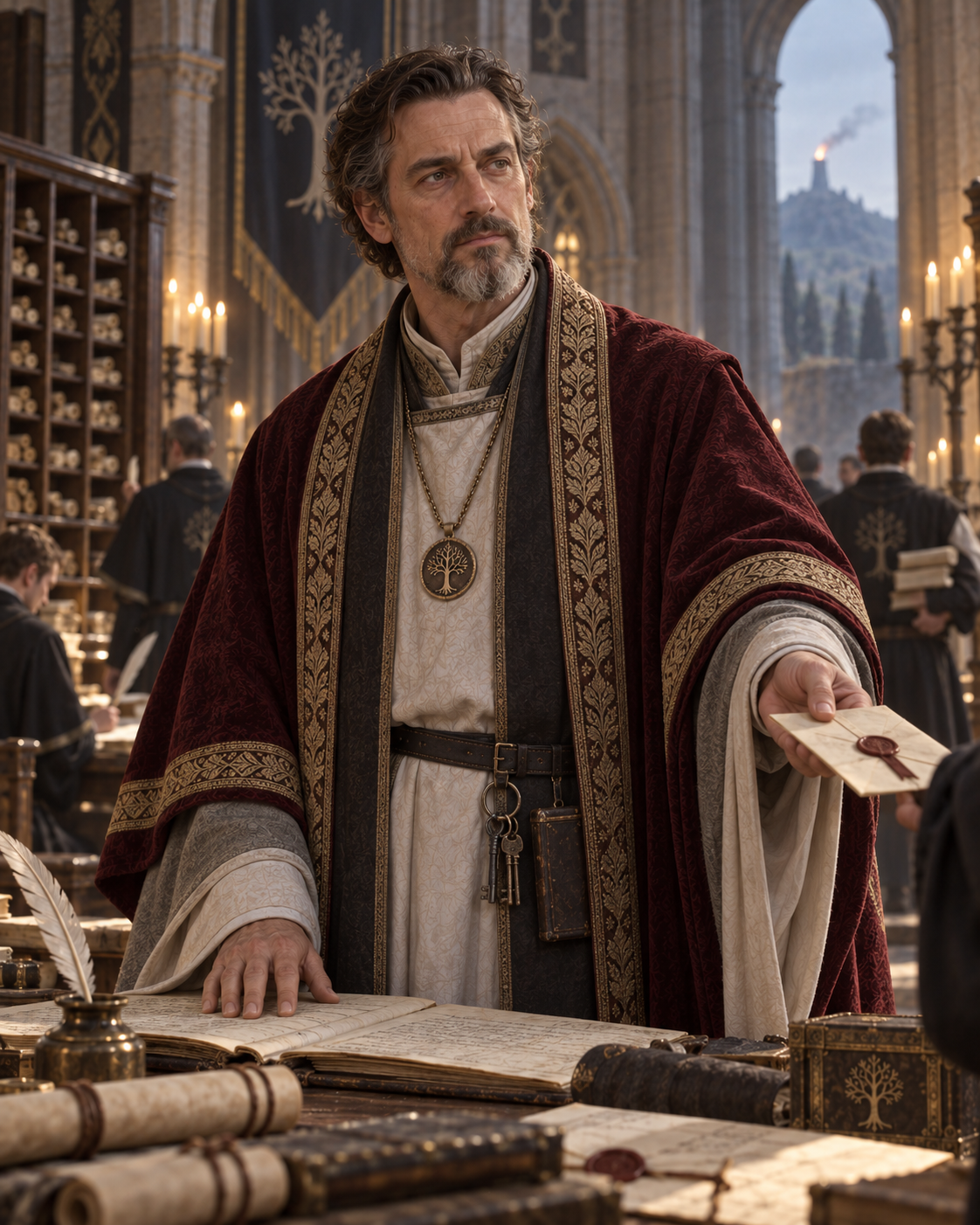
Father Helfcene is King John’s chancellor and the senior Chancelry priest who turns royal death into coordinated public ritual: messengers, records, the Hayefur beacon, and a grave cut into frozen Swertclif. Under Elias, that administrator becomes a warning. In Book 2, Helfcene’s body is one of nine hanging above Nearulagh Gate. The man who ordered the kingdom’s mourning is displayed by the next king as an instrument of fear.
At a Glance
The chancellor who organizes one king’s burial and becomes another king’s public corpse
- Name
- Helfcene
- Title
- Father
- Office
- King John’s chancellor and senior Chancelry priest
- Administrative role
- Directs messengers, priests, and writing activity during John’s decline
- Funeral orders
- Kindles the Hayefur and prepares John’s Swertclif burial site
- Book 1 status
- Alive through John’s funeral arrangements
- Book 2 discovery
- One of nine bodies hanging above Nearulagh Gate
- Final status
- Dead; execution circumstances unrecorded
Crisis in the Chancelry
Helfcene’s authority appears through people and paper already moving at his direction
As King John’s condition worsens, the northeastern Hayholt becomes visibly administrative.
Father Helfcene’s shocked messengers and distracted Chancelry priests carry papers between chambers and toward the Hall of Records.
The record does not show Helfcene issuing each instruction directly. It identifies the messengers through him and establishes the larger machinery under his office.
This is religious administration beyond bedside prayer. A dying king produces legal, ceremonial, archival, diplomatic, and practical consequences. Information must be copied, sent, stored, and acted upon.
Helfcene is John’s chancellor, giving him responsibility at the intersection of crown and Church. He does not merely interpret death spiritually; he helps convert it into coordinated state action.
The workers’ shock matters. Institutional motion is being performed by people who understand that a reign is ending even before public ritual stabilizes the event.
The profile cannot assign Helfcene private grief, political faction, or opinion of Elias from these papers. It can confirm that his office remains active under pressure.
Forty Days Between Death and Earth
Helfcene helps transform John from inaccessible body into public history
John dies on Saint Tunath’s Day, exactly eighty years after the date on which he killed Shurakai and drove the dragon through Erchester’s gates.
Custom requires forty days before a king’s burial.
In the Hall of Preparing, priests bathe the body in rare oils, apply southern-island herbal resins, wrap it in white linen with prayers, dress it in a simple first-vow knight’s gown, and place it on a throne-room bier among black candles.
The ledger does not identify Helfcene performing each bodily rite. His confirmed role lies in directing the larger preparations and issuing the major geographical orders.
Once dead, John begins to belong to history-scribes, poets, and priests. Helfcene is one of the institutional figures managing that conversion.
The process balances intimacy and state theater. A human body is washed and preserved; an eighty-year reign is narrated through anniversary, beacon, procession, burial landscape, and visiting powers.
Helfcene’s office helps ensure that grief becomes legible across the kingdom rather than remaining inside the royal chamber.
Light the Hayefur
Helfcene makes royal death visible from Wentmouth
Helfcene orders the Hayefur kindled on the rock fortress at Wentmouth.
The great beacon is reserved for war and great happiness. John’s death occupies the charged space between those categories: a kingdom-shaping event requiring the same monumental signal.
Mourners see its distant glow for the last time.
The order turns private knowledge into landscape. People who cannot enter the Hayholt or hear a proclamation can see fire against distance and understand that something immense has happened.
The ledger does not establish who physically lights the beacon, what fuel it uses, how long it burns, or the complete signaling network.
Helfcene’s action is command. He activates an existing piece of royal infrastructure and gives the realm a shared visual marker for the end of John’s life.
Cut the Grave at Swertclif
The chancellor chooses frozen ground already crowded with kings
Helfcene orders a burial pit prepared at Swertclif, the windy headland east of Erchester overlooking Kynslagh.
Six snow-covered royal barrows already stand there.
Frozen ground delays the excavation through much of Jonever. A red-and-white sailcloth tent eventually covers the site.
The order must contend with material resistance. Royal authority can choose the landscape but cannot command frozen earth to open quickly.
John is later buried within Sea-Arrow, his beloved small boat from the Westerling islands. The funeral connects conquest, island origin, kingship, and remembered seafaring.
Helfcene’s preparation creates the physical destination for the long public procession and the final placement of the king among predecessors.
The record does not say he designs the grave, supervises every worker, attends the final burial, or chooses Sea-Arrow. His confirmed contribution is the burial-site order.
From John’s Chancellor to Elias’s Target
The later regime turns senior household continuity into something punishable
Helfcene’s Book 1 work is defined by continuity. He organizes rites that place John within inherited monarchy and preserve orderly succession.
Book 2 reveals that continuity has failed violently.
Rachel sees nine additional bodies hanging above Nearulagh Gate, including Chancellor Helfcene.
The record confirms the body and death. It does not provide arrest, accusation, trial, executioner, date, resistance activity, last words, or the exact reason Elias’s regime selects him.
His office alone makes the display politically legible. A king’s chancellor possesses institutional memory, administrative relationships, and visible connection to the previous reign.
We may infer that public hanging functions as repression and warning. We cannot claim a specific charge without text.
Above Nearulagh Gate
The place carved with royal victory becomes a frame for royal terror
Nearulagh Gate bears chalcedony reliefs of John’s victory over Imperator Ardrivis, the conquest that brought Nabban under the royal hand.
In Book 1, Simon passes beneath that history on his way to market.
Under Elias, bodies hang above the same gate. Helfcene is one of them.
The juxtaposition is brutal. Monumental art celebrates the founding violence that legitimized John. Fresh corpses demonstrate the violence Elias uses to secure obedience.
Helfcene’s body is not merely disposed of. It is elevated into public instruction where residents, workers, and travelers must see it.
The page should not make the corpse the hero image. His canonical identity belongs to the living administrator who coordinated mourning. Secondary historical art may show the gate at respectful distance without graphic spectacle.
His death completes an institutional reversal: the man who made John’s passing publicly visible is made publicly visible by Elias after death.
Connections
The dead king, successor regime, household witness, and institutions around Helfcene
King John
The ruler Helfcene serves as chancellor and whose funeral geography he helps organize.
King Elias
The successor under whose repressive rule Helfcene is killed and publicly displayed.
Rachel
The Hayholt household leader through whose Book 2 perspective Helfcene’s hanging body is confirmed.
Bishop Domitis
The church authority who declares John dead while Helfcene’s administration manages the aftermath.
The Chancelry priests
The distracted religious administrators moving papers through Helfcene’s crisis apparatus.
Wentmouth and Swertclif
The beacon and burial landscapes activated by Helfcene’s funeral orders.
Why Father Helfcene Matters
His arc turns administration into a measure of regime change
Helfcene matters because kingdoms do not mourn or govern themselves. Someone organizes messages, records, signals, sites, and labor.
His Book 1 authority shows the Hayholt’s institutional depth beneath royal personalities.
His Book 2 death shows Elias’s rule attacking that depth. Repression is not only violence against rivals in battle; it is the removal and display of people who carry the previous order’s memory.
The arc is concise and devastating: Helfcene coordinates the proper treatment of one dead king, then receives no recorded rite of his own—only public suspension above a gate.
On the Record
Books 1–2, death confirmed, execution details still unknown
This is Father Helfcene’s one canonical full-spoiler profile. His Chancelry and funeral work occurs in Book 1. His hanging body is confirmed in Book 2. No later direct receipt appears in Books 3–4.
The record confirms his titles as Father, John’s chancellor, and senior Chancelry priest; his administrative messengers and priests; his orders to kindle the Hayefur and prepare Swertclif; and his death and public display among nine bodies above Nearulagh Gate.
It does not confirm exact age, face, hair, eyes, body, vestments, family, education, private politics, arrest, charge, trial, executioner, exact death date, last words, body recovery, funeral, or burial. The approved age, build, face, coloring, hair, beard, clothing, keys, tablet case, records table, messenger, hall, banners, beacon view, and light are editorial reconstruction.
This living Chancelry portrait is the canonical hero/card/social identity. Preserve one face and body across funeral and restrained gate-context imagery; never use the hanging as hero art, invent execution details, or turn Helfcene’s death into decorative gore.