
Memory, Sorrow, and Thorn · Canonical Character Profile
Father Dreosan
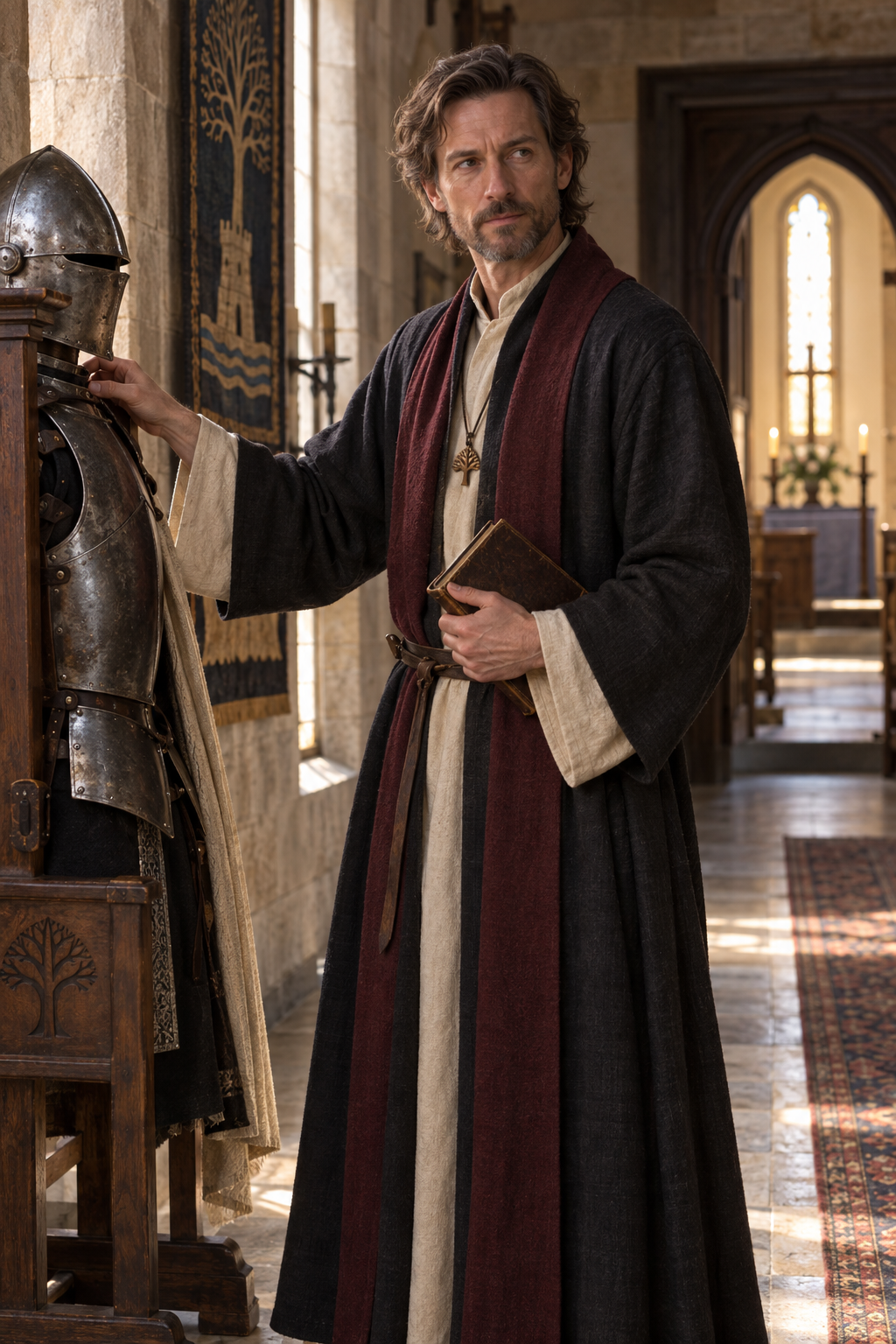
Father Dreosan is the skinny Hayholt chaplain whose walking-hall Simon barrels through, whose armor Simon knocks down, and whose revenge the boy immediately expects. He is also the preacher whose fire-and-demon imagery remains vivid enough to color Simon’s view of King John’s funeral feast. Dreosan never receives a grand political scene. He receives something more domestic: the power to make a castle boy treat an entire corridor as dangerous territory.
At a Glance
The chaplain Simon remembers through obstacles, appetite, singing, sermons, and anticipated revenge
- Canonical name
- Father Dreosan
- Position
- Hayholt chaplain
- Appearance
- Skinny; no other direct physical description
- Territory
- Walking-hall and chapel routes within the Hayholt
- Domestic impression
- Associated in Simon’s mind with eating and singing after morning prayers
- Teaching trace
- Fire-and-demon sermon imagery remembered during John’s funeral feast
- Simon incident
- His displayed armor is knocked down during Simon’s hurried passage
- Status
- Alive in his recorded Book 1 material; later fate unconfirmed
The Walking-Hall Collision
We meet Dreosan first through the property Simon has just sent clattering
Simon crosses Father Dreosan’s walking-hall on his way toward Morgenes. The route is not neutral space. It belongs to a recognizable adult whose possessions and temper Simon already knows well enough to fear.
In his hurry, Simon knocks down Dreosan’s armor.
The record does not specify whether this is ceremonial armor, ancestral armor, the chaplain’s former military equipment, or merely armor displayed in the hall. It does not inventory the pieces, describe damage, or show Dreosan witnessing the collapse.
Simon expects Dreosan to be vengeful. That expectation establishes the chaplain’s reputation in the boy’s mind, but it does not prove a later punishment occurs. A careful profile must keep anticipated vengeance separate from an enacted one.
The scene works because Simon’s world is full of objects that belong to other people. His curiosity and speed repeatedly convert those objects into consequences. Armor is not scenery when someone is responsible for keeping it standing.
Dreosan’s skinny build creates a visual contrast with the armor, but the text does not interpret that contrast for us. It would be lazy to invent a secret warrior past or to make the display a joke about a thin priest trying to look martial.
What is confirmed is smaller and sharper: the walking-hall is his sphere, the armor matters enough for Simon to panic, and Dreosan’s probable response shapes the emotional speed of the scene even while he remains offstage.
The Chapel Route
Dreosan’s presence turns sacred architecture into a stealth problem for Simon
Later, Simon carries nestlings across the Inner Bailey and chooses the chapel as shelter from the cold wind. Morning prayers are finished.
He hopes Father Dreosan may be eating and singing, leaving the route apparently empty. The pairing is wonderfully ordinary. Dreosan exists in Simon’s memory not only as a threatening authority but as a man with appetite, voice, and habits predictable enough to plan around.
The chapel’s choir loft holds nutshells, apple cores, wooden stools, and scraps bearing monks’ private written messages. Simon compares the disorder to a cage for apes or festival bears.
This is Dreosan’s religious workplace: sacred, administrative, social, and untidy at once. Nothing in the record says the debris belongs specifically to him, and the profile should not assign every apple core to the chaplain simply because Simon imagines him eating.
When voices enter below, Simon fears discovery by either Dreosan or Barnabas, the chapel sexton. He hides inside a wall hanging and accidentally overhears Josua warning Elias about Pryrates.
Dreosan does not enter that conversation. His possible arrival supplies the pressure that keeps Simon concealed while royal family anxiety becomes political evidence.
The distinction between chaplain and sexton should remain clear. Dreosan holds the named religious office. Barnabas belongs to the practical material policing of chapel and tower routes. Simon experiences both as adults capable of ending his unauthorized adventure.
Dreosan again changes the scene without direct action. His known authority defines concealment as necessary, and concealment allows Simon to become an accidental witness.
The Ordinary Stair
Even absent, Dreosan helps determine how Simon moves through Green Angel Tower
After climbing Green Angel Tower, Simon’s injured knee stiffens. The secret leap route he used on the way up is no longer safe, so he accepts the ordinary internal stair.
That choice carries the risk of encountering Barnabas or Father Dreosan.
The repeated association shows that Dreosan is not a one-joke owner of fallen armor. He belongs to Simon’s durable map of supervised territory around the chapel, Chancelry, and tower access.
The ordinary stair leads Simon toward the hidden youth who calls himself Malachias. Once again, Dreosan neither creates nor witnesses the revelation. Institutional boundaries and Simon’s attempts to evade them help channel him toward it.
Minor characters often disappear from plot summaries because they do not possess secret swords or decide battles. Dreosan demonstrates another kind of narrative function: he makes architecture social. A hall has an owner. A route has watchers. A child’s movement contains knowledge of who will object.
Fire and Demons at the Feast
Dreosan’s preaching survives in Simon as a language for excess
After King John’s burial, the Great Hall hosts a deliberately merry funeral feast. Simon carries heavy wine ewers through smoke, noise, straw, bones, crumbs, scraps, laughter, and barking caged hounds.
He interprets the spectacle through remembered fire-and-demon imagery from Father Dreosan’s sermons.
The ledger does not reproduce a full Dreosan sermon. It does not confirm the exact doctrine, scripture, occasion, audience response, or whether Simon listened attentively at the time.
It confirms retention. Dreosan has supplied Simon with images vivid enough to reactivate when the hall becomes hot, chaotic, and morally unsettling.
The comparison does not make the feast literally infernal. It tells us how a castle child uses religious rhetoric as sensory vocabulary. Fire, demons, smoke, appetite, and disorder give shape to a political celebration occurring one night before Elias takes the crown.
Dreosan therefore participates indirectly in Simon’s education. Morgenes teaches reading, history, skepticism, and disciplined curiosity. Rachel teaches responsibility through labor. Dreosan’s sermons lodge a moral-imaginative lexicon in the boy, whether or not Simon would describe himself as a diligent pupil.
That surviving image is the strongest evidence of Dreosan’s professional effectiveness. Simon may avoid the chaplain in hallways, but he cannot fully avoid carrying the chaplain’s language.
Connections
The boy, sexton, doctor, and royal household within Dreosan’s small recorded orbit
Simon
Knocks down Dreosan’s armor, fears his response, avoids his routes, and remembers his sermons.
Barnabas
The chapel sexton paired with Dreosan in Simon’s calculations about discovery and tower access.
Doctor Morgenes
Simon is hurrying toward Morgenes when he disrupts Dreosan’s walking-hall.
Rachel
Sets Simon’s responsibilities and routes through the same working Hayholt Dreosan inhabits.
Prince Josua
Speaks to Elias beneath the loft where Simon hides partly to avoid Dreosan.
King Elias
His funeral-feast table becomes the spectacle Simon reads through Dreosan’s sermon imagery.
Why Father Dreosan Matters
He makes religion part of the Hayholt’s daily texture before it becomes a continental crisis
The trilogy contains immense religious institutions, relics, doctrinal claims, church politics, martyrs, and supernatural questions. Dreosan anchors that scale in ordinary childhood experience.
For Simon, religion is also a skinny chaplain’s hallway, an adult who might catch him, a post-prayer meal, a singing voice, and memorable pictures of fire and demons.
That ordinariness matters. Institutions become powerful not only through lectors and councils but through repeated local habits: where children may walk, what they hear in sermons, and which authority figures remain in memory.
Dreosan also helps preserve the Hayholt as a lived workplace. The castle contains royal plots, but it also contains displayed armor that can fall and someone who will care that it did.
His profile should not pretend he secretly governs Simon’s spiritual development. It should recognize the evidence actually present: Dreosan’s authority changes Simon’s movements, and Dreosan’s words change the images available to Simon’s mind.
On the Record
Father, not Brother; Book 1 only; biography kept inside the evidence
This is Father Dreosan’s one canonical full-spoiler profile. All direct and remembered Dreosan material occurs in Book 1. No additional direct receipt appears in the completed Books 2–4 ledger.
The reading record consistently calls him Father Dreosan and identifies him as the Hayholt chaplain. The earlier empty draft title “Brother Dreosan” was unsupported and has been corrected in the canonical title, slug, registry name, and metadata.
The record confirms his skinny build, walking-hall, displayed armor knocked down by Simon, Simon’s expectation of vengeance, association with eating and singing after morning prayers, authority around chapel and tower routes, and sermon imagery remembered during John’s funeral feast.
It does not confirm exact age, face, hair, eyes, height, vestments, armor history, family, birthplace, education, politics, private theology, later response to Pryrates, actions during the Hayholt crisis, or final fate.
Visual state: approved editorial reconstruction. CVM depicts Father Dreosan as a strikingly handsome skinny adult chaplain with a long intelligent face, warm-brown eyes, collar-length dark-chestnut hair lightly threaded with gray, and a neat short beard. His charcoal, burgundy, and aged-cream working robes, prayer book, plain Tree pendant, and proximity to the upright armor establish grounded authority rather than generic fantasy-bishop grandeur. Preserve this exact face, body, age, coloring, hair/beard map, robe logic, and working presence across walking-hall, chapel, sermon, and contextual imagery. The same canonical attachment powers featured image, hero, directory card, and social metadata.