
Fairy Tail Episode 39 React: A Prayer Under the Holy Light
Etherion completes Jellal's machine, but Natsu refuses to let Erza become its final material.
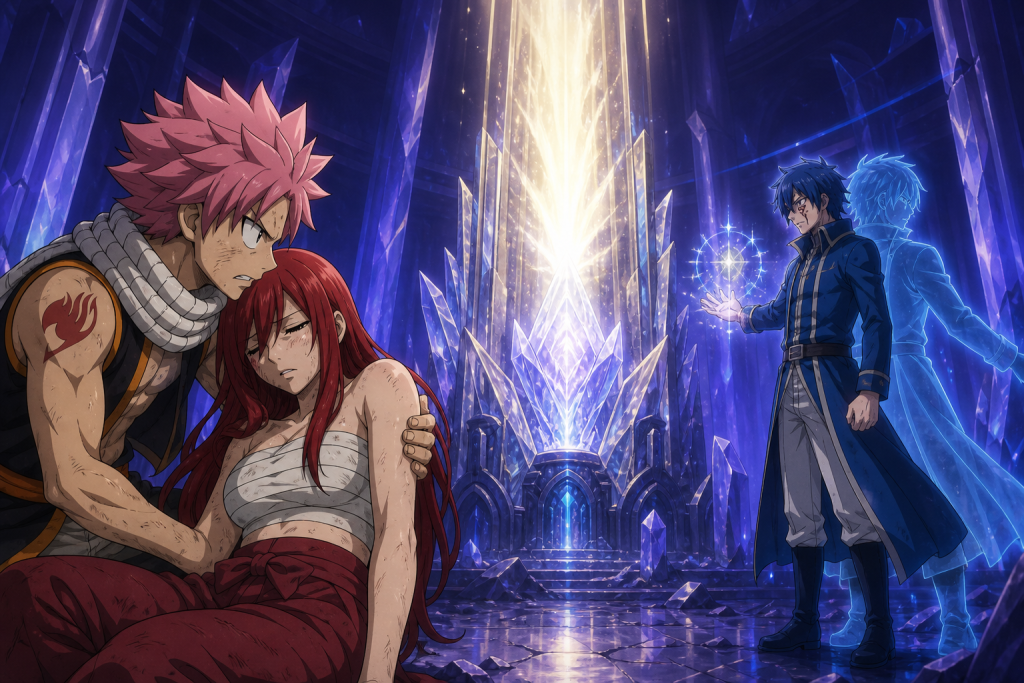
Bottom line: Episode 39 turns the Magic Council’s holy light into proof that procedure can be manipulated as easily as a person. The Council prays over Etherion, believing it will destroy the Tower of Heaven. Jellal has spent years arranging the opposite. The tower absorbs the blast, Siegrain returns to the body that projected him, and Erza learns that her willingness to die beside Jellal was another resource he planned to use. Natsu enters with the least polished rescue speech imaginable and the clearest moral judgment: Erza is a person, not resurrection material.
The receipt box
- Episode: 39
- English title: A Prayer Under the Holy Light
- Japanese title: 聖なる光に祈りを
- Romanization: Seinaru Hikari ni Inori o
- Original Japanese air date: July 26, 2010
- Series: Fairy Tail (2009–2013)
- Episode type: Manga canon
- Manga material: Chapter 93 from page 8 through Chapter 96
- Arc: Tower of Heaven
- Opening: “R.P.G. ~Rockin’ Playing Game” by SuG
- Ending: “Kimi ga Iru Kara” by Mikuni Shimokawa
- Where to watch: Watch A Prayer Under the Holy Light on Crunchyroll
Erza mistakes shared death for repair
Erza reaches Jellal after defeating Ikaruga. She can fight him. She still cannot emotionally reduce him to an enemy.
Jellal claims he was possessed by Zeref’s spirit and has no freedom. He presents himself as a puppet whose choices were settled before they began. Erza responds by offering to remain with him when Etherion strikes.
I understand the impulse. She loved the boy he was. She carries guilt for escaping when the others remained. If she cannot bring that boy back, dying beside him can feel like the last proof that she never abandoned him.
It is still self-erasure.
Erza does not owe death to demonstrate loyalty. She cannot repair Jellal by joining his chosen ending. Shared destruction would only turn both of them into evidence for his claim that nobody is free.
This arc keeps testing whether Erza can love people without making her body the payment.
Jellal performs weakness to gain control
Jellal tells Erza he gave in to weakness. He lowers his guard and appears ready to accept the blast. She releases him out of pity.
Then his expression changes.
The scene matters because confession can be weaponized. Naming pain is not automatically accountability. Jellal offers language that sounds vulnerable while withholding the information that determines Erza’s choice: Etherion will not kill them. He knows the tower is built to absorb it.
Erza consents to a final embrace under false conditions. Jellal uses her empathy to keep her in place until the R-System is charged.
That does not make compassion foolish. It makes deception the violation.
The answer cannot be “never believe someone who says they are hurting.” The answer is to compare words with power, disclosure, and conduct. Jellal controls the setting, the timetable, and the hidden mechanism. His apparent surrender costs him nothing.
The Council prays over a weapon it does not understand
At Era, Council members lower their heads as Etherion fires. The title frames the moment as prayer under holy light.
The ritual gives violence moral decoration. Prayer can express grief, humility, or hope. Here it also lets officials imagine solemnity is the same thing as responsibility.
They have approved a blast powerful enough to erase the tower. They do not know Siegrain is Jellal’s Thought Projection. They do not know the structure is a giant Lacrima designed to absorb the energy. They barely understand the people still inside.
Their seriousness does not make the decision informed.
Institutions love ceremony because it converts doubt into a shared pose. Everybody bows, the machine activates, and personal responsibility dissolves into procedure.
Yajima asked the correct question in Episode 37: who bears the lives lost? This episode answers with brutal clarity. The people under the light bear them. The Council gets to pray.
Etherion does exactly what Jellal wanted
The beam lands. The tower’s metal shell breaks away. Instead of disappearing, the structure reveals its true form as an enormous Lacrima.
It absorbs Etherion’s Magic Power.
The reveal changes the entire arc. Jellal never needed to defeat the Council’s weapon. He needed the Council to fire it for him. Years of labor, manipulation, and construction created the receiver; Siegrain’s work inside the institution delivered the charge.
This is not a villain overpowering the state from outside. It is regulatory capture with better hair.
Jellal entered the Council through a projection, shaped the debate, supplied selective information, and turned official authority into private infrastructure.
The Council’s mistake is not merely being tricked by one brilliant man. Its process allowed urgency, secrecy, and elite confidence to substitute for independent verification.
Siegrain was never a twin brother
Siegrain disappears from the Council chamber and appears beside Jellal. The two merge.
The reveal establishes that Siegrain was a Thought Projection created by Jellal, not a separate physical twin. The projection could speak, vote, persuade, and hold a Council position while Jellal remained at the tower.
When it returns, Jellal recovers the Magic Power invested in maintaining it.
The deception works because institutions often treat a polished identity as proof of legitimacy. Siegrain had the posture, title, access, and vocabulary of authority. Nobody demanded that the public role and private interest be separated because nobody knew they occupied the same body.
The story will later complicate Jellal’s possession claim and Ultear’s influence. Episode 39’s boundary is narrower: the Council persona was his magical projection, and it successfully arranged Etherion.
No, this is not Mystogan. Fairy Tail will introduce enough blue-haired identity confusion to require a small municipal filing office, but Episode 39 is specifically about Jellal and Siegrain.
Ultear destroys the room after the decision
Ultear uses Arc of Time as the Council collapses. She presents herself as devoted to Jellal’s dream.
Her position deserves precision. She participated in the institutional deception and helped remove evidence and opposition once Etherion fired. She is not simply an assistant standing near the scheme.
Later canon will reveal more about her history, manipulation, and relationship to Hades. Those facts do not need to be imported early as an excuse. The Episode 39 receipt is conduct: she supports the plan, uses her magic against the Council environment, and helps preserve the result.
Accountability does not require pretending a character has no context. It requires refusing to let future pain erase present agency.
Jellal turns Erza into resurrection material
With the R-System charged and his projection restored, Jellal overpowers Erza. He places her inside the Lacrima as the sacrifice for Zeref’s resurrection.
His explanation is horrifyingly technical. Her body will be decomposed and reconstructed into someone else.
That is the endpoint of his possessive language. He says he loves Erza while designing a process that removes her identity, body, future, and consent.
Love that requires a person to stop existing is not love. It is ownership wearing grief makeup.
The tower children were forced to build a resurrection system with their bodies. Jellal now tries to complete it with Erza’s. His paradise has never been about restoring freedom to the enslaved. It depends on continuing the same logic at a larger scale.
One chosen body becomes material for somebody else’s dream.
Natsu rescues Erza with rent money
Natsu enters and pulls Erza out of the Lacrima. His argument includes future jobs and Lucy’s rent.
It is funny because the stakes are cosmic and Natsu sounds like he remembered an overdue group project. It is also exactly what Erza needs.
Jellal offers destiny, sacrifice, Zeref, paradise, and death. Natsu offers ordinary life.
There are jobs to take. Lucy has bills. The guild will be loud. People expect Erza to return and participate in a future too mundane to qualify as mythology.
That everyday obligation restores scale. Erza’s life does not need a grand purpose to deserve continuation. She can survive because her friends want her around for work, meals, arguments, and rent-related chaos.
Found family is often strongest when it refuses to romanticize disappearance.
Natsu sees what Erza cannot say
Erza says she cannot move. Natsu responds with physical comedy, then prevents her from interfering and turns toward Jellal.
The tickling is tonally ridiculous. It confirms she is conscious and breaks the sacrificial solemnity Jellal imposed. Natsu refuses to behave like the ritual deserves reverence.
His anger is more serious. He says Jellal made Erza cry, shake, and give up.
Natsu is not the arc’s best historian. He does not fully understand every layer of the Council scheme. He understands Erza’s conduct. The woman who normally terrifies him has been pushed into accepting death.
That is enough evidence that the system is wrong.
Natsu’s emotional intelligence often arrives without elegant language. He notices when a friend no longer acts like herself and treats the change as an emergency.
Heavenly Body Magic changes the fight
Natsu attacks first and appears to pressure Jellal. Jellal then reveals how much power returned with Siegrain.
He uses Heavenly Body Magic to amplify speed and force. Grand Chariot turns the sky’s pattern into a devastating attack. Natsu struggles to track him.
The shift matters because Jellal arranged the entire episode to restore this advantage. His power is not simply a natural ranking. It is partly accumulated through infiltration and stolen institutional energy.
That makes the fight political as well as physical. Natsu is not only facing one strong mage. He is facing the concentrated result of enslaved construction, Council weaponry, Ultear’s support, and Jellal’s projection scheme.
Power levels look different when we audit the supply chain.
Natsu attacks the infrastructure
After Grand Chariot drops him, Natsu throws broken Lacrima at Jellal and begins damaging the tower.
Jellal reacts because the R-System’s stored Magic Power could destabilize if the structure breaks.
Natsu identifies the leverage immediately. If he cannot win the duel under Jellal’s conditions, he can destroy the mechanism that makes Jellal’s victory useful.
This is Natsu at his best. The destruction is not random property damage. It is strategic sabotage against coercive infrastructure.
The tower was built to convert bodies and Etherion into resurrection. Protecting it would mean accepting the villain’s definition of the battlefield.
Natsu changes the question from “Can I overpower Jellal?” to “Can Jellal complete the ritual if there is no stable tower left?”
Sometimes the correct answer to a rigged system is not winning inside it. It is breaking the machine.
The survivors are saved by Juvia's water
Outside, Etherion’s force threatens the escaping group. Juvia uses Water Lock to protect them.
The beat continues her membership argument from Episode 37. She is no longer only asking whether Fairy Tail will accept her. She is using her magic to keep the group alive.
In the manga, the group is soaked after falling into the sea. The anime keeps them dry while preserving Juvia’s rescue. The adaptation reduces the physical mess, but the action remains important.
Juvia’s water has been used as attack, body, prison, and partnership across two episodes. Here it becomes a shelter.
That range is character development expressed through magic, not a speech pasted over it.
Adaptation choices
Episode 39 adapts Chapter 93 from page 8 through Chapter 96. The anime changes the tower’s exterior and Lacrima design, the interior room where Erza confronts Jellal, and the platform from which Etherion fires.
The visual redesign makes the revealed crystal tower look more jagged and otherworldly. The scale sells the amount of power absorbed, though it can make the human labor behind the structure easier to forget.
The anime keeps the escaping group dry during Juvia’s Water Lock rescue, unlike the manga’s soaked aftermath.
Jellal changes clothing after Natsu’s initial attack. The manga uses a special suit suited to Heavenly Body Magic, while the anime presents a sleeveless outfit and adds a glowing Zeref-associated symbol at his right eye during battle.
That eye symbol is anime-specific visual language here. It should not be treated as a manga mechanic.
RaeRae's verdict
Episode 39 is about people who turn faith into machinery.
The Council prays and fires a weapon it does not understand. Jellal performs surrender and uses Erza’s compassion to keep her beside him. Siegrain’s respectable public identity returns to the body that invented it. Etherion becomes fuel for a resurrection system built through enslavement.
Then Natsu interrupts the ritual with Lucy’s rent.
That joke is the episode’s moral center. Erza does not exist to complete Jellal’s tragedy. She has an ordinary future with people who expect her to show up.
Jellal offers holy light, destiny, and a dead man’s return. Natsu offers work, bills, and friends who notice when Erza is not acting like herself.
I know which one sounds more like life.
Sources
Continue the watch
- Previous: Fairy Tail Episode 38 React: Destiny
- Next: Fairy Tail Episode 40 React: Titania Falls
- Browse every Fairy Tail episode
- Open the Fairy Tail Episode Reacts hub
- Return to the Fairy Tail hub