
Fairy Tail Episode 38 React: Destiny
Erza abandons the performance of invulnerability and faces Ikaruga with one sword and a clear decision.
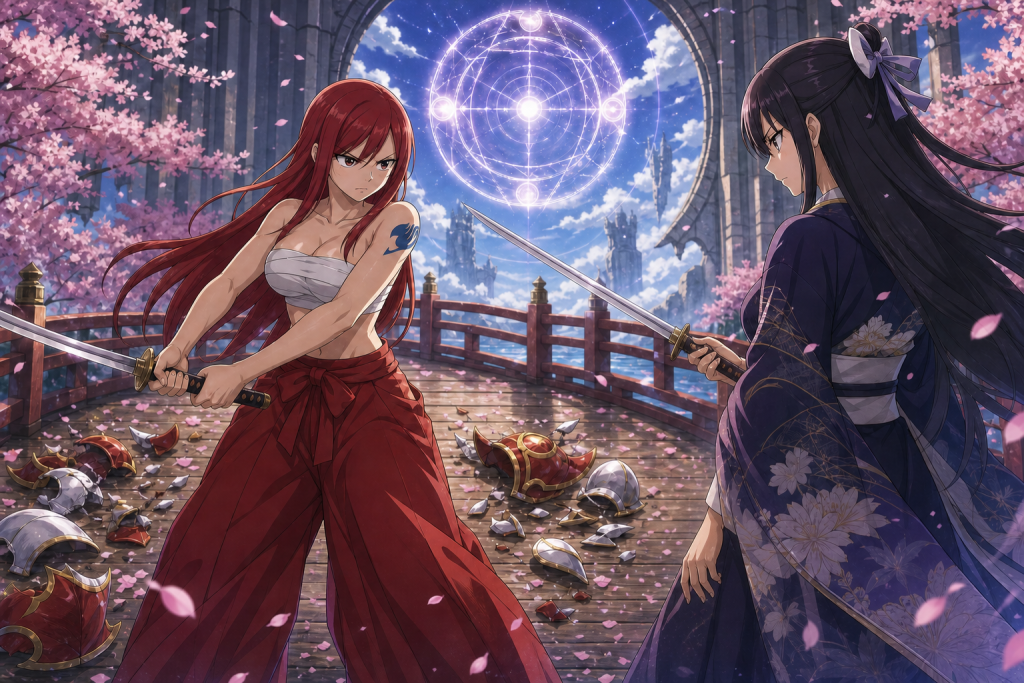
Bottom line: Erza wins Episode 38 only after she stops treating armor as proof that she is strong. Ikaruga cuts through Heaven’s Wheel, Flame Empress, and Purgatory Armor like expensive wrapping paper. Erza answers by wearing ordinary cloth, holding one sword, and trusting the people she once kept at a distance. That is not the show saying protection is useless. It is Erza realizing protection became a wall when she used it to hide every need.
The receipt box
- Episode: 38
- English title: Destiny
- Japanese title: 運命(デスティニー)
- Romanization: Desutinī
- Original Japanese air date: July 19, 2010
- Series: Fairy Tail (2009–2013)
- Episode type: Manga canon
- Manga material: Chapters 90–92 and Chapter 93 through page 7
- Arc: Tower of Heaven
- Opening: “R.P.G. ~Rockin’ Playing Game” by SuG
- Ending: “Kimi ga Iru Kara” by Mikuni Shimokawa
- Where to watch: Watch Destiny on Crunchyroll
Etherion turns time into another weapon
The Magic Council has voted. Etherion is preparing to fire. Everyone inside the Tower of Heaven now lives inside a countdown they did not choose.
That pressure changes every decision. Gray, Lucy, Juvia, Wally, Millianna, Happy, and the others have defeated opponents, but victory inside the tower will mean nothing if the Council erases the building and everyone in it.
The institutional language makes the attack sound clean. A strategic weapon will neutralize a dangerous location. The people underneath it experience something simpler: powerful adults decided their lives could be converted into acceptable loss.
Jellal depends on that distance. He wants Etherion fired. The Council members believe they are opposing him while moving exactly where he needs them.
Nothing says “responsible governance” like handing the villain the weapon he designed his entire plan around.
Sho still confuses protection with possession
Sho carries Erza inside one of his cards while racing toward Jellal. He believes the card keeps her safe. It also removes her control over her body, movement, and timing.
The distinction matters because Sho’s fear is real. He lost Erza once. He has spent years believing she abandoned the tower children. Now that he understands Jellal lied, he wants to keep her from being taken again.
Fear does not turn captivity into care.
Erza tells him to release her. He refuses. Ikaruga then cuts through the card’s dimensional barrier, proving Sho cannot create safety by simply making Erza smaller and easier to carry.
Erza uses the distortion to free herself. The scene returns agency to the person everyone keeps trying to manage.
Sho’s growth cannot stop at learning Erza did not betray him. He also has to accept that she is not his evidence, his lost sister-shaped object, or his protected cargo. She is a person who gets to choose the risk.
Ikaruga is the opponent Erza cannot out-dress
Ikaruga enters as Trinity Raven’s final assassin and its clearest challenge to Erza’s identity. She is calm, precise, and so technically confident that she does not need Jellal’s theatrical commentary.
Her sword can cut through dimensions and magical defenses. She attacks Erza inside Sho’s card. Once Erza emerges, Ikaruga begins dismantling the visual language that has always announced Erza’s strength.
Heaven’s Wheel Armor falls. Flame Empress Armor falls. Purgatory Armor falls.
The sequence works because each Requip usually solves a tactical problem. Heaven’s Wheel supports multiple weapons. Flame Empress reduces fire damage. Purgatory Armor arrives with the reputation of overwhelming power. Ikaruga’s Yasha’s Empty Flash and Garuda Flame refuse to respect the hierarchy.
This is not “Erza forgot she owns more armor.” The episode is making her confront what the armor means when no set can guarantee control.
Armor is a tool, not a personality
Erza’s Requip Magic is one of the series’ best visual systems because clothing, weapons, movement, and strategy become one language. She changes forms to meet the battlefield.
The danger comes when everyone starts reading the wardrobe as the person.
Guildmates call Erza invincible. Enemies fear Titania. Sho begs her to put on something stronger because he assumes strength must arrive with metal, ornament, and a name.
Erza knows better. She tells him the armor helped her hide weakness and maintain distance from other people.
That confession does not make Requip fake. Her training, inventory, speed, and sword skill are real. The problem is emotional outsourcing. Erza has used armor to perform certainty when she is terrified, grieving, or lonely.
The performance helped her survive. It also taught everyone around her not to ask whether she needed help.
Clear Heart Clothing is not magical underwear logic
Erza changes into simple cloth and carries one katana. The form is often called Clear Heart Clothing. It provides almost no defense.
Anime loves a lighter outfit that somehow unlocks maximum power, and yes, the trope can become nonsense with a dramatic soundtrack. Here the choice has a specific function.
Ikaruga has already demonstrated she can cut every armor Erza presents. More metal will not solve the fight. Erza removes weight, accepts vulnerability, and concentrates everything on one strike.
The decision is tactical and emotional at the same time.
She is not protected by a stronger shell. She is supported by memory: Rob, Natsu, Gray, Lucy, Happy, the guild, and the tower survivors who still believe she can reach Jellal.
That support does not physically block Ikaruga’s blade. It changes what Erza thinks she must carry alone.
The one-sword duel earns its stillness
The fight narrows after several loud Requips. Two women stand with one sword each. The episode lets silence and timing replace the armor spectacle.
Ikaruga’s confidence comes from technique. She has cut space, cards, armor, and expectation. Erza’s resolve comes from surrendering the performance of invulnerability.
Their final exchange is brief because the story has already staged the argument. Extending it with ten more attacks would weaken the point.
Erza wins by committing fully to a strike without the illusion that armor will absorb the cost. In the manga, her shoulder is visibly cut. The anime reduces that injury, which makes the television version less bloody but also softens the physical price of her choice.
Vulnerability is not supposed to mean nothing can hurt you. It means you act without pretending hurt is impossible.
Ikaruga's style deserves accountability too
Ikaruga is elegant, controlled, and visually memorable. Her swordsmanship forces Erza to rethink her entire approach.
She is also a paid assassin enforcing Jellal’s plan.
The episode gives her aesthetic authority without giving her a moral exemption. She knows the tower is approaching destruction. She still blocks Erza and Sho because Trinity Raven accepted the contract.
Skill can reveal character, but skill is not virtue. Ikaruga’s discipline makes her dangerous precisely because she has placed it in service of someone else’s coercive system.
Fandom can appreciate the duel without rewriting the job as neutral. Beautiful sword work still has a client.
Everyone outside the duel has to choose whether to leave
After the Trinity Raven fights, the surviving group faces the practical question: escape before Etherion or turn back for Erza and Natsu.
This is where found family gets expensive.
It is easy to say nobody gets left behind when there is no missile in the sky. The extended anime argument lets fear remain visible. These people are injured, exhausted, and standing inside a structure built to kill them.
Returning is not automatically the only moral choice. People do not owe suicide to prove affection. What matters is that Jellal and the Council have created the false choice between abandoning friends and dying beside them.
The group searches for a route that preserves more lives. That is solidarity as practical work, not a slogan.
Simon carries Natsu toward Jellal
Simon moves Natsu through the tower because Natsu remains one of the few people capable of breaking Jellal’s control by force.
The act is brave. It is also part of Simon’s longer accountability problem. He helped abduct Erza and let Fairy Tail follow because he wanted strong allies. His methods repeatedly involve deciding what other people need to know.
Carrying Natsu now is a more honest use of that strategic instinct. Simon is not arranging a secret pursuit from the shadows. He is physically sharing the danger and moving toward the person who manipulated all of them.
Repair appears through conduct. It does not erase the earlier choices.
Erza reaches Jellal without becoming his sacrifice
After defeating Ikaruga, Erza continues toward Jellal. She is tired, exposed, and short on time.
Jellal traps her in a Darkness Cage. The anime extends the moment by letting the voices and memories of her friends help her break free. The addition makes the emotional argument more explicit than the manga’s quicker escape.
There is a risk in making friendship sound like an instant power battery. The scene works when we read those voices as Erza changing her decision, not as other people magically doing the labor for her.
Jellal built his control on isolation. He convinced tower survivors that Erza abandoned them and convinced Erza that saving everyone required self-sacrifice. Every remembered relationship contradicts him.
Erza attacks because she no longer accepts the role of living sacrifice, even when the R-System was designed around her body.
“Destiny” is Jellal's favorite excuse
The episode title can sound romantic or inevitable. Inside this arc, destiny is a political tool.
Jellal tells people the tower has a grand purpose. Siegrain tells the Council Etherion is necessary. Sho once believed Erza’s betrayal explained their suffering. Each story converts human decisions into something that supposedly had to happen.
Erza’s victory rejects that logic.
She cannot change the childhood she endured. She can decide what it means now. She can wear armor without being trapped inside Titania. She can love the tower survivors without surrendering her body to their expectations. She can face Jellal without completing the sacrifice he planned.
Fate may describe the road behind her. It does not get sole ownership of the next step.
Adaptation choices
Episode 38 adapts Chapters 90 through 92 and the opening pages of Chapter 93. The anime adds aftermath for the Vidaldus and Fukuro fights, more Etherion preparation, and a longer debate among the survivors about turning back.
Ikaruga meets Erza and Sho on a bridge surrounded by water and cherry blossoms instead of the manga’s hallway. The beauty creates contrast with the violence and gives the duel a ceremonial stillness.
Several armor designs differ between versions. The anime also extends Erza’s Purgatory Armor exchange before Ikaruga destroys it. That extra motion makes the armor look less instantly useless while preserving Ikaruga’s superiority.
The manga shows more injury in the final strike. The anime removes the shoulder wound, consistent with its softer presentation of blood in this broadcast slot.
The anime adds guards fleeing by boat and expands the rescue group’s argument. It also lengthens Erza’s time inside Jellal’s Darkness Cage, using remembered encouragement as the key to her escape.
These additions make the episode’s interpersonal thesis clearer. They also need restraint. Erza’s friends matter because they changed how she understands belonging, not because a friendship montage replaces sword skill.
RaeRae's verdict
Episode 38 is one of Erza’s defining episodes because it refuses the lazy version of strength.
She does not win by finding a secret fourth armor with a bigger shoulder plate. She wins after three famous armors fail. She admits the metal has also been emotional distance, changes into ordinary cloth, and stakes the fight on one clear decision.
That does not make protection shameful. Erza will use armor again because tools are useful. The lesson is that a tool should not become the only language a person has for existing around other people.
Ikaruga cuts the shell. Fairy Tail gives Erza a reason to remain when it is gone.
The Council’s countdown keeps moving, Jellal still expects a sacrifice, and the tower is nowhere near safe. Erza reaches the top as herself anyway.
Sources
Continue the watch
- Previous: Fairy Tail Episode 37 React: Heart’s Armor
- Next: Fairy Tail Episode 39 React: A Prayer Under the Holy Light
- Browse every Fairy Tail episode
- Open the Fairy Tail Episode Reacts hub
- Return to the Fairy Tail hub