
Fairy Tail Episode 37 React: Heart's Armor
Lucy and Juvia turn a forced rivalry into trust while Gray remembers the child beneath Erza's armor.
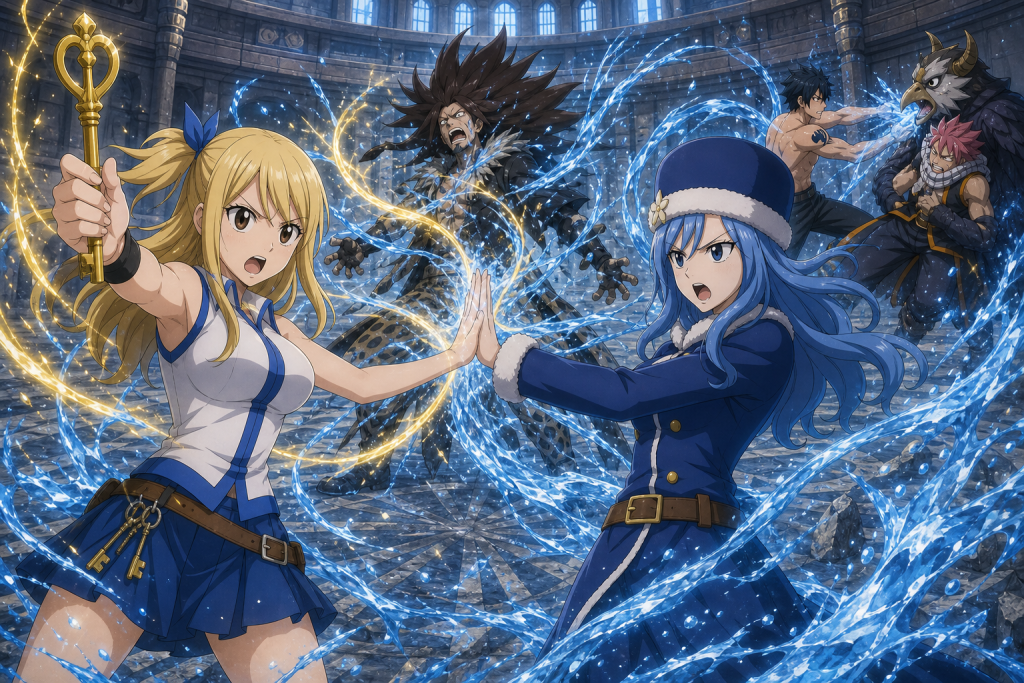
Bottom line: Episode 37 earns its title by asking what actually protects a heart. Vidaldus controls Juvia’s body and orders her to hurt Lucy. Lucy does not answer by treating Juvia as the enemy. She listens for the woman trapped under the spell, uses Juvia’s own water to summon Aquarius, and trusts a brand-new teammate long enough to create a Unison Raid. Meanwhile, Gray defeats Fukuro because he remembers the child Erza hid behind armor. The episode’s best idea is simple: strength is not pretending pain does not exist. Strength is refusing to abandon the person still inside it.
The receipt box
- Episode: 37
- English title: Heart’s Armor
- Japanese title: 心の鎧
- Romanization: Kokoro no Yoroi
- Original Japanese air date: July 12, 2010
- Series: Fairy Tail (2009–2013)
- Episode type: Manga canon
- Manga material: Chapters 87–89
- Arc: Tower of Heaven
- Opening: “R.P.G. ~Rockin’ Playing Game” by SuG
- Ending: “Kimi ga Iru Kara” by Mikuni Shimokawa
- Where to watch: Watch Heart’s Armor on Crunchyroll
Lucy refuses Vidaldus's version of the fight
Vidaldus wants a “cat fight.” He turns Juvia into a controlled weapon, orders her to attack Lucy, and treats two women’s bodies as a show staged for him.
Lucy does not accept the script.
She defends herself, but she keeps speaking to Juvia as a person. That choice matters because the visible attacker is Juvia’s body while the controlling intent belongs to Vidaldus. The episode does not pretend the damage disappears. Lucy is hit, whipped by water, and nearly drowned inside Juvia’s transformed body. She still separates the person from the coercion.
That is not passive kindness. It is accurate moral judgment under pressure.
Vidaldus depends on everyone confusing control with consent. If Lucy decides Juvia secretly wanted this, his spell wins twice. He gets the physical attack and destroys the possibility of trust after it.
Lucy denies him the second victory.
Juvia's inner voice is not permission
Inside the water, Lucy hears Juvia’s real thoughts. Juvia apologizes. She says she does not want to hurt a guildmate. She thinks about Fairy Tail’s warmth and the friends she has only begun to believe she might keep.
The direction needs that inner voice because possession stories can get morally lazy. A body moves, another character reacts, and the controlled person later carries all the shame. Episode 37 makes the split audible. Vidaldus gives commands. Juvia resists internally. Her tears do not stop the spell, but they tell Lucy where responsibility belongs.
Juvia is not innocent of everything she has ever done. She participated in Phantom Lord’s attack and previously fought Gray. This scene does not wash that history away. It shows a new choice under impossible conditions: she values Lucy’s life and the guild’s trust even while her body is being used against both.
Accountability is not the same as permanent suspicion. If no later conduct can matter, then nobody can ever join a community they once harmed.
Lucy recognizes a friend before the paperwork does
Lucy tells Juvia that someone who cries for her friends will not be rejected by Fairy Tail.
That is a big promise from a member who joined recently herself. Lucy is not the guild master. She cannot formally decide every membership question. What she can do is recognize conduct.
Juvia is trying to protect someone she once called a romantic rival. Lucy sees that effort and names the relationship Juvia is afraid to claim.
This is found family without the greeting-card nonsense. Nobody says the past never happened. Nobody demands instant intimacy. Lucy makes one concrete offer: I see what you are choosing now, and I will not let this man define you by what he forces your body to do.
That is how a guild becomes more than a building with a logo.
Aquarius enters through Juvia's water
Lucy’s tactical answer is excellent. Juvia attacks with Water Jigsaw, and Lucy reaches into the water to open Aquarius’s gate.
Celestial Spirit Magic normally depends on a key, a contract, and access to the spirit’s element or appropriate conditions. Lucy uses the water already surrounding her instead of waiting for a cleaner battlefield. The move proves that reading a fight can matter as much as raw output.
It also depends on Juvia’s nature. Vidaldus turned her water body into a cage for Lucy. Lucy turns that same medium into a door.
I love a magical reversal with receipts.
Aquarius arrives furious because Aquarius is contractually incapable of entering a scene like a normal coworker. Her wave hits everyone, including Lucy. The comedy works because Aquarius retains agency. Lucy summons her, but she does not own her personality. Their contract is a relationship with power, limits, and enough mutual irritation to run a municipal office.
The joke should not erase Lucy’s risk. She chooses a spirit whose force could hurt her because the alternative is leaving Juvia under Vidaldus’s control.
Unison Raid makes trust mechanical
Vidaldus absorbs water to counter Aquarius. That choice weakens his control over Juvia. Once Juvia regains herself, she reaches for Lucy, and their magic combines into a Unison Raid.
The series treats Unison Raid as difficult because two mages must synchronize magic closely enough to produce a joint spell. Lucy and Juvia do it before they have a long partnership or rehearsed routine.
The scene does not mean they are magically perfect best friends forever. It means their priorities align at the exact moment Vidaldus expects jealousy and coercion to keep them divided.
He built his strategy around a sexist assumption. He thought calling Lucy a love rival would make Juvia’s controlled violence feel natural. Instead, the women create a spell he cannot absorb.
The water overwhelms his capacity, breaks the spell, strips away the giant hair that carried his threat, and knocks him out. The visual gag is deserved. He wanted to stage women for his entertainment, and the episode leaves him bald on the floor after their teamwork exceeds his imagination.
Sometimes symbolism wears a wig.
Juvia's first kindness from a woman
After the battle, Lucy tells Juvia to stop calling her formally and accepts her as a friend and guildmate. Juvia says a woman has never treated her kindly like this, then describes her tears as rain falling from her eyes.
That line explains part of her rivalry habit without excusing it. If Juvia learned to see women mainly as competitors, Lucy offers another model. A woman can be a teammate, witness, rescuer, and friend without negotiating around Gray first.
The series will not always protect this development from recurring jealousy jokes. This episode still establishes the better version of their relationship. Lucy and Juvia can create something together that neither could produce alone.
That should be the baseline whenever later comedy tries to drag them backward.
Gray fights a copy of Natsu's fire
Fukuro swallows Natsu and reproduces his Fire Dragon Slayer attacks. Happy cannot overpower him. Gray steps in because Erza remains trapped in Sho’s card and the Etherion decision is closing in.
Fukuro’s copy has spectacle, but Gray recognizes that it is weaker than Natsu’s real fire. He freezes the attack, controls the space around Fukuro’s beak, and prevents the assassin from swallowing him too.
The battle respects Gray’s intelligence. He is not simply the ice opposite to Natsu’s fire. He knows Natsu well enough to judge the difference between borrowed technique and lived power.
That knowledge comes from years of rivalry, missions, broken furniture, and refusing to admit they pay attention to each other.
Fukuro treats magic like a consumable identity. Gray proves a technique is more than its visible effect.
Gray remembers Erza before the armor hardened
Gray’s flashback returns to Erza’s early days in Fairy Tail. He remembers challenging her, losing, and hearing other members predict how strong she would become.
Then he finds her crying alone by the river.
The important beat is not that Gray solves her grief. He does not. He sits beside her.
Young Erza says she is comfortable alone because isolation has become armor. If nobody gets close, nobody can be taken from her and she never has to explain the tower. Her strength makes the distance look respectable.
Gray sees the cost before he understands the history.
That memory gives his fight with Fukuro a purpose beyond rescuing Natsu. Erza belongs at Fairy Tail because the guild gave her somewhere she did not have to cry alone. Saving her means protecting the conditions that let her become more than the strongest person in the room.
The title is about emotional armor, not Requip
Erza’s armor is literal. Her Requip Magic lets her change weapons and defensive forms in battle.
The title points deeper. Her emotional armor is the belief that competence can replace need. She can lead, fight, discipline Natsu and Gray, and carry everyone else’s crisis. The tower reveals the child underneath who still expects rescue to cost someone else’s life.
Gray does not shame that child. He remembers her.
Lucy offers Juvia a similar mercy. Juvia’s rain, formality, and fixation on Gray all help her survive loneliness. Lucy does not require her to become emotionally tidy before treating her as human.
Both stories argue that armor can protect a wound while also keeping care out. The answer is not ripping it away for dramatic effect. The answer is staying close enough that the person can lower it by choice.
The Council votes for Etherion
While the guild fights inside the tower, Siegrain persuades the Magic Council to authorize Etherion. The vote shifts decisively, with Yajima left opposing the strike.
This is institutional violence wrapped in procedure. Council members can tell themselves they followed a vote, assessed a threat, and selected the only available weapon. The people inside the blast zone do not become less alive because the paperwork was orderly.
Yajima asks whether Siegrain will take responsibility for the deaths, including the risk to the twin brother he claims is inside. Siegrain says he will bear it.
That promise is cheap because the dead would bear the actual cost. Powerful people love symbolic responsibility when somebody else supplies the bodies.
The episode crosscuts personal rescue with institutional abandonment. Lucy and Gray look at controlled or hidden people and try to preserve them. The Council looks at a location and prepares to erase it.
Adaptation choices
Episode 37 adapts Chapters 87 through 89. The anime keeps the circular chamber for Lucy and Juvia’s battle and the cage-filled room for Gray’s fight with Fukuro, both established in Episode 36.
Those spaces sharpen the themes. Lucy and Juvia fight in a room built like an arena while refusing Vidaldus’s entertainment. Gray fights in a chamber full of cages while remembering Erza’s self-isolation.
The anime adjusts several physical beats from the manga. Happy’s fall is staged around the added cages. Gray’s childhood scuffle with Erza is softened in one detail, while his condition after challenging her and the river encounter receive different visual emphasis. Fukuro’s defeat also uses the cage-filled environment.
The Council stands on a large magic circle instead of simply gathering around a table. That staging makes the vote feel ceremonial, which is exactly why the moral question must stay visible. Spectacle can make an institution look wise without making its decision humane.
RaeRae's verdict
Episode 37 gives the women the best fight and does not make their relationship disposable afterward.
Lucy believes Juvia’s resistance before she can prove it publicly. Juvia reaches back. Aquarius supplies the flood, but trust creates the Unison Raid. Vidaldus loses because he cannot imagine women choosing each other over the rivalry he assigned them.
Gray’s half of the episode makes the same argument from another direction. He defeats copied fire because he knows Natsu, and he fights for Erza because he remembers the girl who cried where nobody could see.
The Council votes to destroy the entire tower because institutions are often worst at the kind of attention these guild members practice naturally.
Heart’s armor is useful. It gets people through the day. This episode asks whether anyone will remain beside them when it is finally safe to take it off.
Sources
Continue the watch
- Previous: Fairy Tail Episode 36 React: Heaven’s Game
- Next: Fairy Tail Episode 38 React: Destiny
- Browse every Fairy Tail episode
- Open the Fairy Tail Episode Reacts hub
- Return to the Fairy Tail hub