
Fairy Tail Episode 36 React: Heaven's Game
Heaven's Game
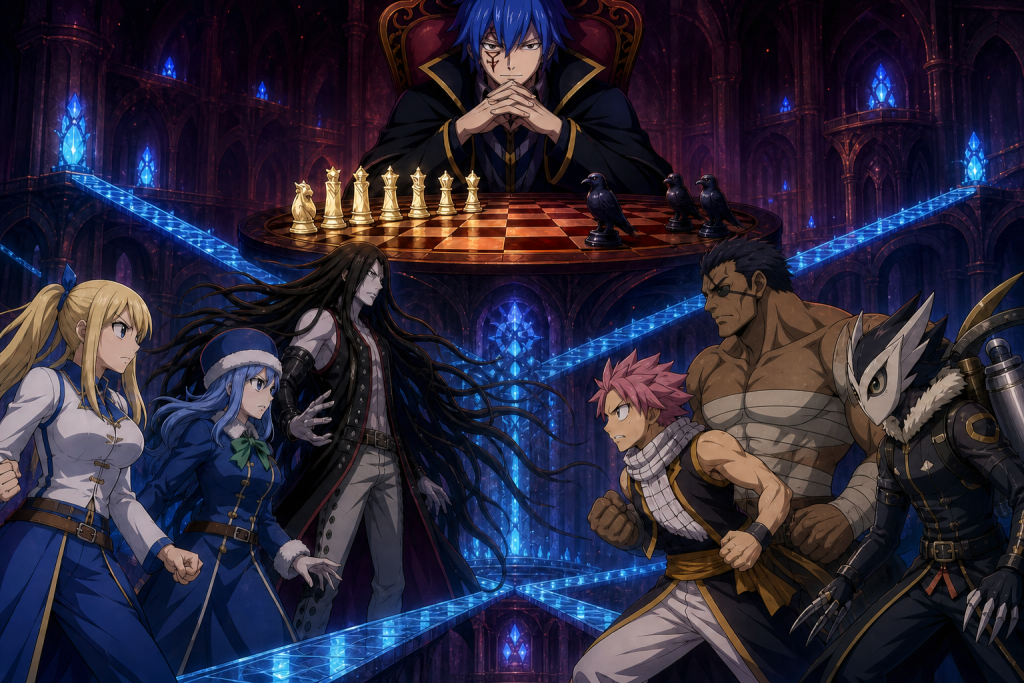
Bottom line: Jellal calls the Tower conflict a game because “game” makes coercion sound clever. He recruits Trinity Raven, assigns living people to chess pieces, and watches survivors fight inside rules only he designed. Natsu answers with Fairy Tail’s messier idea of freedom: nobody is free if one man decides the board, the teams, and which bodies count as disposable.
Episode 36 is setup-heavy, but the setup has a point. Jellal turns trauma into entertainment. The rescue team keeps turning assigned opponents back into people.
The receipt box
- Episode: 36
- English title: Heaven’s Game
- Japanese title: 楽園ゲーム
- Romanization: Rakuen Gēmu
- Original Japanese air date: July 5, 2010
- Series: Fairy Tail (2009–2013)
- Episode type: Manga canon
- Manga material: Chapters 84–86
- Arc: Tower of Heaven
- Opening: “R.P.G. ~Rockin’ Playing Game” by SuG
- Ending: “Kimi ga Iru Kara” by Mikuni Shimokawa
- Where to watch: Watch Heaven’s Game on Crunchyroll
Jellal needs the word “game” to hide the labor
The Tower of Heaven was built by enslaved people. It now runs through manipulated loyalty, magical defenses, and a ruler who decides what everyone else is allowed to know.
Calling the confrontation a game does ideological work. Games imply consent, shared rules, and meaningful choice. Jellal’s participants did not agree to the board. Erza was kidnapped. Happy was restrained. Natsu, Lucy, Gray, and Juvia entered to rescue friends. Sho, Simon, Wally, and Millianna were shaped by years of false information and tower control.
Jellal counts them as pieces anyway.
That is not play. It is administration with better branding.
The chess imagery makes his distance visible. From the throne room, loss becomes a fallen shape. He does not have to hear pain, confusion, or disagreement. Abstraction protects the person in power from the human cost of his decisions.
The board exposes Jellal's creative failure
Jellal is staging an event. He controls entrances, opponents, architecture, and commentary. In another context, those are directing skills.
The problem is that art requires collaborators. Jellal wants puppets.
He assigns Trinity Raven three roles against the group inside the tower. He adds pieces for Erza’s friends and, in the anime, appears to count Happy among the eight opposing participants. The production expands the board from the manga’s three-versus-seven structure to three-versus-eight.
That extra fish-shaped or animal-coded piece is funny until we remember what it means: even Happy’s life is a scoring unit to Jellal.
Creative control becomes abuse when everyone else’s agency is treated as an obstacle to the intended ending. Jellal does not want to discover what the participants will choose. He wants the pleasure of watching whether they survive his design.
Trinity Raven are contractors, not believers
Vidaldus Taka, Ikaruga, and Fukuro belong to Trinity Raven, a special unit connected to the Death’s Head Caucus assassin guild. Their entry changes the conflict because they are not tower children bound by shared memory.
They are hired force.
That separation matters for accountability. Sho and the others operate inside manipulation, survivor bonds, and Jellal’s lie about Erza. Trinity Raven accept a job to kill or stop intruders. Their motives may differ, but they enter with professional competence and awareness that they are enforcing Jellal’s game.
The anime gives each a highly stylized identity: Vidaldus turns rock performance and hair into magic; Fukuro combines an owl-like mask with jet mobility; Ikaruga carries the calm authority of a swordswoman whose threat does not require noise.
Style should not make the contract invisible. A cool entrance is still an entrance on behalf of the tower’s ruler.
Wally finally says what he wanted
Wally tells Natsu that the tower children wanted freedom. That statement breaks through the revenge plot because it names the original goal beneath years of manipulation.
Natsu’s response draws a sharp line between Jellal’s system and Fairy Tail. Freedom at Fairy Tail does not mean nobody has duties or consequences. Members take jobs, follow guild rules imperfectly, answer to Makarov, and clean up some percentage of the property they destroy.
The difference is chosen belonging. Members can disagree, leave, form teams, and define relationships without one ruler holding their friends hostage.
Wally has been told that finishing Jellal’s paradise honors the freedom they lost. Natsu sees the contradiction immediately. If Jellal controls where Wally lives, who he fights, and what information he receives, then the tower is still a prison.
Sometimes Natsu’s political philosophy is just yelling “that is stupid” at the correct institution. I support the accessible curriculum.
Natsu defeats Wally without treating him as disposable
Wally’s Polygon and Guns Magic make him a dangerous ranged opponent. The anime changes part of the visual from a transformed gun-hand to a held pistol, but the tactical idea remains: Wally attacks through angles and distance.
Natsu closes that distance. His Fire Dragon Slayer Magic is direct, physical, and hard to contain inside Wally’s preferred geometry.
The moral beat matters more than the matchup. Wally is an obstacle in the rescue, but he is also someone Erza wants freed from Jellal’s lie. Natsu can defeat him without deciding his life has no value.
That restraint separates rescue from conquest. Natsu is not entering the tower to replace Jellal as the strongest man who tells everyone what to do. He is trying to remove the structure that makes fighting compulsory.
Millianna's capture of Happy starts to crack
Millianna entered the arc treating Happy as a beloved cat object. Her affection ignored his consent and strategic importance.
As the conflict develops, the certainty holding the childhood group together begins to weaken. Information from Erza, Simon’s actions, and Wally’s encounter with Natsu make it harder to maintain Jellal’s version unchanged.
Happy’s personhood remains a useful test. If Millianna truly cares about cats, can she recognize that this cat has his own friends, choices, and fear? Or does “love” still mean possession?
The episode does not complete her accountability. It places pressure on the contradiction.
Found family rhetoric means nothing if affection only counts when the object of affection complies.
Sho uses Card Magic on Erza again
Sho traps Erza in a card because he wants to control whether and how she confronts Jellal. Even after hearing information that destabilizes the betrayal story, he struggles to release the need to manage her body.
His fear is understandable. Jellal is powerful. Erza’s return threatens the emotional system Sho has used to survive. If she faces Jellal directly, Sho may lose her again.
The act remains coercive.
Erza has already spent years being contained by the tower and by Jellal’s threat. Sho’s Card Magic repeats that structure in the name of protection. He turns her into something portable because her independent action scares him.
Protective intent does not make captivity respectful. The arc has now made this point through Jude, Karen, Millianna, and Sho in different forms. Fairy Tail is not subtle about the pattern, and apparently it needs not to be.
Simon treats Natsu as a necessary ally
Simon joins Natsu after revealing his doubt about Jellal’s story. He understands that defeating the tower’s ruler requires power beyond the childhood group.
His choice helps the rescue and acknowledges Fairy Tail’s relationship with Erza. It also continues Simon’s habit of arranging other people without full disclosure. He allowed pursuit because he needed stronger mages. Now he moves with Natsu through a game whose deeper identity problem he understands better than Natsu does.
The extended anime conversation around Jellal and Siegrain points toward the connection between the tower ruler and the Council member. Episode 36 does not complete the full reveal, so the React should not state the mechanism as settled fact here.
What Simon knows is enough to make him wary. Jellal’s influence extends beyond the tower. The Council debate is not happening outside his reach.
Fukuro turns “justice” into hired violence
Fukuro enters as an owl-masked assassin with Jet Magic. His design borrows authority cues: bird of prey, uniform-like armor, controlled movement.
The manga marks his jet pack with repeated “justice” language; the anime removes that text. The irony survives. He works for an assassin unit hired by Jellal while presenting a disciplined, almost official silhouette.
Justice is not a costume. It depends on who is protected, who decides, and what process separates guilt from inconvenience.
Fukuro attacks Natsu and Simon because the game assigned them as opponents. His professional role lets Jellal outsource direct violence while preserving the fantasy that the board itself is neutral.
It is not neutral. Somebody chose the matchup.
Lucy and Juvia are not a “love rival” joke first
Lucy and Juvia move together through the tower while searching for Natsu. Juvia frames Lucy as a romantic rival because of Gray, even though Lucy has not entered that competition.
That framing is comic on the surface and revealing underneath. Juvia is trying to enter a new community while organizing other women through imagined scarcity around one man.
Lucy does not owe participation in that triangle. Juvia’s feelings are hers to manage.
Their actual partnership is more important. They are two capable mages navigating an enemy structure. Juvia’s Water Magic and Lucy’s Celestial Spirit Magic offer different tactical options. The episode gives them a chance to build trust through conduct rather than romance discourse.
Vidaldus attacks that possibility directly.
Vidaldus weaponizes hair and forced obedience
Vidaldus’s magic begins through his enormous hair, which can absorb or counter Juvia’s water and sets up Rock of Succubus. The spell will force Juvia into attacking Lucy.
Episode 36 begins the encounter without completing its resolution. The consent boundary is already clear. Turning a person’s body against a friend is not ordinary mind-game combat. It converts relationship into a weapon and leaves the controlled person carrying the image of harm.
That is especially cruel for Juvia. She is trying to prove she can belong in Fairy Tail after fighting against it. Vidaldus takes that insecurity and creates the exact conduct she fears will confirm rejection.
The spell does not reveal Juvia’s secret desire to hurt Lucy. It overrides agency.
Episode 37 will need to keep Juvia’s internal resistance visible or the fight will become another excuse to stage women attacking each other for a man’s attention.
New opening, new framing
Episode 36 introduces “R.P.G. ~Rockin’ Playing Game” as the opening and “Kimi ga Iru Kara” as the ending. The opening change aligns with Jellal’s game framing and the arc’s increasingly structured battles.
An RPG metaphor can celebrate teams, roles, progression, and chosen quests. Jellal uses the same language in reverse. He is the game master who withholds rules and forces participation.
The title sequence’s energy should not make the episode’s coercion feel fun by default. The production can enjoy stylized matchups while the editorial analysis keeps asking who consented to the match.
That is the difference between fandom excitement and moral endorsement. We can like the battle design without buying Jellal’s framing.
Adaptation changes
Episode 36 adapts Chapters 84–86. The anime redesigns several locations, moving Lucy and Juvia’s encounter with Vidaldus from a hallway into a circular chamber and placing Natsu and Simon’s Fukuro encounter in a larger cage-filled room.
The cages intensify the prison motif, though the visual should not imply additional captives without evidence. The changed spaces make each matchup easier to distinguish on television.
Jellal’s announcements also shift from mouths appearing on walls in the manga to glowing eyes in statues and images. The anime version makes surveillance feel architectural. The tower itself appears to watch.
Wally’s weapon presentation changes, and the anime extends dialogue about Jellal and Siegrain. Those additions help the identity mystery but must remain clues rather than premature conclusions.
The game board’s eighth opponent is the clearest structural change. Counting Happy reinforces the story’s ongoing insistence that Exceeds are participants, not mascots.
RaeRae's verdict
Episode 36 calls itself a game and then spends twenty-four minutes proving nobody agreed to play.
Jellal assigns pieces. Trinity Raven accept contracts. Sho puts Erza back inside a card. Wally admits all he wanted was freedom. Lucy and Juvia are pushed toward a fight designed to destroy new trust.
Natsu’s answer is simple enough to fit on guild stationery: if one person decides everybody’s moves, that is not freedom.
The episode is mostly setup, but good setup tells us what the battles mean. These fights are not only power comparisons. They test whether people can see each other after Jellal has converted them into roles.
The board belongs to him. The choices do not.
Continue the watch
- Previous: Fairy Tail Episode 35 React: Voice of Darkness
- Next: Fairy Tail Episode 37 React: Heart’s Armor
- Browse every Fairy Tail episode
- Open the Fairy Tail Episode Reacts hub
- Return to the Fairy Tail hub
Sources
- Crunchyroll: Fairy Tail Episode 36, “Heaven’s Game”
- Fairy Tail manga, Chapters 84–86 by Hiro Mashima