
Fairy Tail Episode 28 React: Fairy Law
Fairy Law
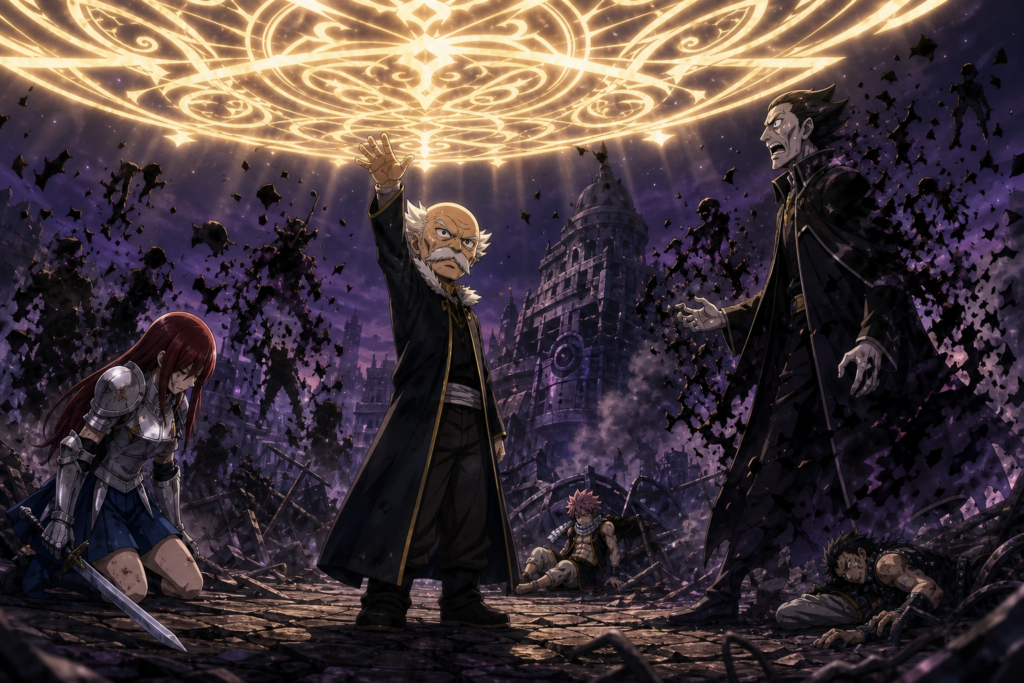
Bottom line: Episode 28 closes the Phantom Lord war by pairing two kinds of judgment. Natsu defeats Gajeel through support that restores his capacity without taking the fight away from him. Makarov defeats Jose with Fairy Law, a spell that distinguishes enemies from allies through the caster’s heart. Both victories reject indiscriminate power. The episode is satisfying because it does not pretend the guild hall is unbroken or that Lucy was never harmed. Winning stops the attack. Repair still has to begin.
The receipt box
- Episode: 28
- English title: Fairy Law
- Japanese title: フェアリーロウ
- Romanized title: Fearī Rō
- Original Japanese air date: May 3, 2010
- Series: Fairy Tail (2009–2013)
- Episode type: Manga canon
- Manga material: Chapters 64–66
- Arc: Phantom Lord
- Where to watch: Watch Fairy Law on Crunchyroll
- Spoiler boundary: This React discusses events through Episode 28 only.
Natsu's second wind belongs to a team
Episode 27 ended with Sagittarius creating fire so Natsu could eat. Episode 28 cashes that support immediately.
The replenishment does not make Lucy or Sagittarius decorative assistants. It proves that Natsu’s strength is relational even when his fist lands the final blow. Happy identified the need. Lucy used her remaining key. Sagittarius converted archery into ignition. Natsu then did what only he could do with the resulting flame.
Nobody becomes less capable because help was involved. The chain works because each participant contributes something distinct.
Fairy Tail’s version of power is not self-sufficiency. It is capacity that can move between people without erasing them.
Gajeel loses the advantage of a room built for him
Gajeel recovered by eating iron from Phantom Lord’s structure. Natsu initially had no corresponding resource.
Once Lucy changes that condition, the matchup becomes a test of what each Dragon Slayer does with replenished power. Gajeel no longer gets to treat environmental privilege as proof of natural superiority.
This is why the fire matters beyond spectacle. It removes an asymmetry.
Natsu still has to break through Iron Dragon’s Scales and survive Gajeel’s attacks. Support creates a fairer possibility, not a guaranteed result.
The decisive blow answers targeted cruelty
Natsu’s fury remains connected to what Gajeel did to Lucy, Levy, Jet, and Droy. The battle does not ask us to forget those choices because Gajeel is an exciting rival.
At the same time, Natsu’s goal is to stop him, not reproduce his behavior against another helpless body. The violence occurs between active combatants inside an ongoing attack.
That difference matters. Shōnen stories often make aggression visually interchangeable even when its ethics are not.
Natsu hits an opponent who continues trying to hurt his guild. Gajeel previously selected restrained and ambushed people to communicate dominance. Similar force does not mean similar purpose.
Lucy is allowed to witness the answer without becoming its property
Natsu protects Lucy, but he does not claim her as the prize for winning.
She remains the person who found the resource solution, spoke against Phantom Lord while captive, and chose trust before the final outcome was certain.
The rescue is reciprocal in a way romance-only framing would miss. Natsu interrupts Gajeel’s violence. Lucy makes Natsu’s continued resistance materially possible.
They do not owe each other possession. They have evidence that each will act when the other is in danger.
That is already a substantial relationship.
Erza has reached the limit a victory over Aria could not erase
Erza stopped Abyss Break after taking Jupiter’s blast. She then faced Jose while her body was already depleted.
Her refusal to surrender is emotionally credible, but the episode does not turn it into infinite stamina. Jose overwhelms her.
This protects the stakes and Erza’s humanity. If courage canceled accumulated injury, sacrifice would become cosmetic.
She has carried the guild across multiple emergencies. Reaching a limit is not a moral failure. It is the predictable result of one person being asked to absorb too much.
Jose wants hierarchy to look like natural law
Jose is one of the Ten Wizard Saints, as is Makarov. He treats that public status as confirmation that his private choices deserve obedience.
But a title cannot cleanse the contract to abduct Lucy, the attack on Magnolia, or the willingness to cast Abyss Break.
Institutional recognition tells us that Jose possesses unusual magic. It does not establish that he uses it justly.
The episode’s title answers him directly. If there is going to be law in this conflict, it will not be whatever the strongest official says while everyone else is trapped beneath his power.
Makarov returns as a parent who recognizes institutional failure
Makarov calls Fairy Tail’s members his children and says he should have ended the battle sooner.
The language is affectionate, but it also carries responsibility. He does not praise young members for absorbing unlimited harm on his behalf. He recognizes that leadership failed to contain a conflict that reached them.
This is an important correction to the heroic-parent fantasy. A parent does not earn devotion merely by arriving for the climax. Authority includes accountability for the conditions that made rescue necessary.
Makarov’s anger matters because it turns toward the adult leader who organized the harm, not toward the members who struggled to survive it.
Fairy Law is selective, and that selectivity is the ethical center
Fairy Law strikes those the caster recognizes as enemies while leaving allies untouched.
The spell is enormous, but its defining feature is discrimination rather than scale. It asks the caster’s heart to identify whom the judgment should reach.
That makes Fairy Law the opposite of Abyss Break. Jose’s weapon threatened everyone within its destructive area. Makarov’s spell passes through a crowded battlefield and distinguishes.
Powerful magic is not automatically ethical because it is selective. A corrupt caster could define enemies badly. The episode nevertheless establishes a standard: force should be accountable to intention and target, not simply admired for brightness.
The caster's heart is both protection and danger
Fairy Law’s targeting depends on Makarov’s inner judgment. That protects Fairy Tail members in this moment because his bonds are genuine and Jose’s aggression is clear.
It also raises a question the story should never ignore. What happens when a leader’s certainty is wrong?
Law cannot rely only on the goodness of one powerful person. Healthy institutions need procedures, evidence, challenge, and repair.
Episode 28 gives us an emergency where hesitation would prolong mass harm. Makarov’s decision works. The victory should not become a universal argument for unchecked magical authority.
Jose experiences the judgment he tried to monopolize
Throughout the arc, Jose has decided what Lucy is worth, what Fairy Tail deserves, and how much of Magnolia can be endangered for his contract.
Fairy Law removes his monopoly over consequences.
He is not defeated because Makarov presents a louder insult. He is defeated by a spell whose logic recognizes the hostility Jose spent the arc making visible.
The light functions as judgment because the preceding episodes supplied receipts. The story does not need us to accept a vague claim that Jose feels evil. We watched the choices.
Makarov and Jose reveal two models of guild leadership
Jose preserves himself while his subordinates power weapons, conduct kidnappings, and absorb the first wave of battle. Makarov returns before fully recovered because his members have already carried more than they should.
Neither model is perfect. Makarov’s guild culture often normalizes dangerous chaos, and his delayed response left members exposed. Still, the direction of obligation differs.
Jose believes the guild exists to extend the master’s will. Makarov believes the master is responsible for protecting the guild’s people.
That difference is more important than the shared Wizard Saint title.
Victory does not reverse the destruction
Gajeel falls. Jose falls. Phantom Lord’s attack stops.
Fairy Tail’s headquarters is still ruined. Members remain injured. Lucy has endured repeated abduction and targeted violence. Levy, Jet, and Droy are not magically returned to the night before the assault.
A decisive ending can create emotional relief without creating restoration.
This distinction protects survivors from a common narrative demand: the villain lost, so everyone should be fine now. Safety is the beginning of recovery, not proof that recovery has happened.
Lucy's family conflict remains larger than Phantom Lord
Jose accepted the job, but Lucy’s father initiated the contract that treated her return as something to purchase and enforce.
Defeating Phantom Lord removes the immediate machinery. It does not resolve the family structure that made the machinery profitable.
Lucy will still need to define her relationship to the Heartfilia estate and to a father who used institutional violence rather than conversation.
The guild can stand beside her. It cannot make that history disappear.
This is why the next episode’s focus on resolve matters. External rescue has to be followed by Lucy’s own decision about home.
Aria's final attempt confirms why boundaries need enforcement
After the main judgment, Aria attempts another attack on Makarov. Makarov stops him immediately.
The moment is brief, but it shows that some actors interpret mercy or pause as another opportunity to harm.
Boundaries are not only statements. They require consequences when someone tests them again.
Makarov does not reopen a theatrical duel. He closes the threat and makes the condition clear: continued aggression will not be tolerated.
That directness is more protective than an endless exchange designed to display dominance.
Fairy Law works because the guild has already practiced recognition
The spell’s magical selection echoes the social work Fairy Tail has done throughout the arc. Members keep identifying one another across distance, disguise, injury, and divided fronts.
Mirajane recognizes what Elfman needs. Gray recognizes Juvia as an opponent rather than a weather curse. Loke tries to reach Lucy. Lucy understands what Natsu needs. Erza knows where to send him.
Fairy Law makes recognition visible as light.
The final spell belongs to Makarov, but the moral grammar behind it has been practiced collectively.
Adaptation notes
Episode 28 adapts Chapters 64 through 66 and resolves the central battles of the Phantom Lord arc. Natsu completes his fight with Gajeel while Makarov returns to confront Jose and casts Fairy Law.
The parallel ending keeps the Dragon Slayer rivalry from swallowing the institutional conflict. Gajeel was Phantom Lord’s most visible attacker, but Jose authorized and escalated the war.
Both levels require an answer. Natsu stops the direct aggressor. Makarov addresses the leader and the remaining shades.
The next episode turns from battle resolution toward Lucy’s choice and the guild’s aftermath.
RaeRae's verdict
Episode 28 earns its light show because Fairy Law is not presented as destruction without thought. Its force depends on recognition.
That does not make magical judgment a healthy replacement for ordinary law. It makes this emergency response morally different from Jose’s indiscriminate weapons.
My favorite choice remains smaller: Lucy, Happy, and Sagittarius create fire for Natsu. The episode’s two victories share that foundation. Power becomes defensible when it protects specific people, respects their contributions, and refuses to flatten a crowd into acceptable damage.
Fairy Tail wins the war. The guild hall is still rubble, Lucy still has a father to confront, and everyone still has injuries to carry.
The light ends the attack. What they build afterward will tell us what the judgment was for.
Continue the watch
- Previous: Fairy Tail Episode 27 React: The Two Dragon Slayers
- Next: Fairy Tail Episode 29 React: My Resolve
- Browse every Fairy Tail episode
- Open the Fairy Tail Episode Reacts hub
- Return to the Fairy Tail hub
Sources
- Crunchyroll: Fairy Tail Episode 28, “Fairy Law”
- Fairy Tail manga, Chapters 64–66 by Hiro Mashima