
Fairy Tail Episode 27 React: The Two Dragon Slayers
The Two Dragon Slayers
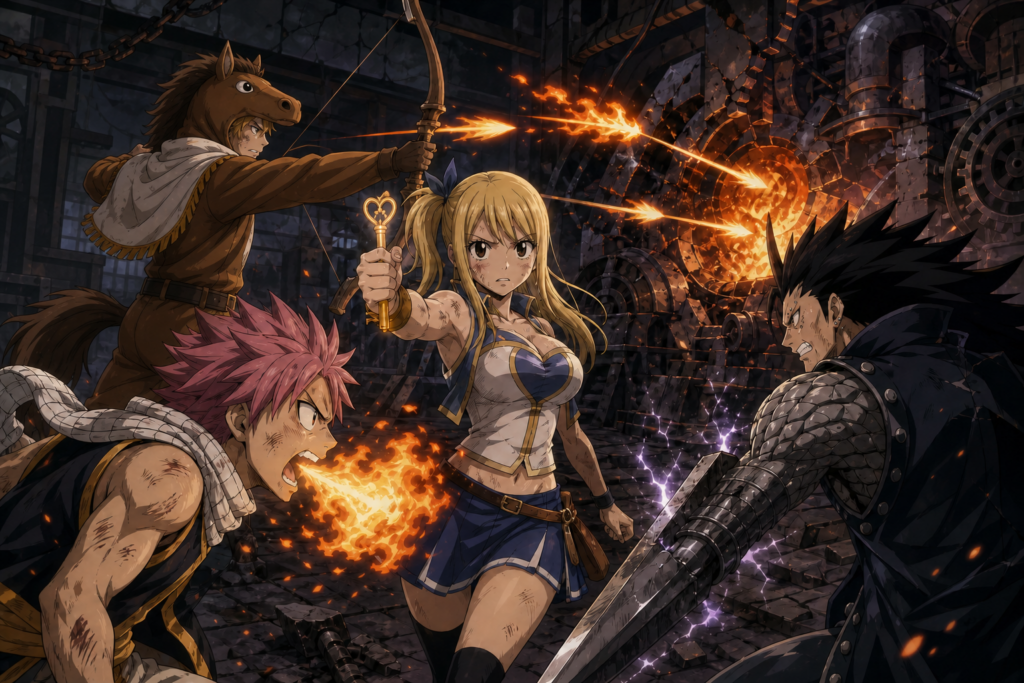
Bottom line: Episode 27 turns the Natsu and Gajeel fight into an argument about what a guild is allowed to mean. Gajeel treats Phantom Lord as a source of rank, protection, and material advantage. Natsu remembers Fairy Tail as the place where people taught him, fought with him, grieved with him, and made room for a blue cat hatching from an egg. Iron gives Gajeel a tactical edge. Memory gives Natsu a reason to keep choosing the fight. Lucy and Sagittarius then prove that support does not need to look impressive to change the outcome.
The receipt box
- Episode: 27
- English title: The Two Dragon Slayers
- Japanese title: 二人の滅竜魔導士
- Romanized title: Futari no Doragon Sureiyā
- Original Japanese air date: April 26, 2010
- Series: Fairy Tail (2009–2013)
- Episode type: Manga canon
- Manga material: Chapters 61–63
- Arc: Phantom Lord
- Where to watch: Watch The Two Dragon Slayers on Crunchyroll
- Spoiler boundary: This React discusses events through Episode 27 only.
The fight begins with anger that has an exact address
Natsu is not furious because another strong man challenged him. He is furious because Gajeel hurt Lucy while she was restrained and because Phantom Lord has spent days turning guild members into messages.
That distinction keeps the battle from becoming a generic contest between elemental brands. Natsu’s anger has evidence behind it: Levy, Jet, and Droy on the tree; Lucy abducted twice; the guild building attacked; Magnolia threatened by Jupiter and Abyss Break.
Anger can become reckless, but it can also identify a violated boundary. Episode 27 lets Natsu’s rage say that none of those people were disposable material for somebody else’s demonstration.
Two Dragon Slayers do not represent the same kind of power
Natsu and Gajeel share a magical category. Both learned Dragon Slayer Magic from dragons, both can consume their element, and both transform that element into physical force.
The similarity creates a tempting false equivalence. If their techniques mirror one another, perhaps their ethics do too.
They do not.
Power describes capacity, not character. Gajeel chose to target people who could not answer him equally. Natsu arrived to interrupt that control. The episode uses matched abilities to make the difference in purpose easier to see.
The question is never simply which Dragon Slayer is stronger. It is what each one believes strength permits.
Iron punishes Natsu for relying on familiar impact
Gajeel’s Iron Dragon’s Scales make every direct hit expensive. Natsu strikes him and damages his own hands. Fire that normally overwhelms an opponent cannot immediately solve a body turned into armor.
This gives the fight necessary structure. Natsu cannot repeat his normal rhythm and expect determination to rewrite material conditions.
Gajeel’s defense is not absolute, but it forces adaptation. Cracks appear. Both men take damage. The episode establishes that the iron body can be broken while refusing to make breaking it easy.
That balance is important in a rivalry. A counterpart should reveal limits, not merely wait to receive a protagonist’s signature move.
Matching roars make the shared lineage impossible to ignore
When fire and iron Dragon Roars collide, the visual symmetry places Natsu and Gajeel inside the same tradition.
Neither of them learned magic through an ordinary guild curriculum. Their absent dragon teachers sit behind the fight even though Igneel and Metalicana are not physically present.
The collision therefore carries an unspoken family question. What did each student inherit beyond technique? What did each one decide after the teacher disappeared?
The episode does not answer the full mystery yet. It does establish that ancestry cannot excuse conduct. A rare origin may explain why someone can do extraordinary things. It does not decide whom they choose to hurt.
Gajeel replenishes himself because the environment favors him
After the two fighters wear each other down, Gajeel eats iron from Phantom Lord’s structure. His guild headquarters is also a supply depot for his body.
Natsu has no equivalent flame available. The imbalance is practical, not moral. Gajeel planned or benefits from fighting where his resource is abundant.
This is what institutional advantage often looks like. One person appears naturally more resilient because the room was built to feed him.
Fairy Tail cannot answer by insisting Natsu should simply want victory more. Lucy has to change the resource conditions around him.
Lucy refuses the role of rescued spectator
Natsu reached Lucy before Gajeel could strike again, but rescue does not end her participation.
She studies the problem: Gajeel can eat iron, Natsu needs fire, and the room offers no obvious source. Her available key is Sagittarius, whose known skill does not initially match the need.
Lucy summons him anyway and asks a precise question.
That is competence under pressure. She does not pretend to have the right answer before acting. She brings in another capacity, communicates the constraint, and keeps searching when the first response is no.
The scene protects Lucy from becoming a prize placed behind the men’s battle. Her work changes whether Natsu can continue.
Sagittarius is useful because he listens past the literal request
Sagittarius cannot shoot fire. If usefulness meant performing the exact action Lucy first requested, the summon would be a failure.
Then Happy clarifies that Natsu needs flames to eat. Sagittarius recognizes that arrows can strike machinery and create an explosion.
This is collaborative problem solving in miniature. The group separates the desired outcome from the proposed method. They do not need a fire-producing archer. They need any safe-enough chain of actions that produces fire.
Sagittarius contributes through accuracy, not elemental magic. A specialized skill becomes relevant because someone reframes the problem.
The horse costume is not evidence that the spirit is unserious
Sagittarius arrives dressed like a horse and punctuates his speech with an awkward verbal habit. The design invites comedy at the exact moment the battle needs a practical solution.
Fairy Tail repeatedly asks viewers not to confuse presentation with worth. Happy is a small blue cat whose flight keeps people alive. Virgo’s maid imagery coexists with enormous physical ability. Sagittarius looks absurd and creates the opening Natsu needs.
Competence does not have one acceptable costume.
The humor also gives Lucy a breath without minimizing the danger. Relief and effectiveness occupy the same scene.
Destroying the guild building is an attack on accumulated life
Outside, Phantom Lord’s shades gather into a force that tears down Fairy Tail’s headquarters.
A building is replaceable. What happened inside it is not.
Natsu remembers arrival, conflict, instruction, Lisanna, Happy’s birth, loss, and Lucy. The guild hall stored the ordinary repetitions through which strangers became family. Its destruction cannot erase those experiences, but it is still violence against the place that held them.
Saying people matter more than property should never become permission to destroy the spaces people built together. Home is both relationship and material shelter.
The flashbacks explain belonging without pretending it was gentle
Natsu’s memories are not a polished montage of uninterrupted affection. Gray fought him. Erza disciplined him. He struggled to read. Lisanna died. Happy’s arrival carried joy beside later grief.
Fairy Tail became home through friction as well as comfort.
That matters because abusive groups also claim intensity and loyalty. The difference is not whether conflict exists. It is whether people retain personhood inside the conflict and whether the relationship can hold growth, repair, and mutual care.
Natsu remembers being shaped, not owned. The guild gave him more connections, not fewer choices.
Makarov's explanation of the name becomes a moral inheritance
Young Natsu once asked why the guild was called Fairy Tail. The question behind the name is whether fairies have tails, and the uncertainty points toward an endless adventure.
In Episode 27, that playful story becomes resistance to Phantom Lord’s certainty.
Jose’s institution is built around rankings, contracts, and visible dominance. Fairy Tail’s name begins with a question nobody can conclusively settle. Its identity permits curiosity.
Natsu is defending a place that taught him uncertainty could be shared rather than feared. That is a very different inheritance from a hierarchy that treats doubt as weakness.
Gajeel forces Natsu to watch because humiliation is part of the weapon
Gajeel does not merely benefit from the building’s destruction. He directs Natsu’s attention toward it.
The goal is psychological conversion: make the loss prove that resistance was foolish, that Fairy Tail’s bonds could not protect their home, and that Phantom Lord’s power defines reality.
Natsu grieves. He does not accept the interpretation.
Pain is evidence that something mattered. It is not evidence that loving it was a mistake.
That refusal is the emotional pivot of the episode. Natsu gets up without denying what has been lost.
Eating flame is dependence, and the story treats that as strength
Natsu’s recovery requires Happy to name the need, Lucy to summon a spirit, Sagittarius to reinterpret his skill, and the surrounding machinery to provide combustible energy.
The protagonist does not manufacture his second wind from pure individual will.
He eats what other people make possible.
That is an excellent expression of guild power. Support does not replace Natsu’s effort. It restores his capacity to make an effort. Interdependence is not the opposite of agency. It is often the condition that keeps agency available.
Lucy's magic works through relationship rather than possession
Celestial Spirit Magic can look contractual in a way that superficially resembles Phantom Lord’s arrangement with Lucy’s father. Both involve written agreements and access.
The ethical content is completely different.
Lucy’s spirits speak, object, interpret, and contribute their own judgment. Sagittarius does more than obey a command. He understands the team’s need and chooses a method.
Jose’s contract reduces Lucy to an object being transferred. Lucy’s contracts create partnerships with subjects who remain themselves.
Episode 27 places those models close together and lets the relational one produce the decisive resource.
Natsu stopping iron with his hands is a boundary made physical
Once replenished, Natsu catches Gajeel’s Iron Dragon’s Roar and advances.
The image reverses the episode’s opening problem. Iron initially made contact punish Natsu. Now he stops a concentrated iron attack without allowing it to dictate distance.
The change is not arbitrary. He has fuel, accumulated knowledge of Gajeel’s rhythm, and a reason clarified by witnessing the guild’s destruction.
His declaration that attacking Fairy Tail was a mistake is not a claim that the guild cannot be hurt. We have just watched it be hurt extensively. It is a promise that harm will meet organized resistance.
The episode understands that a home can survive demolition and still need rebuilding
Fairy Tail continues through its people, but the ruined building should not be dismissed as cosmetic damage.
Members will need shelter, work infrastructure, archives, gathering space, and the rituals the hall supported. Emotional continuity does not replace material repair.
The episode holds both truths. Phantom Lord cannot destroy the guild merely by destroying its headquarters. Phantom Lord has nevertheless caused a real loss.
Resilience is not pretending nothing was taken. It is refusing to let what was taken become the final definition of what remains.
Adaptation notes
Episode 27 adapts Chapters 61 through 63. The anime expands the destruction of the guild headquarters by having Phantom Lord’s Shade Troopers combine into a large dark form rather than relying only on the manga’s battering-ram action.
The expanded destruction gives Natsu’s memory sequence a visible present-tense counterpoint. As the physical hall comes apart, the episode reconstructs its meaning through his relationships.
The battle remains unresolved at the ending. Natsu has recovered, Gajeel has lost the easy advantage of exclusive access to fuel, and the fight moves toward its decisive phase.
RaeRae's verdict
Episode 27 could have settled for the novelty of fire versus iron. Instead, it asks what feeds each fighter.
Gajeel eats the building around him because Phantom Lord was structured to support his element. Natsu eats flames created by Lucy, Sagittarius, and Happy solving a problem together. One resource comes from institutional advantage. The other comes from cooperation.
Natsu’s memories do not give him magic by themselves. They tell him why accepting Gajeel’s interpretation of the ruins would be another loss. Lucy’s action then supplies the actual fuel.
That combination is the episode’s best choice. Feeling matters. Material support matters too.
The two Dragon Slayers may share a magical lineage. Only one of them is being carried forward by people who still get to remain people.
Continue the watch
- Previous: Fairy Tail Episode 26 React: Wings of Flame
- Next: Fairy Tail Episode 28 React: Fairy Law
- Browse every Fairy Tail episode
- Open the Fairy Tail Episode Reacts hub
- Return to the Fairy Tail hub
Sources
- Crunchyroll: Fairy Tail Episode 27, “The Two Dragon Slayers”
- Fairy Tail manga, Chapters 61–63 by Hiro Mashima