
Fairy Tail Episode 26 React: Wings of Flame
Wings of Flame
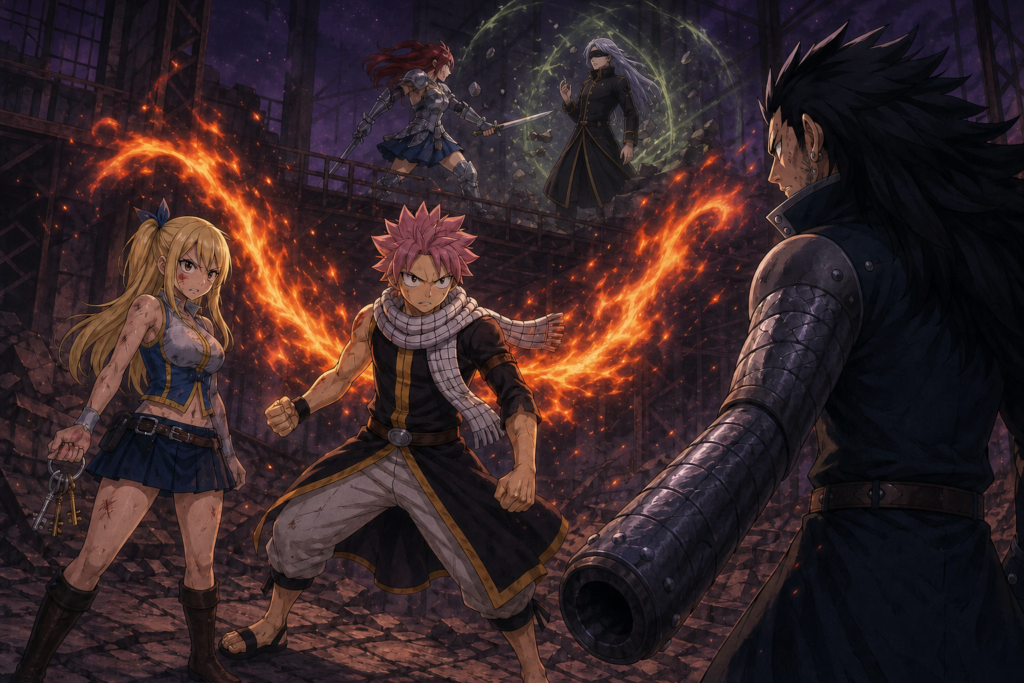
Bottom line: Episode 26 is not about proving who can hit hardest. It is about what power is for. Aria uses magic to empty other people. Jose uses it to turn fear into government. Erza, already injured, spends what she has left stopping a mass-casualty spell and then tells Natsu to use his strength for Lucy. Lucy, meanwhile, refuses to let captivity write Phantom Lord’s version of her. The wings in this title belong to more than fire. They belong to trust moving faster than control.
The receipt box
- Episode: 26
- English title: Wings of Flame
- Japanese title: 炎の翼
- Romanized title: Honō no Tsubasa
- Original Japanese air date: April 19, 2010
- Series: Fairy Tail (2009–2013)
- Episode type: Manga canon with anime-expanded kidnapping material
- Manga material: Chapter 58 from page 7 through Chapter 60
- Arc: Phantom Lord
- Where to watch: Watch Wings of Flame on Crunchyroll
- Spoiler boundary: This React discusses events through Episode 26 only.
Aria attacks the part of a mage nobody else can see
Aria’s Airspace Magic makes a cruel opponent for Natsu because it does not meet fire with a more impressive element. It changes the conditions around him. Natsu cannot punch an absence, and he cannot burn through an attack he struggles to locate.
That mismatch matters. Fairy Tail has trained us to expect Natsu’s determination to convert pressure into momentum. Aria turns pressure into depletion. He removes magic rather than simply absorbing damage, repeating what he did to Makarov.
The fight exposes the limit of treating persistence as a universal solution. Natsu keeps standing, but standing inside a system designed to drain him is not the same as gaining ground. Courage is still present. It is simply not sufficient by itself.
Being fired up does not make Natsu invulnerable
Natsu’s signature phrase is usually a promise that emotional heat will become physical force. Episode 26 briefly refuses that conversion.
He can be furious, loyal, and ready to fight while still being outmatched by a particular technique. That does not diminish him. It makes his eventual growth more credible because the story allows power to have structure.
Aria’s advantage comes from control of space and magic flow. Natsu’s usual direct approach gives him few tools against it. The episode lets a protagonist need rescue without turning that rescue into humiliation.
Natsu is not less heroic because Erza arrives. He is part of a guild precisely because no one member should have to solve every threat alone.
Erza enters injured because the alternative is worse
Erza has already taken Jupiter’s blast. Her body has every reason to remain down. She rises because Aria is preparing to do to Natsu what he did to Makarov, and because Abyss Break threatens everyone below.
This is not a health lesson about ignoring injury. Erza’s decision is emergency triage under catastrophic conditions. Rest is normally necessary. Here, refusing to move would leave a mass attack powered and a guildmate drained.
The distinction matters because stories often romanticize women who continue caring through unbearable pain. Erza’s worth does not come from being endlessly usable. Her action has meaning because it is a choice made in a narrow crisis, not a permanent obligation to sacrifice herself whenever others need help.
Aria's closed eyes are restraint without ethics
Aria normally keeps his eyes shut to contain his power. On the surface, that sounds disciplined. The problem is that restraint serves no moral principle if the stored power is eventually released to erase life.
He treats control as proof of superiority. He can regulate the weapon, therefore he believes he has earned the right to use it.
Erza rejects that logic. Her anger is not fear of strong magic. Fairy Tail contains plenty of dangerous abilities. She condemns the willingness to take lives casually.
Technical mastery answers whether someone can deploy power. Ethics answers whether they should. Aria has trained the first question while abandoning the second.
Erza's victory is fast because her decision is already complete
Aria builds himself as the strongest of the Element 4. He removes his blindfold, expands the danger, and expects fear to create time for spectacle.
Erza cuts through his airspace and ends the fight.
The speed is the point. She does not enter to measure him, prove herself, or enjoy a duel. She enters to stop Abyss Break and protect Natsu. Once her path is clear, Aria’s theater has no value.
Her Heaven’s Wheel attack is not evidence that the preceding damage did not matter. She collapses afterward. The victory cost remains visible even though the decisive exchange is brief.
Stopping Abyss Break shows why distributed courage works
The Element 4 have been powering one enormous spell from separate positions. Fairy Tail answers with separate fighters who each remove one piece of the system.
Elfman defeats Sol. Gray defeats Juvia. Natsu and Erza confront Aria after Totomaru falls. No single victory is enough until the network loses its final support.
This structure gives supporting characters material consequences. They are not clearing rooms while waiting for the lead to solve the real problem. Their fights change whether Magnolia survives.
The guild’s strength is not merely friendship as a feeling. It is coordination under pressure, with different people carrying work that cannot safely be concentrated in one body.
Jose enters after his subordinates absorb the risk
Jose waits while the Element 4 operate the spell, Gajeel retrieves Lucy, and Phantom Lord’s shades exhaust Fairy Tail. Then he steps into the room with overwhelming magical pressure.
That is hierarchy working exactly as intended for the person at the top. Others take exposure while leadership preserves force and controls the timing of escalation.
Jose calls this superiority. The episode shows the machinery beneath it. His power is real, but so is his willingness to treat guild members as replaceable parts.
Fairy Tail’s members also take risks for one another. The difference is consent and reciprocity. Erza does not spend Elfman so she can remain pristine. She spends herself because the danger reaches everyone.
Pure evil is not a substitute for politics
The story describes Jose’s magic as terrifyingly evil, and the immediate physical effect communicates danger. Still, his actions are more revealing than an aura.
He accepted a private contract to abduct Lucy, escalated it into open war, attacked a city, and prepared a spell that would harm people far beyond the original dispute. He uses institutional status to make private domination look legitimate.
Calling him evil should not hide that sequence. Villains become easier to understand when we examine how they turn authority, money, and fear into permission.
Jose is dangerous not because darkness happens to surround him. Darkness surrounds a man who has repeatedly chosen control over human life.
Erza's heart is strengthened by people, not owned by them
Jose cannot understand how Erza remains standing after Jupiter. She answers through her bond with her friends.
That line can be flattened into a familiar power-of-friendship slogan, but the episode has earned something more specific. Gray, Elfman, Mirajane, Natsu, Lucy, and the wider guild have all acted on different fronts. Erza is carrying evidence that other people are still carrying her.
Connection does not eliminate pain. It changes what the pain means. Her injury is no longer a private test of endurance. It is one part of collective resistance.
Jose hears attachment and imagines leverage. Erza experiences attachment as shared capacity. Their definitions of relationship are opposites.
Lucy refuses to perform gratitude for her captors
Gajeel has Lucy physically contained and expects that imbalance to settle the moral argument. Instead, she names Phantom Lord’s weakness.
They needed a contract, a surprise attack, a giant weapon, multiple kidnappings, and violence against injured or restrained people. None of that looks like the confidence of an unquestionably superior guild.
Lucy’s defiance does not magically protect her body. Gajeel hurts her. The scene is difficult because courage receives no immediate shield.
Still, her speech matters. Captivity is also an attempt to control narrative. Lucy denies him the clean story in which Phantom Lord won because it deserved to.
Gajeel mistakes access to a body for authority over a person
Gajeel attacks Lucy because he is bored and because the structure around him permits it. The casualness makes the violence more revealing, not less.
He is not fighting an opponent who can currently answer on equal terms. He is testing how much control the room grants him.
Lucy challenges him with the certainty that Fairy Tail will not forget. That is not a request for men to avenge her honor. It is a statement that community survives separation and coercion.
Gajeel can reach her body. He cannot force her to agree that she has become disposable.
Lucy's threat is really a promise about belonging
When Lucy says Fairy Tail will pursue Phantom Lord, she is speaking from a membership she only recently gained.
Episode 2 introduced her as someone desperate to join the guild she admired. Episode 26 lets her speak as someone who knows the bond is reciprocal.
She does not need to earn rescue by being calm, agreeable, or strategically useful. Phantom Lord’s contract may assign a price to her capture, but Fairy Tail does not reduce her to that price.
Her confidence shows how quickly genuine belonging can alter a person’s internal options. She can be afraid and still refuse the identity her captors offer.
Natsu rises through the floor as an answer, not an owner
Natsu’s arrival works because Lucy has already defended her own personhood. He does not give her courage retroactively. He answers the promise she made.
The rescue image is spectacular, but its ethics depend on that sequence. Lucy resists. Natsu arrives. Their agency connects without one erasing the other.
Erza sends him toward Lucy because she understands where his strength is most needed. This is leadership as allocation, not command for its own sake.
Natsu leaves the stronger opponent behind and trusts Erza’s judgment. Charging toward Gajeel is not abandonment. It is the guild dividing an impossible battlefield again.
The title turns clipped wings into collective motion
Aria describes Natsu as a dragon whose wings of flame will rot and fall. He wants defeat to mean permanent diminishment.
The episode answers by moving Natsu through other people’s strength. Erza interrupts the drain. Her victory stops Abyss Break. Her trust sends him toward Lucy. Lucy’s defiance gives the rescue moral direction.
The wings are therefore not a solo power-up. They are a chain of people making movement possible.
Fire still belongs to Natsu’s magic, but flight comes from relationship. The episode’s strongest image is not a hero proving he never needed help. It is help becoming momentum.
Adaptation notes
Episode 26 adapts the remainder of Chapter 58 plus Chapters 59 and 60. It also expands the circumstances around Lucy’s kidnapping with additional Phantom Lord members and rearranges the order of the Jose and Gajeel sequences.
The anime’s cross-cutting makes the two forms of domination answer each other. Jose tries to crush Erza’s collective faith while Gajeel tries to crush Lucy’s individual defiance. Both believe control of the room equals control of the person.
Neither succeeds. Erza remains oriented toward her guild even while injured. Lucy remains oriented toward hers while captive. Natsu’s arrival connects those two refusals and points directly toward the next battle.
RaeRae's verdict
Episode 26 gives Erza one of her clearest early statements of purpose. She is not impressive because pain cannot reach her. She is impressive because pain does not make Jose’s values correct.
Aria has more available force than Natsu in their matchup. Erza has less available health than almost anyone in Phantom Mk II. Lucy has almost no physical leverage in Gajeel’s room. The episode keeps asking whether advantage determines truth.
It does not.
Fairy Tail stops Abyss Break through distributed victories. Lucy refuses the captor’s story before rescue arrives. Erza turns trust into a decision about where Natsu should go next.
The wings of flame are not proof that Natsu stands alone. They are what appear when a guild refuses to let any one person fall alone.
Continue the watch
- Previous: Fairy Tail Episode 25 React: A Flower Blooms in the Rain
- Next: Fairy Tail Episode 27 React: The Two Dragon Slayers
- Browse every Fairy Tail episode
- Open the Fairy Tail Episode Reacts hub
- Return to the Fairy Tail hub
Sources
- Crunchyroll: Fairy Tail Episode 26, “Wings of Flame”
- Apple TV: Fairy Tail Season 1, Episode 26
- Fairy Tail manga, Chapters 58–60 by Hiro Mashima