
Fairy Tail Episode 21 React: Phantom Lord
Makarov will rebuild damaged walls. He will not let Phantom Lord use his children as a message.
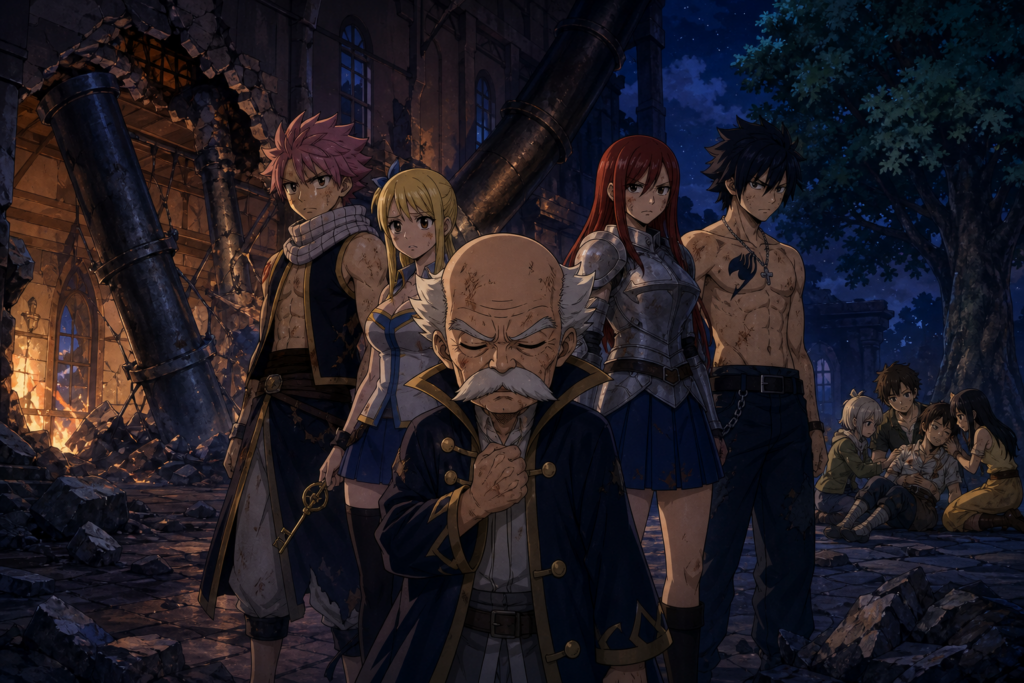
Bottom line: Episode 21 destroys Fairy Tail’s building and Makarov refuses to turn damaged property into a guild war. Then Phantom Lord attacks Levy, Jet, and Droy and displays their injured bodies as a message. The threshold changes because the harm changes. Makarov is willing to rebuild walls. He is not willing to teach an enemy guild that his children can be used as stationery.
The receipt box
- Episode: 21
- English title: Phantom Lord
- Alternate dub title: The Phantom Lord
- Japanese title: 幽鬼の支配者
- Romanized title: Yūki no Shihai-sha
- Original Japanese air date: March 8, 2010
- Series: Fairy Tail (2009–2013)
- Episode type: Manga canon
- Manga material: Chapter 46 from page 16, Chapter 47, and Chapter 48
- Arc: Phantom Lord
- Where to watch: Watch Phantom Lord on Crunchyroll
- Spoiler boundary: This React discusses events through Episode 21 only.
Fairy Tail comes home to a warning
Team Natsu returns from work and finds the guildhall impaled by metal beams.
The attack is designed for an audience. Phantom Lord does not merely damage a rival’s property. It changes a familiar public building into a display of reach. The message is that Fairy Tail can be entered, marked, and humiliated without warning.
Natsu responds as if the building itself were a wounded person. That reaction makes sense. The guildhall is where he grew up, where Happy hatched, where jobs become adventures, and where absent people remain present in stories.
Home is material and relational. Destroying the material part can still injure the relationship people have with safety.
Makarov distinguishes insult from a reason to start a war
Makarov stops the immediate rush toward retaliation. Buildings can be repaired. A guild war would expose members and civilians to far greater harm.
This is not weakness.
Leadership requires separating emotional urgency from strategic necessity. Phantom Lord wants a response it can shape. If Fairy Tail charges immediately, anger becomes the enemy’s command structure.
Makarov absorbs the humiliation because the alternative could cost lives. He does not deny that the attack matters. He refuses to let damaged walls make the decision for him.
Restraint is credible here because Makarov has the power to retaliate. He is choosing not to use it yet.
A building can be sacred without becoming worth more than people
Fairy Tail’s guildhall holds years of memory. Treating it as replaceable does not mean treating it as meaningless.
Makarov’s response establishes a hierarchy of care. The building serves the guild. The guild does not exist to avenge the building at any cost.
Institutions often reverse that order. They protect property, reputation, and procedure while asking injured people to remain patient. Episode 21 begins by placing property below life.
That makes Makarov’s later decision legible. He is not inconsistent when he refuses war after the building and declares war after members are attacked. The protected object has changed.
Walls can carry history. People carry futures.
Phantom Lord escalates because restraint is mistaken for permission
An aggressor can interpret de-escalation in two ways: as an opportunity to stop or as evidence that more harm will be tolerated.
Phantom Lord chooses the second.
The attack on Shadow Gear moves from property damage to targeted bodily violence. Levy, Jet, and Droy are not injured accidentally during a clash. They are selected, beaten, and displayed.
This is violence as communication. Their bodies are used to write a message to Fairy Tail.
That use adds another layer of violation. Phantom Lord does not only hurt three people. It denies them control over who sees their pain and what meaning gets attached to it.
Levy is targeted as more than the quiet book girl
Levy’s presence in Episodes 19 and 21 creates a brutal contrast. She recently served as the guild’s translator and problem-solver. Now an enemy uses physical force to reduce her to evidence of vulnerability.
This is how violent organizations choose symbolic targets. They do not need to defeat the strongest fighter first. They attack someone whose injury will travel emotionally through the whole group.
Levy matters to Fairy Tail through knowledge, friendship, and daily participation. Her value is not measured by whether she can overpower Gajeel.
The attack relies on a hierarchy in which the physically vulnerable are acceptable surfaces for a stronger person’s message. Makarov rejects that hierarchy when he treats harm to Levy, Jet, and Droy as harm to the entire guild.
Jet and Droy are not background decoration for Levy's pain
The scene can easily be remembered as “what happened to Levy,” but Jet and Droy are victims too.
Shadow Gear is a team. Phantom Lord attacks the three of them together and displays them together. Their injuries should not disappear because Levy becomes the emotional focus of later storytelling.
This matters for how ensemble stories distribute sympathy. Named women often receive close-up vulnerability while male teammates become proof that an attacker is broadly violent. All three people deserve recognition as persons, not set dressing around somebody else’s arc.
The guild’s response includes them because membership is not ranked by narrative importance.
Gajeel turns strength into public terror
Gajeel’s assault demonstrates power, but not courage. He chooses isolated guild members and converts surprise into spectacle.
Strength without accountability is useful to an organization like Phantom Lord. It gives the guild plausible pride while leadership directs where violence lands. The individual fighter gets to call himself powerful. The institution gets intimidation.
The attack also creates a false comparison with Natsu. Both are Dragon Slayers. Both are destructive and impatient. That surface similarity will tempt viewers to treat them as mirror images.
Episode 21 already marks the difference. Natsu destroys while protecting or reacting. Gajeel deliberately turns injured people into a message.
Power type does not determine ethics. Choice does.
Makarov's language of children is responsibility, not ownership
Makarov refers to guild members as his children. That language can become controlling when a leader uses family to demand obedience, silence criticism, or erase boundaries.
Here, he uses it to name his obligation.
He does not say the members belong to him, therefore only he may harm them. He says their safety is a responsibility he cannot outsource. Phantom Lord crossed a line by treating people under his care as instruments.
Family language becomes ethical when it increases what the powerful owe the vulnerable. It becomes abusive when it increases what the vulnerable owe the powerful.
Makarov’s declaration works because the obligation points downward from leader to members.
Declaring war is still a dangerous decision
The attack justifies intervention. It does not make every form of retaliation wise.
Makarov leads the guild toward Phantom Lord because inaction would invite continued targeting. Yet war will expose more members to injury, escalate conflict between legal guilds, and risk people who had no role in the initial attack.
The episode wants the march to feel righteous, and emotionally it does. The leadership question remains: how do you stop an organization that uses restraint as permission without copying its disregard for people?
Fairy Tail needs objectives beyond “make them pay.” Protect members. Stop further attacks. Identify leadership responsibility. Avoid treating every Phantom Lord member as equally culpable.
Anger can begin the movement. It cannot be the whole plan.
The Magic Council's system has already failed before the war begins
Both Fairy Tail and Phantom Lord are legal guilds operating within an official structure. That structure is supposed to regulate jobs, conduct, and conflict.
Phantom Lord can still attack a rival headquarters and brutalize members before meaningful protection arrives.
This exposes a gap between regulation and safety. Institutions often become visible after harm, when they can punish everybody for escalation, rather than before harm, when prevention would require confronting a powerful actor.
Fairy Tail’s unauthorized Galuna mission drew immediate internal concern. Phantom Lord’s organized violence reaches the guild directly.
Rules are only as protective as the willingness to enforce them against the people most able to ignore them.
Lucy enters an old conflict without knowing its cause
Lucy is still new to Fairy Tail. She returns from Galuna Island, learns about the attack, and watches a guild she recently chose move toward war.
New membership becomes frightening here. The family promise includes histories and enemies she did not create. She cannot know yet why Phantom Lord chose this moment or how far the conflict will reach.
That uncertainty does not make her less involved. Once an aggressor treats the guild as one target, newcomers do not receive exemptions.
The episode lets the audience share Lucy’s partial view. We understand the immediate harm before we understand every motive behind it.
That is often how violence arrives: consequence first, explanation later.
The tonal shift works because the previous episodes built home
Episodes 19 and 20 spend time inside the guildhall. Changeling turns it into a chaotic body-swap clinic. The dragon egg memory shows Happy hatching there among younger members.
Episode 21 then damages that space.
The sequence gives the attack weight without needing a speech about architecture. We just watched the building hold comedy, archive, childhood, and care. Metal beams through the walls therefore strike more than a set.
This is why quieter episodes matter in an action series. They establish what action threatens.
If every scene were a battle, destruction would become visual punctuation. Because the guildhall has daily life, its damage feels like intrusion.
The attack turns private pain into group identity
When Levy, Jet, and Droy are found, their injuries belong first to them. The guild’s collective outrage must not erase that ownership.
At the same time, solidarity means refusing to isolate victims inside a private problem. Phantom Lord chose them because of the mark connecting them to Fairy Tail. The guild has to respond as a community.
The balance is difficult. Do not use victims as mascots for retaliation. Do not leave them alone because respecting privacy feels safer than action.
Episode 21 leans hard toward collective response. Later consequences will test whether the guild can keep the injured members’ needs visible after the march begins.
Fairy Tail's unity is both defense and vulnerability
The guild’s members care intensely about one another. That bond mobilizes immediate protection. It also gives enemies a clear pressure point.
Phantom Lord does not need to defeat every powerful mage separately. It can hurt one team and provoke the entire guild into predictable movement.
Community therefore requires more than loyalty. It requires strategy strong enough to keep love from becoming an easily pulled lever.
Makarov’s first restraint shows he understands that. His declaration of war shows the limit of restraint when people remain in danger.
The challenge is acting together without letting the attacker choose every term.
Adaptation notes
Episode 21 adapts the end of Chapter 46 and continues through Chapters 47 and 48. The anime expands the sense of guild life around the attack and adjusts which members discuss possible retaliation.
The structure uses two thresholds. The first attack damages the guildhall. Makarov refuses escalation. The second attack targets Shadow Gear. Makarov declares war.
That repetition is not delay. It defines the leader’s values through contrast.
The episode closes the distance between symbolic violence and bodily violence, then sends the full guild toward Phantom Lord.
RaeRae's verdict
Episode 21 begins a guild war by asking what a leader is willing to lose.
Makarov will lose a building before he spends his members’ bodies defending his pride. Phantom Lord reads that restraint as weakness and attacks Levy, Jet, and Droy. The injured team becomes a public message, and the moral category changes.
The march toward Phantom Lord is satisfying because we understand the line that was crossed. It is also dangerous. Righteous anger does not make everyone in its path equally guilty.
Makarov calls the guild his children. Now he has to prove that family language means protection rather than permission to spend them in revenge.
Phantom Lord damaged the house. Fairy Tail kept still. Then it used people as the next wall to write on.
The guild is done being stationery.
Continue the watch
- Previous: Fairy Tail Episode 20 React: Natsu and the Dragon Egg
- Next: Fairy Tail Episode 22 React: Lucy Heartfilia
- Browse every Fairy Tail episode
- Open the Fairy Tail Episode Reacts hub
- Return to the Fairy Tail hub
Sources
- Crunchyroll: Fairy Tail Episode 21, “Phantom Lord”
- Fairy Tail manga, Chapters 46–48 by Hiro Mashima