
Fairy Tail Episode 20 React: Natsu and the Dragon Egg
Natsu expects a dragon, while Lisanna helps him make room for the child who actually arrives.
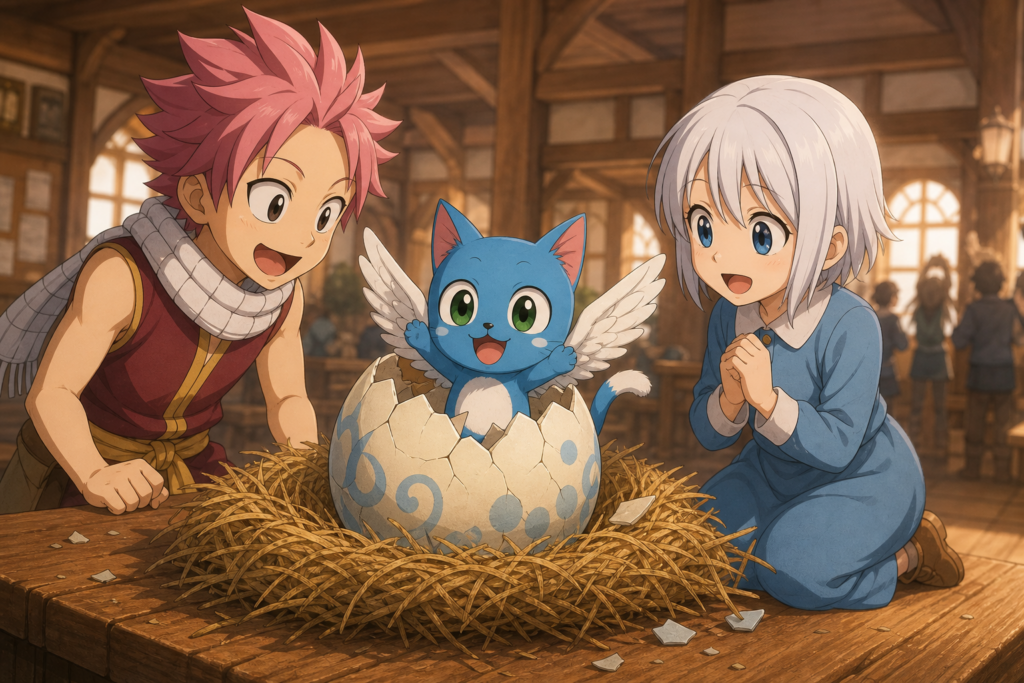
Bottom line: Episode 20 explains Happy’s name by returning to the guild six years earlier, when Natsu found an egg and decided it had to be a dragon. Lisanna helped him build a nest, feed the mystery, and imagine a family before either child knew what would hatch. Happy arrives not as proof that Natsu was right, but as the life their care made room to welcome.
The receipt box
- Episode: 20
- English title: Natsu and the Dragon Egg
- Japanese title: ナツとドラゴンの卵
- Romanized title: Natsu to Doragon no Tamago
- Original Japanese air date: March 1, 2010
- Series: Fairy Tail (2009–2013)
- Episode type: Manga omake adaptation
- Manga material: Natsu and the Dragon Egg, later collected with Volume 15
- Timeline: The central memory takes place six years before Lucy joins Fairy Tail
- Where to watch: Watch Natsu and the Dragon Egg on Crunchyroll
- Spoiler boundary: This React discusses events through Episode 20 only.
A drawing turns the guild archive into family history
Lucy finds an old drawing while helping Mirajane with stored guild material. The image includes younger versions of people Lucy knows, a dragon, and an absence she cannot explain.
Archives work like this. A single object can reveal that the present arrangement was never inevitable. Friends once looked different. Rivalries had earlier shapes. Somebody important occupied the room before the newcomer knew there was a room to join.
Mirajane tells the story rather than treating Lucy’s question as intrusion. That choice welcomes Lucy deeper into the guild. Membership is not only access to current jobs and current jokes. It is permission to learn which memories built the people beside you.
The episode begins with Happy’s origin and quietly becomes a lesson in how families transmit history.
Natsu sees an egg and makes hope louder than evidence
Young Natsu finds a large patterned egg and concludes it belongs to a dragon.
The conclusion makes emotional sense before it makes biological sense. Igneel disappeared from Natsu’s life. A dragon egg offers a route back toward the family he lost. If the egg hatches into a dragon, Natsu can care for the kind of being who once cared for him.
He is not conducting research. He is recognizing a possibility his grief desperately wants.
That does not make his excitement fake or foolish. Children often build hope from incomplete evidence because waiting for certainty would mean never beginning. The important question is what they do while the answer remains unknown.
Natsu protects the egg.
Lisanna joins the work instead of correcting the fantasy
Lisanna does not need to believe every detail of Natsu’s dragon theory to help him care for the egg. She enters the project through practical acts: building a place for it, keeping it safe, and sharing the waiting.
That is kindness without condescension.
An adult or older child could have laughed, announced the species was impossible to identify, and left Natsu alone with his attachment. Lisanna lets reality arrive on its own schedule. In the meantime, the egg genuinely needs care.
Her response separates factual agreement from relational support. You can question a conclusion and still help someone act responsibly toward the thing in front of them.
The friendship grows through labor, not a speech about friendship.
The nest is an early version of home
Natsu and Lisanna construct a nest for a creature neither has met. They are preparing shelter for a future resident.
That is what Fairy Tail does at its best. The guild makes room before a person can prove usefulness. Its standards are inconsistent and its building insurance must be fictional, but belonging is rarely reserved for the already polished.
The nest also gives Natsu a form of agency after Igneel’s disappearance. He cannot force his dragon parent to return. He can become the person who stays beside an egg.
Care does not restore what he lost. It lets loss become something other than an empty search.
Imagined parenting reveals what the children need
Natsu and Lisanna play with the idea of becoming parents to whatever hatches. The fantasy is sweet because both are still children.
It also reveals their understanding of family. A parent feeds, protects, worries, teaches, and remains. Biology is not the first requirement they discuss. Presence is.
Natsu learned family from a dragon who raised a human child. Lisanna belongs to a sibling household shaped by Mira and Elfman. Neither has reason to treat species as a boundary around kinship.
The egg makes that flexible idea visible. They are ready to love a dragon, a bird, or a mystery. The relationship begins before classification.
The guild's teasing tests whether care can survive an audience
Fairy Tail is not a quiet place to nurture anything. Other children comment, compete, doubt, and turn Natsu’s project into public entertainment.
Teasing can strengthen intimacy when everybody retains dignity. It can also make tenderness feel unsafe. Natsu protects himself through volume and certainty. If he insists loudly enough that the egg contains a dragon, nobody has to see how much he needs that hope.
Lisanna’s participation changes the balance. Natsu is not the only person treating the egg as worthy of care. One ally can keep a group joke from becoming isolation.
The episode understands that children often need witnesses who will not punish sincerity.
Young Mira, Elfman, Erza, and Gray make the past feel inhabited
The flashback does more than place smaller character designs around Natsu. It shows that the guild’s current relationships have history.
Mira is not yet the gentle front-desk presence Lucy knows. Elfman’s ideas about strength are still developing inside his sibling relationships. Erza and Gray already carry recognizable traits, but they have not become the exact adults introduced in Episode 1.
This matters because Lucy entered a family in progress. She did not create the group’s bonds, and she is not excluded by arriving later. Learning the earlier versions helps her understand that everyone joined an ongoing story at some point.
There is no original configuration that makes later love counterfeit.
Happy hatches and disproves Natsu without disappointing him
The egg does not contain a dragon. It contains a blue, winged cat.
Natsu is wrong about the species and right about the importance.
That combination gives the reveal its warmth. The story does not shame him for hoping. Happy’s value is not measured by proximity to the dragon Natsu expected. The moment the shell opens, the imagined child becomes a specific person.
Healthy care allows that revision. It prepares for somebody, then lets the somebody who arrives replace the fantasy.
Natsu does not reject Happy for failing to solve the mystery of Igneel. He recognizes a new relationship.
A name records what a life did to the room
The guild names him Happy because his birth changes the emotional temperature. Conflict and tension give way to shared delight.
Names can become cages when adults use them to prescribe a child’s personality. A person named Happy is still allowed fear, anger, grief, and irritation. The episode works because the name begins as a record, not an order.
This child brought happiness when he arrived.
Happy grows into someone capable of far more than cheerful mascot work. He carries Natsu, challenges Carla, confronts fear, and makes choices rooted in loyalty. The origin of his name should not flatten that range.
Joy is part of his history, not the limit of his personhood.
Natsu and Happy become family through repetition
Hatching creates the meeting. It does not create six years of trust in one instant.
Natsu and Happy become brothers through repeated life: meals, missions, arguments, training, travel, danger, and return. Episode 20 frames the beginning without pretending beginnings complete relationships.
That is why a present-day quarrel can coexist with love. Family members do not stop being family when they irritate each other. Repair matters more than permanent harmony.
The flashback gives their current bond depth. Happy is not an accessory Natsu acquired before the story. He grew up beside him.
They have been choosing each other since the shell opened.
Lisanna's absence changes the story Mirajane tells
Lucy notices Lisanna in the old memory without knowing the full weight of her place in the Strauss family and Natsu’s childhood.
Mirajane’s narration carries an absence the episode does not fully explain. She can tell the story of Happy’s birth, but the person who shared the nest-building is not standing in the present guildhall.
That gap gives the cheerful episode a quiet ache. Family archives preserve people who cannot answer new questions themselves. The storyteller decides how much to reveal, when to stop, and which joy can be remembered without turning immediately into an account of loss.
Lucy deserves the truth. Mirajane also deserves agency over how she tells a painful family history.
The episode lets the name Lisanna remain a question rather than using grief only as a cliffhanger.
Lucy learns that intimacy includes people she never met
Joining a long-established family means encountering loyalties formed before your arrival. That can create insecurity. A newcomer may wonder whether there is enough room left or whether every meaningful role already belongs to somebody absent.
Lucy does not need to replace Lisanna to matter to Natsu, Happy, Mira, or the guild. Relationships are not job vacancies with one permanent occupant.
Learning about Lisanna expands Lucy’s understanding of the people she loves. It does not reduce her place among them.
This is especially important because Lucy is a writer. She pays attention to narrative, sequence, and the details other people leave in storage. The archive gives her material, but friendship requires treating that material as entrusted history rather than content she owns.
The omake earns a full episode by changing context
Episode 20 adapts a manga omake rather than advancing directly into the next major conflict. That placement gives the series a breath after Galuna Island.
The story adds no new villain and requires no larger display of power. Its value is contextual. Happy’s presence becomes historical. Lisanna enters the anime’s emotional vocabulary. Younger versions of the guild show that current identities were built over time.
This kind of episode is not filler in the dismissive sense. It fills in relationships.
Action tells us what characters will risk. Domestic memory tells us why they believe the risk is worth taking.
Care is not validated by getting the expected result
Natsu expected a dragon. Lisanna helped prepare for a dragon. The egg produced Happy.
Nothing about the labor becomes wasted.
The shelter still protected a living creature. The waiting still taught responsibility. The partnership still deepened their friendship. The guild still received a new member.
This is a useful answer to any worldview that treats care as investment guaranteed to produce a chosen outcome. Children, friends, and communities do not owe the caretaker fulfillment of a fantasy.
The work is worthwhile because a real person benefits, even when that person is not who the caretaker imagined.
The episode makes adoption ordinary
Nobody demands a blood test before accepting Natsu and Happy as family. Nobody treats a human raised by a dragon and a cat raised by guild children as a philosophical crisis.
Fairy Tail’s world contains many failures of care, but its broad definition of kinship is one of its strengths. Family can cross species, magic systems, and origin stories. What matters is the sustained practice of belonging.
Episode 20 does not present adoption as a lesser copy of biological relation. It presents it as the normal shape of these characters’ lives.
Natsu was chosen by Igneel. Happy is chosen by Natsu and Lisanna. Lucy is choosing Fairy Tail. The pattern keeps moving outward.
RaeRae's verdict
Episode 20 tells us Happy’s origin without turning him into a dragon substitute.
Natsu finds an egg because he is still searching for Igneel in every impossible possibility. Lisanna helps him build a nest because care can begin before certainty. When a blue cat hatches instead of a dragon, nobody calls the project a failure.
The room becomes happy. The name stays.
The old drawing also reminds Lucy that Fairy Tail existed before she arrived and included a girl whose absence still shapes the people telling the story. That history does not close the guild around its past. Mirajane shares it.
Happy entered a shelter made for somebody imaginary and became entirely himself. That is what a good home should allow.
Continue the watch
- Previous: Fairy Tail Episode 19 React: Changeling
- Next: Fairy Tail Episode 21 React: Phantom Lord
- Browse every Fairy Tail episode
- Open the Fairy Tail Episode Reacts hub
- Return to the Fairy Tail hub
Sources
- Crunchyroll: Fairy Tail Episode 20, “Natsu and the Dragon Egg”
- Hiro Mashima, Natsu and the Dragon Egg manga omake