
Fairy Tail Episode 19 React: Changeling
A translation job becomes a body-swap emergency about consent, expertise, and recognition.
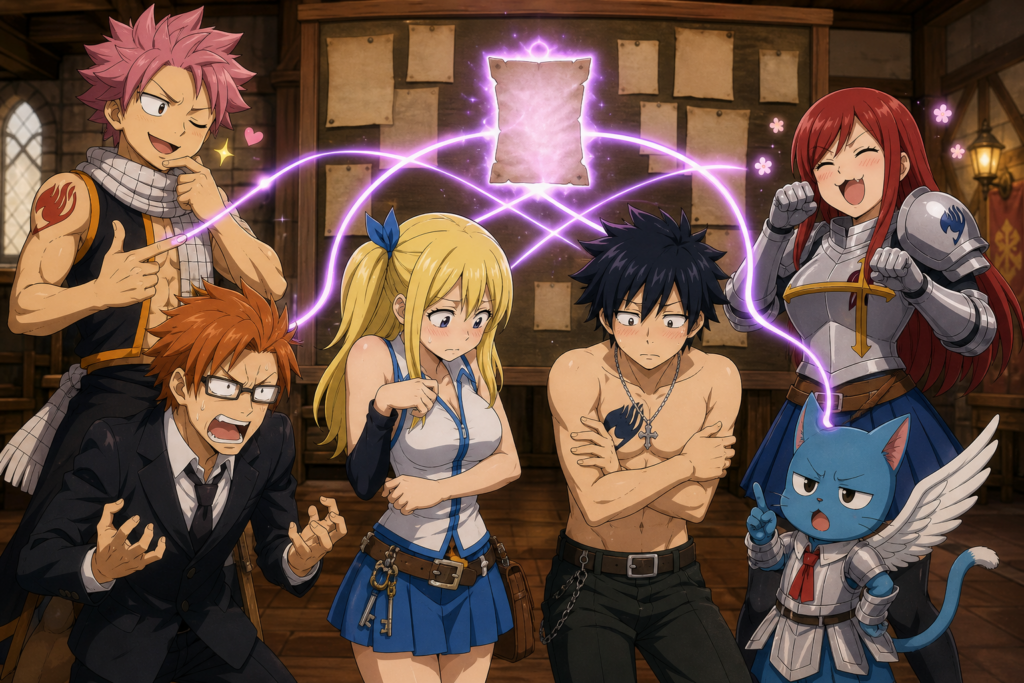
Bottom line: Episode 19 turns a translation request into a body-swap emergency and lets Fairy Tail discover that power is not portable without context. Natsu, Lucy, Happy, Loke, Gray, and Erza exchange bodies, magic, and social assumptions while Levy races a thirty-minute deadline. The comedy is loud, but the useful idea underneath it is precise: a body is not a costume, and access is not the same thing as understanding.
The receipt box
- Episode: 19
- English title: Changeling
- Japanese title: チェンジリング
- Romanized title: Chenjuringu
- Original Japanese air date: February 22, 2010
- Series: Fairy Tail (2009–2013)
- Episode type: Anime-original comedy episode
- Arc placement: After the Galuna Island mission and before Phantom Lord
- Central spell: Changeling swaps minds, bodies, and accessible magic
- Time limit: The guild believes the exchange will become permanent after thirty minutes
- Where to watch: Watch Changeling on Crunchyroll
- Spoiler boundary: This React discusses events through Episode 19 only.
The request board punishes curiosity
The guild receives what appears to be a translation job. Decode ancient writing. Levy’s knowledge makes that request feel safer than a combat mission.
Then somebody reads the spell and the room becomes an identity pileup.
The setup is funny because Fairy Tail treats the request board as ordinary infrastructure. Jobs arrive, mages select them, and expertise should help determine who takes what. Changeling hides an active magical effect inside language itself.
Reading is usually how a person gains control over a text. Here, reading lets the text act on the reader.
That reversal gives Levy’s work real stakes. Translation is not decorative scholarship. One mistaken assumption about grammar, activation, or context changes what several people can do with their own bodies.
The first swaps expose relationships through mismatch
Natsu exchanges with Loke. Lucy exchanges with Gray. Happy exchanges with Erza.
Each pairing is built for maximum friction.
Natsu’s directness lands inside Loke’s practiced social presentation. Loke’s habits meet a body built around Dragon Slayer Magic and motion sickness. Lucy and Gray have to navigate powers, clothing habits, and boundaries neither chose. Happy and Erza create the most dramatic scale shift, placing one of the guild’s most intimidating presences inside its smallest flying member.
The joke is not merely that everybody looks wrong. The swaps reveal how much identity depends on repeated coordination among body, magic, memory, and social expectation.
Nobody becomes another person just because they occupy the same physical space.
Access to magic is not mastery
The swapped members can encounter abilities attached to their new bodies, but access does not provide training.
That is an important limit. Magic in Fairy Tail is personal craft. It develops through practice, temperament, physical capacity, and a wizard’s relationship to a particular form of power. If a mind could instantly use every borrowed ability perfectly, years of discipline would become a hardware setting.
Changeling refuses that shortcut.
The body carries possibilities. The person still needs knowledge, timing, and judgment. A powerful body in unfamiliar hands can be less effective than an ordinary body used with experience.
The guild learns this while surrounded by breakable furniture, which feels like the correct Fairy Tail laboratory.
Lucy and Gray's swap needs boundaries, not only jokes
Body-swap comedy often treats privacy as disposable. Put a man in a woman’s body or a woman in a man’s body, then let embarrassment do the writing.
Episode 19 participates in that tradition, but the situation is more useful when read through consent. Lucy and Gray did not agree to give each other access to their bodies. Neither person’s curiosity, discomfort, or clothing habit overrides the other’s ownership.
Gray’s habitual stripping becomes different when somebody else is living with the consequence. Lucy’s body becomes a site the guild may stare at or comment on even though Lucy cannot control its presentation directly.
The ethical answer is not complicated: borrowed access creates more responsibility, not less.
Comedy can acknowledge the awkwardness without pretending violation becomes harmless when everybody is yelling.
Happy and Erza prove size is not authority
Erza’s social power does not disappear when her voice comes from Happy’s small body. Happy does not automatically gain her authority because he occupies her physical form.
The contrast reveals that intimidation is partly embodied and partly relational. Guild members react to Erza because of what she has done, the standards she enforces, and the certainty with which she speaks. Armor and physical presence amplify that history. They do not create it alone.
Happy’s identity is equally durable. Wings, height, and strength change, but his attachments and habits remain recognizable.
This pairing lets the episode ask a silly question with a serious answer: if every familiar signal changes, how do friends know who is speaking?
They know through patterns of care, irritation, language, and choice.
Natsu inside Loke disrupts performance
Loke presents himself through charm, sunglasses, flirtation, and controlled distance. Natsu does not maintain that performance.
The swap therefore exposes how much of Loke’s public identity is deliberate. His body may carry familiar visual cues, but Natsu does not know the script. The result looks like Loke with the social machinery removed.
That is especially interesting after Episode 15’s focus on Gray and Lyon. Fairy Tail’s members often build identities that help them survive what they are not ready to discuss. Gray uses composure. Loke uses charm. Erza uses authority. Natsu appears simpler, but even his constant motion keeps quieter questions about Igneel at a distance.
Changeling scrambles the containers and lets the guild see how much behavior completes a recognizable person.
The thirty-minute deadline turns embarrassment into coercion
The guild learns that if the spell is not reversed within thirty minutes, the swaps may become permanent.
Without that timer, the episode could remain an inconvenience. With it, every failed attempt carries the threat of losing control over one’s life indefinitely.
Permanence changes the moral stakes. A temporary exchange can be survived through rules and mutual care. A permanent exchange would force people to negotiate identities, relationships, health, and magic in bodies they never chose.
The urgency also pressures Levy. Everybody expects her literacy to produce an immediate solution even though she did not create the spell.
Expertise often attracts blame the moment a system becomes unreadable. Levy deserves room to investigate. The clock gives her none.
Levy's knowledge is treated as emergency labor
Levy is the obvious person to decode ancient writing. The guild depends on her while also surrounding her with panic, demands, and new magical accidents.
This is familiar labor for the person in a group who can translate, troubleshoot, organize, or explain. Their skill becomes invisible when things work and suddenly public property when things break.
Levy keeps working because her friends need help. That willingness should not erase what the room owes her: accurate information, physical space, and cooperation.
Instead, Fairy Tail responds like Fairy Tail. More people interact with the spell, the problem expands, and the translator has to solve a moving target.
Knowledge is power. It is also work, and the guild is not famous for respecting a clean work environment.
A guild can know you across a changing body
The swaps generate confusion, but nobody becomes socially invisible. Friends test voices, behaviors, magical responses, and declared identities. They believe each other because years of relationship provide evidence beyond appearance.
That is the episode’s warmest idea.
Fairy Tail is a place where bodies matter without being the sole proof of personhood. Magic can alter appearance, possession can occur, transformation is common, and species differ dramatically. Community therefore requires a broader practice of recognition.
Who remembers this argument? Who worries about that person? Who reaches for a familiar joke? Who knows a secret that belongs inside this relationship?
Identity remains embodied, but recognition is relational.
The secondary swaps show that chaos spreads through attempted fixes
As the guild tries to reverse Changeling, more members become involved and additional exchanges complicate the room.
The escalation is standard farce. Every solution opens another door and releases a worse problem.
It also offers a practical warning. When the mechanism is poorly understood, intervention can enlarge the blast radius. The responsible move is not to stop experimenting forever. It is to control participation, document what changed, and avoid making desperate guesses on uninvolved people.
Fairy Tail does none of that because the episode wants comedy. RaeRae would have evacuated the guildhall, placed the text behind a barrier, and made everyone wear name tags.
Nobody asked RaeRae, which is why the furniture remains endangered.
Anime-original does not mean irrelevant
Changeling is not adapted from a numbered manga chapter. It is an anime-original episode placed between major arcs.
That makes it optional for plot tracking, but not empty by definition. A long series needs spaces where the ensemble can exist outside escalating threats. Comedy episodes test chemistry, reveal daily habits, and let supporting members participate without a villain demanding the frame.
The danger is using “fun” as permission for jokes that ignore bodily autonomy or flatten gender into embarrassment. The opportunity is to show why these people remain recognizable to one another even when appearance and power change.
Episode 19 contains both impulses. The useful reading does not require pretending every gag aged perfectly.
The guildhall is the right place for a controlled disaster
After Galuna Island, the team needs a return to ordinary guild life. Fairy Tail’s ordinary life happens to include ancient magic detonating from the request board.
Nobody is isolated on an island. Senior members, support mages, and friends are nearby. The danger is real but bounded enough to become communal problem-solving.
That makes Changeling a recovery episode without calling itself one. Gray does not have to discuss Ur. Natsu does not have to process how close Gray came to death. Lucy does not have to narrate the fear of an unauthorized S-Class mission.
They can survive a ridiculous crisis together and reestablish the rhythm of home.
Sometimes recovery begins with safety. Sometimes it begins with yelling from the wrong body while Levy searches for a translation.
The ending preserves Fairy Tail's favorite kind of order
The spell crisis resolves enough for life to continue, though the path back to normal is messy and the joke keeps finding new targets.
Fairy Tail rarely restores order by making everybody calm. Its version of stability is recognizable chaos. People return to their relationships, arguments, and jobs. The guildhall remains loud because loudness is not the same thing as danger.
That distinction matters after an episode about losing control of the body. Home is not the place where nothing unpredictable happens. It is the place where people keep trying to identify, protect, and retrieve you when it does.
The guild fails the emergency-management exam. It passes the recognition test.
RaeRae's verdict
Episode 19 is a translation job that becomes a consent seminar nobody agreed to attend.
The best comedy comes from mismatch. Erza’s authority in Happy’s body, Happy’s habits in Erza’s body, and Natsu dismantling Loke’s carefully maintained presentation all prove that appearance cannot carry identity by itself.
The weaker material treats privacy and gendered embarrassment as automatic punchlines. A body swap does not suspend ownership. If anything, it makes care more urgent because the person with access is not the person who will live with every consequence.
Levy deserves hazard pay. The request board deserves a quarantine policy. The guild needs labels, a timer, and one adult willing to stop people from reading glowing ancient text aloud.
Instead, it has Makarov and a room full of wizards. We were never getting a quiet solution.
Continue the watch
- Previous: Fairy Tail Episode 18 React: Reach It! To That Sky
- Next: Fairy Tail Episode 20 React: Natsu and the Dragon Egg
- Browse every Fairy Tail episode
- Open the Fairy Tail Episode Reacts hub
- Return to the Fairy Tail hub