
Fairy Tail Episode 17 React: Burst
Deliora rises, then Ur's ten-year victory takes away every trophy the living tried to claim.
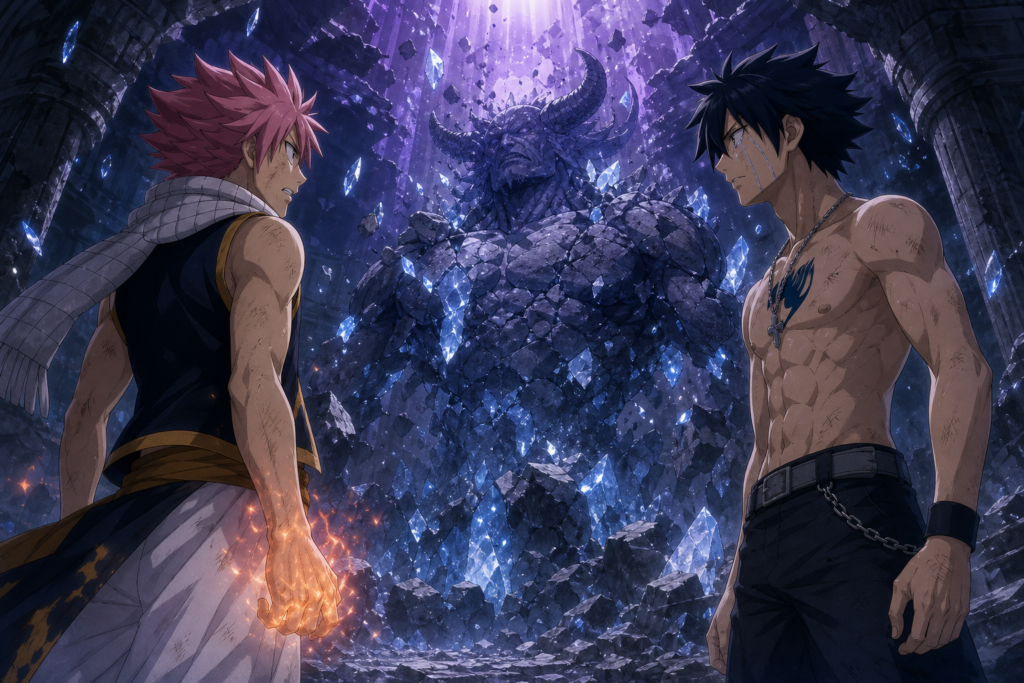
Bottom line: Episode 17 lets Deliora stand long enough for everybody to fear the worst, then turns the supposed final boss into evidence that Ur already won. Natsu defeats Zalty’s attempt to claim the demon. Gray learns the ice he treated as a grave was still carrying Ur’s will. Lyon loses the victory he wanted, but he gains the truth he refused: his teacher was never waiting to be surpassed.
The receipt box
- Episode: 17
- English title: Burst
- Japanese title: BURST(バースト)
- Romanized title: Burst
- Original Japanese air date: February 8, 2010
- Series: Fairy Tail (2009–2013)
- Episode type: Manga canon
- Manga material: Chapters 42–44
- Arc: Sub-Zero Emperor Lyon, also known as the Galuna Island arc
- Where to watch: Watch Burst on Crunchyroll
- Spoiler boundary: This React discusses events through Episode 17 only.
Deliora rises because everybody arrived late to Ur's victory
The Moon Drip succeeds. The ice breaks. Deliora stands over the ruins and roars.
For Gray, this is the nightmare that has controlled his life returning in physical form. For Lyon, it is the opponent he believes will finally give his life a ranking. For Zalty, the demon is an asset to be recovered and used.
All three men look at the same body and see a different claim.
None of those claims change what Ur did. Her Iced Shell has spent ten years draining Deliora’s life. The demon can rise because the prison is gone, but it cannot resume the future everybody imagined for it. It crumbles.
The spectacle arrives after the result.
Ur's magic was active when everyone called it frozen
Ice looks still. That appearance shapes how Gray and Lyon understand the seal.
Gray sees Ur’s frozen body holding a danger in place. Lyon sees an unfinished fight locked away from him. Both treat the ice as a pause. Episode 17 reveals it was a process.
Ur remained at work inside the seal. Her magic did not simply build a wall around Deliora. It changed the demon over time until resurrection could not restore it.
That makes Iced Shell even more complicated. Ur lost the ordinary future in which she could raise her students, but her final act was not passive absence. The protection continued.
Gray has spent years believing her sacrifice created a debt. The episode gives him another reading: Ur made a choice with a completed purpose. He does not have to finish it by dying.
Natsu recognizes life where Gray sees only a grave
Natsu rejects Gray’s attempt to cast Iced Shell because he can feel something Gray’s guilt has hidden from him. Ur’s ice is not merely a tomb.
This is not Natsu becoming a scholar of forbidden magic. His insight is relational. He understands living force through the body. Fire, motion, appetite, impact, and presence are how he reads the world. When he encounters the seal, he does not accept Gray’s conclusion that Ur is only gone.
Gray has history and expertise. Natsu still notices what Gray cannot.
That is one reason chosen family matters. People outside a trauma can miss its depth, but they can also see the rules a survivor has mistaken for reality. Gray believes repeating Ur is loyalty. Natsu sees a living friend and a protection that is still doing its work.
He does not let grief have the final technical opinion.
Zalty wants to turn catastrophe into inventory
Zalty’s interest in Deliora exposes a colder layer beneath Lyon’s obsession.
Lyon wants an opponent. Zalty wants a usable object. The demon that destroyed Isvan, killed families, consumed Ur’s life, and endangered Galuna Island becomes something to obtain.
This is how institutions and powerful individuals often approach catastrophe. Survivors see a wound. The ambitious see an asset whose danger can be converted into leverage.
Zalty’s time magic makes that worldview literal. If an object’s condition can be manipulated, destruction begins to look reversible and therefore exploitable. Consequence becomes a temporary setting.
But people are not objects, and history is not a warehouse. Restoring a ruin does not restore consent. Releasing Deliora does not restore Ur. Reversing physical damage does not return the years Gray and Lyon lost.
Zalty’s power encourages him to confuse material state with moral repair.
Natsu fights the person profiting from somebody else's grief
Natsu’s battle with Zalty is not emotionally symmetrical. Zalty has information, a hidden plan, and a form of magic Natsu does not understand. Natsu has a simple conclusion: this person helped restart the ritual and intends to use Deliora.
That simplicity serves him.
Zalty depends on distance between his private objective and everybody else’s partial knowledge. Natsu closes distance. He does not negotiate with the mask’s air of sophistication. He treats manipulation as participation in the harm.
There are limits to punching as a political method. Fairy Tail will test every one of them. In this moment, the target is a combatant actively enabling catastrophe. Stopping him is not a substitute for understanding the island. It is the necessary interruption that allows understanding to matter later.
Lyon receives the answer and hates the question
Lyon built his identity around defeating Deliora because Ur could not. Deliora’s collapse proves that premise false.
Ur did defeat it.
The answer should be comforting. The teacher Lyon admired was even more powerful than he understood. Instead, it destroys the project that gave his grief direction. If Ur already won, Lyon cannot use the demon to prove he surpassed her.
This is the danger of building a life around one future event. Achievement stops being something you do and becomes permission to exist. When the event disappears, the person underneath it has no prepared identity.
Lyon’s loss is deserved. His confusion is still human.
He has to discover a reason to live that is not measured against a dead woman.
Gray is allowed to cry without becoming a child again
Deliora’s collapse confirms Ur’s victory and breaks open the grief Gray has carried behind irritation, rivalry, and discipline.
Tears do not undo the adulthood he built. They let the child who survived Isvan exist inside it.
Gray’s earlier choices were shaped by the belief that emotional control meant responsibility. He tried to contain the situation alone. He considered Iced Shell. He treated his death as a cleaner outcome than asking his friends to share the danger.
The episode gives him a different kind of control: he can stop fighting the fact that Ur mattered.
Grief expressed in front of other people is not a loss of competence. It is evidence that the person no longer has to spend all available strength hiding the injury.
“Burst” names more than the ice breaking
The title points toward rupture. Ur’s seal bursts. Deliora’s body breaks apart. Zalty’s controlled operation falls into direct conflict. The story Gray and Lyon told themselves also bursts under the weight of new evidence.
Not every rupture is destruction.
The seal breaking looks catastrophic, but it reveals that the demon cannot continue. Gray’s emotional restraint breaks, but the result is grief rather than self-erasure. Lyon’s fantasy breaks, creating the possibility of a life not governed by surpassing Ur.
The episode understands that some structures protect and others imprison. Ur’s ice did both: it protected the world from Deliora while trapping her students inside an incomplete understanding of her choice.
When the ice goes, the demon dies and the truth remains.
Ur's victory does not erase the cost
It would be easy to use Deliora’s death to declare Iced Shell entirely justified. The spell worked, therefore every part of the choice was right.
The story is more interesting if we resist that shortcut.
Ur faced an immediate threat with very few options. She saved Gray and Lyon and prevented more destruction. Her magic killed Deliora. Those facts matter.
So do the ten years her students spent without her. Gray inherited a model of suicidal responsibility. Lyon turned love into competition. Neither consequence means Ur should have allowed Deliora to kill them. It means successful protection can still leave wounds that require care.
Outcome is part of ethical judgment, not the entire judgment.
Ur won the battle. The boys still needed adults and truth after it.
The arc finally distinguishes sacrifice from disposal
Ur chooses Iced Shell to save children from a demon. Gray prepares to choose it because he believes his life is the appropriate payment for guilt.
Those acts look similar from the outside. Their meanings are not identical.
Sacrifice responds to danger. Disposal responds to a belief that one person’s continued existence matters less. Gray disguises the second as the first. Natsu refuses to let him.
This distinction will matter throughout Fairy Tail. The series loves characters who throw their bodies between harm and somebody they love. The best versions of that instinct preserve a future for everyone. The worst versions make death the proof that the feeling was sincere.
Episode 17 sides with survival. Ur’s choice saved a future. Gray honors it by entering that future, not by recreating its cost.
Erza arrives as authority and witness
Erza came to Galuna Island intending to retrieve the unauthorized team and enforce guild discipline. The mission has grown beyond a simple violation by the time she sees the ritual and Deliora.
Her presence matters because accountability needs accurate facts. Natsu, Lucy, Gray, and Happy broke rules. They also uncovered an operation endangering an island and confronted a demon tied to Gray’s childhood.
A good authority figure must hold both truths.
Erza does not have to pretend the rule-breaking was harmless in order to recognize the rescue work. She also cannot reduce everything that happened to disobedience. Context does not erase standards. Standards without context become laziness wearing armor.
The episode positions her to judge what comes next after witnessing what the team actually faced.
Deliora's body refuses to become a trophy
Lyon wants to kill it. Zalty wants to use it. Gray once wanted revenge against it. Deliora’s collapse denies all three forms of possession.
Nobody gets the finishing blow. Nobody gets the weapon. Nobody gets to carry the corpse home as proof of mastery.
Ur’s magic returns the demon to ruin before another person can build an identity from owning its defeat.
That anti-trophy ending is quietly radical for a battle series. Power is usually made visible through domination. Episode 17 locates power in protection whose author is absent when the result becomes visible.
Ur receives no applause inside the story. Her students receive evidence.
What they do with it will matter more than a victory pose.
The island's problem is not finished with the demon
Deliora’s death closes the threat that brought Gray and Lyon into conflict, but the villagers still believe they are cursed. Their bodies, memories, and fear do not disappear when the boss falls.
This is important structural honesty. Communities do not become healthy because the most cinematic danger has ended. Somebody still has to investigate the conditions people live under, repair damage, and separate the story they were told from what is actually happening.
Fairy Tail’s team cannot leave merely because Gray’s personal arc reached a revelation. They accepted a job from the villagers. The people who asked for help remain the measure of whether the job is complete.
The next problem may require less force and more perception.
Adaptation notes
Episode 17 adapts Chapters 42 through 44 and brings the major battles on Galuna Island to a close. It places Deliora’s apparent resurrection beside Natsu’s fight with Zalty and the revelation of Ur’s long victory.
The pacing depends on expectation. A demon described as immortal finally breaks free, so viewers expect an extended fight. Its immediate deterioration is not missing action. It is the answer to the arc’s central misunderstanding.
The battle happened ten years earlier. This episode reveals the result.
That choice keeps Ur from becoming backstory fuel for a younger man’s triumph. Her magic remains the decisive force, while Gray’s growth is measured by whether he can live with that truth.
RaeRae's verdict
Episode 17 gives Ur her victory without pretending victory returns what she lost.
Deliora bursts free and falls apart. Lyon’s decade-long plan becomes unnecessary at the exact moment he expects it to become meaningful. Zalty’s attempt to turn the demon into an asset fails. Gray finally sees that the ice he called a grave was still protecting him.
Natsu’s role is beautifully direct. He does not solve Gray’s grief. He prevents Gray from letting grief kill him before the evidence arrives.
The demon dies without becoming anyone’s trophy. Ur is not surpassed. She is understood a little more accurately.
Now Gray and Lyon have the harder assignment. They have to build lives after the goal that organized their pain is gone.
Continue the watch
- Previous: Fairy Tail Episode 16 React: The Final Showdown on Galuna Island
- Next: Fairy Tail Episode 18 React: Reach It! To That Sky
- Browse every Fairy Tail episode
- Open the Fairy Tail Episode Reacts hub
- Return to the Fairy Tail hub
Sources
- Crunchyroll: Fairy Tail Episode 17, “Burst”
- Fairy Tail manga, Chapters 42–44 by Hiro Mashima