
Fairy Tail Episode 16 React: The Final Showdown on Galuna Island
Lyon gets the resurrection he demanded and learns Ur won the battle ten years before he arrived.
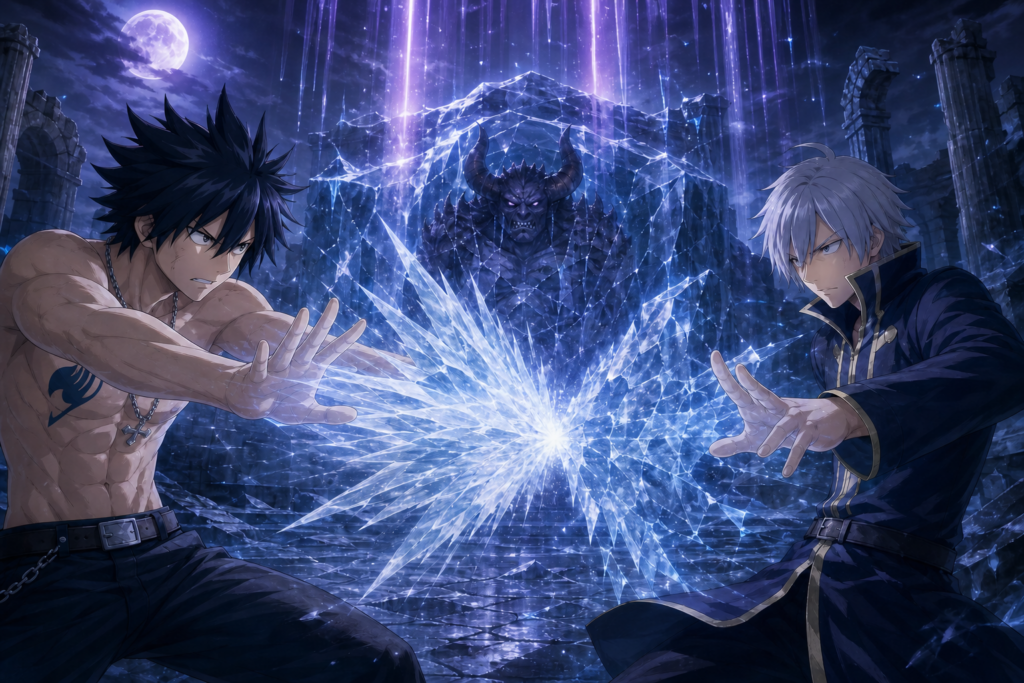
Bottom line: Episode 16 gives Lyon the resurrection he demanded and denies him the victory he built his life around. Gray stops trying to die like Ur. Natsu treats a manipulated ruin as a problem that can be punched crooked again. Deliora finally wakes, roars, and collapses because Ur defeated it ten years ago. The boys were never waiting for the result of her battle. They were waiting to understand it.
The receipt box
- Episode: 16
- English dub title: The Final Showdown on Galuna Island
- Crunchyroll title: Galuna Island, the Final Battle
- Japanese title: ガルナ島 最終決戦
- Romanized title: Garuna-tō Saishū Kessen
- Original Japanese air date: February 1, 2010
- Series: Fairy Tail (2009–2013)
- Episode type: Manga canon
- Arc: Sub-Zero Emperor Lyon, also known as the Galuna Island arc
- Where to watch: Watch Galuna Island, the Final Battle on Crunchyroll
- Spoiler boundary: This React discusses events through Episode 16 only.
Gray finally chooses a future over a reenactment
Episode 15 ended with Gray preparing Iced Shell. He knew the spell would erase him. He also knew exactly what that erasure would do to the people left behind because he had spent years living inside Ur’s absence.
Natsu stops him.
That interruption matters more than any lecture about forbidden magic. Gray has turned his guilt into a private moral system. In that system, Ur died because he challenged Deliora, so his own death is the only payment large enough to settle the account. Natsu refuses the premise. A friend is not an overdue bill.
Gray does not become free of guilt in one scene. He does something more believable. He changes his next choice. Instead of copying Ur’s final act, he faces Lyon as a living opponent who can be defeated without another funeral.
Survival here is not cowardice. It is Gray accepting a responsibility that sacrifice would let him escape: he has to remain present after the battle.
Lyon wants proof, not justice
Lyon claims he needs to defeat Deliora because Ur could not. Every step of his plan is organized around that comparison.
The villagers’ curse does not matter enough to stop him. His followers’ safety does not matter enough. Ur’s continuing seal does not matter enough. He has turned a disaster that killed Gray’s family and consumed Ur’s life into an examination designed for one student.
That is why his grievance against Gray never produces justice. Lyon is not trying to repair the harm Gray caused as a child. He is trying to recover an imagined future in which he surpasses their teacher. Gray becomes a convenient defendant because blaming him lets Lyon avoid the truth: Ur never agreed that love between teacher and student should end with one of them winning.
Lyon’s pain is real. His project is still selfish.
Their Ice-Make reveals two different ideas of strength
Gray and Lyon learned under the same teacher, but their fight shows how far their approaches have separated.
Lyon favors one-handed Ice-Make. Gray insists on using two hands because Ur taught that a stable creation needs balance. The difference is not merely a technique trivia box. It tells us what each man thinks mastery means.
Lyon treats deviation as proof that he has advanced beyond the old lesson. Gray returns to the fundamentals because he finally understands why Ur insisted on them. One student wants to escape his teacher’s shadow by rejecting her limits. The other honors her by applying the discipline she gave him to a new situation.
Tradition is not automatically wisdom, and innovation is not automatically arrogance. The fight works because motive and result meet. Lyon’s shortcut serves his obsession with superiority. Gray’s balance serves his decision to stop treating power as a performance of grief.
Gray uses pain without making death the goal
Gray is badly hurt during the confrontation. He uses what is available, including his own blood, to keep control of the fight and catch Lyon off guard.
There is still self-endangerment in the strategy. Fairy Tail is not suddenly offering a wellness seminar in the ruins. The important difference is purpose. Gray is no longer choosing a technique whose success requires his disappearance. He is taking a dangerous action to create an opening and remain in the battle.
That distinction is narrow, but it is morally significant. People recovering from a sacrificial identity do not move instantly from “I should die for everyone” to perfect self-preservation. They begin by imagining solutions in which their continued life is possible.
Gray defeats Lyon because he knows him, knows Ur’s training, and refuses to let Lyon define the terms of strength.
Natsu solves the problem in front of him
While Gray and Lyon fight through ten years of grief, Natsu deals with Zalty and the Moon Drip ritual.
Natsu previously tilted the ruins to disrupt the beam. Zalty uses time-manipulation magic to restore the structure and restart the ceremony. The response is a useful summary of their conflict. Zalty can manipulate the condition of an object. Natsu keeps changing the immediate physical problem faster than the plan can settle.
Natsu does not understand Zalty’s full identity or motive. He understands that the ritual is melting Ur’s ice and that stopping it protects Gray and the island. He acts on the part he can verify.
This is one of Natsu’s better traits when the story controls it carefully. He does not need to own the entire explanation before helping. He needs a clear harm, a reachable target, and enough trust in his friends to know where he belongs.
Zalty treats everybody else's history as a tool
The masked Zalty has information and magic that place him outside Lyon’s understanding of the operation. Lyon believes the ritual exists for his showdown with Deliora. Zalty has his own interest in what will happen when the demon is released.
That hidden agenda makes Lyon’s fantasy of control look smaller. He has spent years recruiting followers, occupying the island, and directing Moon Drip. Yet he still does not know why one of his most useful allies is present.
Manipulators do not need every participant to share the same goal. They need each person to believe the arrangement serves the desire already controlling them. Lyon wants a rematch with Ur’s enemy. Zalty helps create the conditions and lets Lyon call that help loyalty.
The episode does not resolve Zalty’s full story, so neither will this React. What matters here is the imbalance. Lyon believes he is the author of the final battle. He is also somebody else’s instrument.
The Moon Drip ceremony violates Ur twice
Moon Drip is introduced as magic powerful enough to melt an otherwise unbreakable seal. In practical terms, it threatens to release Deliora. Emotionally, it attempts to reverse Ur’s final choice.
Nobody asked Ur whether her body could be used as the stage for Lyon’s achievement. She cannot consent, object, or revise the plan. Her sacrifice has been turned into material for men who want an answer from the dead.
Lyon frames the ritual as necessary because he needs to defeat the demon himself. That language hides what he is doing. He is dismantling the protection Ur created for the people still alive.
Grief can explain why somebody touches a wound. It does not grant ownership over everyone harmed by reopening it.
The villagers live beneath the ceremony. Gray carries the original trauma. Lyon’s followers risk becoming casualties. His private need is being paid for with public danger.
Deliora wakes and the victory disappears
The ice melts. Deliora rises. For a moment, Lyon appears to have achieved the confrontation he spent ten years constructing.
Then the demon collapses.
Ur’s Iced Shell did more than hold Deliora in place. Over the years, her ice drained the demon’s life. The creature Lyon wanted to defeat was already dying inside the seal. By the time it can move again, the outcome has been decided.
This is not a technicality that steals Lyon’s win. There was never a win available for him to claim. Ur defeated Deliora through a process Lyon could not see because he reduced battle to the instant one fighter stands and another falls.
Her victory took ten years to become visible.
Ur surpassed the question Lyon kept asking
Lyon wanted to know whether he could become stronger than Ur. Deliora’s collapse answers a different question: what did Ur use her strength to protect?
She was not trying to preserve a ranking. She was trying to stop a demon and save her students. Iced Shell cost her the life she might have shared with them, but it achieved its protective purpose long after the boys assumed the battle remained unfinished.
Lyon cannot surpass her by killing Deliora because she already killed it. More importantly, he cannot honor her by continuing to treat her as an opponent.
The episode takes away the scoreboard. What remains is grief without an assignment.
That may be the first real chance Lyon has had to mourn her.
Gray's guilt also loses its central claim
Gray believed Ur’s death sealed a disaster he caused without truly defeating it. Deliora’s collapse changes that understanding.
Ur did not merely postpone the catastrophe. She won.
That truth cannot erase Gray’s childhood choice or restore Ur’s ordinary life. It can challenge the idea that her sacrifice was an incomplete debt Gray must finish with his own body. The seal worked. The future she protected arrived. Gray is standing in it.
His task is no longer to become a replacement sacrifice. It is to decide what to do with the life Ur kept available to him.
Fairy Tail as a guild gives him an answer that is imperfect and loud but usable: return, accept consequences for the unauthorized job, keep growing, and let other people care whether you survive.
A dead enemy cannot provide closure
Lyon designed his entire adulthood around a future fight. Deliora’s collapse reveals the danger of outsourcing closure to an opponent.
Even if Lyon had defeated the demon through his own power, Ur would still be gone. The years of blame would still have happened. Gray would still remember Isvan. Victory could give Lyon a fact, but not the relationship he wanted with his teacher.
Closure is often marketed as a final event: a confession, a punishment, a funeral, a battle. Episode 16 is smarter than that. The final battle ends without the anticipated fight. The emotional work begins after the spectacle fails to deliver meaning.
Lyon has to live without the contest. Gray has to live without the debt. Neither man gets to ask Deliora to solve that for him.
The episode separates defeat from humiliation
Gray beats Lyon. Ur’s magic defeats Deliora. Lyon is wrong about the ritual, wrong about Gray, and wrong about what surpassing a teacher means.
The story could treat that pile of errors as permission to discard him. It does not need to. Accountability is not the same as declaring a person worthless.
Lyon endangered an island and manipulated followers to serve his obsession. Those choices require consequences. They also came from a young man who never learned how to grieve a parent figure without turning love into a test.
Understanding that wound does not make the Moon Drip harmless. It makes future change imaginable. If the only available identity is villain, Lyon has no reason to examine anything beyond whether he lost. If he remains a person, he has to face what his choices did to other people.
Losing the fight may be the beginning of that responsibility.
Adaptation notes
Episode 16 continues the manga-canon Galuna Island confrontation. The anime presents the parallel conflicts clearly: Gray and Lyon settle the immediate fight while Natsu tries to stop Zalty and the restored Moon Drip ceremony.
The structure lets the ritual keep moving even after Gray rejects Iced Shell. That matters because personal growth does not automatically halt a machine already set in motion. Gray can make a better choice and still be unable to prevent every consequence of Lyon’s plan.
Deliora’s brief revival provides the expected monster image, then refuses a conventional boss fight. The anti-climax is the point. Ur’s slow victory is more meaningful than another round of attacks could be.
RaeRae's verdict
Episode 16 is called the final showdown, but its strongest move is refusing to give Lyon the showdown he ordered.
Gray wins by stepping out of Ur’s final footprint. Natsu helps by treating Gray’s planned death as unacceptable, then keeps attacking the machinery around the ritual. Zalty proves that Lyon never controlled as much of the operation as he imagined.
And Ur wins ten years after her body became ice.
Deliora’s collapse does not make her sacrifice painless or automatically correct every lesson it taught. It does establish that her magic completed its purpose. The demon was not waiting for Lyon. It was dying inside the protection he kept calling unfinished.
Gray and Lyon can stop competing over who will complete Ur’s story. She completed her battle. Their responsibility is to build lives that do not require another person to disappear.
Continue the watch
- Previous: Fairy Tail Episode 15 React: Eternal Magic
- Next: Fairy Tail Episode 17 React: Burst
- Browse every Fairy Tail episode
- Open the Fairy Tail Episode Reacts hub
- Return to the Fairy Tail hub
Sources
- Crunchyroll: Fairy Tail Episode 16, “Galuna Island, the Final Battle”
- Fairy Tail manga by Hiro Mashima, Galuna Island arc