
Fairy Tail Episode 15 React: Eternal Magic
Ur saves two grieving boys, and both inherit the wrong lesson from her sacrifice.
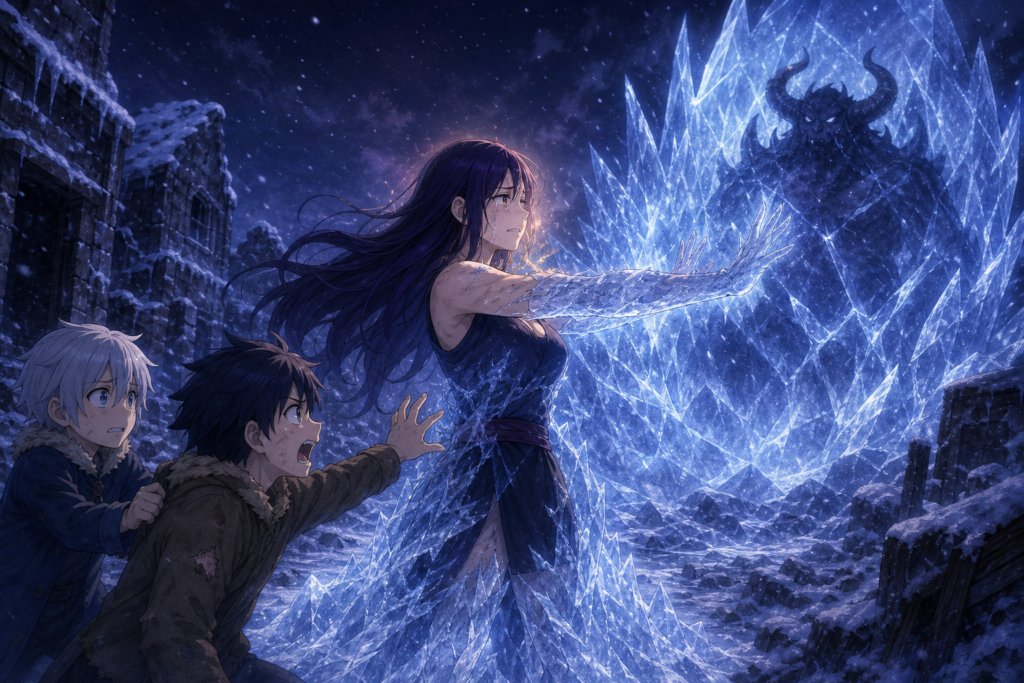
Bottom line: Episode 15 finally tells us why Gray treats ice like both a weapon and a debt. Ur saved two boys from Deliora, but her sacrifice did not end the damage. Gray inherited her willingness to erase herself for other people. Lyon inherited the belief that love had to be proven through victory. In the present, both men are still arguing with a woman who is no longer there to correct them.
The receipt box
- Episode: 15
- English title: Eternal Magic
- Japanese title: 永遠の魔法
- Romanized title: Eien no Mahō
- Original Japanese air date: January 25, 2010
- Series: Fairy Tail (2009–2013)
- Episode type: Manga canon
- Manga material: Chapter 36 from page 19, Chapter 37, and Chapter 38
- Arc: Sub-Zero Emperor Lyon, also known as the Galuna Island arc
- Where to watch: Watch Eternal Magic on Crunchyroll
- Spoiler boundary: This React discusses events through Episode 15 only.
Gray did not begin with a rivalry
Gray’s childhood begins with loss, not competition. Deliora destroys Isvan and kills his family. Before Gray becomes the cool-headed member of Team Natsu who loses his clothes every ten minutes, he is a child whose home has been erased by a monster.
That distinction matters because revenge stories often turn grief into a clean motivation. Someone is hurt, the hero trains, the hero defeats the villain, and the pain receives a satisfying shape. Gray’s story refuses that neat line. His need to kill Deliora is not a strategic mission. It is a child’s attempt to make the world admit that what happened to him mattered.
Ur finds him inside that need. She gives him shelter and teaches him Ice-Make magic alongside Lyon. She does not remove his anger. She gives it structure, discipline, and a home where another future might become possible.
Gray is not ready to choose that future yet.
Ur gives them a language, not identical lives
Ur trains Gray and Lyon in the same magic, but the boys do not receive the same lesson from her care.
Gray learns that strength might let him confront the thing that took his family. Lyon learns that strength might let him surpass Ur. Gray is looking backward at Deliora. Lyon is looking upward at his teacher. Both boys organize their identities around a woman who is trying to raise them beyond the need to prove themselves.
This is one reason their present conflict is so bitter. They can name the same teacher, remember the same training, and still carry incompatible versions of what that relationship meant.
Ur teaches creation through ice. Ice-Make is not only freezing an enemy. It asks the wizard to imagine a form and give it purpose. Yet both students become trapped in fixed ideas. Gray believes Deliora must die by his hand. Lyon believes Ur’s greatness is a height he must conquer. The magic is flexible. The boys are not.
Adults do not become responsible by suffering more
Ur understands the danger before Gray does. He goes after Deliora anyway.
The episode does not excuse that decision. Gray’s grief explains why he acts, but explanation is not absolution. He is a child making a disastrous choice with consequences for everybody who loves him. Ur has to enter a battle he cannot survive. Lyon follows because his own pride and attachment will not let him stay behind.
Still, placing responsibility only on Gray would be too easy. Children test limits precisely because they do not understand every cost. Adults are supposed to protect them without demanding that they first become wise enough not to need protection.
Ur does protect him. The tragedy is that her final method also gives Gray a model of love built on self-destruction.
Iced Shell is love turned into disappearance
Deliora is beyond what Ur can defeat through ordinary combat. She loses a leg and replaces it with ice, but even that injury does not make the difference in power disappear. When Lyon attempts Iced Shell, Ur stops him. She will not allow her student to pay the price.
Then she pays it herself.
Iced Shell converts the caster’s body into ice and seals the target. The technique is presented as extraordinary magic, but its emotional meaning is brutally simple: one person decides everyone else will live because she will no longer exist as a person among them.
Ur’s choice saves Gray and Lyon. It stops Deliora. It is also a terrible lesson for two grieving children to inherit.
Gray remembers that the strongest expression of care is to remove yourself from the future. Lyon remembers that the teacher he wanted to surpass reached a level he cannot challenge because she became the prison holding Deliora. Neither boy is equipped to process a sacrifice this large.
The title “Eternal Magic” sounds beautiful. The eternity is not gentle. Ur remains present as the ice around Deliora, denied the ordinary life in which love can keep changing, apologizing, arguing, and growing.
Ur's last request is an act of care with consequences
Ur tells Gray to say that she died. She wants Lyon to stop measuring himself against her and move forward.
I understand the mercy in that decision. If Lyon believes Ur is simply gone, perhaps he can build an identity that is not organized around defeating her. Ur is trying to release him from a competition she never asked to enter.
But a lie cannot control the meaning people make from loss. Lyon does not move forward. He decides Gray is responsible for taking away his chance to surpass Ur. The silence where Ur’s explanation should be becomes a place for blame to grow.
Gray carries the instruction and its consequences. He cannot tell Lyon the full truth without breaking Ur’s final request. He also cannot make Lyon understand a sacrifice Lyon experienced as theft.
This is not proof that Ur was wrong to protect them. It is proof that even loving adults cannot choreograph how children will survive their absence.
Lyon turns grief into a scoreboard
Lyon’s plan to revive Deliora is not courage. It is grief trying to manufacture a rematch.
He believes defeating the monster Ur could not defeat will prove that he surpassed her. That logic reduces Ur from a person who loved him to a benchmark. Her teachings, protection, and hopes for his life become secondary to the number he wants to place beside his name.
The cruelty is that Lyon does love her. His obsession is not the absence of feeling. It is feeling narrowed until only achievement remains visible.
Children often learn to seek approval in the form adults reward. Lyon chooses power because Ur was powerful, then mistakes imitation for intimacy. He cannot receive her last lesson because receiving it would require accepting that she never needed him to defeat her.
She needed him to live.
Gray is about to repeat the sacrifice he cannot forgive
In the present, Gray interrupts the fight between Natsu and Lyon and begins Iced Shell.
This is the episode’s sharpest turn. Gray knows exactly what the spell costs. He has lived inside its aftermath. He understands the grief it leaves behind, and he reaches for it anyway.
Trauma does not only make people avoid what hurt them. Sometimes it teaches them that the harmful act is what responsible love looks like. Gray watched Ur solve an impossible problem by erasing herself. Faced with Deliora and Lyon again, he chooses the same answer.
He can tell himself the circumstances demand it. Ur probably believed that too. He can call it accountability for the childhood decision that brought Ur to Deliora. But dying does not repair that decision. It transfers the pain to Natsu, Lucy, Erza, Happy, Lyon, and everyone at Fairy Tail who expects Gray to return.
Self-sacrifice can be brave and still be a refusal to imagine that other people need you alive.
Natsu has to reject the inherited script
Natsu spends much of this arc acting before he understands the whole story. That is usually dangerous. Here, his refusal to respect Gray’s fatal logic may be exactly what Gray needs.
Gray sees Iced Shell as a serious, responsible answer. Natsu sees his friend preparing to disappear. One reading has history, guilt, and magical precedent behind it. The other has a much simpler moral claim: you do not get to call your death a solution and expect the people beside you to accept it quietly.
Fairy Tail repeatedly treats chosen family as a practice rather than a slogan. Membership means somebody may interrupt the version of nobility you built to survive alone. Natsu cannot undo Ur’s sacrifice. He can refuse to let Gray turn it into a family tradition.
That refusal does not cheapen Ur’s decision. It honors the future she purchased.
Deliora is more than a monster to defeat
Deliora functions as a physical enemy, but Episode 15 makes the demon carry several different meanings.
For Gray, Deliora is the event that divided his life into before and after. For Lyon, it is a measuring device. For Ur, it becomes the final threat standing between her students and adulthood. In the present, the frozen body is also a monument to everything the boys failed to understand about her.
That is why releasing Deliora is such a violation. Lyon treats Ur’s continuing sacrifice as an obstacle to his personal resolution. He is willing to undo the safety she created because safety does not give him the victory he wants.
The Moon Drip ritual is not only melting ice. It is an attempt to rewrite the meaning of Ur’s choice without her consent.
The episode makes blame look smaller than grief
Gray blames himself. Lyon blames Gray. Both positions give the past a single cause they can hold.
Grief is harder. Grief asks them to accept that Deliora destroyed lives, that Ur made a choice under impossible conditions, that Gray was a traumatized child who acted recklessly, and that no later victory can restore the years they lost.
Blame offers action. Punish Gray. Defeat Deliora. Surpass Ur. Cast Iced Shell. Each action promises an ending.
None of them can create the conversation these men actually need to have: Ur loved both of them, neither understood that love completely, and surviving her does not make either one her replacement.
Adaptation notes
Episode 15 draws from the end of Chapter 36 and continues through Chapters 37 and 38. The anime expands portions of the memory, including more of Ur’s confrontation with Deliora and additional connective material around Gray’s past.
Those additions keep the episode centered on the emotional cost of the battle rather than treating the flashback as a quick explanation for a new spell. The important adaptation result is clarity: Iced Shell is not an abstract forbidden technique when Gray begins casting it in the present. We have just seen the life it consumed and the two children left to interpret the silence.
That sequencing makes Gray’s decision feel frightening rather than triumphant.
RaeRae's verdict
Episode 15 is where Gray’s coolness finally cracks open and reveals the child underneath it.
Ur saved him from Deliora, trained him, protected him from Lyon’s attempted sacrifice, and gave her own life so both boys could continue. They honor that gift badly because they are human. Gray turns guilt into a willingness to die. Lyon turns love into a competition with the dead.
Neither reaction is what Ur wanted.
The episode’s real conflict is not Gray versus Lyon or even Ur versus Deliora. It is whether the next generation must repeat the most devastating choice of the last one. Gray believes taking Ur’s place will settle the debt. Natsu’s presence argues that Gray is not a debt waiting to be paid.
Ur’s magic became eternal. Her students still have to learn that their grief does not have to be.
Continue the watch
- Previous: Fairy Tail Episode 14 React: Do What You Must!!
- Next: Fairy Tail Episode 16 React: The Final Showdown on Galuna Island
- Browse every Fairy Tail episode
- Open the Fairy Tail Episode Reacts hub
- Return to the Fairy Tail hub
Sources
- Crunchyroll: Fairy Tail Episode 15, “Eternal Magic”
- Fairy Tail manga, Chapters 36–38 by Hiro Mashima