
Fairy Tail Episode 14 React: Do What You Must!!
Lucy risks Aquarius, Erza brings consequences, and Natsu decides the building is part of the problem.
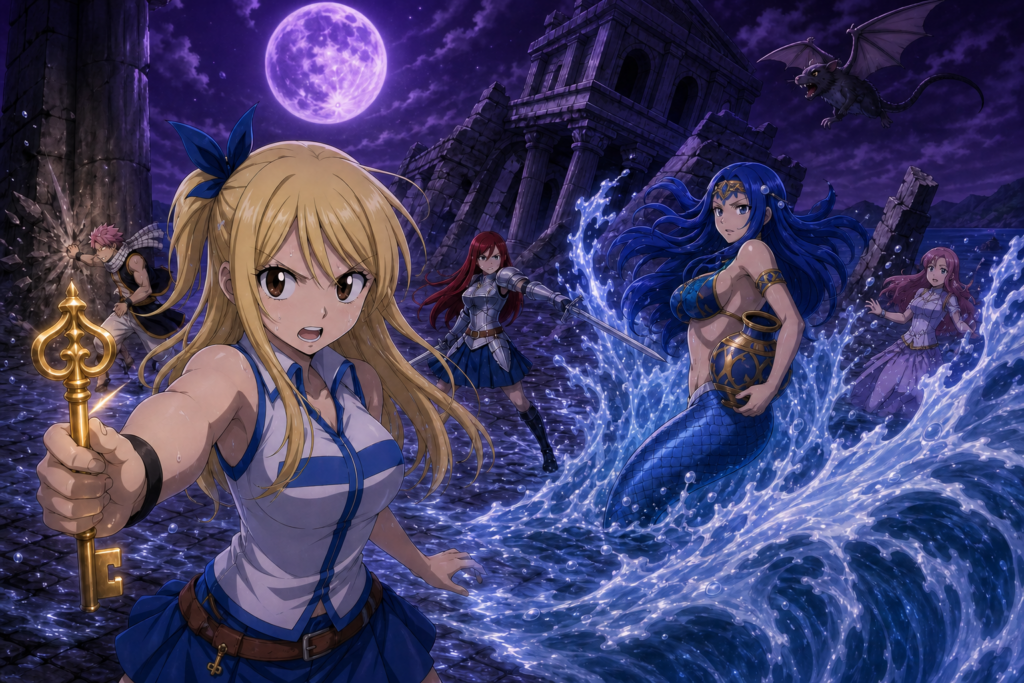
Bottom line: Episode 14 is about people acting without permission, then finding out whether their choices can survive contact with everybody else. Lucy summons Aquarius knowing the water will not politely separate friend from enemy. Natsu attacks the ruins instead of following the fight somebody prepared for him. Erza arrives with the authority to drag the whole unauthorized team home. Gray finally tells her that punishment can wait because the danger cannot. Nobody gets a clean choice. That is exactly why the choices matter.
Receipt box
- Episode: 14
- English title: Do What You Must!! / Just Do Whatever!!
- Japanese title: 勝手にしやがれ!!
- Romanization: Katte ni Shiyagare!!
- Original Japanese air date: January 18, 2010
- Story arc: Galuna Island / Sub-Zero Emperor Lyon
- Manga material: Chapters 34 and 35, then Chapter 36 through page 18, according to the adaptation ledger
- Japanese principal cast: Aya Hirano as Lucy, Sayaka Ohara as Erza, Tetsuya Kakihara as Natsu, Yūichi Nakamura as Gray, Saori Hayami as Sherry, Eri Kitamura as Aquarius, and Rie Kugimiya as Happy
- Opening / ending: “Sense of Wonder” / “Tsuioku Merry-Go-Round”
- Where to watch: Fairy Tail Episode 14 on Crunchyroll
- Episode type: Manga canon
Lucy's plan is not safe. It is honest.
Lucy is stuck in the kind of matchup that attacks the structure of her magic. Sherry’s Doll Attack can manipulate nonhuman beings, which turns Lucy’s Celestial Spirits into possible weapons against their own contractor. Lucy cannot solve that problem by summoning another Spirit as if she is choosing a different appliance. The enemy is exploiting the relationship itself.
So Lucy reaches for Aquarius.
This is not a cute friendship move. Aquarius is powerful, temperamental, and famously unwilling to shape every flood around Lucy’s comfort. Lucy understands that. She summons her anyway because a huge, indiscriminate surge of water can break the arrangement Sherry is controlling.
That makes the choice risky, but it also makes it honest. Lucy does not pretend she commands a perfectly obedient servant. She works with the Spirit she actually has. Aquarius brings her own mood, her own judgment, and enough force to wash the battlefield clean whether Lucy enjoys the ride or not.
The comedy lands because the consequence is real. Lucy’s trump card does not kneel afterward and congratulate her. Aquarius is annoyed. Lucy gets caught in the water too. The show refuses to turn a contract between two difficult people into a fantasy of one-sided ownership.
That is the ethical center of Lucy’s magic. The keys open gates. They do not erase personhood.
Sherry weaponizes the category of "not human"
Sherry’s magic is useful because it exposes a nasty assumption. Doll Attack treats nonhuman life as available material. If a being fits the category, Sherry can try to move it like a piece.
Fairy Tail lives in a world crowded with Spirits, transformed creatures, magical animals, demons, and beings who do not fit a human social box. A power built on controlling “the other” is not neutral just because it comes with pretty animation and a confident pose.
Sherry does not ask what Lucy’s Spirits want. She sees access. Her magic takes a difference in species and converts it into permission.
Lucy answers by relying on Aquarius’s agency, including the inconvenient parts. That is why the matchup works beyond spectacle. Sherry’s method says nonhuman means controllable. Lucy’s relationship with Aquarius says nonhuman still means somebody.
The series will not always examine every Celestial Spirit joke with this much care. I am not giving it extra credit it has not earned. In this episode, though, the contract has teeth. Lucy wins room to move because Aquarius remains more than a tool.
Erza arrives as the consequence everybody tried to outrun
Erza does not reach Galuna Island as a cheerful rescue package. She comes to retrieve guild members who took an S-Class job without permission. The team knew the rule. Lucy may be new, but Natsu and Happy are not. Gray followed them and then made the crisis personal. Their reasons differ. The violation does not disappear.
Erza’s arrival changes the emotional weather before her sword changes the battlefield. Lucy and Happy know what she represents: guild authority, discipline, and the possibility that surviving the island will lead directly to punishment at home.
Good. It should.
Found family becomes meaningless if it only provides comfort. A guild that assigns dangerous work by rank needs a way to respond when members gamble with lives and call it confidence. Erza’s anger is not betrayal. It is part of the structure that keeps a magical workplace from becoming a weekly insurance scam.
At the same time, authority can become stupid if it refuses to read the room. The village is still in danger. Moon Drip is still falling. Lyon is still trying to revive Deliora. Marching everybody home immediately would protect the rule and abandon the people the rule is supposed to help wizards serve.
That tension gives Erza something better than a dramatic entrance. It gives her a decision.
Gray finally challenges Erza for something bigger than pride
Gray standing up to Erza matters because the series has already established how much her presence can shut down a room. He is not casually disagreeing with a teammate. He is pushing against the guild member everyone expects to obey.
His argument is not that the team did nothing wrong. It is that the work cannot stop here. Lyon, Deliora, Ur’s sacrifice, and the villagers’ safety are connected now. Gray intends to finish it.
This is a better use of defiance than the secrecy that brought him into the ruins alone. Gray finally puts his position in front of another person and lets that person answer. He does not vanish into a private suicide plan. He speaks.
Erza’s willingness to hear him is equally important. Leadership is not the ability to make everybody quiet. It is the ability to distinguish a challenge to your ego from information you need.
The episode does not turn their exchange into a soft group hug. Thank goodness. Erza can delay punishment without pretending the original choice was responsible. Gray can demand action without becoming right about every earlier decision. Accountability and urgency can occupy the same scene.
Natsu attacks the architecture of the problem
Natsu’s solution is beautifully Natsu. If Moon Drip needs the ruins positioned beneath the moon, then attack the structure holding the ritual in place.
He is not trying to win the formal fight Lyon imagined. He is trying to make the ritual fail. Smashing supports and tilting the ruins is reckless construction work performed by a man who should never be handed a permit, but the logic is sound.
This continues the tactical growth from Episode 13. Yuka could cancel magic, so Natsu stopped feeding him the answer he expected. Lyon has arranged a ritual inside a structure, so Natsu treats the building as part of the spell.
That is more interesting than another speech about firepower. Natsu reads systems physically. He may not explain the geometry, but he notices what must stay standing and makes it stop standing.
There is still danger in the method. The ruins contain people. The islanders live nearby. Structural sabotage is not automatically heroic because Natsu grins while doing it. The episode makes the plan legible, not tidy.
This is where the title earns its double edge. “Do what you must” can mean courageous action when procedure fails. “Just do whatever” can also describe the exact attitude that caused the unauthorized mission. The line between the two is consequence.
Permission is not the same as responsibility
Every main character is negotiating permission in this episode.
Lucy does not have Aquarius’s cheerful cooperation, but she knows the terms of the relationship and accepts the backlash. Natsu does not have guild permission, but he targets the ritual rather than chasing applause. Gray does not have Erza’s approval at first, so he explains why the team must remain. Erza has formal authority, but she does not use it as an excuse to stop thinking.
Sherry provides the contrast. Her magic creates control without consent. She can move a being, so she treats movement as obedience.
That difference is the episode’s real moral line. Permission can be absent for complicated reasons. Responsibility shows up in what a person does with power, what risk they accept, and whether other people’s lives count as more than scenery.
Fairy Tail is not presenting a policy manual. It is asking whether rules and relationships still mean something when the obvious safe option is gone.
The workplace read: rank exists because danger is real
The S-Class restriction has sometimes functioned like a shiny forbidden-door sign placed in front of Natsu for comedy. Galuna Island explains why the rule exists.
This job contains a cursed village, an ancient demon, a resurrection ritual, multiple hostile wizards, and a history Gray was emotionally unprepared to confront. That is not an entry-level assignment with a spicy travel allowance.
RaeRae’s reading is that Fairy Tail has both a supervision problem and a culture problem. The guild has ranks and rules, but its legends are built around people who break limits. Younger members absorb the hero story more easily than the risk procedure. Natsu hears “S-Class” and imagines proof of strength. Lucy hears a huge reward and a chance to establish herself. Gray hears Deliora and loses the distance required to judge anything cleanly.
Erza is the person forced to make the institution visible after the institution failed to stop them from leaving.
That does not make Makarov uniquely negligent for every choice grown wizards make. It does show that culture is more than posted rules. If reckless success earns affection while prevention feels like punishment, members will keep learning the wrong lesson.
Japanese performance: authority, panic, and somebody else's tide
Aya Hirano gives Lucy’s decision the right mix of fear and stubborn calculation. Lucy is not pretending Aquarius will make everything pleasant. Her voice carries the strain of choosing a dangerous ally because the controlled battlefield is worse.
Eri Kitamura’s Aquarius does not sound like an extension of Lucy. That separation matters. Aquarius enters with her own irritation and force. The performance protects the character from becoming a visual effect with a face.
Sayaka Ohara gives Erza authority without flattening her into a scolding machine. The firmness is immediate, but the performance leaves room for Erza to process Gray’s refusal. Leadership sounds strongest here when it does not need to scream.
Yūichi Nakamura lets Gray push through injury and fear without making the challenge sound easy. Tetsuya Kakihara keeps Natsu’s structural attack energized and direct. Natsu sounds like someone who has already moved to the next action while everybody else is still naming the problem.
Saori Hayami’s Sherry keeps a polished surface around conduct that removes agency. The pleasant confidence makes Doll Attack more unsettling, not less.
Adaptation: three fronts become one argument
Episode 14 adapts Chapters 34 and 35 plus the first eighteen pages of Chapter 36. The television episode braids Lucy’s fight, Erza’s arrival, Gray’s refusal, and Natsu’s attack on the ruins into one question: who gets to decide what happens next?
The cross-cutting matters. Lucy is dealing with control at the level of a magical contract. Erza and Gray are dealing with control inside the guild. Natsu is dealing with the physical system sustaining Moon Drip. Lyon’s side is trying to preserve control over the ritual.
Television gives those layers a shared tempo. Aquarius’s water brings movement and release. Erza’s presence brings a stop. Natsu’s blows bring instability. The episode alternates those rhythms instead of treating each fight like a sealed bracket.
The violet moon and tilted ruins keep the larger threat visible. Even when the comedy hits, the ritual continues. That visual pressure stops Aquarius’s temper and Natsu’s demolition from turning the episode into disconnected gags.
RaeRae's verdict
Episode 14 gives Lucy the strongest material. She does not win because Aquarius becomes obedient. She creates a path through Sherry’s control because Aquarius remains difficult, powerful, and separate. Lucy knows the relationship well enough to risk the consequence.
Erza’s arrival is the other half of the episode. She brings the punishment the team deserves and then proves leadership is more than delivering it on schedule. Gray finally challenges her in the open. She listens without surrendering the rule.
Natsu, meanwhile, decides the temple itself is participating and punches the architecture. Honestly, I cannot say the man lacks focus.
The episode’s argument is not that rules are useless. It is that rules, contracts, and authority only matter when they protect people rather than replace judgment. Doing whatever you want started this mess. Doing what the moment requires may be how the team gets everyone out of it.