
Evangelion Episode 25: Do You Love Me?
Evangelion Episode Reaction
The apocalypse enters the mind and asks whether ending loneliness is worth ending the person who feels lonely.
Bottom Line
Instrumentality begins by putting every private excuse on trial
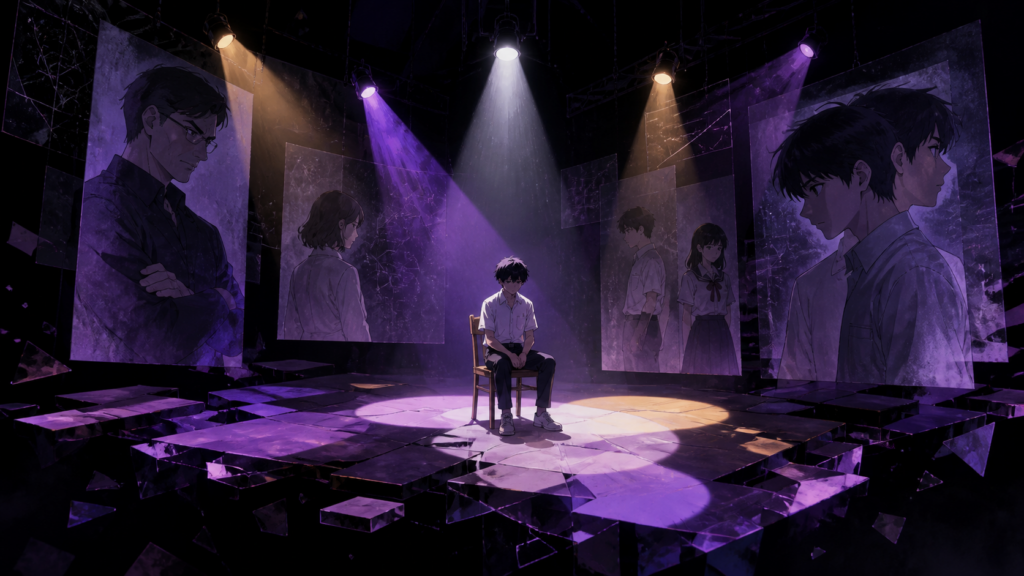
Episode 25 stops pretending the apocalypse can be understood through command screens and exploding cities. The battle has moved inside the people NERV used, and the episode treats each identity as a room built from fear, memory, desire, and borrowed judgment. Shinji, Asuka, Misato, and Rei face versions of themselves shaped by what they believe other people see. The stripped stage is not an escape from the story. The stage is where the story’s emotional machinery finally becomes visible.
RaeRae’s bottom line is that Instrumentality offers relief by attacking the boundaries that make a person separate. Loneliness hurts because another person can reject, misunderstand, or leave. The proposed cure removes that risk by removing the distance between selves. Episode 25 makes the offer sound understandable before viewers can dismiss the project as villain nonsense. Every major character has been trained to experience individuality as a wound.
The episode can frustrate viewers expecting external answers, especially after Kaworu’s death and NERV’s collapse. That frustration is valid. Evangelion asks audiences to accept emotional interrogation before explaining the physical route into Instrumentality. Yet the formal break also matches the crisis. Ordinary continuity cannot describe a process designed to dissolve continuity, bodies, and private thought.
The Stage
A bare room exposes how much identity depends on an audience
Black space, spotlights, handwritten words, repeated frames, and unseen voices replace the familiar geography of Tokyo-3. Characters stand as though called to testify, but no neutral judge exists. Each question comes from another character, the self, or the internalized voice of someone whose approval still controls the person being questioned. The uncertainty matters because shame rarely announces who is speaking.
The stage removes props that once stabilized identity. Shinji has no Eva cockpit to prove usefulness. Misato has no rank, gun, or apartment performance. Asuka has no score board showing superiority. Rei has no command waiting from Gendo. Without those roles, each person confronts a frightening possibility: the self may not be one permanent object hidden beneath performance. The self may be assembled through relationships, choices, and stories repeated until they feel natural.
Instrumentality exploits that instability. If identity depends partly on other people, merging every mind could appear to complete the self. Missing perspectives would become available, and misunderstandings might vanish. The danger is that no one could refuse another person’s interpretation. A shared mind can end loneliness only by ending privacy, disagreement, and the right to remain unfinished.
Shinji
The question is not whether Shinji deserves love, but whether he can survive needing love
Shinji’s interrogation returns to the belief that piloting earns permission to exist. He learned the bargain through Gendo, NERV, praise after battles, and abandonment whenever he stopped being useful. The belief now speaks with Shinji’s own voice. He expects rejection before another person decides, then treats withdrawal as proof that rejection was inevitable.
Kaworu’s death deepens the pattern. Shinji received direct affection and lost the person connected to that affection through his own hand. The lesson he fears learning is not simply that love ends. The lesson is that accepting love creates a new weapon someone can use against him. Instrumentality becomes attractive because a merged existence might provide recognition without another final messenger disappearing.
Episode 25 refuses to call Shinji selfish for wanting reassurance. Children need dependable care before they can build a stable sense of worth. The adults around him offered conditional attention, secrecy, and emergencies. His dependence therefore has a history. Understanding that history does not excuse every choice, but moral judgment without context would repeat NERV’s habit of blaming pilots for damage produced by command.
The episode’s harder challenge asks whether Shinji can recognize other people as separate subjects rather than mirrors measuring his value. Wanting love is human. Requiring every relationship to certify existence places an impossible burden on the other person. Shinji must eventually risk connection without controlling the verdict, which means accepting that affection can be real even when permanence is impossible.
Asuka
Pride collapses when applause can no longer drown out abandonment
Asuka’s inner trial shows the cost of building identity around superiority. She does not merely want to pilot well. She needs achievement to prove that she is not the helpless child who watched her mother turn toward a doll and away from her. Every victory has been an argument against that childhood. Every failure therefore feels like evidence that the abandoned girl was the true self all along.
The episode allows Asuka’s hostility to coexist with desperate need. She attacks dependency in others because her own need terrifies her. Shinji’s withdrawal angers her, but direct closeness also threatens the protective image of independence. Kaji’s adult attention, Misato’s authority, Rei’s calm, and Shinji’s performance all become surfaces on which Asuka measures whether she remains exceptional.
Instrumentality promises to reveal the need she hid, yet exposure without consent is not healing. A person can confess vulnerability when safety, time, and choice exist. Forced access recreates the violation performed by Arael. Episode 25 therefore makes shared consciousness look less like therapy and more like a system that claims ownership of every private wound.
Asuka deserves more than a lesson about humility. Her pride preserved motion when the adults around her failed to provide dependable care. A better future would not destroy pride and call the destruction growth. A better future would let confidence become one part of her identity rather than the emergency wall holding every other part outside.
Misato
Competence cannot erase the child who learned love through absence
Misato’s sections confront the split between professional authority and private shame. At NERV she performs confidence, command, humor, and sexual ease. Alone she fears that those performances hide a person who uses work and intimacy to avoid stillness. The episode does not reveal a secret false Misato beneath a public mask. Both versions are real responses to different demands.
Her relationship with her father remains central. She resented his absence, survived through his final sacrifice, and built a career inside the same militarized scientific world that consumed him. Hatred and imitation share the same room. Misato may believe she chose NERV freely, but grief shaped which choices felt meaningful. Instrumentality displays that inheritance without allowing her the comfort of a clean rebellion.
Her sexuality also receives scrutiny that can become cruel if viewers treat confession as conviction. Misato seeks closeness through patterns available to her, sometimes hurting herself and others. Sexual desire is not the crime. The problem is using another person to silence fear without acknowledging what the exchange asks from them. Shame alone cannot produce healthier intimacy because shame encourages more performance and concealment.
Misato’s tragedy comes from recognizing the children’s pain while remaining part of the institution creating that pain. She cares for Shinji and Asuka, yet command repeatedly outranks caregiving. Episode 25 places those contradictions together. Love does not automatically cancel complicity, and complicity does not prove that every act of love was fake.
Rei
A manufactured role discovers that emptiness was assigned, not natural
Rei enters Instrumentality with the weakest conventional claim to an individual life. Her body was replaceable, her memories were managed, and Gendo treated her as a route toward Yui. Episode 23 proved that another Rei can inherit the name while losing the relationship Shinji remembers. Episode 25 asks what remains when even that borrowed identity begins dissolving.
Her quietness has often been mistaken for absence. The episode shows quiet as conflict compressed almost beyond language. Rei wants connection, resents instrumental use, fears abandonment, and struggles to distinguish chosen loyalty from programming. Gendo supplied a purpose that protected her from asking whether she deserved another purpose.
Instrumentality may seem designed for Rei because bodily boundaries have never been secure for her. Yet merging would complete Gendo’s ownership by turning her into a passage rather than a person. Rei’s emerging resistance matters because she begins to judge the man who named her role. A created person does not owe the creator permanent access.
The question of identity cannot be solved by locating one original soul and declaring every other Rei secondary. Evangelion makes continuity emotional, embodied, and relational. Rei II mattered because of what she experienced and chose. Rei III matters as a new subject, not a defective restoration. Instrumentality threatens both truths by reducing every self to material for one project.
The System
A machine built from trauma calls surrender a cure
NERV, SEELE, and Gendo approach Instrumentality through different motives, but every route treats human boundaries as a technical problem. Pain becomes evidence that separate life has failed. The proposed solution bypasses social repair, accountability, consent, and the slow work of building trust. Powerful adults choose metaphysical redesign instead of admitting how their institutions produced loneliness.
Real systems make smaller versions of the same move. Workplaces offer resilience training without reducing abusive workloads. Schools teach coping while ignoring unsafe environments. Families demand forgiveness before naming harm. Platforms promise constant connection while rewarding exposure and comparison. Individual pain becomes a defect to optimize, and structural responsibility disappears behind the language of wellness.
Episode 25 argues that private psychology and public structure cannot be separated. Shinji’s beliefs formed inside abandonment and military usefulness. Asuka’s pride formed inside grief and performance. Misato’s contradictions formed inside disaster and command. Rei’s uncertainty formed inside literal manufacture. Their minds are personal, but the conditions shaping those minds were organized by other people.
A humane response would expand choices rather than erase boundaries. Honest information, dependable care, shared responsibility, and permission to refuse would not eliminate loneliness. Those practices would make loneliness survivable without demanding the death of privacy. Instrumentality offers certainty because the adults never built a culture capable of tolerating uncertainty.
Criticism
The emotional logic is strong, but the external collapse becomes too distant
Episode 25 demands a radical change in viewing language. The prior episode ended with Kaworu’s body crushed in Unit-01’s hand. NERV’s political and military crisis remains unresolved. Moving immediately into internal theater can feel like a missing reel rather than a deliberate transition. Viewers deserve enough external orientation to understand when the process began and whose plan currently controls the event.
The limited animation also has two effects. Repeated drawings, text cards, and rough imagery create intimacy and instability. The same techniques reveal production constraints and can reduce visual momentum. Artistic purpose and production pressure can coexist. Defending every limitation as flawless symbolism would flatten the difficult conditions under which the episode was made.
Some interrogations risk presenting pain as a puzzle that can be solved through a sharper question. Trauma rarely yields because someone identifies the contradiction. Recognition may begin change, but bodies, habits, relationships, and material safety still matter. The finale needs to avoid turning insight into instant recovery.
Despite those weaknesses, the episode earns its form by refusing spectacle as the only language of apocalypse. Cities can explode without changing anyone. Episode 25 destroys the stories characters use to remain functional. The quieter destruction may be harder to watch because viewers recognize the materials.
Verdict
Episode 25 turns the end of the world into an argument about the right to remain separate
Do You Love Me? is essential because the title asks a child’s question and reveals an adult system hiding behind the answer. Every character wants recognition. None has learned how to receive recognition without fear, bargaining, performance, or control. Instrumentality promises universal access, then quietly removes the person who could say no.
The episode’s greatest strength is refusing one villainous explanation for emotional collapse. Gendo, SEELE, and NERV bear enormous responsibility, but the characters also carry habits developed across years. Structural harm and personal choice interact. Healing requires more than defeating one commander because the commander’s logic has already become an internal voice.
RaeRae’s verdict remains strongly positive with a format warning. Viewers seeking physical chronology may feel stranded, and the episode should have offered a clearer bridge into the internal process. Fans willing to follow the psychological route receive one of television animation’s boldest examinations of identity under pressure.
Episode 25 does not finish the argument. The stage has removed the Eva, the city, and the command chain, but Shinji still believes other people possess the authority to define him. The final episode must decide whether freedom means escaping every relationship or entering relationships without surrendering the right to exist as a separate, changing person.