
Memory, Sorrow, and Thorn · Canonical Character Profile
Lord Ethelferth of Tinsett
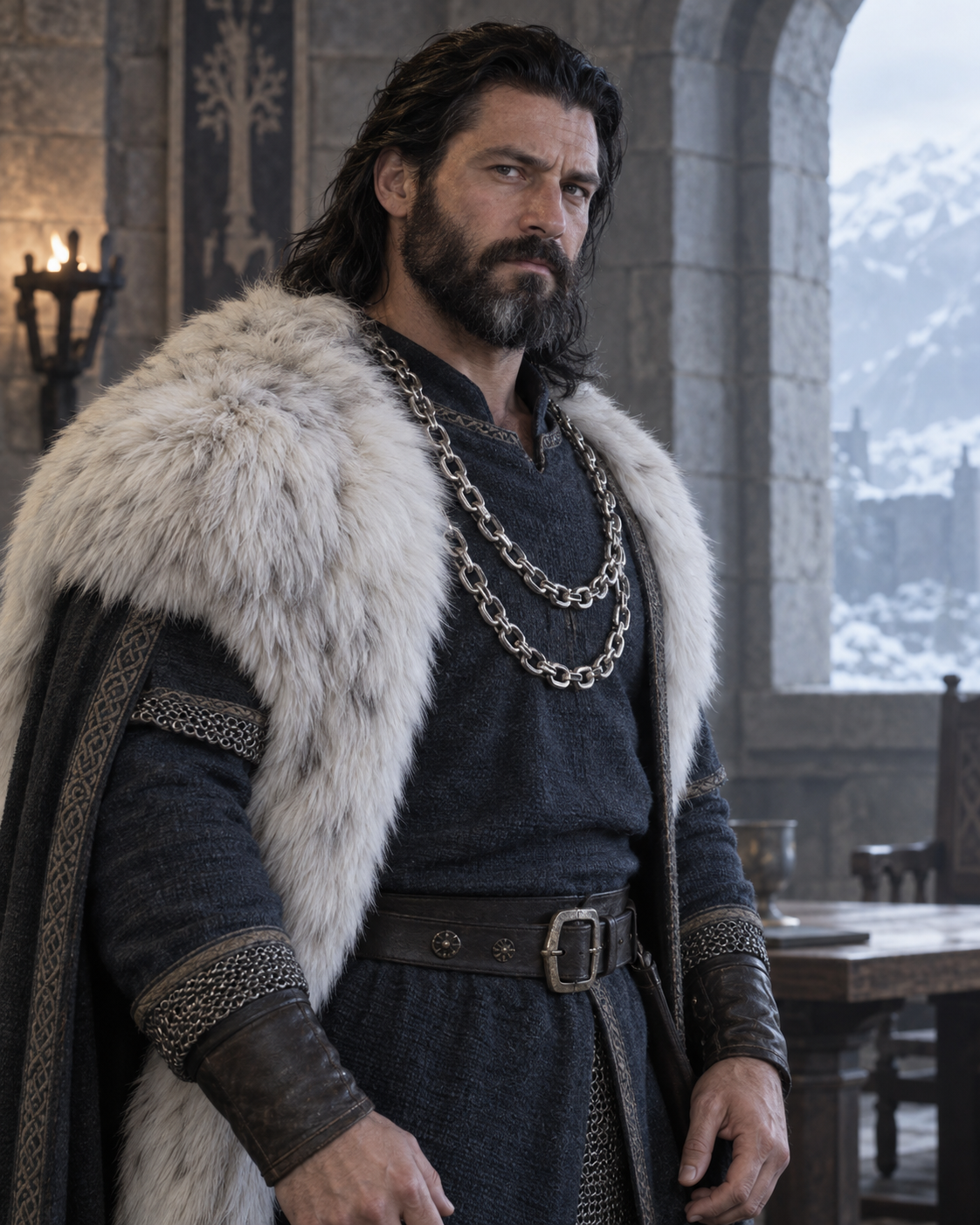
Lord Ethelferth arrives at Naglimund with two hundred men, white furs, silver chains, a muscular frame, and no natural appetite for polished council language. He supports Josua, says Elias has lost his wits, recognizes the Storm King’s divide-the-neighbors strategy, and opposes the green-tent parley after Benigaris murders Leobardis. Ethelferth’s gift is blunt pattern recognition: he may dislike court speech, but he keeps noticing when powerful men are using memory and trust as openings.
At a Glance
The blunt lord who brings bodies to the alliance and questions the stories holding its prince hostage
- Name
- Ethelferth
- Title
- Lord of Tinsett
- Appearance
- Muscular and bearded
- Dress
- White furs and silver chains
- Speech
- Blunt; plainly uncomfortable with court polish
- Military contribution
- Arrives at Naglimund with two hundred men
- Last confirmed state
- Alive at Naglimund before the Harrowing; later fate unconfirmed
Two Hundred Men from Tinsett
Ethelferth enters the resistance as logistics before he becomes an argument
Naglimund’s commons are already crowded with refugees from the Frostmarch, Greenwade valley, Utanyeat, and nearby farms. Some flee impossible weather and banditry; others carry the damage of Guthwulf’s passage.
Into that pressure comes Ethelferth with two hundred men from Tinsett. Baron Ordmaer brings one hundred from Utersall. Gwythinn brings a Hernystiri company. Local lords and outriders continue arriving.
The number makes Ethelferth consequential immediately. Two hundred fighters require food, space, command, equipment, and coordination. They also materially increase Naglimund’s ability to resist Elias.
His appearance matches that visible weight: muscular, bearded, dressed in white furs and silver chains. The combination suggests rank and northern practicality without providing a coat of arms or exact cultural origin beyond his Erkynlandish holding.
Ethelferth does not arrive alone to offer moral support from a warm seat. His allegiance is embodied by people who may die because he chose Naglimund.
The record does not state whether every man is a household soldier, levy, volunteer, or mixed force. It confirms the contribution and the political fact that Tinsett’s lord has made Josua’s cause more than a private family quarrel.
The Naglimund Raed
He supports Josua without pretending the prince’s uncertainty makes Elias reasonable
The Raed gathers around a horseshoe of tables. Roughly fifty lords, soldiers, clergy, emissaries, and witnesses share a room without sharing one preferred outcome.
Josua says Elias remains High King but has answered crisis with taxes, military seizure, imprisonment, and garrisons. He frames the choice as keeping chains or cutting them while accepting the wound.
Devasalles asks whether Josua wants accommodation, revenge, or the throne. Gwythinn demands war. Josua admits anger and danger but refuses to begin rebellion on rumor alone.
Ethelferth openly supports him and says Elias has lost his wits.
The bluntness fits his manner. He is not comfortable translating judgment into elegant court ambiguity. Yet his support does not erase the council’s evidence problem. Devasalles continues demanding firsthand grounds, and Josua produces Miriamele as his strongest witness.
Ethelferth’s position is therefore decisive without being treated as sufficient proof. He has already chosen Josua and brought men. The Raed still asks what can justify the coalition to itself and to the wider kingdom.
Blunt Is Not Simple
His discomfort with court speech does not prevent sophisticated political reasoning
Ethelferth’s rustic or blunt manner could be mistaken for intellectual limitation. His later contributions reject that reading.
When Jarnauga reveals the connected history of Asu’a, Sorrow, Ineluki, and the League of the Scroll, the council is forced to consider a power whose methods extend across centuries.
Ethelferth recognizes a political pattern: Ineluki may regain strength slowly by making neighboring human rulers fight one another. The Storm King could use Elias’s desire for power to weaken everyone around him before destroying the king as well.
That is strategic analysis, not superstition. Ethelferth identifies divide-and-conquer behavior operating through existing ambition rather than imagining supernatural control replaces human responsibility.
Josua considers the theory plausible but distinguishes it from evidence. The ledger preserves that boundary. Ethelferth offers an inference capable of explaining events; the council does not promote it into confirmed access to Ineluki’s mind.
His value lies in seeing method while respecting, or at least inhabiting, a room where method and proof remain different things.
Make the Neighbors Fight
Ethelferth understands that supernatural strategy still recruits ordinary human weakness
The series does not excuse Elias by revealing larger powers. Pryrates, Sorrow, the Red Hand, and Ineluki magnify the crisis, but Elias’s resentment, possessiveness, and hunger for authority remain active.
Ethelferth’s theory holds both levels together. A returning enemy does not need to invent every rivalry. He can strengthen one ruler, encourage conflict, and let mortals spend one another.
Naglimund itself demonstrates the danger. Elias marshals barons, mercenaries, siege engines, and neighboring forces against his brother while the true northern threat gathers beyond the human battlefield.
The theory also explains why Ethelferth matters beyond troop count. He is watching not only who fights but who benefits when human powers exhaust themselves.
The page must keep the attribution clear. This is Ethelferth’s analysis and Josua’s plausible consideration, not confirmed omniscient narration. Jarnauga himself refuses to claim complete knowledge of the Storm King’s mind.
The Green Tent
After Leobardis’s murder, Ethelferth refuses to let Josua call memory a security plan
Benigaris’s betrayal destroys the Nabbanai relief effort and kills Duke Leobardis. Soon afterward, Elias offers a parley in a green tent outside bowshot.
Ethelferth objects. Isorn, Deornoth, and Jarnauga object with him.
The sequence matters. Their warning is not generic fear of negotiation. It follows a fresh betrayal in which family trust and battlefield geometry were deliberately weaponized.
Josua still believes Elias possesses a private code of honor separate from Pryrates’s influence. Jarnauga warns that the prince may be stretching memory into excuses for his brother.
Ethelferth’s objection continues the pattern established in his Storm King theory. Powerful enemies use existing relationships. The belief that an old bond remains protected can become the opening through which violence enters.
Josua goes anyway. Deornoth and Isorn arrange the guard despite their wounds, and Ostrael becomes the frightened third member of the party.
Elias does not attack inside the meeting, so the objectors are not vindicated by an immediate trap. Their concern remains reasonable because the parley produces no peace and confirms the abyss between the brothers.
Ethelferth’s role is not to be the man who is always proven right. It is to challenge the emotional premise Josua is using when tactical evidence points the other way.
White Fur, Silver Chains
His visual language carries rank without making him fluent in court theater
Ethelferth’s white furs and silver chains communicate wealth, regional identity, and status. They do not make him elegant in debate.
That contrast creates a strong canonical portrait. He is visibly a lord and plainly uncomfortable with the verbal performance expected from one.
The discomfort should not be played for peasant comedy. Ethelferth brings more men than many polished speakers, speaks directly when others hedge, and identifies strategies the room needs to consider.
Nor should art turn white fur into a fantasy barbarian costume. The materials belong to a landed Erkynlandish lord in a medieval secondary world, not a generic northern-warrior mood board.
The record leaves hair color, eye color, exact age, height, scars, family, heraldry, and weapon unspecified. His beard, muscularity, clothing materials, and social bearing are the hard visual anchors.
What Two Hundred Men Mean
His political insight is backed by lives that cannot be replaced
When Ethelferth speaks at the Raed, his words carry the weight of two hundred followers already inside Naglimund’s survival economy.
When he objects to the green tent, the risk is not abstract. If Josua dies or is captured, the alliance containing those men may fracture while Elias’s army waits outside.
The siege later teaches Deornoth that Elias can spend soldiers like apple peelings while Naglimund cannot replace its losses. Ethelferth’s contingent is part of the finite defense being consumed.
The completed record does not provide a casualty count for Tinsett’s men or specify Ethelferth’s battlefield station. The profile should not assign him a wall scene merely to make his support look martial.
His contribution is already concrete: arrival, manpower, council commitment, strategic analysis, and opposition to an unnecessary leadership risk.
Connections
The prince, skeptics, witnesses, and betrayed duke around Ethelferth’s counsel
Prince Josua
Receives Ethelferth’s military support, political backing, strategic theory, and objection to the parley.
Jarnauga
Supplies the history from which Ethelferth derives his divide-the-neighbors theory.
Baron Devasalles
Demands firsthand proof while Ethelferth states his support and blunt judgment of Elias.
Isorn
Joins Ethelferth in opposing the green-tent meeting after Leobardis’s murder.
Deornoth
Shares the parley objection and then helps build the guard Josua requires.
Duke Leobardis
His murder supplies immediate proof that kinship and negotiation can be weaponized.
Why Ethelferth Matters
He proves plain speech and careful pattern recognition are not opposites
Ethelferth could have been a troop-count character: two hundred men from Tinsett, end of entry.
Instead, he participates in the resistance’s intellectual work. He names Elias’s incapacity, interprets Ineluki’s likely political method, and challenges Josua’s belief that private brotherhood still guarantees safe contact.
His bluntness does not produce certainty. Josua correctly distinguishes theory from proof, and the parley does not become an ambush. But Ethelferth consistently asks the coalition to stop treating desire as evidence.
That makes him a valuable counterweight to courtly fluency. The man least comfortable performing the language of power may be among the quickest to notice how power is performing through everyone else.
On the Record
Book 1 only, canonical spelling corrected, and later fate left open
This is Lord Ethelferth of Tinsett’s one canonical full-spoiler profile. The freshly reconciled ledger consistently spells his name “Ethelferth”; the unpublished placeholder’s “Ethelfert” title and slug have been corrected rather than preserved as canon. His arrival, Raed support, Storm King theory, and green-tent objection occur in Book 1. No direct Ethelferth receipt appears in Books 2–4.
The record confirms Tinsett, two hundred men, muscularity, beard, white furs, silver chains, blunt speech, discomfort with court performance, support for Josua, judgment that Elias has lost his wits, divide-the-neighbors theory, and objection to the parley. It does not confirm exact age, hair or eye color, family, heraldry, battlefield station, troop casualties, participation in the Harrowing, death, or later fate.
Visual state: approved editorial reconstruction. CVM depicts Ethelferth as a devastatingly handsome adult Erkynlandish lord around thirty-eight with a tall heavily muscular functional build, slate-gray eyes, weathered fair skin, collar-length swept-back jet-black hair, a full dense black beard with one subtle silver chin streak, and a direct skeptical expression. Deep-charcoal-blue wool, restrained mail, dark leather, canonically required functional white fur, and two plain layered silver chains establish rank without barbarian shorthand. Preserve this exact face, adult baseline, body, coloring, hair, beard/silver map, white-fur cut, chain pattern, wardrobe, and impatience with ceremony across arrival, Raed, counsel, and siege-era imagery. Never invent heraldry, scars, a battlefield station, Harrowing outcome, or death scene. The same attachment powers featured image, hero, directory card, and social metadata.