
Memory, Sorrow, and Thorn · Canonical Character Profile
Ethelbearn
Ethelbearn is the scarred Erkynlander who volunteers for the Thorn expedition and dies before the party reaches the people who can explain Simon’s White Arrow. He receives no grand final speech. What survives is better evidence of a life: a loud laugh, a soldier’s sword in frozen ground, and a helmet another man refuses to waste.
At a Glance
The veteran whose laugh outlives the road
- Realm
- Erkynland
- Calling
- Veteran soldier in the Thorn expedition
- Company
- Simon, Binabik, Haestan, Grimmric, Sludig, and Qantaqa
- Confirmed distinction
- Scarred, bushy-mustached, nearly as large as Haestan, and remembered for a loud laugh
- Death
- Killed during the Haethstad pursuit
- Final status
- Dead in Book 1, Chapter 37
The Visual Receipt
Built like a road-tested soldier, not a polished court knight
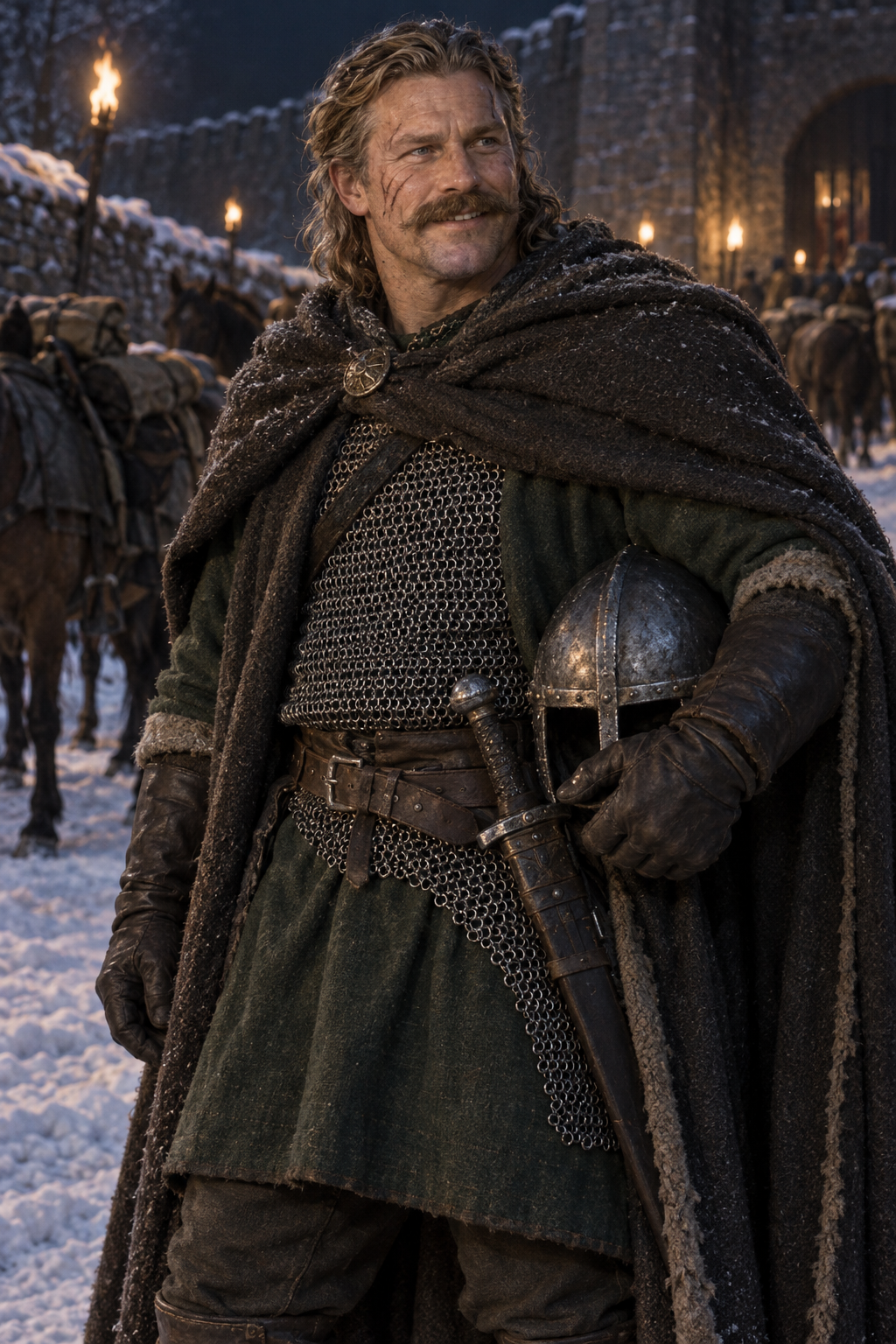
Ethelbearn is a scarred veteran with a bushy mustache and a frame nearly as large as Haestan’s. The text gives him no courtly palette, eye color, hair color, exact age, or ornate personal heraldry. His equipment includes a sword and helmet suitable for the winter expedition.
CVM’s approved editorial reconstruction makes him an exceptionally handsome, weathered adult Erkynlander whose size and scars suggest real campaigning rather than decorative toughness: steel-blue eyes, dark-blond hair touched by frost, a magnificent bushy mustache, old cheek-and-brow scars, and a very large road-tested body. His sword, rounded helmet, practical mail, pine-green wool, and heavy charcoal-brown cloak carry the expedition rather than court polish. Preserve this exact identity in departure, pursuit, burial-memory, and memorial imagery.
Book 1 · The Dragonbone Chair
A volunteer in a mission that cannot afford hero theater
Leaving Naglimund
Ethelbearn steps forward when the captains ask for men
Haestan is one of three Erkynlanders who volunteer for Binabik’s northbound search; Ethelbearn and Grimmric complete the trio. Ethelbearn’s scarred face, heavy build, and veteran presence make him part of the expedition’s practical spine. These are not anonymous guards assigned by a roster. They choose a mission whose route is uncertain and whose quarry may be a legendary sword beneath a dragon’s mountain.
He rides out at night with the others while Naglimund prepares for Elias’s siege. The choice means leaving one danger for another, not escaping war.
The Haethstad pursuit
An ashwood arrow ends the road before the Sithi can explain it
Near burned Haethstad, the dog-helmed hunter and eight armored riders drive the party into a mounted flight. The companions scatter among trees and snow while arrows follow them uphill.
Ethelbearn is struck through the neck beneath his beard by an ashwood shaft. His horse falls and rolls over him. When the survivors are allowed to search, they find his body twisted beside the road, already beyond help.
The chapter does not grant him final words, a duel, or a convenient killer standing over the corpse. Death arrives inside confusion, distance, and pursuit—the exact conditions under which war converts a known companion into someone the others must go back to recover.
The frozen grave
His company makes a memorial from what the road will allow
The survivors hack at the frozen earth with swords and axes, wrap Ethelbearn in his thick cloak, and lower him into a shallow grave. They plant his sword upright as the marker.
Haestan asks Sludig to take Ethelbearn’s helmet because the dead man would not have wanted useful equipment abandoned. Sludig accepts it and promises vengeance. Simon remembers Ethelbearn’s loud laugh—one ordinary human sound that carries farther than a formal epitaph.
Company
The people who carry him beyond the grave
Haestan
The fellow volunteer helps recover and bury him, then makes sure Ethelbearn’s helmet continues serving the living.
Sludig
Sludig takes the helmet and vows blood for blood. Ethelbearn’s death sharpens the Rimmersman’s already volatile idea of honor.
Grimmric
The third Erkynlandish volunteer survives the same pursuit and helps make the frozen grave.
Simon
Simon remembers the veteran’s laugh and later hears Haestan invoke Ethelbearn’s death as a reason not to waste Thorn or its bearers on suicidal rescue theater.
Binabik
The expedition leader carries Ethelbearn’s willing service forward by refusing to let the mission collapse into private revenge.
The Thorn mission
Ethelbearn dies before Thorn is found, but later survival depends upon treating his sacrifice as an obligation to finish rather than permission to die dramatically.
Why He Matters
Not every sacrifice announces itself as legend
Ethelbearn matters because epic quests consume ordinary people before they reach the mythic destination. The Sithi, the White Arrow, Uduntree, and Thorn may dominate the chapter’s lore, but his body is the cost sitting underneath that wonder.
His memorial also reveals the company’s values with unusual clarity: recover the dead, dig even when the ground resists, mark the grave, preserve useful gear, remember the laugh, and keep moving.
The Volunteer
Choosing the expedition matters because nobody can promise what the mission will become
Ethelbearn leaves Naglimund with Haestan and Grimmric when Binabik needs Erkynlanders willing to ride north. The company does not possess a reliable map to a conventional objective. They are following evidence toward a legendary sword while Elias’s forces close around the refuge they leave behind.
Volunteer does not mean carefree adventurer. Ethelbearn’s scars and veteran build place previous violence on his body. He knows enough of campaigning to understand cold, pursuit, poor information, exhausted horses, and sudden death. The decision carries more weight because it is made without the illusion that courage guarantees survival.
His role also resists the chosen-one funnel. Simon and Binabik matter enormously, but they cannot reach the north through private destiny alone. The road requires soldiers willing to guard, scout, fight, recover companions, share supplies, and absorb danger that prophecy does not redistribute fairly.
Death in Pursuit
The ashwood arrow denies him the clean ending heroic memory prefers
Ethelbearn does not fall after delivering a polished last line. An arrow enters through the neck beneath his beard. His horse collapses and rolls over him. The company is still fleeing, scattered through trees and snow, and cannot immediately convert the moment into ceremony.
The exact killer remains unknown. That boundary matters because battle often destroys the tidy relationship between action and witness. The profile can identify the dog-helmed hunter’s pursuing force, the ashwood shaft, the wound, the fallen horse, and the recovered body. It cannot manufacture a named opponent or final exchange.
His twisted position beside the road keeps death physical. The horse’s weight, frozen terrain, blood, and interrupted flight are not decorative grimness. They explain why recovery and burial require effort from survivors who are still in danger.
The Frozen Grave
Sword, helmet, cloak, and memory divide what the dead can still give the living
The ground will not accept a proper grave. The survivors hack at it with weapons and tools, wrap Ethelbearn in his thick cloak, and make the burial as deep as circumstance allows. Planting his sword upright creates a marker from the object most closely tied to his service.
The helmet follows a different path. Haestan asks Sludig to take it because useful equipment should not be abandoned. The decision does not dishonor the body; it recognizes the living still face the pursuit that killed him. Material inheritance becomes a survival practice.
Sludig answers with vengeance, but Haestan later gives Ethelbearn’s death another meaning. When Simon wants suicidal rescue theater, Haestan argues that Ethelbearn and Grimmric died helping carry Thorn north; wasting sword and bearers would make those deaths fruitless. Memory becomes a restraint against dramatic self-destruction.
That argument is not permission to use dead companions as moral leverage forever. It reflects the immediate expedition’s unfinished obligation. Ethelbearn chose the mission. Honoring that choice means bringing its people and purpose through the next danger, not creating more bodies beside his grave.
The Loud Laugh
One ordinary sound keeps the veteran from becoming only a casualty receipt
The ledger preserves no childhood, spouse, private dream, or long conversation for Ethelbearn. Simon remembers his loud laugh. That small sensory memory does work invented biography cannot improve.
A laugh implies social presence without explaining it away. It tells us the veteran occupied space among companions before the arrow reduced him to a recovery problem. Simon’s memory reaches past armor, size, scars, and utility to the sound another person made while alive.
The canonical profile therefore does not need to fabricate domestic history to prove Ethelbearn mattered. It needs to keep the verified fragments together: he volunteered, rode with named companions, died in pursuit, was recovered and buried, passed equipment to the living, shaped later decisions, and was remembered for joy loud enough to survive the road.
On the Record
Scope, spoilers, and evidence limits
This is Ethelbearn’s one canonical full-spoiler profile for Book 1 and the franchise directory, grounded in the completed ledger and freshly reverified Chapter 37.
The books do not establish his family, hometown, rank, earlier battles, private thoughts, or exact killer. Those details remain unknown. Visual state: approved editorial reconstruction. The same canonical attachment powers featured image, hero, directory card, and social metadata; later death and burial imagery must preserve this exact living face, body, scars, mustache, coloring, hair, and equipment without making gore his identity.