
Memory, Sorrow, and Thorn · Canonical Character Profile
Einskaldir
Einskaldir is Isgrimnur’s dark-bearded Rimmersman: wounded scout, suspicious interrogator, Naglimund defender, corpse-detector, order-breaking executioner, and finally the man who grabs a torch and makes himself the target. He is harsh enough to frighten a frightened boy and watchful enough to save a sleeping company from the dead thing wearing their friend.
At a Glance
The hard man whose suspicion keeps becoming somebody else’s survival
- People
- Rimmersman of Elvritshalla
- Allegiance
- Duke Isgrimnur, then Prince Josua’s refugee company
- Work
- Chieftain, fighter, scout, interrogator, and rear-guard protector
- Signature strength
- Reads danger before more courteous people admit it exists
- Signature flaw
- Kills a captured Norn against Josua’s direct order
- End status
- Dead; dies from arrow wounds after serving as a torch decoy
The Visual Receipt
Dark beard, burning eyes, and a helmet built for work rather than ceremony
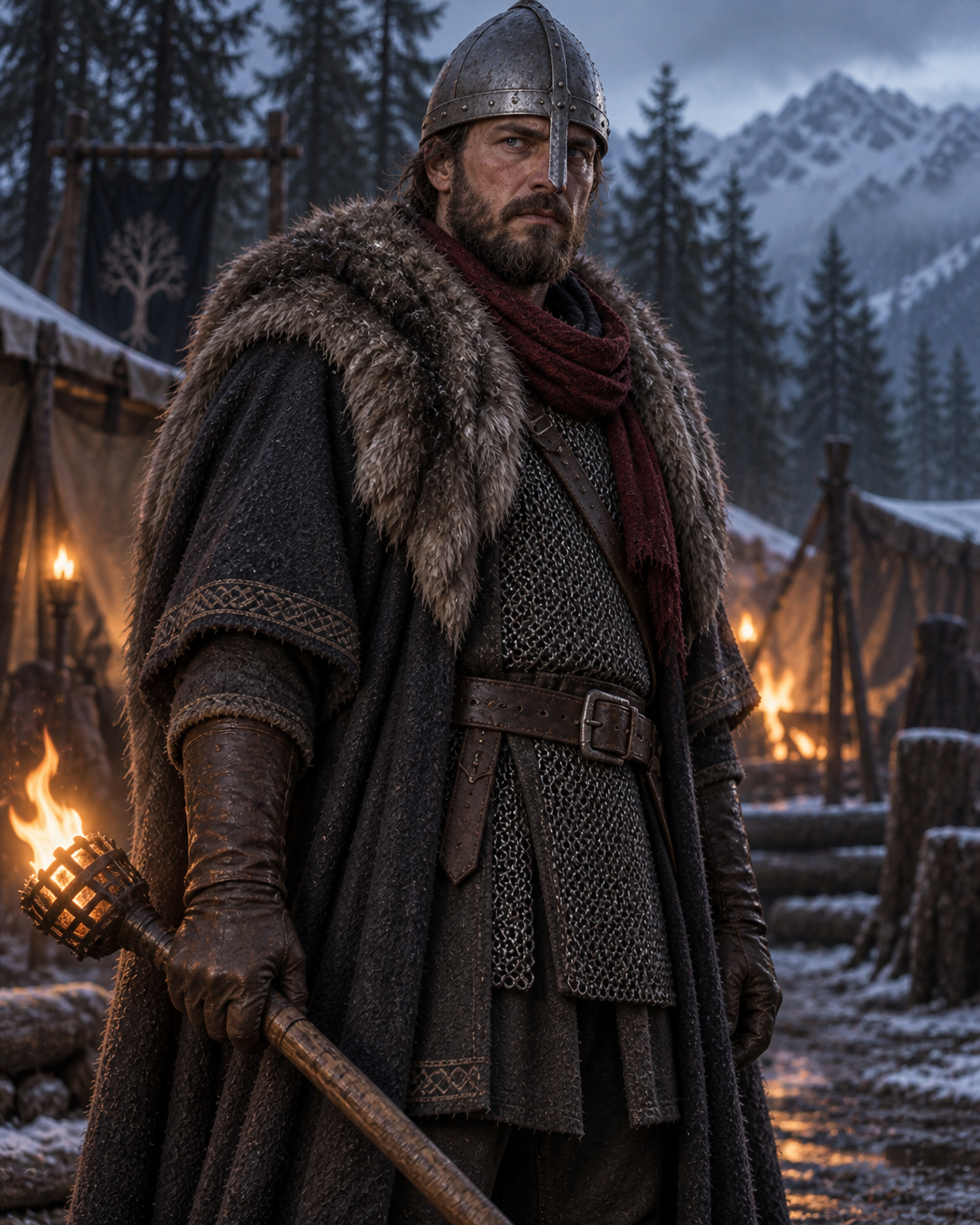
Einskaldir has a dark beard and a deep-set stare described through its burning intensity. At Naglimund he wears a plain steel cap with a metal beak protecting the nose. The few visual receipts fit the man: practical armor, hard attention, no court display.
The approved portrait makes him ruggedly attractive without sanding away his danger. He belongs to the same northern visual world as Isgrimnur, Isorn, Gutrun, and Sludig, but he is not a duplicate of any of them: a long angular face, heavy brow, steel-gray eyes, weathered fair skin, nearly black beard, and his blunt beaked steel cap. “Fantasy hot” here means the person you notice across the fire and then reconsider approaching because he has already noticed you.
This adult identity remains stable across the Saint Hoderund ambush, Simon’s interrogation, Naglimund’s walls, Aldheorte flight, Ostrael revelation, Norn capture, torch run, and burial. The low torch in the hero image is visual foreshadowing, not a claim that this exact camp portrait occurs in the prose.
Book 1 · The Dragonbone Chair
He survives Saint Hoderund, retrieves his dead, and brings Simon into Isgrimnur’s road
At Saint Hoderund, a black-robed monk tries to warn Isgrimnur’s approaching force before an ambusher shoots him down. The attackers include a leader in a snarling-hound helmet. Young Hove dies in the opening fighting. Einskaldir is wounded, kills his attacker, and survives an unnaturally fast storm that ends the immediate pursuit.
Wounded does not mean finished. Einskaldir returns to the abbey with fair-haired Sludig to retrieve Hove’s body. They bring the dead Rimmersman back to his people rather than leave him among the ruined monastery—and return with a bound, red-haired, freckled boy found nearby.
That boy is Simon, desperately inventing the identity of Malachias, a runaway chandler’s apprentice. Einskaldir’s uncertain hearing of “Benna” or “Binnock” becomes the missing dog in Simon’s improvised story. The exchange is funny because Simon is audacious, not because Einskaldir is stupid. The Rimmersman tests details while Isgrimnur notices that this supposed tradesman’s boy speaks too carefully.
Naglimund
Southern disbelief meets one northern man who has entirely run out of patience
Einskaldir reaches Naglimund beside Isgrimnur and the remaining Rimmersmen. Their duke reports that Elias has declared him traitor, handed Elvritshalla to Skali Sharp-nose, and taken Isorn as leverage. He also reports the abbey attack and the mass of Bukken near the Knock.
Devasalles questions testimony that does not fit southern assumptions. Einskaldir answers with insult. The argument grows openly hostile when the Rimmersmen discover Binabik is a troll. His defensiveness is not admirable simply because outsiders are condescending; it shows a man whose world is collapsing and whose threshold for unfamiliar allies is dangerously low.
Yet when Elias’s siege engines approach, Einskaldir stands beside Isorn in his plain steel cap. Faced with overwhelming numbers, he promises the attackers will be eaten and spat out. The boast is grim morale work from someone who understands the arithmetic perfectly well.
Book 2 · Stone of Farewell
After Naglimund, survival becomes a shrinking circle of names
Einskaldir escapes the fallen fortress with Josua, Vorzheva, Gutrun, Deornoth, Isorn, Father Strangyeard, Towser, Sangfugol, Helmfes, and a handmaiden. The forest appears to deter the pursuing Bukken, but safety keeps contracting. Helmfes and the handmaiden die. Gamwold falls and cannot be recovered. Sangfugol carries part of a Norn arrowhead in a numbing leg.
The remnant eventually numbers nine: Josua, Deornoth, Einskaldir, Isorn, Towser, Gutrun, Strangyeard, Vorzheva, and wounded Sangfugol. Titles and ceremony have been stripped away. Einskaldir’s value is immediate: watch, fight, distrust the convenient explanation, and keep moving.
Ostrael at the Fire
Everybody sees a wounded survivor; Einskaldir sees the body failing to behave like one
Ostrael staggers into camp black with dried blood. He cannot swallow. His throat wound should already have killed him. Most horrifyingly, his bare foot burns in the fire while he remains placid.
Einskaldir recognizes that the young pikeman is not alive and pins him before the body can attack. Crimson fire fills Ostrael’s emptied eye sockets. A Red Hand spirit speaks through the corpse and confirms that, without Einskaldir’s intervention, the carrier would have murdered the company in its sleep.
The body is decapitated and dismembered before Josua orders an Aedonite burial. The moment is the purest expression of Einskaldir’s gift. Suspicion can make him cruel and provincial; suspicion also notices the bare foot nobody wants to interpret because interpreting it means the wounded friend is gone.
The Captured Norn
His certainty saves lives until it crosses the line Josua is trying to hold
Norns seize Strangyeard during his watch and put a black knife to his throat. Deornoth attacks barehanded; Josua and Einskaldir join the fight. When the survivors capture a Norn, the prisoner deliberately provokes blasphemy and contempt.
Josua wants control of the interrogation and commands that the prisoner not be killed. Einskaldir answers the provocation with his axe anyway. Josua hates the cold-blooded execution, even while conceding that the likely outcome may have been the same. He orders the body searched and buried so the enemy remains uncertain.
The scene does not cancel Einskaldir’s courage, and courage does not excuse it. He is a retainer trained by feud, invasion, and immediate threats; Josua is trying to construct authority that does not become identical to the violence hunting them. Their collision is political philosophy with blood already on the blade.
The Torch Run
When obedience finally matters most, he makes himself the visible man
The remnant is wounded, exhausted, and driven through Aldheorte by Norn arrows. Josua orders a deliberately exposed climb toward high ground. The command forces even Einskaldir to choose: obey the prince he has already defied, or leave.
He stays. More than that, he takes the party’s torch and runs alone as a decoy, drawing the Norn attack away from the others and toward the one moving light. He reaches the old river tunnel with arrows in his back and side, feverish and struggling to breathe.
Geloë treats him in Shisae’ron, but healing cannot undo the wounds. Einskaldir dies and is buried beneath a simple mound marked with his helmet and Strangyeard’s wooden Tree. Isorn adds the death to the blood-feud debt owed by Skali, Elias, and their allies.
The helmet matters. The plain steel cap that identified him on Naglimund’s wall becomes the marker above the man who kept danger looking at him long enough for others to disappear.
Connections
The people who command him, survive him, and inherit his unfinished anger
Isgrimnur
Duke and original lord. Einskaldir fights under him, retrieves Hove, helps capture Simon, and shares the northern outrage at Elias’s betrayal.
Isorn
Isgrimnur’s son and fellow Naglimund survivor, who carries Einskaldir’s death into the Rimmersman blood-feud ledger.
Prince Josua
Refugee leader whose orders Einskaldir both violates and ultimately serves with fatal courage.
Simon
The frightened boy Einskaldir binds and questions after Saint Hoderund, accidentally helping produce the “missing dog” in Simon’s cover story.
Ostrael
Fallen pikeman whose possessed corpse reveals why Einskaldir’s hard suspicion is sometimes the company’s best defense.
Father Strangyeard
Survivor whose life is defended in the Norn attack and whose wooden Tree later marks Einskaldir’s grave.
Why He Matters
He is not the lovable soft-hearted warrior hiding under a scowl—and that is better writing
Einskaldir’s profile should not domesticate him. He is loyal, brave, observant, prejudiced, insubordinate, and capable of killing a prisoner after being ordered not to. The same instincts produce incompatible outcomes because instincts are not virtues by themselves.
His arc asks what happens when a man built for immediate danger enters a war where enemies can wear dead friends, kings can legalize theft, and survival depends on trusting trolls, witches, princes, and forests. He does not become philosophically flexible before he dies. He does make the decisive practical choice to let the enemy see him so others can live.
That is why the torch run lands. It does not reveal a secretly different Einskaldir. It reveals the highest use of the man he has always been: once he decides where the danger belongs, he puts himself between it and his people.
On the Record
Scope, status, and visual boundaries
This is Einskaldir’s one canonical full-spoiler profile. He appears directly in The Dragonbone Chair and Stone of Farewell. He survives the Book 1 siege sequence, dies in Book 2 after the torch run, and does not receive invented later-volume participation.
The ledger identifies him as Isgrimnur’s fierce liegeman, chieftain, scout, interrogator, and defender. It gives a dark beard, deep-set burning stare, and plain steel cap with a beaked nasal guard. It does not provide an exact age, eye color, height, facial geometry, hair, clothing colors, fur, mail pattern, scarf, gloves, torch design, camp, weather, or private romance; those visible portrait details are editorial reconstruction.
Future directory, hero, Saint Hoderund, Naglimund, Ostrael, Norn, torch-run, death, grave, and social images must preserve this one attractive adult Rimmersman identity. The burial and wounds should remain emotionally legible, never gore decoration, and the final torch run must not retroactively turn every image into a martyr pose.