
Memory, Sorrow, and Thorn · Canonical Character Profile
Deorhelm
Deorhelm is an Erkynguard soldier lodging beside the Dragon and Fisherman, scheduled to take the road with Godstan at cockcrow. When Cadrach’s old purse trick leaves Simon looking like the thief’s partner, Freawaru drags the boy toward Deorhelm and Godstan for identification. Simon head-butts the innkeeper and runs before the soldiers can judge him. Deorhelm’s power in the scene lies precisely in the verdict he never gets to deliver.
At a Glance
The soldier waiting in the next cottage while Simon decides flight is safer than explanation
- Name
- Deorhelm
- Affiliation
- Erkynguard
- Confirmed dress
- Green Erkynguard livery
- Lodging
- An adjoining cottage beside the Dragon and Fisherman
- Companion
- Godstan
- Schedule
- Expected to take the road at cockcrow
- Scene function
- Potential identifier or authority in Freawaru’s theft accusation
- Status
- Alive in the inn scene; later fate unconfirmed
Beside the Dragon and Fisherman
Deorhelm’s military presence sits one doorway away from food, credit, music, and theft
Simon reaches the Dragon and Fisherman exhausted, hungry, and desperate for ordinary work.
Freawaru runs the inn with enough strength and practical judgment to manage travelers, debts, and trouble. Cadrach has already built a relationship there through charm and credit.
Deorhelm and Godstan lodge in the adjoining cottage. They are not described drinking in the common room or participating in Cadrach’s performance. Their proximity is enough.
The Erkynguard is the High King’s military force, and green livery makes the soldiers institutionally legible. Simon does not need a personal history with Deorhelm to understand what being taken before armed royal men could mean.
The cottage detail gives the scene geography. Freawaru does not have to send across town for authority. He can physically drag the suspected accomplice next door.
Deorhelm is expected on the road at cockcrow with Godstan. That schedule suggests a temporary lodging stop within wider military movement, but the record does not confirm destination, orders, unit, patrol, escort, or campaign.
His presence shows how soldiers circulate through civilian spaces during Elias’s deteriorating rule. Inns feed, house, and connect the people carrying royal authority beyond the Hayholt.
The Verdict Simon Refuses to Wait For
Freawaru turns toward Deorhelm because suspicion wants institutional confirmation
Cadrach produces a cut-open purse embroidered with a seagull. Simon recognizes it as his own, confirming that the friar stole it during their earlier Hayholt encounter.
When Simon calls him a thief, Cadrach runs.
Freawaru catches Simon and interprets the sequence through a recurring inn trick: one thief escapes while a supposed partner remains to distract, deny, or exploit sympathy.
The innkeeper says he would have hired Simon if the boy had simply asked. The line makes the misunderstanding sting because honest refuge was available moments before Cadrach’s history contaminated it.
Freawaru drags Simon toward Deorhelm and Godstan for identification.
The record does not say what the soldiers already know, whom they might identify, or what process would follow. They may recognize a known trick, compare Simon with another description, question him, detain him, or simply support Freawaru’s judgment. None occurs on-page.
Simon head-butts Freawaru and escapes into Aldheorte before reaching them.
Deorhelm therefore remains an approaching authority rather than an enacted one. His possible judgment shapes Simon’s choice even though he never speaks.
Known to Freawaru
The innkeeper trusts the soldiers enough to make them part of local dispute resolution
Freawaru refers to Deorhelm and Godstan by name rather than calling for anonymous guards.
That familiarity may come from the current lodging arrangement, previous visits, reputation, or routine military traffic. The text does not specify which.
It nevertheless establishes a working social connection. Freawaru expects access to them and believes their involvement can clarify or resolve the accusation.
This is how state power operates at ground level. It does not arrive only through proclamations and throne rooms. It is present in the soldiers sleeping next door, available when a civilian proprietor needs a suspected thief identified.
The profile should not turn that connection into friendship or corruption. Freawaru’s reliance is confirmed; its emotional and political nature is not.
Evidence Pointing Two Ways
The purse proves Simon’s story and simultaneously makes his innocence harder to see
The cut-open seagull purse is genuine evidence. Simon recognizes it because Cadrach stole it from him at the Hayholt.
For Simon, the object proves he has encountered the friar before and has been robbed by him. For Freawaru, the same prior connection can look like partnership in a practiced fraud.
Cadrach’s immediate flight strengthens both readings: a guilty thief escapes, but he also leaves behind the boy who publicly knows him.
Deorhelm and Godstan are summoned into a dispute where physical evidence exists but relationship evidence is ambiguous. The soldiers’ unrealized role is not simply to decide whether a purse was cut. It is to decide what Simon’s connection to its owner means.
The scene ends before they can hear him, so no canonical verdict exists. Later knowledge confirms Simon’s innocence of the trick; it does not tell us what Deorhelm would have concluded from the evidence available that night.
Green Erkynguard Livery
The uniform supplies nearly everything the scene needs before Deorhelm can speak
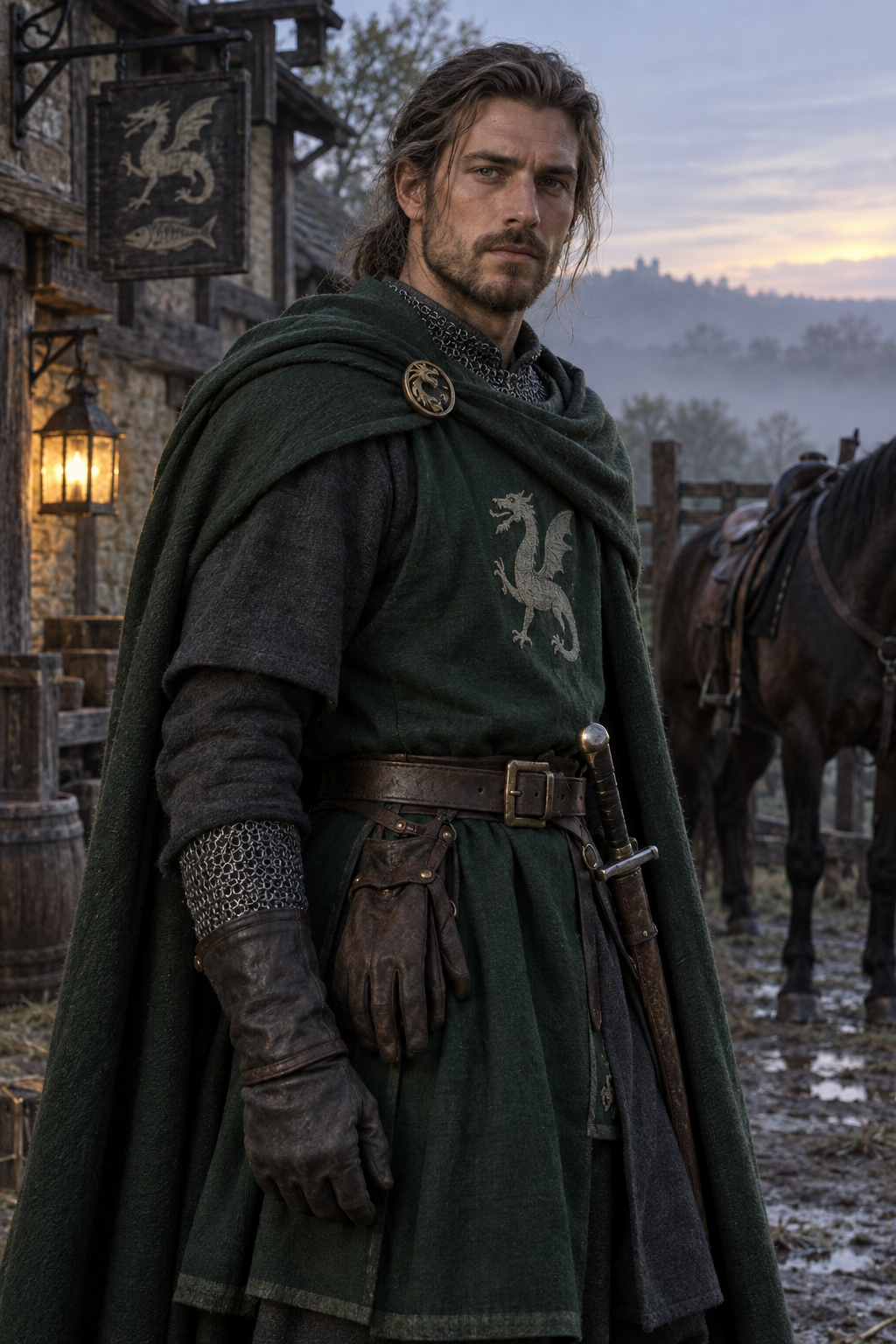
Deorhelm’s only confirmed visual marker is green Erkynguard livery.
The color connects him to Elias’s royal military apparatus. It tells travelers whom he serves and gives civilian suspicion an armed institutional endpoint.
Uniform should not be confused with personal allegiance. The record does not reveal Deorhelm’s opinion of Elias, Pryrates, Josua, the war, or abuses committed by other Erkynguard forces.
Nor does the livery tell us rank, specialty, weapon, armor, age, body, or face.
CVM’s approved editorial reconstruction gives Deorhelm one distinctly handsome, road-ready identity: storm-gray eyes, ash-brown hair tied at the nape, a short beard, lean-muscular build, dark-green livery, charcoal wool, restrained mail, leather travel kit, bronze dragon brooch, and ordinary sheathed sword. Deorhelm and Godstan share affiliation and travel, not one cloned identity.
The green remains consistent with the wider property’s Erkynguard visual language, while this exact face, body, hair, beard, clothing logic, and contained professional bearing now belong only to Deorhelm.
Cockcrow
A departure time gives Deorhelm a life in motion beyond Simon’s crisis
Deorhelm and Godstan are expected on the road at cockcrow.
Simon’s accusation is therefore not the center of their day. They have travel ahead, presumably early enough to use available light and road conditions.
The record does not say whether Simon’s escape delays them, whether Freawaru wakes them, or whether they ever learn his name.
This temporal boundary is useful. Minor characters do not wait motionless until protagonists activate them. Deorhelm has a schedule already in place.
His planned departure also sharpens Simon’s urgency. Any questioning could become detention, forced travel, or handover before dawn, although those outcomes remain possibilities Simon may fear rather than confirmed plans.
Connections
The innkeeper, fellow soldier, fleeing boy, and friar around Deorhelm’s unrealized judgment
Godstan
Deorhelm’s fellow Erkynguard lodger and planned cockcrow road companion.
Freawaru
The innkeeper who knows Deorhelm and tries to bring Simon before the soldiers.
Simon
The suspected accomplice who escapes before Deorhelm can see, question, or identify him.
Brother Cadrach
The actual thief whose flight leaves Simon trapped inside the appearance of an old trick.
The Erkynguard
The royal force whose green livery supplies Deorhelm’s visible authority.
Aldheorte Forest
The dangerous refuge Simon chooses rather than risk the soldiers’ unknown judgment.
Why Deorhelm Matters
He demonstrates how anticipated authority can change a life without taking direct action
Deorhelm never interrogates Simon. The plot still turns because Simon believes reaching him is dangerous enough to justify assaulting Freawaru and fleeing into winter forest.
That choice leads toward the Sithi prisoner, Binabik, Qantaqa, and the next stage of Simon’s journey.
Deorhelm does not knowingly send him there. He functions as the institutional pressure at the edge of the room.
His scene also complicates guilt. Simon is innocent of Cadrach’s theft but looks implicated. Freawaru is wrong about him but has encountered the trick before. Deorhelm’s hypothetical verdict hangs over evidence that can be read several ways.
The page matters because it keeps that ambiguity organized without inventing the scene Simon prevents.
On the Record
Book 1 only, no dialogue, no completed identification, and no cloned Godstan identity
This is Deorhelm’s one canonical full-spoiler profile. His sole direct reference occurs in Book 1 at the Dragon and Fisherman. No additional Deorhelm receipt appears in Books 2–4.
The record confirms his name, Erkynguard affiliation, green livery, lodging in a cottage adjoining the inn, familiarity to Freawaru, association with Godstan, expected cockcrow departure, and intended role in identifying or judging Simon after Cadrach flees.
It does not confirm exact age, face, hair, eyes, body, armor, weapon, rank, destination, orders, political beliefs, speech, actual view of Simon, later journey, survival, death, or final fate.
Visual state: approved editorial reconstruction. Future hero, directory, social, inn-yard, and road art must preserve this exact attractive adult identity and green-livery logic. Do not duplicate Deorhelm for Godstan, manufacture an interrogation, or make him visually responsible for atrocities committed elsewhere. The same canonical attachment powers featured image, hero, directory card, and social metadata.