
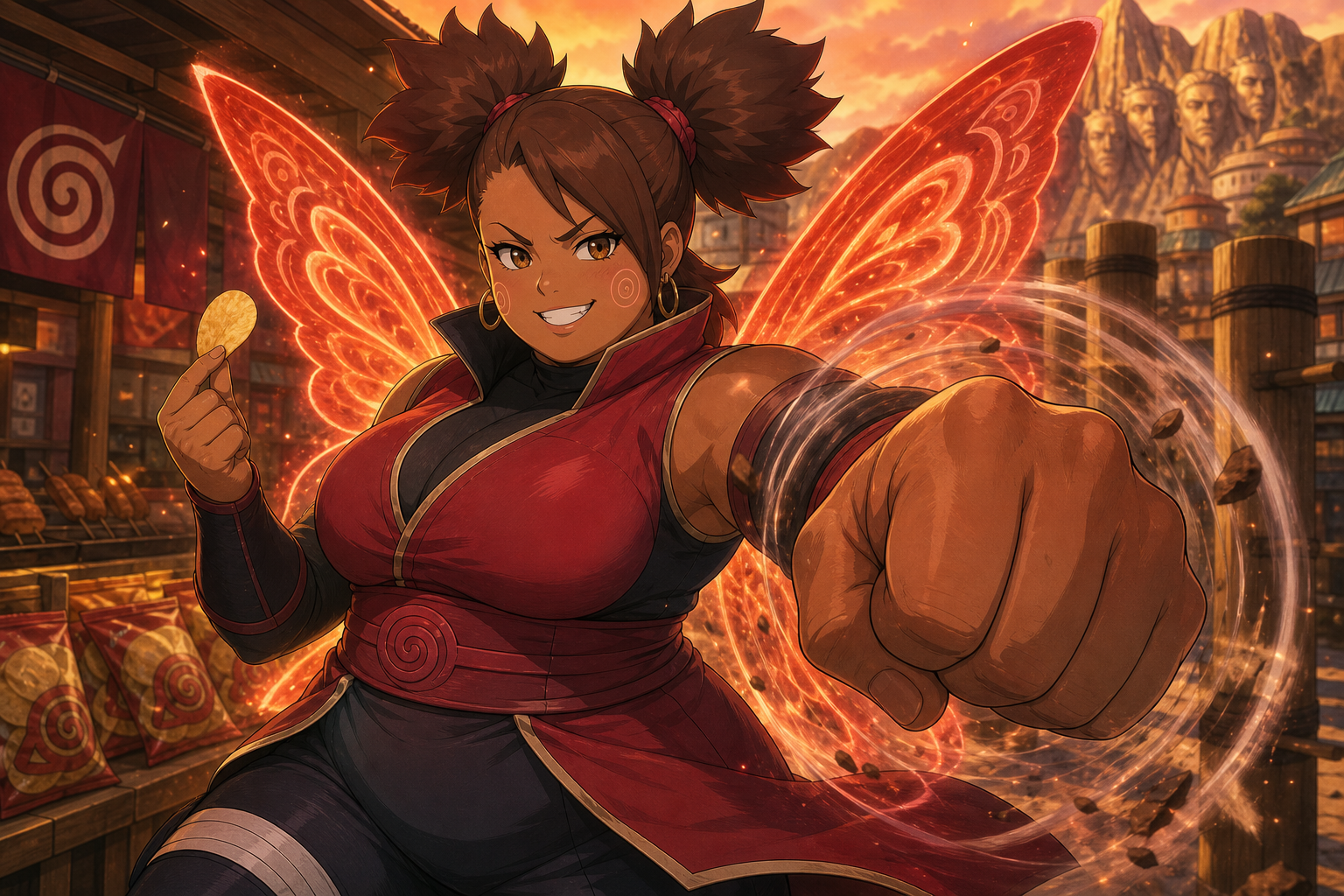
Chōchō Akimichi
Chōchō inherits the Akimichi body, Butterfly Mode, and a village eager to joke about both. She keeps the power and refuses the shame.
Bottom line: Chōchō refuses to shrink so other people can understand her
Chōchō Akimichi is loud, hungry, stylish, romantic, powerful, occasionally ridiculous, and almost never ashamed for long. That mix matters. The Naruto franchise spent years treating large bodies as punchlines before allowing Chōji Akimichi to turn the same body into strength. His daughter inherits the clan technique, but she does not inherit his habit of asking permission to exist. Chōchō likes food. She likes attention. She likes pretty people. She likes herself. When insecurity arrives, she argues with it instead of building a house for it.
That does not make every Chōchō story good. The anime repeatedly reaches for jokes about weight, thinness, romance, and appetite. Some episodes let her control the joke. Others act as if a teenage girl’s body is public property that viewers are entitled to grade. Chōchō survives the material because her personality keeps pushing back. Her best stories are not about becoming thin. They are about learning that Butterfly Mode works when she stops performing a smaller version of herself for somebody else’s approval.
The essential file
- Japanese name: 秋道チョウチョウ, Akimichi Chōchō
- Village: Konohagakure
- Clan: Akimichi clan
- Parents: Chōji Akimichi and Karui Akimichi
- Team: Team 10, the seventeenth-generation Ino-Shika-Chō formation
- Teammates: Shikadai Nara and Inojin Yamanaka
- Team leader: Moegi Kazamatsuri
- Rank: Genin through most of Boruto: Naruto Next Generations; anime promotion claims must be tied to the Chūnin Re-Examination result rather than assumed from time passing
- Birthday: August 8 in the new-generation character data commonly attached to the manga profile record
- First franchise appearance: Naruto manga chapter 700 as part of the new generation
- Major early story: Naruto: The Seventh Hokage and the Scarlet Spring
- Anime debut: Boruto: Naruto Next Generations episode 1
- Primary disciplines: Akimichi body-expansion techniques, chakra-powered close combat, Calorie Control, and Butterfly Mode
- Original Japanese voice: Ryōko Shiraishi
The record is uneven because Chōchō lives in several versions of the franchise at once. Kishimoto introduces her in the postwar family generation and gives her a comic but meaningful role beside Sarada in Scarlet Spring. The monthly Boruto manga keeps her near the ensemble but rarely makes her a central point-of-view character. The television anime gives her far more missions, friendships, fights, jokes, and body-image plots. A complete profile has to separate those shelves. Otherwise anime-original character development gets misrepresented as manga canon, while the manga’s much smaller role makes her look emptier than she actually is on screen.
Her name and the Akimichi inheritance
Chōchō’s given name is written in katakana, チョウチョウ. The sound echoes the Japanese word for butterfly, chōchō, and continues the Akimichi family’s long association with butterflies. The clan converts calories into chakra, producing the butterfly-wing aura associated with its highest-output state. Her father’s name, Chōji, also carries that sound. The repetition is not subtle. The child is named inside the family’s symbolic language before she can choose what that inheritance means.
Her surname carries the Akimichi line publicly even though her mother, Karui, comes from Kumogakure. That makes Chōchō one of the clearest children of the postwar political order. A Leaf clan did not merely survive. It formed a family with a woman from the Cloud after the villages stopped organizing every relationship around the next war. The franchise does not spend enough time on what Karui’s move costs her, but Chōchō’s existence is still living evidence that the alliance became domestic life rather than remaining a treaty signed by men in hats.
Design: the girl is recognizable before she throws a punch
Chōchō inherits Chōji’s brown skin tone, rounded cheeks, and Akimichi swirl markings while carrying Karui’s sharper confidence and fashion awareness. Her twin, spiked ponytails create a strong silhouette. Hoop earrings, sleeveless shinobi clothes, bright accents, and the clan spiral make her read as a teenager with taste rather than a copy of her father in a smaller uniform.
The manga and anime do not color every detail the same way. Her hair has appeared brown, orange-brown, or lighter depending on the production and printed palette. The stable cues matter more than one disputed shade: two large ponytails, cheek spirals, Akimichi build, jewelry, appetite, and a posture that says she expects the room to notice her.
Butterfly Mode changes that silhouette. Calorie conversion produces a slimmer body and luminous chakra wings. The visual can be read as a dangerous fantasy that power arrives only after weight disappears. Chōchō’s stronger stories complicate that image by making the transformation a temporary combat state, not her morally superior body. The body is fuel storage. The wings show energy expenditure. Thinness is a consequence of using stored calories, not proof that she has finally become worthy.
Chōji and Karui: a family the series should have explored more
Chōchō loves both parents, but the franchise first uses her family through a paternity joke. In The Seventh Hokage and the Scarlet Spring, she decides that Chōji and Karui may not be her “real” parents because she does not feel that they resemble the glamorous family she imagines for herself. She joins Sarada’s search while treating a real identity crisis as a possible route to better casting.
The joke works because Chōchō’s doubt is unserious while Sarada’s is painful. The joke also risks making Chōchō look selfish next to her friend. A fair reading notices what she actually does. She accompanies Sarada. She keeps moving through danger. She does not abandon the trip when her private fantasy falls apart. Her silliness becomes social cushioning for a friend who is scared enough to ask whether her entire home rests on a lie.
Chōji offers a model of tenderness that the original series had to fight to let him possess. He knows the cost of clan techniques. He knows what food means when enemies treat appetite as a character defect. He also knows that ridicule can become a voice inside the body. Chōchō inherits his techniques without inheriting his exact wound.
Karui supplies a different inheritance. She is blunt, impatient, physically direct, and unwilling to baby the men around her. Chōchō’s confidence does not come from nowhere. The daughter speaks as if the room can survive her opinion because her mother does too. Their family is funny, but the better joke is that Chōji did not need a quiet woman who rewarded him for becoming conventionally impressive. He married Karui, who will tell him when he is being foolish and still enter the family’s noisy life.
Sarada: the friendship is the center of Chōchō’s emotional record
Sarada Uchiha is Chōchō’s closest and most important friendship. The girls are not interchangeable “besties” pasted into the new generation because the old cast had teams. Their temperaments create useful friction. Sarada plans, studies, and carries ambition like a packed mission bag. Chōchō improvises, socializes, and refuses to hide the embarrassing thought that everyone else is carefully pretending not to have.
During Scarlet Spring, Chōchō turns Sarada’s search for Sasuke into a running story about finding her own “real” father. That sounds insensitive because part of it is. Chōchō does not understand the scale of Sarada’s hurt. She is also the friend who goes with her. The difference matters. Children often support each other imperfectly. Chōchō cannot repair Sasuke’s absence, Sakura’s secrecy, or Sarada’s fear. She can make sure Sarada does not walk toward those answers alone.
Episode 225, “Showdown Between Best Friends,” gives their relationship a cleaner test. The official episode record states that Sarada and Chōchō meet in the final round of the Chūnin Exam and promise to fight seriously. Friendship does not require either girl to become smaller so the other can shine. Chōchō’s respect appears through effort. Sarada’s respect appears through refusing to patronize her.
This is the fight Chōchō needs because the franchise often surrounds her with comedy before letting her demonstrate skill. Sarada does not treat her as a mascot. She treats her as an opponent. Losing a serious fight can honor a character more than winning a joke fight if the story lets her judgment, power, and discipline matter.
Team 10 and the seventeenth Ino-Shika-Chō
Chōchō joins Shikadai Nara and Inojin Yamanaka under Moegi, continuing the alliance among the Akimichi, Nara, and Yamanaka clans. The formation is an inherited institution. That inheritance gives the children ready-made trust, training logic, and political importance. It also creates a risk: the village may see them as the next set of clan functions before seeing them as three people.
Shikadai supplies tactical control. Inojin supplies sensory and mind-technique lineage alongside artistic ninjutsu. Chōchō supplies direct force, durability, and the willingness to rupture overthinking. She is not the team stomach. She is the body that turns a plan into impact.
The anime expands their operational record. In episodes 73 and 74, Team 10 receives orders connected to Boruto and Sarada’s unauthorized search for Mitsuki. The official Episode 74 summary identifies Ino-Shika-Chō as the force intercepting their friends. That creates an institutional problem more interesting than a routine team battle. Children who share classrooms and meals are ordered to enforce village authority against one another. Chōchō’s presence reminds the viewer that loyalty is never an abstract slogan. Loyalty is a friend standing in the road.
Episode 169 sends Team 10 on a joint mission with Shinki’s Sand team to recover an Ōtsutsuki puppet. The official summary places Deepa in their path. The mission matters for Chōchō because ordinary clan competence is forced into contact with Kara-era power escalation. She can be useful without being written as equal to every monster the sequel introduces. Honest limits are not disrespect.
Academy years and becoming a working shinobi
The television anime gives Chōchō a visible school life that the manga does not. She watches Boruto’s chaos, trades observations with Sarada, develops opinions about classmates, and treats social reading as a form of competence. Ninja schools teach chakra control and tactics. Chōchō also studies people because she cannot help herself.
Her graduation into Team 10 turns inherited clan identity into paid public service. The Akimichi technique is not a family party trick. Konoha expects her body to block attacks, enlarge under stress, burn stored energy, and protect clients. That labor should stay visible whenever the comedy circles back to snacks. Food is pleasure for Chōchō. Food is also the material reservoir behind a technique the village wants available on command.
The Akimichi technique shelf
Chōchō’s basic combat language comes from the Akimichi clan’s body-expansion arts. She can enlarge part of her body for close-range strikes and, with greater output, enlarge more of her body. The strength advantage is obvious. The costs are equally important. A larger target is easier to see. Momentum becomes harder to redirect. Confined spaces reduce options. Expansion does not automatically solve speed, range, restraint, or tactical deception.
Partial Multi-Size Technique lets her concentrate power into a limb rather than committing her entire body. The enlarged fist has become one of her clearest visual signatures. That technique suits her personality because the attack announces itself. Chōchō is rarely interested in pretending she has not entered the room.
Calorie Control converts stored calories into chakra. Butterfly Mode releases that energy as wing-like chakra and raises combat output. The older Akimichi generation relied on the clan’s colored pills when natural control was inadequate, and those drugs carried severe bodily costs. Chōchō’s ability to reach a butterfly state without reproducing Chōji’s near-fatal pill sequence marks generational progress. The child receives inherited knowledge without being required to repeat the parent’s exact suffering.
The anime also shows the weakness of a transformation built around concentration and self-belief. If Chōchō enters Butterfly Mode to impress an actor or chase a body ideal, her control becomes unstable or wasteful. That is not proof that confidence is a magic battery. The cleaner reading is technical: a chakra method tied to deliberate calorie conversion fails when the user is divided about why she is invoking it.
“Super Cho-Cho Butterfly Mode”: good thesis, messy delivery
Episodes 67 through 69 place Team 7 and Team 10 on a bodyguard mission involving actors Tomaru and Ashina. The official Episode 67 summary confirms the joint assignment after a death threat. Episode 68 states that Chōchō becomes a stand-in actress, that Tomaru is attracted to her slim form, and that she becomes infatuated. Episode 69 moves the story into kidnapping and ransom.
The arc wants to say that Chōchō should not remodel herself for a shallow man’s approval. Good. The problem is the route. The camera and script spend too much time treating her transformed body as a magical answer before scolding her for believing the answer. That is the entertainment industry’s favorite hustle: sell the insecurity, sell the makeover, then congratulate itself for saying inner beauty matters.
Chōchō eventually recognizes that Tomaru’s attention is not a prize worth losing control over. Her Butterfly Mode becomes stronger when she claims the transformation as her own power rather than a dating filter. That conclusion belongs to her. The body jokes surrounding it belong to the production choices around her.
RaeRae’s read is simple. Chōchō does not need a lesson in becoming lovable. Tomaru needs a lesson in seeing women before they match his preferred silhouette. The story almost says that plainly, then keeps getting distracted by its own thin-body reveal.
Food is culture, fuel, pleasure, and a recurring cheap joke
Food carries several meanings in Chōchō’s life. Akimichi techniques make calories operational. Chōji turns shared food into friendship because the original series repeatedly shows how eating together repairs isolation. Karui’s Cloud background enters a Leaf household through taste, routine, and family argument even when the anime fails to linger on the cultural exchange.
Chōchō also simply enjoys eating. Pleasure does not need a military excuse. A girl should be allowed to like chips without a medical chart or a combat demonstration appearing to justify the bag.
Episode 94, “A Heaping Helping! The Eating Contest!,” places Chōchō and Chōji in a Parent and Child Day contest. The official summary connects their participation to Chōji’s attempt to impress Karui. The episode uses appetite as family comedy, but it also lets Chōchō become an interpreter between her parents. She understands the absurdity of both adults and still wants the household to work.
Episode 156, “I Can’t Stay in My Slim Form,” pairs Chōchō with Anko when thieves disrupt azuki bean deliveries. The official summary grounds the mission in the sweet shop’s supply problem. That tiny plot reveals more about the modern village than another generic bandit attack. Food depends on trade routes, producers, transport, shops, and workers. Stealing ingredients injures a whole local economy. Chōchō’s appetite gives her immediate investment, but the mission is still infrastructure protection.
Episode 256, “The Ultimate Recipe,” sends Chōchō and Inojin after a rogue ninja who now runs a ramen shop. The episode again makes food the bridge between criminal record, civilian labor, reputation, and reintegration. Chōchō belongs in that story because she never accepts the false division between serious shinobi work and the ordinary pleasures shinobi are supposed to protect.
Chūnin examination and the Sarada fight
The Chūnin Re-Examination gives Chōchō a formal chance to prove judgment as well as force. The title matters. A chūnin is not merely a stronger genin. The rank implies leadership, situational reading, and responsibility for other people.
Her fight against Sarada in Episode 225 works because neither girl needs a villain. The official summary emphasizes their promise to fight seriously. Chōchō brings Akimichi power and emotional clarity. Sarada brings Sharingan perception, precision, and broader technical options. The match tests whether Chōchō can manage output against somebody who knows her habits and whether Sarada can respect friendship without softening competition.
The result should not be inflated into a universal power ranking. One tournament fight measures a particular day, rule set, matchup, and tactical exchange. Chōchō’s growth lies in committing to the match without turning the outcome into a referendum on whether she deserves confidence.
Kawaki, orders, and mission consequence
Episodes 229 and 230 place Chōchō and Shikadai with Kawaki on an escort assignment involving Mozuku from the Land of Calm Seas. The official Episode 229 summary identifies the mission as Kawaki’s last chance to become a genin. Episode 230 states that the group is attacked, the package is stolen, Shikadai orders a return, and Kawaki disobeys.
Chōchō’s role is not the headline, but supporting competence matters. Kawaki’s story often consumes everyone around him as evidence for his trauma or growth. Team members still carry the consequences of his choices. Shikadai must issue an order. Chōchō must operate inside a mission whose stakes expand after deployment. Friendship with a damaged boy does not remove the chain of command or the client’s danger.
Sarada, Mitsuki, and the difference between curiosity and possession
Chōchō talks about attractive people with the volume of a sports commentator. The series uses that trait for jokes around Mitsuki and other boys. Her romantic imagination is active, but attraction does not define her loyalty.
With Sarada, she offers companionship that is emotionally imperfect but physically present. With Mitsuki, she reacts to beauty and mystery before she understands the person underneath. Those are teenage responses. The ethical line is whether the story lets another character remain a person rather than a reward for her attention. Chōchō’s better moments accept the difference between wanting somebody to notice her and being entitled to that person’s feelings.
Body image: where the writing helps her and where it fails her
Chōchō’s confidence is often described as delusion because she imagines romantic plots around herself. Male characters in the franchise imagine becoming Hokage, defeating gods, avenging clans, or redeeming mass murderers and receive orchestral music. Chōchō imagines that a handsome boy might like her and gets a rim shot. The scale is different, but the gendered permission structure is obvious.
Her self-love can be funny without being fraudulent. Confidence is not perfect self-knowledge. Chōchō can misread a flirtation, overestimate her control, or use Butterfly Mode for a silly reason while still possessing a healthy refusal to hate her untransformed body.
The production’s thin-form jokes deserve criticism because the transformation repeatedly receives glamorous framing. The character deserves credit because she keeps returning to herself. Chōchō does not end her arc by swearing off food, romance, fashion, or attention. She learns to stop bargaining away her identity for temporary approval.
Gender, race, and the new-generation beauty standard
Chōchō is a brown-skinned girl with a large body in a franchise where central heroines are usually slim and lighter-skinned. Karui’s Cloud heritage matters even when the script refuses to build a full cultural conversation around it. Chōchō’s visual presence widens the range of girls allowed to stand in the Konoha classroom and call themselves desirable.
That representation is not automatically liberating. A character can be visible and still be trapped inside fat jokes. She can be confident and still be filmed through a beauty standard that rewards her temporary thinness. The work becomes meaningful when Chōchō controls the frame, names her own appetite, chooses her clothes, and treats power as hers in both forms.
Viewers should not demand that one teenage character carry every argument about size, mixed-village identity, colorism, femininity, and food. The series chose those materials when it designed her. The series therefore owes them more care than a running gag.
Japanese performance: Ryōko Shiraishi
Ryōko Shiraishi is Chōchō’s original Japanese performer. Aoni Production’s official profile names Boruto: Naruto Next Generations and the role 秋道チョウチョウ directly. That is the receipt. No dub material is needed here.
Shiraishi has to hold several Chōchō modes together: social confidence, appetite comedy, romantic exaggeration, irritation, battle commitment, and the quieter concern she shows Sarada. Those modes can easily become unrelated voices if the performance treats the character as a collection of gags. Chōchō works when the same blunt person remains audible whether she is discussing chips or confronting an opponent.
Without a dedicated scene-by-scene audio comparison in this profile, I am not inventing claims about pitch, breath control, or timing. The useful fact is that the original production entrusted Shiraishi with a character who must move between comic scale and sincere friendship without apologizing for occupying space.
Manga, anime, novel, movie, and game boundaries
The manga foundation begins with the new generation in chapter 700 and expands through The Seventh Hokage and the Scarlet Spring. Chōchō’s “real parents” idea belongs to that Kishimoto-authored story, even though the anime adapts and reframes the material inside its own sequence.
The Boruto: Naruto Next Generations manga uses Chōchō as part of the village and exam generation but does not give her anything close to the television anime’s solo and team episode record. Claims about Tomaru, the actor bodyguard mission, Anko’s azuki-bean case, the later Chūnin rematch structure, and the ramen-shop pursuit must be labeled anime material.
Boruto: Naruto the Movie places Chōchō among the new-generation examinees and village ensemble. Film visibility is not the same as a full film arc. Do not inflate a crowd role into a central narrative.
Novel adaptations and side stories may preserve or extend television and manga events. A format listing is not permission to merge every version. The profile should identify which shelf supplies each major claim.
Games use Chōchō according to their own rosters and mechanics. A playable move, support action, costume, or stat value is supplementary game material unless the manga or anime demonstrates the same ability. Game balance is not a databook.
As of the evidence used for this profile, Boruto: Two Blue Vortex does not provide Chōchō with a sustained central storyline comparable to Sarada, Sumire, Himawari, or the Karma conflict. That boundary is not an insult. It is a refusal to invent a future for her because readers want the timeskip to have distributed attention more fairly.
Relationship atlas
Chōji Akimichi
Father, technique predecessor, and the person who understands the cost of turning food into battlefield power. Chōchō inherits his warmth without repeating his exact shame.
Karui Akimichi
Mother, Cloud-to-Leaf bridge, and likely source of Chōchō’s blunt social confidence. Their relationship deserves more than the franchise gives it.
Sarada Uchiha
Best friend, traveling companion during the parentage crisis, and serious Chūnin Exam opponent. Chōchō supports her imperfectly but consistently.
Shikadai Nara
Teammate and tactical leader inside the inherited Ino-Shika-Chō formation. His plans need her force; her force benefits from his timing.
Inojin Yamanaka
Teammate, social foil, and partner in later anime missions including the ramen-shop pursuit. Their banter should not obscure shared field trust.
Moegi Kazamatsuri
Team leader responsible for turning three clan heirs into an operating unit rather than a ceremonial remake of their parents.
Mitsuki
Friend and frequent object of Chōchō’s aesthetic commentary. Attraction is part of her comic register, not ownership of his attention.
Kawaki
Temporary mission partner whose disobedience forces Team 10 to confront the difference between sympathy and operational responsibility.
Anko Mitarashi
Anime mission partner in the azuki-bean case. Their pairing exposes how quickly the franchise reaches for body jokes while also giving two underestimated women a practical local mission.
Common fandom misreadings
“Chōchō is only a fat joke”
The writing uses fat jokes too often. The character still has a clan role, team function, major friendship, family bridge, serious exam fight, mission record, and a coherent argument about self-possession.
“Butterfly Mode proves she should stay thin”
Butterfly Mode is calorie conversion under combat conditions. The transformed body is temporary evidence of expended fuel, not a permanent moral upgrade.
“She is confident, so body-image criticism does not apply”
Confidence does not erase how a camera, script, love interest, or audience judges her. A self-loving character can still be placed inside harmful framing.
“She does nothing for Sarada”
Chōchō does not solve Sarada’s family crisis. She accompanies her through it. Presence is not nothing, especially when adults created the secrecy.
“Her anime episodes do not count”
They count as anime continuity. They should not be mislabeled as manga events, and they should not be discarded when evaluating the television character viewers actually watched.
“Losing to Sarada proves she is weak”
One match proves one result. Chōchō’s performance, tactical decisions, output, and willingness to fight a best friend seriously provide more information than the winner label alone.
What Chōchō means in the Naruto world
The original Naruto generation fought to survive inherited institutions. The next generation grows up inside institutions their parents repaired but did not finish. Chōchō receives an established clan technique, a stable two-parent home, international family ties, a team waiting for her, and a village at peace. Her struggle is not Chōji’s struggle copied with earrings.
She has to decide whether inheritance is a script or a toolkit. The Akimichi body can become a weapon, a family symbol, a source of pleasure, a target of ridicule, and a public spectacle. Chōchō’s most valuable choice is refusing to let any one of those meanings own the rest.
Her existence also exposes what peace looks like at table level. A Cloud woman and Leaf man raise a daughter who eats local snacks, trains a clan art, joins a traditional formation, befriends an Uchiha, works with an artificial human, and escorts clients from smaller countries. The alliance is not a summit anymore. The alliance is a teenager arguing with her parents before a mission.
RaeRae’s take
Chōchō is the kind of girl fandom calls annoying when she refuses to perform insecurity for their comfort. She likes herself before the plot signs the permission slip. That makes people mad because audiences are used to large girls earning dignity through suffering, dieting, self-sacrifice, or being the funny best friend who never expects romance.
The anime does her dirty when it makes thinness glow and then acts shocked that she wants to stay in the glowing body. You built the magical makeover, sir. Do not lecture the child for noticing the lighting budget.
Her best material is Sarada, Team 10, and the serious use of Butterfly Mode. Those stories let Chōchō be funny without making her humanity the joke. She can want chips and a boyfriend while understanding mission orders, clan duty, bodily cost, and friendship. Human beings contain multiple tabs. Chōchō simply refuses to mute any of hers.
Essential viewing and reading
- Naruto manga chapter 700 for the first new-generation appearance
- Naruto: The Seventh Hokage and the Scarlet Spring for Chōchō and Sarada’s parentage journey
- Boruto: Naruto the Movie for her early exam-generation presence
- Boruto episode 1 for the television introduction
- Episodes 67-69 for the Super Cho-Cho Butterfly Mode actor mission
- Episode 73 and Episode 74 for Team 10’s pursuit of Boruto and Sarada
- Episode 94 for Chōchō, Chōji, Karui, and Parent and Child Day
- Episode 156 for the Anko and azuki-bean mission
- Episode 169 for Team 10’s joint Sand assignment and Deepa encounter
- Episode 225 for Chōchō versus Sarada
- Episodes 229-230 for the Kawaki and Mozuku escort mission
- Episode 256 for Chōchō and Inojin’s ramen-shop case
Receipts and canon boundaries
- NARUTO Official, Boruto: Naruto Next Generations series page and production credits: https://naruto-official.com/en/anime/boruto
- NARUTO Official, Episode 67, “Super Cho-Cho Butterfly Mode!”: https://naruto-official.com/en/anime/boruto/list/01_1011
- NARUTO Official, Episode 68, “Super Cho-Cho Kiss Mode!”: https://naruto-official.com/en/anime/boruto/list/01_1012
- NARUTO Official, Episode 69, “Super Cho-Cho Love Upheaval!”: https://naruto-official.com/en/anime/boruto/list/01_1013
- NARUTO Official, Episode 74, “The Enemy, Ino-Shika-Cho!”: https://naruto-official.com/en/anime/boruto/list/01_1018
- NARUTO Official, Episode 94, “A Heaping Helping! The Eating Contest!”: https://naruto-official.com/en/anime/boruto/list/01_1038
- NARUTO Official, Episode 156, “I Can’t Stay in My Slim Form”: https://naruto-official.com/en/anime/boruto/list/01_1100
- NARUTO Official, Episode 169, “A Joint Mission With the Sand”: https://naruto-official.com/en/anime/boruto/list/01_1113
- NARUTO Official, Episode 225, “Showdown Between Best Friends”: https://naruto-official.com/en/anime/boruto/list/01_1169
- NARUTO Official, Episodes 229-230: https://naruto-official.com/en/anime/boruto/list/01_1173 and https://naruto-official.com/en/anime/boruto/list/01_1174
- NARUTO Official, Episode 256, “The Ultimate Recipe”: https://naruto-official.com/en/anime/boruto/list/01_1267
- VIZ, official Boruto: Naruto Next Generations chapter and volume shelf: https://www.viz.com/shonenjump/chapters/boruto
- Aoni Production, Ryōko Shiraishi official performer profile naming Chōchō: https://www.aoni.co.jp/search/shiraishi-ryoko.html