
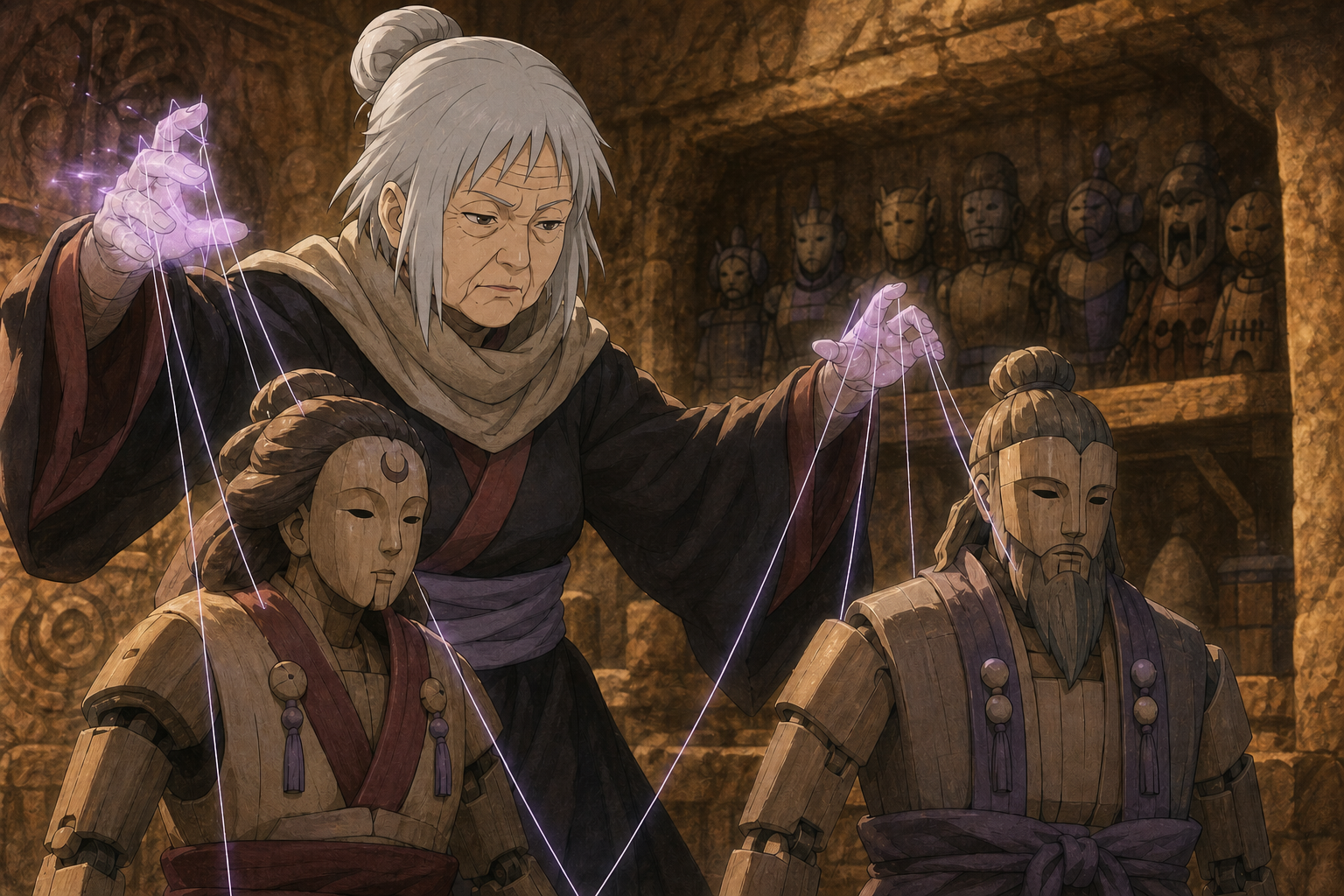
Chiyo
Bottom line
Chiyo is the elder Naruto needed the Hidden Sand to produce. She is brilliant, stubborn, funny when she feels like being difficult, and responsible for some truly ugly machinery. She spends decades mastering puppets, poisons and village warfare. She teaches Sasori the craft he later weaponizes against human bodies. She carries a grudge against Konoha. Then she meets Sakura and Naruto, watches the younger generation behave better than the adults who trained them, and changes her final answer.
That change matters because Chiyo does not receive the soft version of redemption where the story lets an elder say one wise sentence and float away spotless. Her hands are all over Sunagakure’s military history. Her grandson became an S-rank criminal. Her village helped turn Gaara into a weapon and then treated the traumatized child like defective equipment. Chiyo knows how the system works because she helped keep the system working. Her final sacrifice restores Gaara’s life. The act does not erase her record. That choice proves she finally understands what her knowledge is for.
Chiyo Essential File
Identity. Chiyo is a retired Sunagakure kunoichi, master puppeteer, poison expert, medical-nin, former adviser and grandmother of Sasori. She is also Ebizō’s older sister. Fans usually call her Granny Chiyo because the series introduces her as an elderly village legend rather than a current field operative.
Verified profile facts. Guidebook records place Chiyo at seventy-three years old during the Kazekage Rescue Mission. Her birthday is October 15, and her height is 149.1 centimeters. Her small frame never functions as a joke about weakness. The joke is that younger people assume a retired woman has become harmless.
Debut. Chiyo enters the manga during the opening Shippuden-era Sand crisis, with her formal appearance in chapter 252. The anime credits her in Naruto Shippuden episode 9. The story brings her in after Kankurō is poisoned because history has suddenly returned wearing Sasori’s name. Original Japanese performance. Ikuko Tani performs Chiyo in the original Japanese anime. Her performance carries an elder’s dry humor, guarded pride and accumulating regret as Chiyo returns to a world she tried to leave behind.
The Woman Behind Sunagakure’s Puppet War Machine
Chiyo is not merely an old woman who owns excellent puppets. She represents an entire military discipline. Sunagakure uses puppet warfare to extend a shinobi’s reach, hide weapons, deploy poison and turn engineering into battlefield advantage. Chiyo helps develop that tradition across an era of repeated village conflict. Her specialty requires several forms of intelligence at once. She reads anatomy, joint movement, chakra control, weapon timing, mechanical construction and enemy psychology. A puppet master fights through a body outside the body. Every string carries an instruction. Every concealed blade depends on anticipation.
That knowledge gives Suna defensive strength. That choice also creates distance between action and consequence. A controller can wound somebody from across the room while looking at wood instead of skin. Naruto keeps returning to this problem: institutions love techniques that make violence efficient, then act surprised when efficiency teaches people to stop seeing the person on the receiving end.
Medicine and Poison Are the Same Education Pointed Two Ways. Chiyo understands poisons because she understands bodies. She can design compounds, identify toxins, prepare countermeasures and read the time between exposure and organ failure. Her old rivalry with Tsunade grows from wars in which Chiyo’s poisons met Tsunade’s antidotes. The rivalry tells us something uncomfortably practical about medical innovation in the ninja world. One woman develops a better way to kill. Another develops a better way to stop the killing. The village records both as technical achievement while the bodies paying for the research disappear into mission totals. Chiyo respects Tsunade’s skill even while resenting Konoha. That respect prepares her to recognize Tsunade’s training in Sakura. She does not need a résumé. Sakura’s diagnosis, antidote work, movement and refusal to panic are the receipts.
Sasori: Love, Instruction and Accountability
Sasori loses both parents to war while still a child. Chiyo becomes one of the adults responsible for him. She teaches him puppetry, and the lonely boy builds Mother and Father puppets in an attempt to reproduce the embrace he lost. Chiyo loves her grandson. Love is not the same thing as reaching him. She can show him how to make joints move and chakra strings hold. She cannot make the wooden parents generate warmth. She also cannot undo a military culture that taught children to turn grief into technique before teaching them how to name grief.
Sasori eventually develops human puppets, murders the Third Kazekage, abandons Suna and joins Akatsuki. Those choices belong to Sasori. Chiyo did not order every crime. She did, however, help build the craft and institutional environment from which his genius emerged. That distinction matters. Blaming Chiyo for everything would erase Sasori’s agency. Pretending she has no responsibility would erase adulthood.
Why Chiyo Initially Refuses the Future. When the Kazekage Rescue crisis begins, Chiyo is retired in more than the employment sense. She has emotionally withdrawn. She has watched villages fight, treaties fail, children inherit weapons and leaders repeat the same stupidity with different banners. Cynicism feels earned when a person has receipts. Cynicism also becomes an excuse to stop paying the bill. Chiyo has knowledge Suna needs, but she treats the younger generation as people walking toward the same failure she already understands.
Naruto and Sakura challenge that posture without giving a lecture. They show up. Sakura saves Kankurō. Naruto cares about Gaara as a person rather than a jinchūriki asset. Their conduct forces Chiyo to consider that experience can become guidance instead of withdrawal.
Kankurō’s Poisoning Brings the Past Home
Kankurō returns from his fight with Sasori carrying poison Chiyo recognizes as connected to her grandson’s work. The scene makes inheritance physical. Kankurō uses puppets Sasori designed. Sasori knows those machines better than their current owner. Then Sasori’s poison enters the younger puppeteer’s body. Chiyo cannot produce the antidote in time. Sakura can. The answer is not that Chiyo has become useless. The answer is that expertise must keep moving. Sakura uses Tsunade’s medical system, her own analysis and Suna’s available ingredients to create a limited treatment. A Leaf teenager saves a Sand shinobi from a Sand criminal using knowledge sharpened by older women from both villages. Her Mistake with Kakashi Is Funny Until You Look Underneath. Chiyo attacks Kakashi Hatake because she mistakes him for his father, Sakumo, the man connected to the deaths of Sasori’s parents. The moment plays as comedy because Ebizō stops her and because decades have passed.
The grudge underneath is not funny. Chiyo has preserved an enemy’s face longer than she has preserved a workable relationship with her grandson. Kakashi inherits anger attached to a war he did not personally fight. Naruto’s world is full of children receiving bills written before their birth. Chiyo’s growth begins when she stops treating inherited grievance as sacred property.
Chiyo and Sakura: Shared Control Without Erased Agency
During the Sasori battle, Chiyo attaches chakra strings to Sakura and guides her body through attack patterns. A lazy description says Chiyo uses Sakura like a puppet. The actual partnership is more interesting. Sakura consents because Chiyo can read Sasori’s mechanisms and because poison makes every mistake expensive. Chiyo supplies timing and battlefield memory. Sakura supplies speed, strength, medical preparation and judgment. As the fight continues, Sakura reads more for herself.
Shared control does not erase Sakura. The arrangement works because both women keep thinking. Sasori’s ideal puppet obeys one controller. Chiyo and Sakura defeat him by coordinating without reducing either person to equipment. Mother and Father Return to Their Maker. Chiyo uses Sasori’s Mother and Father puppets against him. The choice carries a cruel intimacy. These are not random weapons. They are the objects a lonely child built to simulate the parents war removed.
The puppets finally pierce Sasori’s living core. Chiyo believes he recognized the attack and did not evade it. The story preserves enough uncertainty to keep the moment human. Sasori does not become innocent. His hesitation reveals that the child who wanted an embrace never disappeared as completely as the puppet master claimed. For Chiyo, victory is not clean. She stops a mass murderer and loses her grandson in the same movement.
The Ten Puppets of Chikamatsu
Chiyo’s White Secret Technique summons the ten masterpieces associated with Monzaemon Chikamatsu, remembered as the first puppet master. She controls all ten at once, one through each finger. The collection is dangerous because the puppets operate as a system. Individual bodies carry blades, wires, sealing mechanisms, chakra defenses and coordinated formations. Three can combine into a destructive vacuum attack. Another can suppress chakra through sealing. Mother and Father can generate a cutting wire between their linked hands.
Ten puppets against Sasori’s hundred sounds mathematically ridiculous. Chiyo’s answer is precision. Quantity creates pressure. Coordination creates openings. Mechanical Arm and the Body as Equipment. Chiyo has modified part of her own body with puppet technology. Her mechanical arm can conceal a chakra shield and be replaced when damaged. The adaptation shows that Suna’s puppet tradition does not stop at objects standing across the battlefield.
The difference between Chiyo and Sasori is degree and purpose. Chiyo replaces a body part to remain functional. Sasori replaces nearly the entire body to escape change, aging and vulnerability. One uses machinery as accommodation. The other makes machinery an identity doctrine.
Kishō Tensei: Life Transfer Is Not Casual Healing
Chiyo’s forbidden technique, Kishō Tensei, transfers the user’s life force to another target. She originally developed the research around giving life to puppets. When used to restore a dead person, the cost is the user’s life. This is not a free resurrection button. Naruto contributes chakra because Chiyo is depleted, but he does not cancel the exchange. Gaara lives because Chiyo dies. The distinction protects the story from cheap magic. Death still has a body attached. Chiyo does not discover a loophole. She chooses who will carry the future after her.
Gaara’s Resurrection
Gaara is recovered after Akatsuki extracts Shukaku, but his body no longer carries life. Suna’s shinobi gather around a leader many of the same villagers once feared and rejected. Chiyo prepares Kishō Tensei. Naruto offers his chakra without hesitation. The gesture reaches across the Leaf and Sand history Chiyo has spent years resenting. Her sacrifice is personal, political and generational. Personally, she cannot save Sasori, but she can refuse to let another young Sand life become a casualty of the weapon system. Politically, she invests in the Kazekage who has begun rebuilding trust. Generationally, she gives the future to people willing to cross village lines. Chiyo and Gaara. Chiyo is not Gaara’s warm grandmother figure. Their relationship matters because she belongs to the elder class that failed him.
Suna sealed Shukaku inside Gaara, weaponized his childhood, feared the result and repeatedly tried to eliminate him. Chiyo did not single-handedly create that policy. She represents the adults who had enough authority to understand the cost and still lived inside the system. Saving Gaara becomes a concrete correction. She cannot restore his childhood. She can make sure the child who survived reaches adulthood and leadership.
Ebizō and the Life She Leaves Behind. Ebizō understands his sister’s stubbornness, history and exhaustion. Their sibling scenes give Chiyo a life outside Sasori. She is an elder with somebody who remembers the person before the title. When Chiyo dies, Ebizō loses his sister while Suna gains back its Kazekage. Naruto does not treat sacrifice as a clean trade. Every public miracle creates private grief somewhere.
Reanimation During the Fourth Shinobi World War. Kabuto later returns Chiyo through Edo Tensei. The woman who willingly spent her life becomes a corpse made to fight without consent. The irony matches Sasori’s reanimation. Both puppet masters become controlled bodies. Their art spent years moving objects through strings. Edo Tensei places the string somewhere they cannot cut.
Chiyo’s war return does not undo the Gaara sacrifice. The technique restores a weaponized copy under command, not the freely living elder who chose her death. When Edo Tensei ends, the original choice remains intact.
Technique and Ability Shelf
Chakra threads. Chiyo creates fine chakra strings to control puppets, weapons and human bodies. Precision matters more than raw spectacle. Broken lines, distance, chakra demand and divided attention remain practical limits. Puppet Technique. She reads mechanisms, controls multiple bodies and improvises with available tools. Her skill comes from decades of construction and combat rather than a sudden bloodline gift.
Human-body manipulation. Chiyo can guide a willing partner such as Sakura through chakra strings. The technique does not replace the partner’s intelligence, strength or consent. Ten Puppets of Chikamatsu. The collection combines offense, defense, sealing and coordinated formations. Controlling ten at once proves extraordinary concentration, but damaged puppets and broken formations reduce the system.
Poison and antidote knowledge. Chiyo’s medical expertise includes creating and countering toxins. Sakura’s success shows that later knowledge can surpass an elder in a specific emergency without erasing the elder’s broader mastery. Mechanical chakra shield. Her modified arm provides a defensive chakra barrier. Defense buys time. That choice does not make her invulnerable. Kishō Tensei. The life-transfer technique can restore life at fatal cost to the user. High chakra demand and the one-life-for-another consequence keep the technique from becoming routine medicine. What Chiyo Cannot Do. Chiyo cannot command grief out of Sasori. She cannot make a puppet return parental warmth. She cannot undo the wars that shaped her. She cannot treat Naruto as Sakumo’s debt collector and still claim to understand the next generation. She cannot revive Gaara without paying with her own life.
Those limits give her profile weight. Chiyo is powerful because her choices cost something, not because a guidebook number says an elderly woman can beat everybody. Design and Visual Language. Chiyo’s small body, lined face, tied gray hair and layered Sand clothing reject the idea that important women must remain cosmetically young. Her hands carry the visual story. Fingers spread, chakra threads appear, and age becomes precision rather than decline.
Puppets surround her with bodies that do not age. Chiyo herself ages openly. That contrast makes her a direct answer to Sasori. He freezes a youthful face and loses his humanity. She keeps the wrinkles and eventually recovers hers. Original Japanese Performance. Ikuko Tani voices Chiyo in the original Japanese anime. The role requires comedy, suspicion, battle authority, grief and the calm of a person who knows exactly what her final technique costs.
This profile does not manufacture comments about pitch, breath or timing without a lawful direct performance review. The verified credit and the scenes carrying her dramatic range are enough to establish the record honestly. Manga, Anime, Games and Continuity Boundaries. The manga supplies Chiyo’s central biography, Sasori battle, Gaara sacrifice and war reanimation. The anime adapts that spine while adding staging, timing and expansion around some memories and battles. Anime-added material should be labeled rather than quietly promoted into manga fact.
Games frequently make Chiyo playable with condensed Ten Puppets attacks and team combinations. A move designed for a fighting-game roster does not automatically become a new manga technique. Chiyo has no later Boruto-era life to invent. Her consequence survives through Gaara, Kankurō, Sakura and Suna’s changed relationship with Konoha.
Confucian Duty: The Elder Must Pass Down More Than Technique
A Confucian lens puts pressure on the obligations between generations. Chiyo passes down puppetry to Sasori but fails to pass down a stable moral home. The younger generation receives skill without enough guidance for grief. Her final act corrects the direction of transmission. She gives life rather than another weapon. She trusts Naruto, Sakura and Gaara to carry a future she will not control.
Buddhist Attachment: Letting Go of Grudge and Possession. Chiyo spends years attached to grievance, regret and the belief that village history has already determined every outcome. Attachment makes the past feel like identity. Sasori tries to defeat impermanence by preserving bodies. Chiyo finally accepts impermanence by releasing her own. Her death is not a rejection of life. That choice is a refusal to cling to life while a more hopeful future lies dead in front of her.
Fandom Misreadings
“Chiyo carried Sakura.” Chiyo supplies experience and strings. Sakura supplies antidotes, strength, judgment and increasing independent movement. The victory belongs to their partnership. “Sakura carried Chiyo.” Sakura cannot read every puppet mechanism or deploy Chikamatsu’s collection. Reducing Chiyo to support repeats the same mistake in reverse. “Chiyo caused Sasori.” Her teaching and failures matter. Sasori still chooses murder, corpse conversion and Akatsuki. Explanation is not a transfer of guilt. “Her resurrection technique makes death meaningless.” The technique demands her life. The exchange makes death more visible, not less.
“She only saves Gaara because Naruto talks her into it.” Naruto’s conduct changes what she believes about the future. Chiyo makes the decision and understands the price. “Old Chiyo is weaker Chiyo.” Age reduces stamina but increases judgment, knowledge and efficiency. The Sasori battle depends on the complete package. Essential Chiyo Reading and Viewing Path. Begin with Kankurō’s poisoning and Sakura’s antidote. Continue through Chiyo’s attack on Kakashi, the Akatsuki pursuit, the Hiruko fight, the Third Kazekage puppet, Sakura’s guided movement, the Ten Puppets battle and Sasori’s death between Mother and Father. Finish with Gaara’s resurrection and Chiyo’s funeral. Then return during the Fourth Shinobi World War to see the final irony of a puppet master reanimated under another person’s control.
Consequence Ledger
Chiyo helps build Suna’s poison and puppet power. Tsunade builds counters. Sasori receives the craft and turns human bodies into inventory. Kankurō inherits Sasori’s designs and nearly dies from Sasori’s poison. Sakura inherits Tsunade’s medicine and saves him. Chiyo and Sakura stop Sasori, but Chiyo loses her grandson. Gaara dies because Akatsuki treats a jinchūriki as extractable equipment. Chiyo gives her life because she finally refuses that logic. Ebizō loses a sister. Suna regains a Kazekage. Naruto gains proof that the cycle can change when an elder stops defending the old answer.
Why Chiyo Matters
Chiyo matters because Naruto lets an elderly woman be technically brilliant, morally compromised, physically dangerous, politically relevant and capable of change without pretending age has made her pure. She cannot repair Sasori. She can face him. She cannot erase Suna’s past. She can refuse to let the past own Gaara’s future. She cannot keep her life and restore his.
So she chooses. That choice turns expertise into accountability. The greatest thing Chiyo ever gives the next generation is not a puppet, poison or secret technique. She gives them the chance to do better than she did.
Repair is not the same as erasure
Chiyo’s final technique can look like the cleanest possible apology. Gaara is dead. She trades her life for his. The village receives its Kazekage back, Naruto sees a generation choose differently, and the elder dies with purpose. That emotional result is real. It still does not turn one sacrifice into a receipt marked paid in full.
Sunagakure’s harm reached further than Gaara’s body. The village built a policy around jinchūriki weaponization, treated a child as military infrastructure, and normalized decisions that left families carrying state violence in private. Chiyo participated in the world that made those choices possible. She also trained Sasori in a craft that became his language for turning people into objects. She did not order every crime he committed, but love cannot erase the consequences of what an elder teaches and fails to confront.
Her repair matters because she stops protecting herself with distance. Sakura is not dismissed as a Konoha child. Naruto is not reduced to another container. Gaara is not treated as a failed asset. Chiyo works beside the younger generation, shares control instead of hoarding it, and finally spends her own life rather than volunteering somebody else’s body for the village.
The choice also changes the political meaning of resurrection in this arc. Sasori preserves corpses to defeat change. Chiyo gives life back and accepts that the future will move without her. One form of mastery keeps bodies as possessions. The other releases control. Her technique is extraordinary, but the moral turn is simpler: the elder stops asking young people to carry every cost.
That is why her death can be moving without becoming absolution. Accountability is not a magic eraser. It is conduct that acknowledges the bill, reduces further harm, and leaves other people more freedom than the person inherited. Chiyo cannot repair Sasori’s childhood or Gaara’s years of isolation. She can decide that the next life in front of her will not be sacrificed to preserve the authority of the old.
Sources and canon boundary
Manga chronology controls this profile. Anime staging, databook material, novels, films, games, and reanimation-era appearances are labeled instead of being blended into one false continuity.
Primary franchise references: Naruto Official and VIZ Media Naruto. CVM Sekai’s conclusions about puppetry, poison, Sasori, Sakura, village responsibility, Gaara’s revival, sacrifice, repair, and accountability are editorial analysis, not invented creator quotations.