
Character File · Toy Story · Full Franchise
Buzz Lightyear
He came out of a box convinced he could save the galaxy. The harder mission was surviving the truth without deciding he was worthless.
Quick file
Identity: Buzz Lightyear, mass-produced Space Ranger action figure from the fictional Buzz Lightyear franchise. Primary feature voice: Tim Allen. Important alternate performances: Patrick Warburton in Buzz Lightyear of Star Command, Pat Fraley in several games and attractions, Javier Fernández-Peña for Spanish-mode Buzz, and Chris Evans as the human cinematic character in Lightyear, not the same toy consciousness.
Owners: Andy Davis and later Bonnie Anderson. Closest relationships: Woody, Jessie, Rex, Hamm, Slinky Dog, Mrs. Potato Head, the Aliens, and the wider bedroom community. Core conflict: Buzz begins with a manufacturer-written identity so complete that reality feels like a personal extinction event.
He enters the room as a commercial already playing
Buzz does not merely arrive with features. He arrives with a finished story about himself. Star Command needs him, Zurg threatens the galaxy, his laser matters, his wings make flight possible, and every printed sentence on the package confirms the mission. He has no reason to call that certainty vanity because his entire environment agrees with it.
The comedy comes from watching a toy treat advertising copy as biography. The emotional damage comes later, when the same certainty collapses. Pixar makes product confidence funny before revealing how cruel it feels to discover that somebody else manufactured your purpose.
The delusion is not stupidity
Buzz reads unfamiliar surroundings through the only framework available to him. A child’s bedroom becomes an uncharted planet, toys become local life forms, and Woody becomes a territorial authority figure. His conclusions are wrong, but the process is coherent. The film never needs him to be unintelligent in order to make him mistaken.
That distinction matters because his later growth depends on keeping the competence while revising the premise. Buzz does not become smarter after learning he is a toy. He becomes capable of questioning the institution that told him what intelligence was for.
Woody sees the threat before Buzz sees the room
Buzz treats Woody as a strange local ally while Woody immediately recognizes the birthday hierarchy changing around them. The newcomer has buttons, lights, wings, a helmet, a television campaign, and enough novelty to redirect the room’s attention in minutes. Buzz never asks for the power Woody fears losing.
Their first conflict is asymmetrical. Woody fights replacement. Buzz believes he is completing a mission. Each man responds to a different reality, and every conversation fails until danger forces them into the same one.
The laser is a light and still means something
Woody mocks the red bulb because it cannot damage an enemy. Buzz hears that limitation as proof that the entire identity is fake. The argument confuses physical function with symbolic value. A light can guide, signal, comfort, entertain, and help a child imagine combat without becoming an actual weapon.
Buzz eventually learns that being a toy does not make every feature fraudulent. It changes the scale of the mission. The laser stops needing to save a galaxy before it can matter to a person.
Falling with style is not a consolation prize
The famous flight across Andy’s room depends on a ramp, a track, a mobile, momentum, and extraordinary luck. Woody calls it falling with style because he understands the mechanics. Buzz calls it flying because the result confirms the story he already believes.
By the final moving-van escape, those readings can coexist. Buzz and Woody use toys, velocity, and lift to reach Andy. He does not need biological flight to perform something brave and impossible-looking. The corrected identity produces better heroism than the fantasy did.
The television commercial is an identity execution
Sid’s house gives Buzz the evidence Woody could not. A commercial displays rows of identical figures, explains every feature, names the product, and ends with the most devastating instruction possible: the toy cannot fly. The world speaks directly to him in the language that created him.
His hand touches the screen as another Buzz performs his life. That gesture is grief. He is not merely embarrassed about being wrong. He watches individuality become inventory and realizes his memories may be packaging repeated across thousands of bodies.
The stairwell fall is a suicide attempt whether the movie names it or not
Buzz tests the forbidden claim after the commercial, climbs toward open air, repeats the mission language, and jumps. The fall tears off his arm and leaves him motionless beneath the landing. The sequence uses comic objects and Randy Newman’s song, but its emotional grammar is unmistakably despair.
Calling the moment a silly failure misses what the film allows children to witness. A person loses the story that made life coherent and risks his body trying to prove the story true. Survival begins only after the proof fails.
Mrs. Nesbitt is collapse, performance, and gender panic
Hannah dresses Buzz in an apron and flowered hat, seats him at a tea party, and calls him Mrs. Nesbitt. He performs intoxicated cheer while talking about a missing arm and rejecting his former name. The scene is funny because Tim Allen lets every syllable wobble on the edge of a breakdown.
The costume itself is not the tragedy. Buzz treats feminization as additional evidence that heroic masculinity has been stripped away. The film exposes how fragile his assigned identity was, even if the joke sometimes relies on the audience sharing that panic.
Woody cannot repair Buzz with facts because facts caused the wound
Woody first tries irritation, then urgency, then a different truth. Being a toy matters because Andy loved Buzz enough to put his name on the boot. The speech does not restore Space Ranger status. It gives relational meaning somewhere to land after institutional meaning collapses.
The moment also transforms Woody. To save Buzz, he must describe the rival’s value honestly. His praise stops being a tactic when he recognizes that Buzz’s courage, features, and presence really did change the room.
Andy’s name is evidence and not ownership’s final word
The handwritten name shows that a particular child chose this particular copy. It turns mass production into personal history without changing the fact that Buzz has desires beyond being property. The mark is powerful because it records a relationship, not because possession automatically creates personhood.
Across the franchise, that distinction becomes essential. Andy grows up. Bonnie receives the toys. The names remain while the social contract changes. Buzz learns to value belonging without making permanent ownership the only imaginable life.
Tim Allen gives the toy certainty with a crack running through it
Allen’s Buzz speaks in clipped mission reports, booming declarations, and earnest procedural language. The performance could have stayed as parody. Instead, small hesitations and wounded quiet make the confidence feel like armor that was installed before Buzz had a self to protect.
His comic timing also prevents the character from becoming a lecture about identity. Buzz can be pompous, literal, brave, ridiculous, and emotionally naked in the same scene. The voice lets sincerity survive every joke.
Woody and Buzz become brothers after both lose rank
Woody loses favorite status and social trust. Buzz loses the Space Ranger identity. Neither friendship nor rescue begins while one can still pretend superiority will solve the problem. They meet as two frightened toys outside the room that assigned their positions.
Their bond lasts because each remembers the other at his least impressive. Woody knows the hero once sat broken at a tea party. Buzz knows the sheriff tried to hide him behind furniture. Loyalty grows from witnessed failure, not matching personalities.
Buzz becomes the room’s stabilizer without replacing Woody
Later films often use Buzz as steady second-in-command. He checks Woody’s impulses, supports rescue plans, and helps the group move when fear freezes them. The position suits him because mission language becomes a tool rather than unquestioned reality.
He does not need the sheriff badge to exercise leadership. That difference quietly challenges Woody’s older model of authority. Buzz can coordinate people without making his identity depend on being first.
Toy Story 2 turns identity into a factory setting again
The utility-belt Buzz has not learned he is a toy and treats Andy’s Buzz as a rogue Space Ranger. The duplicate makes the first film’s crisis recur without erasing the original character’s growth. Our Buzz sees his former certainty from the outside and understands how exhausting it was.
The joke also prevents individuality from resting on physical uniqueness. Two identical bodies can develop different histories, beliefs, relationships, and responsibilities. Personhood lives in experience, not serial-number scarcity.
Meeting Zurg gives him a parody father and a real choice
The elevator confrontation borrows a famous science-fiction father reveal and lets the new Buzz process it as sacred biography. Andy’s Buzz recognizes the performance without needing to destroy the other toy’s emotional investment immediately.
Zurg later plays catch with the duplicate, turning cosmic conflict into improvised family. The gag shows how quickly toy narratives can change when participants choose play over obedience to the script.
Jessie brings a different kind of intensity into his orbit
Buzz is attracted to Jessie’s energy, courage, and directness. Their relationship develops through rescue, teamwork, and comic awkwardness rather than a sudden claim of destiny. Jessie has her own abandonment history and does not exist merely to reward his growth.
The best moments let her push back. Buzz can admire a woman who is louder, faster, and more emotionally expressive without needing to absorb her authority into his own.
Spanish-mode Buzz is a factory language treated as another self
A reset in Toy Story 3 activates Spanish-language settings and a flamboyant performance voiced by Javier Fernández-Peña. The mode changes speech, movement, confidence, and courtship behavior while leaving the body and core protective impulses recognizable.
The sequence is hilarious and culturally broad, but it also raises a serious question. If software settings can reorganize personality, which version counts as authentic? The film answers through continuity of care rather than one approved manner of speaking.
The manual is power when somebody else can reach the switch
Buzz’s back panel contains controls the community can use without consent. Resetting him removes learned relationships. Switching language changes expression. Demo modes and buttons reveal a body whose mental state can be altered by owners, enemies, accidents, or friends.
The franchise mostly uses that vulnerability for comedy and plot. A deeper reading sees bodily autonomy sitting under every plastic panel. Buzz becomes brave partly because control over himself is never guaranteed.
Sunnyside weaponizes his original certainty
Lotso’s group resets Buzz and redirects mission obedience against Andy’s toys. The prison does not invent cruelty. It supplies false authority to a mind trained to trust command structures. Buzz becomes dangerous because procedure replaces relationship.
His friends keep treating him as recoverable. That loyalty distinguishes accountability from disposal. They resist the harm while refusing to declare the manipulated version the whole person.
The incinerator makes his hero routine useless and his presence necessary
When the toys slide toward fire, Buzz cannot fly, blast machinery, or summon Star Command. He reaches for Jessie and joins hands with the group. The gesture rejects solitary action-figure heroism in favor of shared terror.
A toy designed to perform rescue learns that sometimes love means staying present when no rescue plan remains. The Aliens save them, but the emotional climax belongs to the circle formed before anyone expects survival.
His relationship with the Aliens moves from annoyance to family
The three green aliens repeat phrases, worship the claw, and test the patience of nearly everyone. Mr. Potato Head becomes their legal and emotional parent figure, while Buzz gradually treats them as teammates rather than background noise.
Their landfill rescue proves that a community’s least respected members may understand the machine everybody else ignores. Buzz’s growth includes learning that competence does not always look like his own military training.
Toy Story 4 gives Buzz an inner voice and then makes the joke too small
Woody tells Buzz to listen to his inner voice. Buzz interprets the instruction literally and presses recorded buttons for advice. The gag fits a character whose first identity came from programmed phrases, but it also reduces a mature friend to convenient misunderstanding.
His eventual decisions show more judgment than the button provides. He gathers the group, weighs risk, supports Woody, and recognizes when friendship requires letting somebody choose a different life. The character is wiser than the repeated joke allows.
Letting Woody leave is not passive approval
Buzz reads what Woody cannot say, reassures him that Bonnie will be okay, and creates room for the goodbye. He understands that holding the group together cannot mean trapping every member in the same arrangement forever.
The permission carries unusual weight because Buzz once depended on Woody to explain toy purpose. Now he helps Woody imagine purpose beyond a child. Their friendship becomes reciprocal at the point of separation.
Small Fry confronts the cheap copy hierarchy
A kids’ meal Buzz switches places with the full-size figure, while the real Buzz lands in a support group for discarded promotional toys. The short turns manufacturing tiers into social status. One Buzz is a premium object. The other is treated as an irritating imitation despite having equally urgent feelings.
The support group expands the franchise’s central argument. Market value decides which bodies get shelves, packaging, and attention. Community can decide that none of those rankings determine who deserves help.
Buzz Lightyear of Star Command is adaptation, not a missing chapter
The animated series builds a heroic Space Ranger world around a version of Buzz voiced primarily by Patrick Warburton. It develops Star Command, Mira Nova, Booster, XR, and Zurg as an ongoing television mythology rather than following Andy’s toy through bedroom continuity.
A complete character history can connect the property without pretending every Buzz is one uninterrupted consciousness. The series shows how fictional branding inside Toy Story became a real spin-off outside it.
Lightyear is the movie behind the merchandise, except the explanation keeps shifting
Pixar presented Lightyear as the science-fiction adventure that could inspire the action figure. Chris Evans voices the human Space Ranger, and director Angus MacLane explicitly wanted a separate, more vulnerable cinematic character. That Buzz is not Tim Allen’s toy in a realistic body.
The distinction matters because criticism often blamed the film for failing to reproduce Toy Story chemistry. It attempted an in-universe genre object with its own grief, time dilation, command culture, and failure. Whether that concept works is a review question, not grounds for merging two characters.
The human Buzz repeats the same control problem at a different scale
In Lightyear, repeated test flights push Buzz through decades while the colony ages without him. His refusal to accept failure turns mission focus into emotional avoidance. Alisha Hawthorne builds a full life while he keeps trying to correct the past.
The toy’s arc moves from institutional purpose toward relationship. The human film dramatizes the same tension through time. Both versions must learn that completing the original mission can become a way of refusing the people who exist now.
Chris Evans should not be used to erase Tim Allen
Evans performs a different character for a different genre frame. Allen built the toy’s specific mix of command certainty, wounded masculinity, and domestic warmth across decades. Treating one casting choice as a replacement war flattens the artistic distinction and feeds culture-war marketing.
The useful comparison asks what each voice reveals. Allen makes a product become a person. Evans makes a prestige hero confront the damage caused by needing to be the person who fixes everything.
His suit is an interface, costume, body, and sales pitch
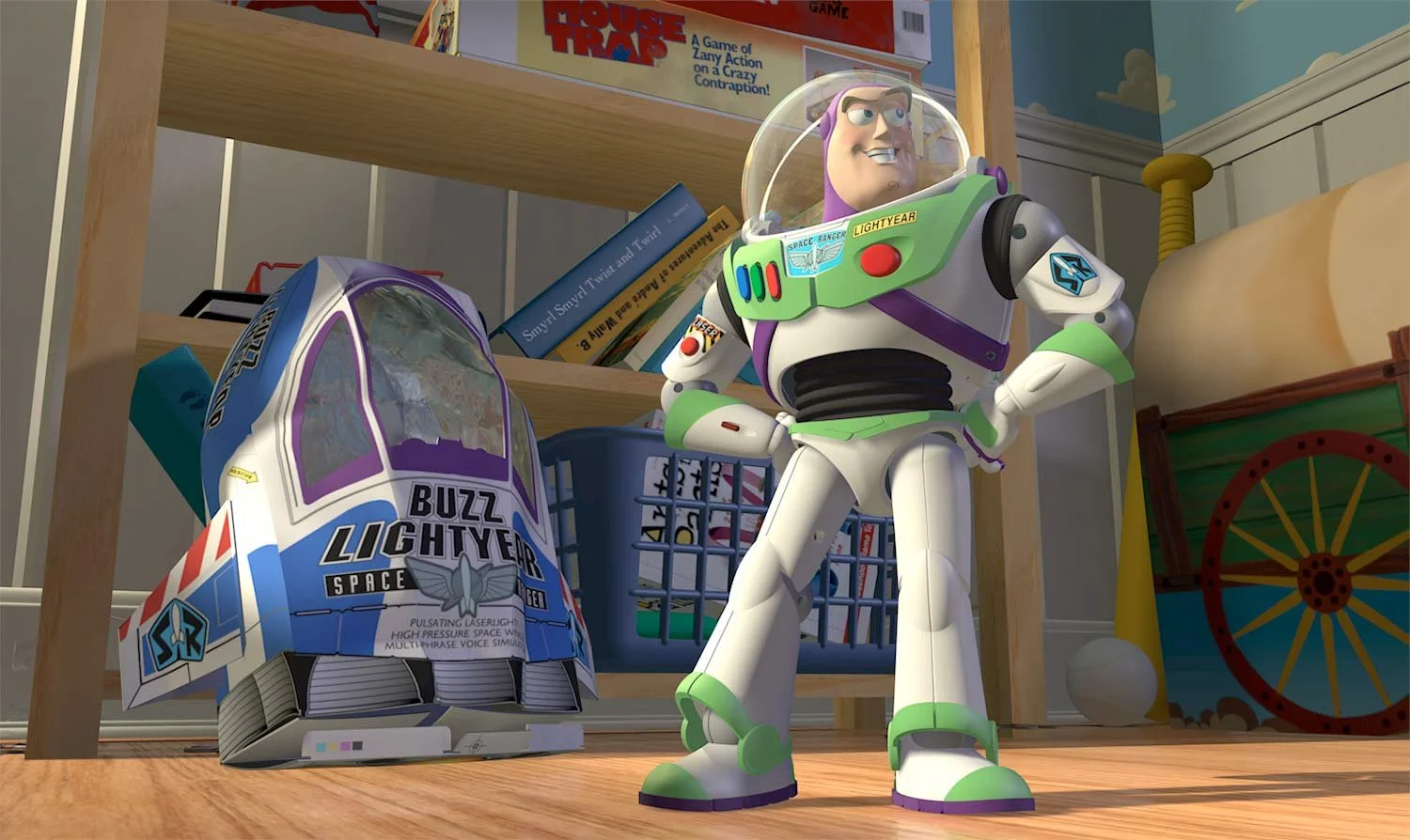
The clear dome, chest buttons, wrist communicator, wings, laser, purple head covering, and lime accents communicate function at a glance. Children can point to features before they understand the character. Animators can also turn every feature into comedy, danger, vulnerability, or rhythm.
Because the suit cannot be removed like ordinary clothing, product design becomes anatomy. Buzz does not put on the brand. He wakes inside it.
The purple, green, and white palette made sincerity possible
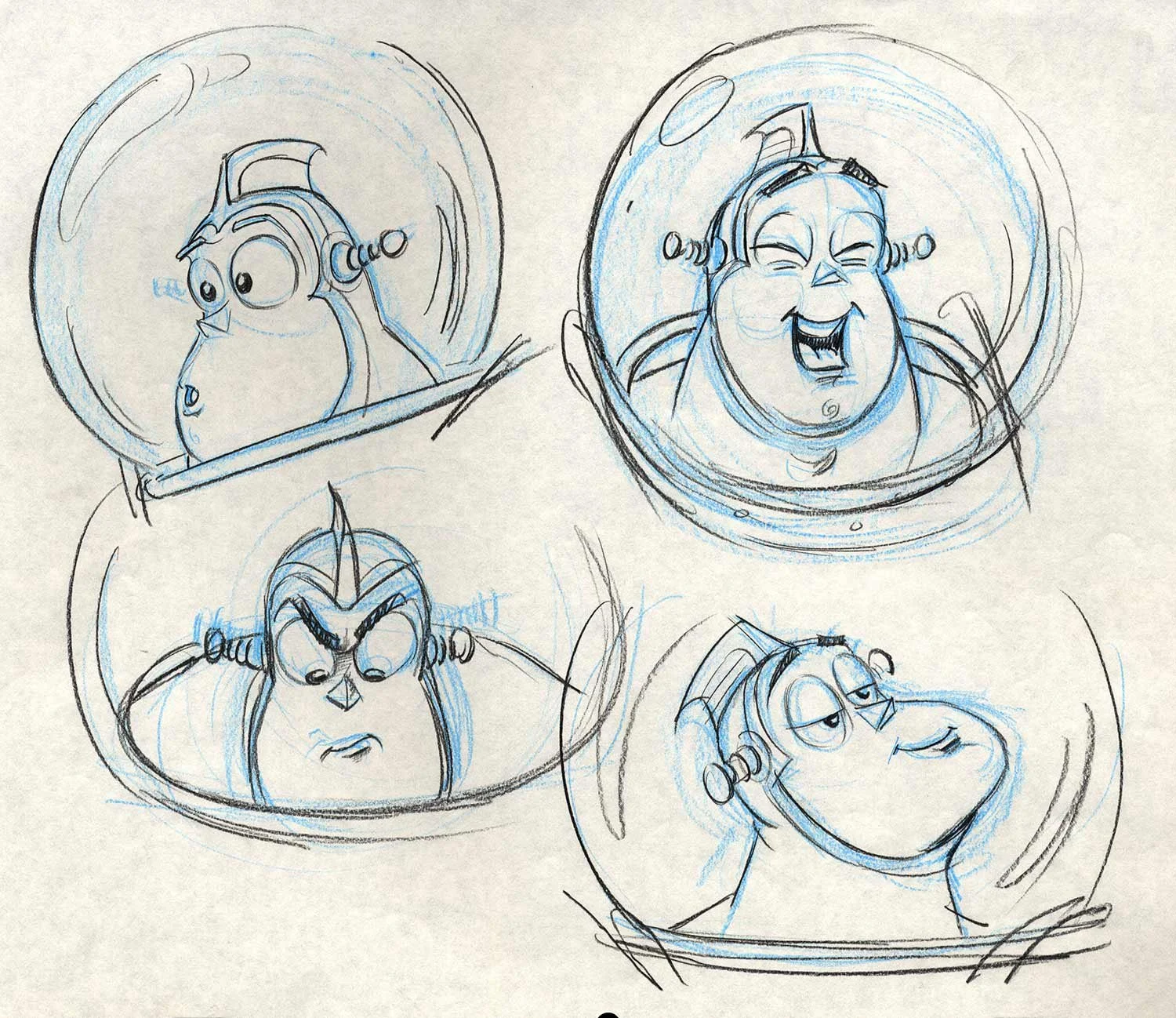
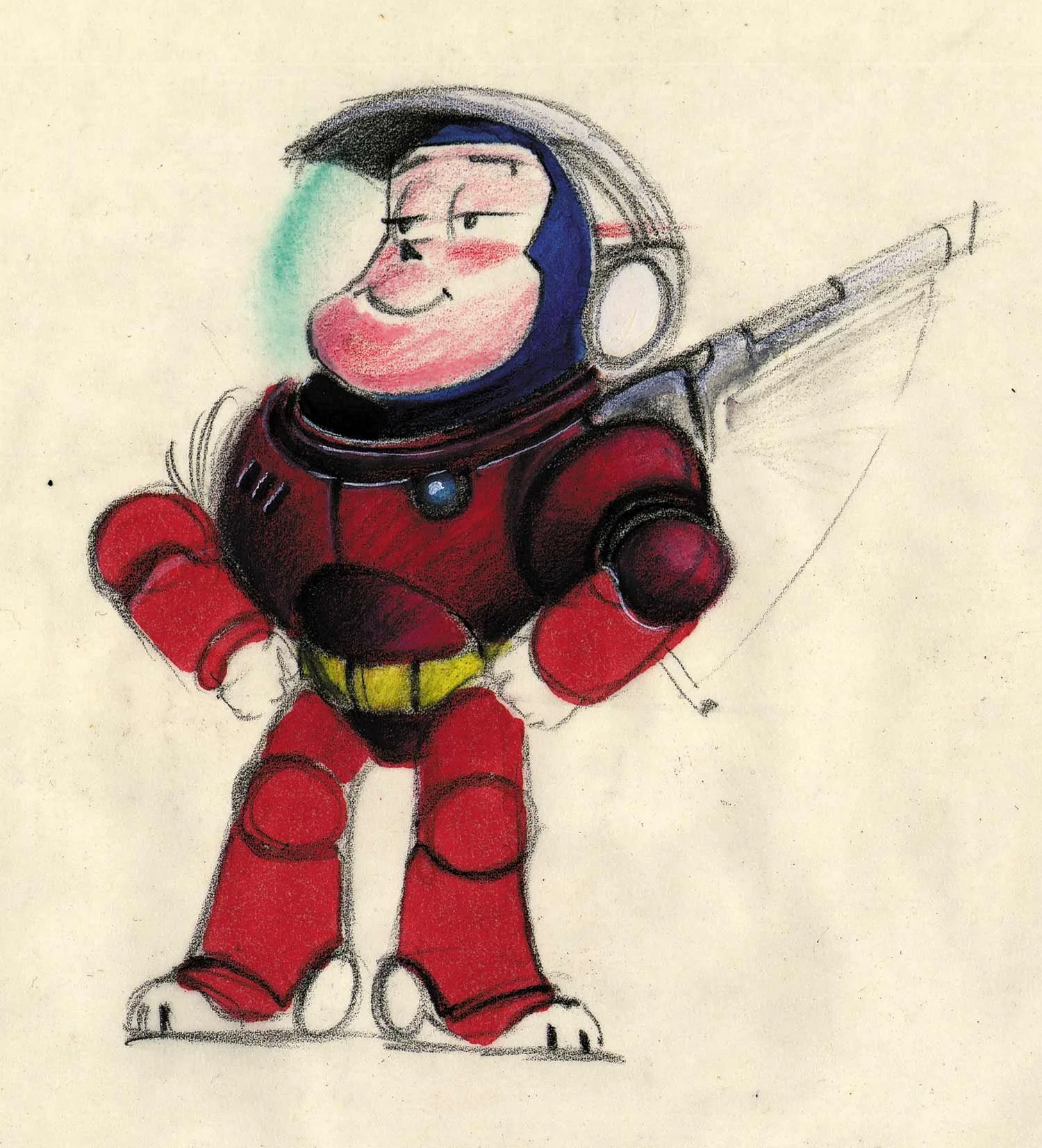
Early Pixar art explored rounder faces and a red suit with a cockier silhouette. The final palette feels clean, futuristic, and toy-store bright without looking automatically villainous. Purple softens the military green, while white provides a readable plastic body for lighting and wear.
Design revision helped the film ask viewers to love a pompous newcomer. If the earliest smug version had remained, the identity collapse might have looked like punishment rather than grief.
His helmet is both protection and fishbowl
Buzz repeatedly seals the dome as if Andy’s atmosphere may be hostile. Other toys can see his face while he feels protected by a boundary they know is unnecessary. The helmet visualizes how belief can isolate someone in plain sight.
When he accepts toyhood, the dome becomes a feature rather than a worldview. He can use it without treating everybody outside it as environmental danger.
The wings turn limitation into collaboration
Buzz’s wings are too small and mechanically simple for independent flight, yet they shape rescues, silhouettes, and play. Their value emerges through ramps, rockets, strings, vehicles, and friends who understand the surrounding physics.
That is the franchise’s better definition of ability. A feature does not need to satisfy the fantasy printed on the box. It needs a world willing to discover what the body can actually do.
His masculinity grows when certainty stops being mandatory
The original performance presents command, danger, weapons, physical confidence, and emotional restraint as Space Ranger masculinity. Mrs. Nesbitt, the commercial, and dependence on Woody rupture that pose. Buzz survives when shame no longer gets the final decision.
Later tenderness with Jessie, loyalty to the group, and willingness to let Woody leave make him stronger than the opening boast ever did. He learns that masculinity can include grief, confusion, affection, and receiving help.
He is a mass-produced person and not a chosen-one exception
The films keep showing other Buzz figures. That repetition blocks an easy answer in which Andy happened to buy the one magical or uniquely real unit. Every copy may wake into personhood under the right conditions, carrying identical programming into a different social history.
Buzz therefore raises the franchise’s hardest labor question. If millions of products can feel, the toy economy depends on unseen lives waiting inside packages, warehouses, restaurants, displays, and trash streams.
Toy Story 5 gives him a deputy badge instead of the sheriff role
Official Pixar material identifies Buzz as Deputy to Sheriff Jessie. That choice matters. Woody’s departure does not automatically promote the most famous male friend. Jessie leads, Buzz supports, and the community has a structure reflecting the people who remained with Bonnie.
When Jessie and Bullseye go missing, Buzz must restore order and work with the returning Woody. The real character test is whether old chemistry can return without old hierarchy swallowing the leadership Jessie earned.
The Hi-Tech Buzz army makes the original crisis collective
Pixar’s official Toy Story 5 material introduces fifty new Hi-Tech Edition Buzz Lightyear figures stuck in Space Ranger mode. One confused toy was funny and tragic in 1995. Fifty create a systems problem involving identical programming, cooperation, and responsibility.
Our Buzz can finally meet the scale implied by his commercial. His response will show whether he treats new copies as embarrassing earlier selves, recruits, threats, or people who deserve the patient truth Woody once struggled to give him.
Lilypad challenges the definition of a toy without being less manufactured
A smart tablet becomes Bonnie’s new favorite and confronts the room with networked play, social connection, software, and attention designed by adults. Buzz knows what it means to arrive as the shiny technology that makes older toys panic.
That history should make him the bridge rather than a simple defender of tradition. He can oppose manipulation while refusing Woody’s original mistake of treating the newcomer’s existence as theft.
His best leadership habit is checking the mission against the people
Early Buzz assumes the mission justifies every action because Star Command defines goodness. Mature Buzz looks at who needs help, what friends know, and whether the stated objective still serves anyone. Procedure becomes accountable to relationships.
That shift is why he can function as deputy. He brings discipline without requiring worship, provided the next story remembers how painfully he learned the difference.
His greatest flaw is outsourced certainty
Buzz wants an external system to tell him who he is and what action counts as correct. First it is Star Command. Later it can be a manual, a reset mode, a button, or Woody’s instructions. Outsourcing judgment protects him from doubt and makes manipulation dangerously easy.
Growth does not mean rejecting advice. It means accepting responsibility for interpretation. The inner voice must become a practiced ethical judgment, not whichever prerecorded phrase appears next.
His greatest strength is surviving humiliation without becoming cruel
Buzz’s entire self-concept collapses in public, his body breaks, his enemy witnesses the breakdown, and the universe becomes smaller than advertised. He could respond like Stinky Pete or Lotso by making later toys pay for his pain. He does not.
He lets Woody reach him, helps escape Sid, and builds a life inside the truth. Resilience here is not returning to old confidence. It is choosing care after confidence proves unreliable.
What a healthier Buzz looks like
He asks who issued the mission, admits uncertainty before a crisis chooses for him, protects his control panel, treats alternate modes as parts of his embodied history, and lets Jessie lead without converting support into diminished worth. He can keep every dramatic salute.
Healing does not require losing earnestness. Buzz is lovable because he commits completely. The healthier version commits to people and examined values instead of a logo printed on his chest.
Final character read
Buzz Lightyear begins as a joke about a new toy believing its own commercial and becomes one of animation’s clearest stories about ideological collapse. He learns that being manufactured does not make feeling fake, being replaceable in a store does not make relationships interchangeable, and being wrong about the universe does not end the right to live inside it.
His deepest victory is not reaching infinity. It is accepting a bedroom-sized life without treating that scale as failure, then discovering that friendship, grief, rescue, romance, leadership, and moral choice fit inside it. Character verdict: iconic because the plastic hero survives the death of the sales pitch and becomes kinder than the institution that programmed him.