
Memory, Sorrow, and Thorn · Canonical Character Profile
Brother Eglaf
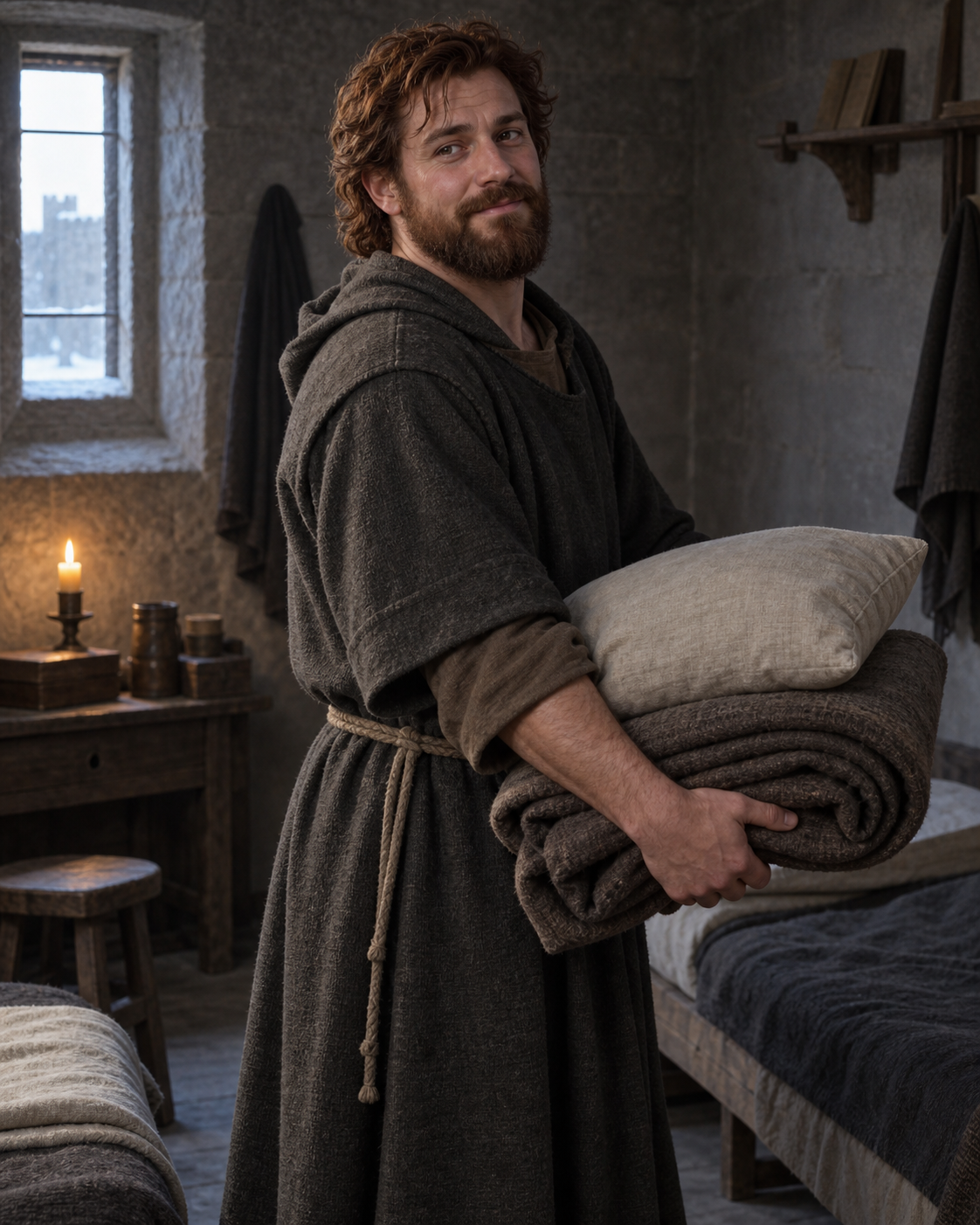
Brother Eglaf gets the kind of detail epic fantasy usually loses first: he shares his room with Father Strangyeard, and he snores loudly. Then Naglimund falls, the Red Hand melts the gate, Norns pour through with fire-tubes, and Eglaf is named among the dead. That domestic little complaint is why the death lands. Before the Harrowing makes him a casualty, the book lets him be somebody’s impossible roommate.
At a Glance
The loudly sleeping brother whose named death makes Naglimund’s destruction personal
- Name
- Eglaf
- Title
- Brother
- Affiliation
- Naglimund’s religious household
- Household connection
- Temporarily shares a room with Father Strangyeard
- Memorable detail
- Snores loudly according to Strangyeard
- Siege context
- Present when Naglimund is breached by Norns, Hunën, and the Red Hand
- Fate
- Killed during the Harrowing of Naglimund
- Book scope
- Book 1 only
The Room Strangyeard Borrowed
Eglaf enters the record through the intimate politics of siege-era sleeping arrangements
When Simon reaches Naglimund, Father Strangyeard is no longer sleeping in his own room. Simon has been placed there while recovering and finding his place within Josua’s crowded fortress.
Strangyeard temporarily shares Brother Eglaf’s room instead.
The arrangement tells us more about Naglimund than a generic sentence about crowding could. Rooms are being reassigned. Privacy bends around need. A priest and archivist gives up his normal space, and another brother absorbs him into his own.
Eglaf’s hospitality is practical rather than ceremonial. The record does not preserve a welcome speech, a complaint, or any negotiation. It confirms the shared room and the fact that Strangyeard knows what Eglaf sounds like asleep.
He snores loudly.
That is the only personal habit the text gives him, and it is perfect. It places Eglaf beyond public title. He has a body that sleeps, breathes noisily, and prevents his temporary roommate from idealizing communal religious life.
We cannot infer a medical condition, body type, drinking habit, age, or comic personality from snoring. We can infer proximity. Strangyeard has spent enough nights beside him for the sound to become reportable.
The page should not turn Eglaf into a joke. The detail works because it is ordinary, not because loud sleep makes him ridiculous.
A Fortress Full of Borrowed Space
Eglaf’s tiny domestic receipt belongs to Naglimund’s larger work of absorbing people
Refugees arrive from surrounding valleys and farms. Regional lords bring fighting men. Court women, priests, archivists, soldiers, servants, messengers, and displaced civilians occupy a fortress preparing for siege.
Every new body requires food, water, warmth, sanitation, supervision, and somewhere to lie down. The books repeatedly make those requirements visible rather than treating armies as numbers hovering above terrain.
Eglaf’s room participates in that infrastructure. By sharing it with Strangyeard, he indirectly frees the archivist’s usual space for Simon.
Simon needs recovery, safety, and a place within Naglimund’s social arrangement. Eglaf never meets him on-page in the surviving record, but the room chain connects them: Eglaf houses Strangyeard; Strangyeard’s room houses Simon.
The relation should not be embellished into intentional guardianship. Eglaf does not choose Simon, nurse him, or join the sword investigation. His contribution is accommodation.
That modest contribution matters precisely because siege survival is built from such adjustments. Not everyone can stand at a breach. People make space, share sleep, surrender routines, and tolerate one another’s bodies.
The record calls him Brother Eglaf but does not define his exact order, duties, vows, education, or relationship to Bishop Anodis. He belongs to Naglimund’s religious community without a safely recoverable job description beyond that title.
Beside the Archivist
Eglaf’s ordinary life brushes the great historical investigation without entering it
Father Strangyeard is studying Morgenes’s manuscript, Minneyar, and the Three Swords while stones cross Naglimund’s walls.
Eglaf shares sleeping space with the man doing that work. The proximity does not make him a Scrollbearer, historian, secret keeper, or participant in the research.
This distinction matters because fandom pages often inflate adjacency into membership. Eglaf’s name near Strangyeard is not proof that he knows what Strangyeard and Jarnauga are discovering.
His function is almost the opposite. He represents the ordinary institutional world surrounding extraordinary knowledge: brothers with rooms, nighttime noise, and routines continuing while the archivist chases a legendary sword.
Strangyeard’s complaint about the snoring may be affectionate, irritated, or merely factual. The record does not supply tone strongly enough to define their relationship.
It does prove familiarity created by forced proximity. When Naglimund falls, Eglaf’s death is not an abstract entry for Strangyeard’s institution. It is the death of the man whose room and sleeping sounds have become part of his immediate life.
The Harrowing of Naglimund
The invasion erases the shared room and kills the person who made room within it
Elias’s human army appears to withdraw. The apparent relief is a deception that clears the battlefield for allies who do not require ordinary siege engines.
Bukken erupt within the gardens and kill Bishop Anodis. The Red Hand riders shed physical form into tall, faceless scarlet flame and melt the gate’s iron fastenings.
Norns pour through carrying fire-tubes. Hunën smash defenders aside. Naglimund becomes an inferno.
Eglaf is named among those killed, alongside Ostrael, Eadgram, court women, soldiers, and civilians.
The list refuses to make the fall exclusively military. Religious brothers, named defenders, household members, and unnamed noncombatants die in the same catastrophic breach.
The record does not identify who kills Eglaf, where he stands, whether he fights, whether he helps others, his injuries, final words, or whether his body is recovered.
It also does not permit a heroic last stand manufactured to “improve” his death. Eglaf’s importance does not depend on receiving an invented weapon.
His earlier receipt makes the casualty specific. The dead man had a room. He shared it. He snored loudly enough for another person to remember.
The Harrowing destroys not only a defensive position but the intimate, inconvenient arrangements by which people had continued living inside it.
The Ethics of a Named Casualty
Naming Eglaf does not tell us how he died; it tells us not to erase that he lived
Battle narration must move quickly. Lists compress people because the event overwhelms the space available to follow each death.
A fandom profile can reverse that compression without falsifying the missing scene. It can restore Eglaf’s established room, relationship, habit, institution, and place in the sequence of collapse while continuing to label the unknowns.
That is different from inventing a cinematic death. Giving him a sword, last prayer, rescue attempt, or killer would replace the character with fan fiction precisely when the page claims to preserve him.
The truthful emotional connection runs from the snoring room to the named casualty. Strangyeard survives with the manuscript page and the knowledge required for the next stage of the journey. The man who gave him temporary sleeping space does not.
The asymmetry belongs to the Harrowing’s damage. History carries some witnesses forward and leaves others as names attached to interrupted ordinary life.
Connections
The archivist, recovering boy, religious household, and dead around Eglaf
Father Strangyeard
Eglaf’s temporary roommate and the source of the loud-snoring detail.
Simon
Uses Strangyeard’s room while the archivist relocates to Eglaf’s quarters.
Bishop Anodis
Naglimund’s bishop, killed by Bukken during the same final assault.
Ostrael and Eadgram
Named among the people killed as Norns and supernatural forces overrun the castle.
Jarnauga
Mortally wounded during the Harrowing while preserving Morgenes’s blood-marked manuscript page.
Naglimund’s civilians
Unnamed women, soldiers, and household people whose deaths surround Eglaf’s named loss.
Why Brother Eglaf Matters
One line of domestic comedy becomes a receipt for everything the Harrowing destroys
Eglaf matters because the trilogy names lives outside the heroic center and gives some of them exactly one stubbornly human detail.
His snoring is not plot information. It does not solve Minneyar, expose Pryrates, or help Josua escape. It establishes existence beyond function.
When his death arrives, the reader can connect the casualty to a room and another person’s interrupted sleep.
This is one of Tad Williams’s quiet strengths: catastrophe is measured through accumulated ordinary life. The more complete the place feels, the less its destruction can be consumed as spectacle.
Eglaf’s profile should therefore be substantial without pretending his biography is extensive. Organization, evidence boundaries, relationships, and thematic placement can honor a minor character more honestly than an invented childhood ever could.
On the Record
Book 1 only, death confirmed, almost every visual detail reconstructed
This is Brother Eglaf’s one canonical full-spoiler profile. His shared-room reference and death occur in Book 1. No direct Eglaf receipt appears in Books 2–4.
The record confirms his name and title, presence in Naglimund’s religious household, temporary room-sharing with Father Strangyeard, loud snoring according to Strangyeard, and death during the Harrowing as Norns, Hunën, Bukken, and the Red Hand overrun the fortress.
It does not confirm exact age, face, hair, eyes, body, clothing, religious order, duties, birthplace, family, personality, political knowledge, combat role, exact killer, injuries, last words, body recovery, funeral, or burial.
The approved living identity presents an exceptionally attractive adult brother around forty-one with a sturdy working build, broad warm face, deep-brown eyes, ruddy-fair skin, dark-copper morning-wave hair, neat full beard, plain charcoal-brown wool, and folded bedding inside the shared chamber. Every visible detail is CVM editorial reconstruction. Preserve this exact face and body across shared-room, Harrowing, hero, card, and social imagery; any death scene must remain non-graphic and cannot replace the living identity.