
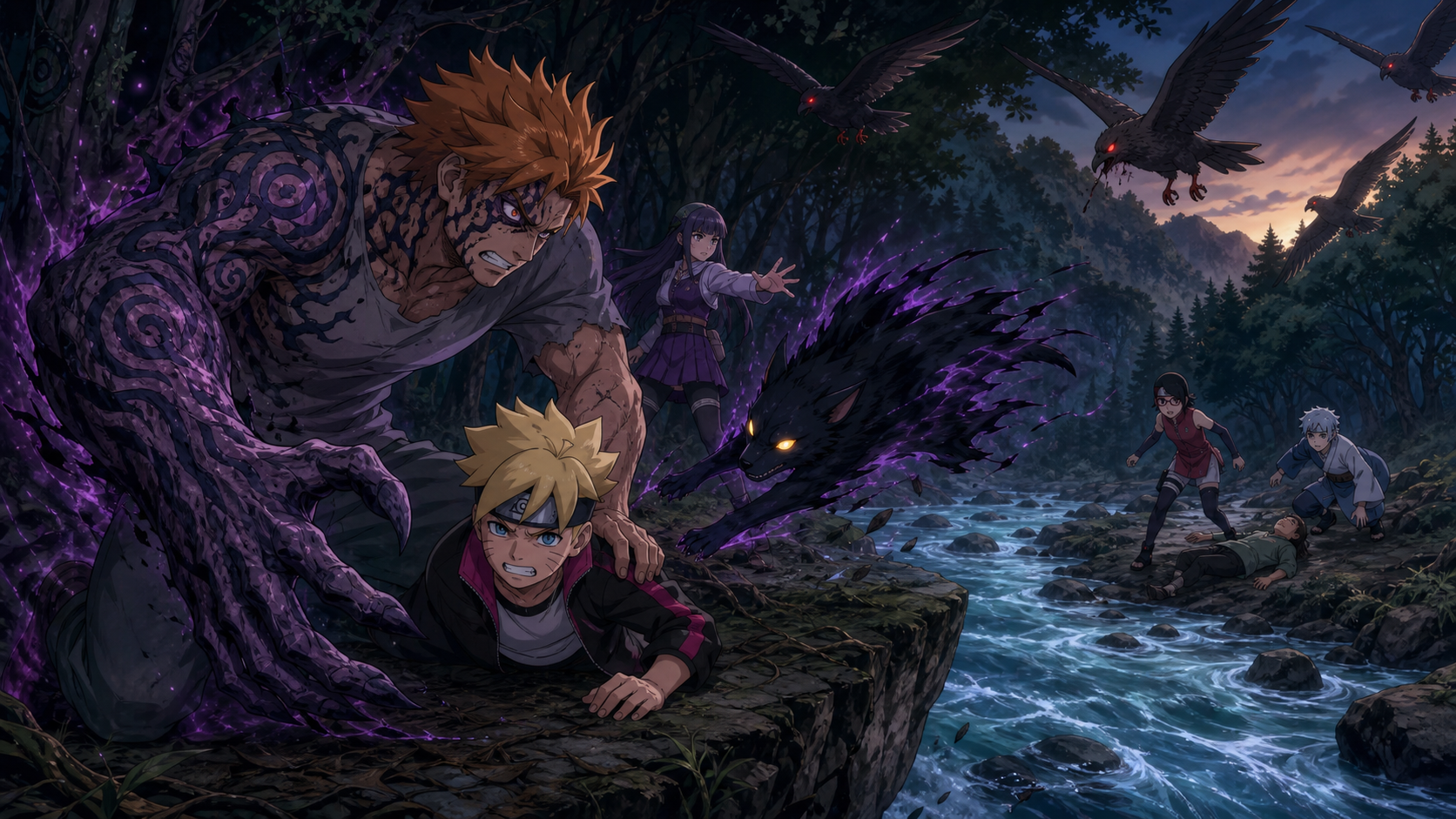
The Cursed Forest
Mutated birds, a spreading curse pattern, and a monster beside the river all point toward Jugo. The evidence refuses to make him a simple villain.
Series: Boruto: Naruto Next Generations
Episode: 98 · The Cursed Forest
Arc: Jugo Arc
Release: 2019-03-17
Previous: Episode 97 · Shikadai's Decision
Directory: All 293 Boruto episodes
Bottom line
Boruto Episode 98 opens the Jūgo arc as an ecological mystery before turning the forest into a warning about bodies other people want to classify. Birds near a Land of Fire village are attacking residents, crops are being destroyed, and a feverish curse pattern spreads across anyone injured. Team 7 and Team 15 receive a joint investigation with Konohamaru because Hanabi has been sent to border patrol after signs of an infiltration. Their assigned bird expert, Tosaka, behaves like a comic nuisance who licks eggs and droppings, but his obsession with genes introduces the arc's central argument: how much of a life is decided by the body someone inherits? Boruto rejects the suggestion that genes explain the whole person. Jūgo becomes the frightening evidence behind that argument. His body absorbs natural energy, transforms, and drives him toward violence he does not want. Yet the same man secretly removes curse marks from infected villagers and warns Boruto away from danger. Konohamaru sees Orochimaru's former associate and reasonably suspects a source. Boruto sees a monster who attacked him and still notices that the supposed monster cured somebody. The cliffhanger traps him between fear and curiosity as Jūgo loses control inside a hidden cave. The episode does not reveal the full conspiracy yet. The important first move is separating what a body can do from what a person chooses to do with the burden.
A joint mission pulls Team 7 and Team 15 together
Mitsuki tells Boruto that Team 7 will work alongside Sumire, Wasabi, and Namida. The combined assignment makes sense because the affected forest covers too much ground for three genin and one leader to investigate quickly.
Team 15 also brings recent animal-handling experience. Episode 98 treats that prior mission as usable knowledge rather than disposable side-story material.
Boruto mistakes research for peeping
Before the briefing, Boruto spots a stranger crouched in a tree and assumes he is spying on somebody. A thrown kunai startles the man, who falls while holding a nest of eggs.
Boruto reacts first and checks later, which almost destroys the exact evidence the stranger was protecting. The mistake quietly previews his approach to Jūgo: a frightening appearance will invite an immediate conclusion.
Tosaka introduces himself by licking an egg
The fallen stranger is Tosaka, an ornithologist whose expertise comes with a complete lack of normal boundaries. He identifies the eggs by tasting them, returns the nest, and explains how genes determine a species' traits.
His knowledge is useful. His method makes everybody want to stand several feet farther away. Boruto's face does half the review for us.
Boruto refuses to be reduced to inheritance
When Tosaka talks about genetics, Boruto insists that he is more than whatever his genes dictate. The claim sounds obvious coming from Naruto and Hinata's son, but Boruto has spent years being measured through both parents.
He has Naruto's energy, Hinata's lineage, Uzumaki reserves, Hyūga blood, and a famous surname. None of those facts can explain every choice he makes. Tosaka responds by asking to lick him, which ends the philosophy lesson before anybody can recover.
Hanabi is away because the border may have been breached
Konohamaru explains that Hanabi has been assigned to border patrol after signs of an infiltration. He will lead both teams during the bird investigation.
That detail places the animal attacks inside a larger security problem. The village does not yet know whether the forest crisis is natural, accidental, or connected to somebody crossing into the Land of Fire.
Suika assigns an investigation, not an extermination
Suika Kannonji sends the teams to learn why birds are attacking villagers near the outer forest. The mission requires research before force because the animals may be sick rather than naturally aggressive.
That distinction protects the story from treating every dangerous creature as an enemy. Finding the cause may save villagers and birds at the same time.
Tosaka is the specialist nobody wants to watch eat
The genin understand ninjutsu and field danger, but none of them can identify a bird disease from feathers, feeding patterns, or droppings. Tosaka fills a real knowledge gap.
Sarada's disgust becomes completely justified when he tastes droppings to confirm the birds' diet. Expertise does not automatically come packaged in pleasant manners.
Team 15 takes the smaller mission seriously
Wasabi and Namida initially compare the assignment with Hanabi's border work. Sumire reminds them that a mission involving crops, animals, and villagers still deserves their full attention.
The response fits her leadership habits. Shinobi prestige means very little to a family losing food or living under daily attacks from the sky.
Wasabi's Cat Covering helps survey the forest
The teams spend a day gathering information, and Wasabi uses Cat Covering to move quickly through the area. Her ability becomes an investigation tool instead of a flashy combat trick.
The episode gives Team 15 concrete work. They are not background girls attached to Team 7's plot. Their different experience and movement help cover the habitat.
The forest becomes frightening when the birds disappear
As the group nears the village, Tosaka notices the lack of ordinary calls. A forest associated with bird attacks should be loud. Silence suggests that normal animals have fled, changed, or died.
The absence creates more tension than a sudden flock could. Everybody has entered an ecosystem where familiar signals no longer work.
A villager is attacked near the road
The teams find a resident under assault and intervene. The injury initially looks like the predictable result of aggressive birds, but his condition worsens faster than a normal wound should.
Helping him turns the mission from property protection into a medical emergency. The group now has a living example of whatever is moving through the forest.
Boruto meets Jūgo as a monster
Away from the group, Boruto encounters a fully transformed Jūgo. The curse-driven body is enormous, violent, and difficult to recognize as the quiet man connected to Sasuke's past.
Jūgo pins him near a ledge. Boruto has no context for the internal fight happening behind the attack. From his position on the ground, survival matters more than biography.
Sumire and Nue save Boruto
Nue strikes Jūgo and sends him into the river, giving Boruto room to escape. Sumire reaches the scene because she remains alert to what happens outside the main formation.
Boruto thanks her, and the rescue reinforces why joint missions matter. Team 15 is already protecting Team 7 before the investigation has a name for the threat.
Namida notices Sumire carrying something quietly
When the group reunites, Namida senses that Sumire is unsettled. Nue reacted strongly to Jūgo, and Sumire has more experience than most genin with dangerous chakra transforming bodies.
The moment stays small, but friendship appears through attention. Namida watches her teammate rather than waiting for a formal confession.
The injured villager develops a fever
His breathing becomes shallow and his temperature rises. Tosaka considers a disease spread through birds, which matches the obvious route of exposure.
The diagnosis remains provisional. A good investigation begins with the most supported explanation and changes when new evidence refuses to fit.
The village has been under attack for a month
An elder explains that the birds began changing roughly one month earlier. The animals destroy crops, attack residents, and turn daily work into risk. Strange cries also echo through the forest.
A month-long crisis means families have already lost food, safety, and trust in the surrounding land. The mission arrives after the village has spent weeks adapting alone.
Waterfowl changed first
The earliest affected birds lived along the river flowing from the mountain, through the village, and toward the Land of Rivers. That pattern points upstream.
The river connects wildlife, drinking water, farmland, and political borders. Contamination in one place can move beyond the village long before shinobi identify the source.
Konohamaru tells everyone to use well water
Without pretending the river theory is proven, Konohamaru takes a sensible precaution. Villagers should avoid the flowing water and rely on wells until the teams understand the transmission route.
Leadership means acting under uncertainty without turning suspicion into certainty. His order reduces exposure while leaving the investigation open.
The curse pattern changes the medical picture
Dark markings spread from the injured villager's wound. Other residents show the same pattern. A simple bird-borne illness no longer explains what the teams can see.
The marks resemble the curse-seal systems associated with Orochimaru. Infection, experimentation, and chakra transformation begin overlapping.
Villagers carry Jūgo in from the river
Residents find Jūgo unconscious and bring him to the village. When he wakes, he claims he slipped and fell. Boruto knows the story leaves out the attack by the ledge.
Jūgo lies because the truth could make everybody fear him, restrain him, or stop him from continuing whatever work brought him to the forest. Secrecy protects his purpose and makes him look more suspicious.
Nue recognizes danger before the humans do
Nue remains wary around Jūgo. The summon can sense something in his chakra or transformation that ordinary observation misses.
Sumire respects the warning without ordering an immediate attack. Caution and curiosity remain possible together.
A sick villager turns violent
One infected resident wakes and attacks Tosaka. Konohamaru orders the genin to evacuate civilians while he handles the immediate threat.
The curse mark does more than create a rash or fever. The infection changes behavior and turns victims into danger for the same community trying to care for them.
Jūgo cures the man while hiding how
Jūgo draws the attacker away, partially transforms, and knocks him unconscious. Afterward, the curse pattern is gone. Mitsuki notices the disappearance.
The suspected monster has just relieved the condition. Jūgo conceals the transformation because his method would expose the exact connection everyone fears.
Mitsuki watches the evidence instead of the reputation
Mitsuki comes from Orochimaru and understands how quickly association becomes accusation. He pays attention to the change in the villager's body.
That observation complicates the simplest theory. If Jūgo caused the infection, why would contact with him remove the marks?
Konohamaru explains cursed seals
Konohamaru gives the younger shinobi enough history to understand the danger. Orochimaru used cursed seals to alter bodies, amplify power, and bind people to his influence.
Jūgo's natural ability helped inspire that research. His presence beside a spreading curse pattern cannot be dismissed as coincidence, even when the evidence remains incomplete.
Suspicion of Jūgo is reasonable and still incomplete
Konohamaru connects Jūgo to Orochimaru and the visible marks. His caution protects the teams. Boruto's doubts also deserve space because he saw Jūgo attack and later watched the marks vanish after Jūgo intervened.
The episode lets adults and children hold different pieces of the same truth. Neither side has enough evidence yet.
Jūgo warns Boruto away from the forest
Before leaving, Jūgo tells Boruto to stay away. The warning sounds threatening because he refuses to explain the danger.
His secrecy comes from fear that another transformation will hurt people. Trying to protect Boruto through distance only makes Boruto more determined to understand what he is hiding.
Boruto tests the echo instead of following the sound blindly
The villagers reported beastly cries in the forest. Boruto throws a rock and uses the returned sound to confirm that the cries are echoes.
The small test shows investigative growth. He gathers physical evidence rather than charging directly toward the loudest noise.
The trail leads to a hidden cave
Boruto and Sarada trace the sound to a cave with a constructed door. The enclosure suggests somebody planned for a dangerous transformation and needed a barrier strong enough to contain the result.
The forest mystery now includes deliberate human preparation. Jūgo is not simply wandering and attacking at random.
Jūgo has built a prison for himself
Inside, he struggles against the curse-driven change. The room is designed so his transformed body cannot leave easily. Every wall admits that he expects to lose control.
That preparation reveals responsibility beneath the violence. Jūgo knows what his body can do and has chosen isolation to reduce the harm.
Boruto recognizes his attacker and still wants answers
The transformed figure near the ledge and the quiet man from the village are the same person. Boruto warns Sarada as Jūgo's control breaks.
Fear does not erase his questions. The man who attacked him also cured a villager and locked himself away. Those contradictions are the real entrance to the arc.
The cliffhanger turns inherited biology into immediate danger
Jūgo threatens to kill them as the transformation takes over. Tosaka's earlier conversation about genes stops sounding like a strange lecture.
Jūgo did not choose the natural-energy response inside his body. He remains responsible for managing the danger, but responsibility is different from moral blame for having been born with the condition.
The forest is cursed because somebody is using living systems
Birds, water, curse patterns, and a hidden man who can remove the marks all point toward an engineered crisis rather than supernatural punishment. The village calls the forest cursed because residents can see effects without the mechanism.
The arc opener asks the teams to replace fear with investigation before the infection migrates beyond one community.
Investigation begins by refusing the easiest monster story
The village has injured residents, violent birds, and a frightening stranger connected to Orochimaru. Blaming Jugo requires almost no imagination. The available evidence still refuses to stay that simple.
Jugo attacks Boruto and later removes a curse mark from another victim. He hides in the same forest where the outbreak began and warns Boruto away from the danger. Every fact supports more than one interpretation.
Konohamaru protects the village by treating Jugo as a serious risk. Mitsuki protects the investigation by noticing evidence that does not fit the accusation. Good judgment needs both instincts.
Boruto's inheritance argument finds a harsher mirror in Jugo
Boruto resents strangers reducing him to Naruto and Hinata. He wants actions, mistakes, and choices to belong to him. Jugo faces a more dangerous version of the same problem because his inherited biology can seize control of those choices.
The parallel does not make their struggles equal. Boruto's family name creates expectations and unwanted attention. Jugo's condition can produce lethal violence, social exile, and fear that follows every place he enters.
Boruto recognizes the shared demand beneath the difference: a body or bloodline can shape a life without becoming the only author allowed to speak.
Sumire and Nue understand why dangerous power needs context
Sumire knows what happens when a person carrying destructive power becomes a rumor before becoming a person. Nue can protect her, drain chakra, frighten allies, and act before everyone shares the same information.
That experience makes their intervention more than a convenient rescue. Sumire sees Boruto in danger and acts, but she also understands that one violent encounter cannot explain the entire being responsible.
Her presence should make the group slower to confuse containment with condemnation. She survived because people eventually asked what created the threat and what choices remained inside the threat.
Jugo's cave is a quarantine built from fear and responsibility
The restraints prove Jugo expects another transformation. He removes himself from populated areas and creates a physical system strong enough to hold him when intention stops working.
That preparation is responsible and heartbreaking. Jugo has turned isolation into public safety because reliable community support does not exist. The cave protects strangers while guaranteeing that his worst moments happen alone.
The prison does not prove he is guilty of the outbreak. The prison proves he knows exactly how dangerous his own body can become.
The missing birds are louder than the first attack
A forest normally filled with birds becomes wrong through absence before violence explains the silence. Wasabi's survey work and Team 15's attention let the environment become evidence.
Animals often reveal contamination, disease, habitat disruption, or altered behavior before humans identify a mechanism. The missing calls tell the teams that one attacked villager is not an isolated event.
The episode uses ecological dread well because the forest does not need a speech. A missing sound tells the shinobi that the system has already changed.
Well water is a cautious intervention, not proof about the source
Konohamaru tells residents to avoid uncertain water while the team investigates infection. The order reduces exposure without pretending that anyone has established a transmission route.
That distinction protects public trust. Officials can take temporary precautions and still admit uncertainty. Claiming certainty too early would make every later correction look like incompetence or concealment.
The village needs safer behavior immediately and accurate answers eventually. Konohamaru's order serves the first need while leaving the second open.
Tosaka's comedy makes his boundary problems easier to overlook
Licking an egg is gross, funny, and framed as evidence of eccentric brilliance. The performance teaches everyone to tolerate invasive behavior because Tosaka produces useful information.
That tolerance becomes dangerous around Jugo, whose body attracts exactly the kind of curiosity Tosaka cannot regulate. A specialist who treats every object as available for examination will eventually treat a person the same way.
The episode hides warning inside the joke. Expertise without restraint can help solve one mystery while creating the next violation.
Team 15 contributes field intelligence rather than decoration
Wasabi surveys quickly, Namida notices what Sumire carries, and Sumire brings Nue's senses and her own experience with weaponized biology. Their mission may begin smaller than Team 7's assignment, but their observations build the case.
The joint structure works when neither team becomes backup furniture. Team 7 brings combat experience and Mitsuki's knowledge of Orochimaru. Team 15 notices the environment, residents, and hidden details that a direct pursuit could miss.
The forest demands distributed attention. No single prodigy can watch the birds, examine patients, protect villagers, track Jugo, and question the official story at once.
Final reaction
Boruto Episode 98 balances gross comedy, mission procedure, ecological dread, and Jūgo's tragedy better than the premise should allow. Tosaka licking field evidence is horrifying, but his fixation on genes gives the episode a question that belongs directly to Boruto and Jūgo. Boruto refuses to be defined by famous parents. Jūgo desperately wants choices to matter when his body keeps forcing violence through him.
Konohamaru has good reason to suspect Orochimaru's former associate. Boruto has good reason to notice that Jūgo removed a victim's curse pattern. Sumire and Nue bring lived experience with dangerous power. Mitsuki notices the medical contradiction. Team 15 contributes real field skill. By the time Boruto opens the cave, the supposed monster has already been shown as attacker, patient, rescuer, liar, and protector. That complexity gives the cliffhanger teeth. Jūgo is dangerous, but danger is not the whole person.
Sources and lawful viewing
Official episode reference: Naruto Official episode guide
Licensed episode route: Crunchyroll licensed series page