
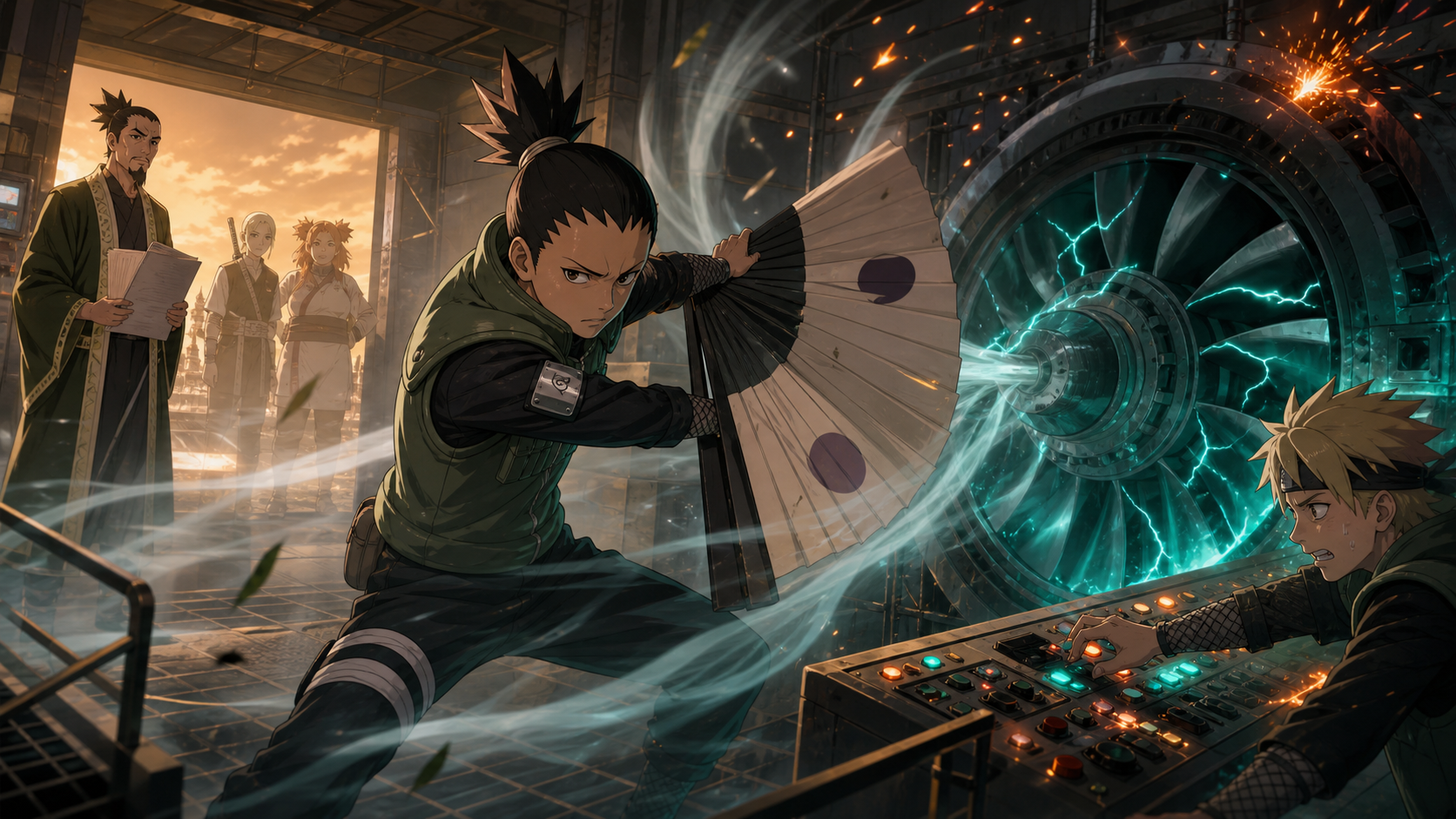
Shikadai's Decision
A prestigious political future could help the Nara clan. Shikadai has to decide whether clan duty is enough reason to leave the shinobi life he chose.
Series: Boruto: Naruto Next Generations
Episode: 97 · Shikadai's Decision
Arc: Team 10
Release: 2019-03-10
Previous: Episode 96 · Blood, Sweat, and Namida
Directory: All 293 Boruto episodes
Bottom line
Boruto Episode 97 gives Shikadai Nara a family burden that cannot be defeated with Shadow Possession. The Nara chief elder looks at Shikamaru's only son and sees a political asset. A two-year internship under the Fire Daimyō could raise clan prestige, strengthen useful connections, and reduce some pressure on Shikamaru. Shikadai agrees because the proposal sounds responsible, not because politics excites him. That difference matters. He begins using only Nara techniques on missions, takes a hiatus from Team 10, and studies a future selected by adults who keep calling the choice an honor. Denki understands the weight of inherited expectation, but he also reminds Shikadai that family legacy does not require surrendering every personal desire. A malfunction at the wind power plant finally gives Shikadai a problem no Nara technique can solve. He uses Wind Release learned from Temari to keep the generator turning until Denki shuts the system down. The rescue proves that his mixed inheritance is already valuable precisely because he refuses to shrink himself into one clan-approved shape. Shikadai rejects the internship and chooses to bring both the Nara and Kazekage family legacies into his shinobi path. The decision does not reject politics forever. Shikadai refuses a political future built from guilt before he has learned who he wants to become.
Team 10 wins and still leaves damage behind
The episode opens with Team 10 capturing bandits at a wind power plant. Shikadai rushes after one attacker and tries to finish the pursuit himself. The bandit drops an explosive tag, damaging part of the facility.
The mission succeeds, but the unnecessary damage gives Shikadai a reason to question his judgment. Responsibility begins to feel heavier right before the clan elder arrives with a respectable alternative.
Shikadai has started carrying his promotion alone
Shikadai is the first member of his Academy class promoted to chūnin. The rank recognizes planning, leadership, and the ability to protect a team. The promotion also makes every mistake feel public.
Inojin and Chōchō can complain, laugh, and recover as genin. Shikadai feels responsible for directing them. The power plant damage becomes evidence that intelligence does not eliminate bad calls.
Enchū measures the Nara clan through reputation
The Nara chief elder, Enchū, worries that the clan looks unimpressive after the Fourth Shinobi World War. Shikamaru serves beside the Hokage and carries enormous influence, yet the elder still wants a clearer public symbol of Nara prestige.
Shikadai becomes the obvious candidate because he is talented, young, and the clan head's only son. His future is treated like an available piece on a political board.
The pressure begins with a complaint about training
Enchū criticizes Shikadai's progress with Nara techniques. The criticism ignores how much he has already accomplished by combining observation, leadership, and skills inherited from both parents.
Clan tradition narrows the measurement. Success means advancing the approved hiden techniques and representing the Nara name visibly. Wind Release from Temari's side receives less attention because that inheritance does not serve Enchū's preferred story.
Shikadai starts using only Nara techniques
Trying to prove his worth, Shikadai limits himself to the clan's shadow techniques during missions. The decision sounds disciplined. In practice, refusing other tools makes Team 10 less adaptable.
The restriction is the first warning that inherited expectation can damage competence. Shikadai usually wins by reading the whole field. Now he deliberately ignores part of his own skill set to satisfy an audience who is not on the mission.
Team 10 pays for his attempt to look correct
Inojin and Chōchō have to adjust when Shikadai insists on solving problems through one family style. Their formation depends on all three people bringing different strengths. His private need for clan approval disrupts that balance.
Shikadai is not selfish in the obvious sense. He believes becoming a better Nara will help everyone. Good intentions still create consequences when the team becomes a stage for proving lineage.
The political offer arrives after the struggle
Enchū sees Shikadai's uncertainty as an opening and offers a two-year internship under the Fire Daimyō. The position would teach politics, build connections, and place a Nara heir near national power.
The offer is substantial. Politics shapes missions, budgets, alliances, reconstruction, and the conditions shinobi are ordered to protect. Shikadai could do meaningful work there.
Honor becomes difficult to refuse
Adults describe the internship as an honor for Shikadai and the clan. Once an opportunity receives that label, refusal can sound childish or ungrateful.
He is asked to decide as though the choice belongs to him, but the proposal arrives wrapped in clan anxiety and his father's workload. Freedom becomes murky when one answer earns praise and the other appears to disappoint generations.
Shikadai thinks politics could help Shikamaru
The official episode description centers his desire to reduce pressure on his father. Shikamaru works beside Naruto, advises the Hokage, coordinates village policy, and carries problems most residents never see.
Shikadai loves him. A political path could create another capable Nara inside the system and distribute responsibility. The reasoning is generous, but a child should not build a life mainly to make a parent's burden lighter.
Shikamaru does not choose for his son
Shikamaru understands clan duty and political labor better than anyone in the household. He also knows the cost of being called brilliant until other people treat every hard problem as automatically his.
Rather than giving Shikadai a direct command, he leaves room for the decision. That restraint can feel frustrating because Shikadai wants certainty. A father choosing for him would only reproduce the pressure under a kinder voice.
Temari's inheritance remains visible even when ignored
Shikadai is a Nara and the nephew of the Kazekage. His mother came from Sunagakure with her own political history, combat style, and Wind Release expertise. His identity has never been one-village or one-clan simple.
Enchū frames prestige through the Nara line, but Shikadai's body and training already carry an international alliance. Treating Temari's influence as secondary wastes half the story that makes him uniquely useful.
Team 10 receives the decision as a rupture
Shikadai tells his friends that he will step away from ninja missions and study politics. Inojin and Chōchō are surprised because the plan changes their daily lives too.
A career decision belongs to Shikadai, yet teammates are not furniture waiting for his return. They trained around his strategies and trusted his leadership. His departure creates operational and emotional gaps.
Boruto cannot understand the sudden surrender
Boruto knows Shikadai as the friend who reads trouble before everyone else and complains while solving the problem anyway. A quiet exit into political study does not match the person he recognizes.
His reaction is not a sophisticated analysis of public service. Boruto sees that Shikadai sounds resigned rather than excited. Friendship catches the emotional truth before the adults finish debating respectable outcomes.
The hiatus gives Shikadai time but not clarity
Shikadai studies and considers the internship away from missions. Removing immediate pressure should help, but the quiet leaves him alone with arguments built from obligation.
He can list reasons the political path would benefit the clan. He struggles to name what he personally wants from the work. A decision supported only by duty can remain logical while feeling wrong.
Denki understands inherited expectations
Denki comes from a powerful business family. His father once wanted him to enter the Kaminarimon Company path and treated shinobi ambition as impractical. Denki knows what happens when a family sees a child as a continuation plan.
That history makes him the right person for Shikadai to meet. He does not dismiss family responsibility. Denki wants to honor his family through technology and shinobi work on terms he helped define.
Living up to a family can include changing the route
Denki tells Shikadai that he still plans to meet family expectations, but in his own way. The distinction gives Shikadai another option beyond obedience or rejection.
Tradition does not have to remain frozen. A child can carry family knowledge into a different profession, combine two inheritances, or create a path older relatives never imagined.
The generator crisis removes the abstract debate
A power generator begins malfunctioning and approaches an explosion. The danger turns political philosophy into immediate labor. People need somebody to understand the machine, somebody to buy time, and both people to trust each other.
Denki works the controls. Shikadai evaluates the failing airflow and realizes a strong gust can keep the turbine moving long enough for a safe shutdown.
Shadow techniques cannot solve every problem
No enemy stands in front of Shikadai. A shadow bind cannot restrain heat, pressure, or a stalled turbine. The power plant does not care which technique gives the Nara clan more prestige.
The crisis proves why his earlier self-imposed restriction was foolish. Shinobi work rewards the right answer for the actual problem, not the most politically flattering answer.
Temari's Wind Release saves the plant
Shikadai uses the fan and Wind Release training inherited from his mother. The controlled gust turns the generator's fan, relieves the dangerous buildup, and gives Denki enough time to finish the shutdown.
The ability Enchū's narrow standard overlooked becomes the decisive skill. Temari's legacy does not compete with the Nara name. Her training expands what a Nara heir can do.
Denki's technology and Shikadai's chakra cooperate
Neither boy solves the emergency alone. Denki understands the machinery and controls. Shikadai supplies physical force through chakra and maintains the airflow under pressure.
Their success belongs to a modern Konoha where shinobi methods and engineering increasingly overlap. Politics matters in that world, but field experience matters too. Shikadai wants to participate where decisions touch real systems and real people.
The emergency gives Shikadai evidence about himself
Before the generator fails, both futures exist mainly as other people's arguments. The rescue creates direct evidence. Shikadai feels useful combining strategy, Nara training, Wind Release, and teamwork.
He does not reject the internship because politics lacks value. He recognizes that leaving the shinobi path now would cut him away from the work that teaches him who he is.
Shikadai refuses the internship
He tells Enchū that he will not accept the Fire Daimyō placement. The refusal is respectful and firm. He no longer needs to make clan anxiety the controlling reason for his life.
Turning down a prestigious offer requires courage because nobody can guarantee that the chosen shinobi path will become more impressive. He chooses uncertainty that belongs to him over certainty designed by somebody else.
He defines clan prestige more broadly
Shikadai plans to strengthen the Nara name by mastering both clan hiden techniques and Wind Release. His answer honors Shikamaru and Temari rather than selecting one parent as the legitimate source of identity.
The combined path may bring the clan greater distinction than a conventional political appointment. More importantly, the plan makes him a fuller shinobi and a more honest son.
Politics may still wait in his future
Shikadai has the temperament for government: patience, strategic vision, coalition thinking, and a strong dislike of wasteful conflict. Declining at this age does not erase those qualities.
Field leadership can prepare him for political work later. He may enter public service with experience, chosen conviction, and a better understanding of how policy reaches ordinary missions. The episode protects that future by refusing to force the timing.
Shikamaru's shadow is both inheritance and warning
Shikamaru became indispensable because competence kept attracting more responsibility. His son admires him and wants to help. Shikadai also risks repeating the habit of accepting burdens before asking whether every burden truly belongs to him.
Choosing the shinobi path is his first clear boundary. He can support Shikamaru without becoming a replacement part in the same political machine.
Team 10 needs Shikadai as a whole person
Inojin and Chōchō do not need a clan mascot who uses Shadow Possession at every opportunity. They need the strategist who understands their abilities, changes plans, and uses whatever skill the mission requires.
Returning with a clearer identity should make Shikadai a better leader. His teammates can trust that future decisions will serve the mission rather than an elder watching from elsewhere.
The episode respects ordinary career pressure
No villain forces Shikadai toward politics. The adults offer a legitimate opportunity, and the family reasons are understandable. That normality makes the conflict sharper.
Young people often face paths that are safe, prestigious, and completely wrong for the current version of themselves. Refusal becomes difficult when the unwanted future would make everyone proud.
A promotion changes Team 10 even when nobody leaves
Shikadai becoming chunin gives him authority his friends do not share. That difference can help the team during a mission, but the title also tempts him to carry every judgment alone.
Inojin and Chocho notice the distance before Shikadai names the pressure. He stops collaborating as naturally, narrows his techniques, and treats mistakes like evidence that he has failed an institution rather than teammates.
Promotion should expand responsibility without shrinking trust. Shikadai begins acting as though leadership means becoming less knowable to the people expected to follow him.
Enchu mistakes reputation management for character development
Enchu sees a talented Nara heir and begins polishing him for the role that would benefit the clan. The concern is not completely selfish. Political influence can protect families, shape policy, and give the next generation resources.
The problem appears when Shikadai's preferences become secondary to the image he could maintain. Using only Nara techniques may look correct to observers, but the restriction makes him a weaker shinobi and a less complete person.
Reputation can document achievement. Reputation should not decide which parts of a child are allowed to count as achievement.
Temari's side of Shikadai cannot remain a useful secret
Shikadai inherits tactical thinking and shadow techniques from the Nara clan. He also inherits Wind Release, Sand history, Temari's discipline, and a maternal family whose political significance crosses village borders.
The pressure to perform Nara identity treats that other inheritance like decorative background. Shikadai is expected to represent one clan cleanly even though his actual life was built by two families and two villages.
Using Wind Release does not dilute his Nara identity. The technique exposes how narrow the approved version had become.
Shikamaru gives advice without pretending neutrality removes influence
Shikamaru refuses to order his son into politics or away from politics. That restraint matters because a direct command would turn Shikadai's career into another mission assignment.
Shikamaru's position still fills the room. Shikadai sees the work, exhaustion, prestige, and public importance attached to his father. A parent can avoid explicit pressure while a child's entire environment communicates expectation.
The episode respects that complication. Shikamaru gives Shikadai space, but the boy still has to separate personal desire from the desire to lighten his father's burden.
Helping a parent cannot require inheriting the parent's unfinished work
Shikadai considers politics partly because Shikamaru carries enormous responsibility. Wanting to help is loving. Turning that love into a career obligation asks the child to solve an adult system with his future.
Shikamaru needs colleagues, institutional support, and boundaries. He does not need a fourteen-year-old successor who abandons current friendships before deciding whether government work fits.
Shikadai may enter politics later and work beside his father. A future yes will mean more if the present no was genuinely available.
Team 10 is allowed to feel abandoned
Inojin and Chocho do not receive Shikadai's announcement as a tidy career update. Their teammate appears to have made a decision that changes their formation, trust, and future without inviting them into the emotional process.
Shikadai owns the final career choice. Team 10 still owns the consequences of that choice for their relationship. Respecting autonomy does not require pretending departure creates no grief.
The rupture reveals how much unspoken permanence the team assumed. Repair begins when Shikadai stops treating their hurt as an obstacle to rational planning.
Denki understands that inheritance can become raw material
Denki's family expects technology, business achievement, and a recognizable form of success. He responds by becoming a shinobi who uses technical knowledge rather than abandoning one world for the other.
His example gives Shikadai a third option. Legacy does not have to be obeyed whole or rejected whole. A person can keep skills, values, and relationships while changing the role those inheritances serve.
Denki's advice lands because he lives the compromise every day. He does not offer rebellion as a slogan. He shows Shikadai what adaptation looks like in practice.
The power crisis proves mixed tools are not diluted identity
The generator failure demands technical knowledge, chakra, Wind Release, and quick coordination. No single approved clan technique can meet every need.
Shikadai succeeds when he stops performing narrow authenticity. Denki understands the machinery. Temari's wind gives Shikadai another means of intervention. Nara judgment helps him organize the response. Teamwork joins those pieces before the plant fails.
The emergency does not magically reveal a permanent career. The emergency gives Shikadai evidence that his best work happens when he uses the whole person rather than the version Enchu can explain fastest.
Public service deserves people who can choose public service
Government work matters too much to become a prestige shelf for reluctant heirs. A person pushed into politics may remain competent, but competence without desire can produce distance, resentment, and decisions made for reputation rather than constituents.
Shikadai's refusal does not insult the work. His refusal protects the possibility that he might enter later with experience, conviction, and a reason beyond clan maintenance.
The episode rejects forced timing rather than politics. Shikadai chooses the work he understands now and leaves another form of service available to an older self.
Final reaction
Boruto Episode 97 works because Shikadai's decision is not framed as a childish choice between exciting ninja battles and boring government work. Politics could matter. The internship could help the Nara clan. Shikadai could probably excel. None of those facts prove that he should give up Team 10 at fourteen and inherit adult pressure before developing a desire of his own.
Denki gives him the most useful advice by example: family legacy can become material rather than a cage. The wind power crisis lets Shikadai combine modern technology, Temari's Wind Release, Nara judgment, and teamwork. He saves the plant because he has more than one inheritance and refuses to use only the approved half. Shikadai chooses the shinobi path with clearer purpose, and the political world can wait until any future yes comes from him.
Sources and lawful viewing
Official episode reference: Naruto Official episode guide
Licensed episode route: Crunchyroll licensed series page