
Blood, Sweat, and Namida
Namida tries to replace the tears that frighten her. Hanabi and Team 15 teach her to control the power she already owns.
Series: Boruto: Naruto Next Generations
Episode: 96 · Blood, Sweat, and Namida
Arc: Team 15
Release: 2019-03-03
Previous: Episode 95 · Tactics for Getting Along With Your Daughter
Directory: All 293 Boruto episodes
Bottom line
Boruto Episode 96 finally gives Namida Suzumeno enough room to be a shinobi instead of a running joke about crying. Her Calling on Tears technique is powerful enough to flatten a gang, the merchants Team 15 was hired to protect, and her own teammates. That strength scares her because raw force without control can make a protector dangerous. Namida responds by trying to replace the whole technique with Water Release, hoping a respectable new jutsu can erase the part of her that feels embarrassing. Hanabi refuses to let her take that shortcut. Wasabi and Sumire refuse to let her struggle alone. The second fight against the Garakuta Gang proves that Namida does not need to stop crying or become a calmer version of somebody else. She needs chakra control, range, aim, judgment, and teammates who can tell the difference between sensitivity and weakness. Her victory comes when she cries on purpose, narrows the sound into a directed strike, and protects the people beside her. She still knocks everybody out after overusing the technique, so the episode does not hand her instant mastery. Growth looks like better choices under pressure, not a personality transplant.
Team 15 starts with a guard mission
Hanabi leads Namida, Wasabi, and Sumire on a job protecting merchants from the Garakuta Gang. The assignment should be manageable for a genin team with an experienced jōnin nearby. Namida is initially told to stay close to the clients while the others handle the attackers.
That placement lands badly because she wants to contribute. Protection is real work, but Namida hears the order through her insecurity and worries that Hanabi sees her as the least useful fighter.
One cut opens the emotional floodgate
A deflected shuriken cuts Namida. She insists she can fight, then fear and pain push tears into her eyes. Wasabi and Sumire know what comes next and cover their ears.
Namida's scream knocks the Garakuta members unconscious. The same sound also hits the merchants and everyone close enough to receive the blast. The mission succeeds in the narrowest possible sense while exposing a serious tactical problem.
Power without aim can injure the people being protected
The Calling on Tears technique has enormous stopping power. Namida does not need a long exchange or a perfect opening. One emotional burst changes the whole battlefield.
The cost is indiscriminate range. A shinobi cannot call an attack successful when clients and allies receive the same punishment as the enemy. Namida understands that problem before anybody turns the failure into a formal lecture.
Wasabi and Sumire lose their hearing
At the Information and Receiving Centre, Wasabi and Sumire have been medically cleared, but their hearing remains damaged after the blast. Team 7 congratulates Team 15 for capturing the gang and receives awkward silence in return.
The comedy lands because the victory report hides the physical cost. Namida has to explain that her own jutsu left her teammates unable to hear the praise. Her embarrassment grows from evidence, not from somebody calling her weak.
Mitsuki says the frightening part aloud
Mitsuki points out that an uncontrolled technique could eventually get Namida's teammates killed. His delivery is blunt, and the observation sounds brutal in a casual conversation. The risk is also true.
Namida already feels responsible, so the warning becomes a verdict in her mind. She decides the answer is to stop crying and learn a different jutsu. Fear sends her toward replacement before she understands what control could change.
Namida reaches for Water Release
Namida practices Water Release because a new technique seems cleaner and easier to respect. The attempt barely affects the target. Wanting another tool is sensible for any shinobi, but she wants Water Release for the wrong reason.
She is trying to become safe by cutting off the ability that frightens her. The weak water blast reflects how little conviction sits behind that choice. She has selected an escape route, not a skill she understands.
Sumire suggests working with the gift she already has
Sumire asks whether Namida should improve Calling on Tears instead of abandoning the technique. The suggestion comes from a teammate who has survived her own fear of dangerous power through Nue.
Sumire knows that a frightening ability can become part of responsible shinobi work when the user accepts limits and trains deliberately. Namida refuses at first because control sounds less certain than starting over.
Hanabi diagnoses chakra control
Hanabi watches Namida's Water Release and identifies the deeper problem. Namida can shape chakra, but strong emotion breaks her concentration. The same issue affects the scream and the new water technique.
Learning another nature transformation will not erase poor control. Hanabi refuses to flatter Namida with an easy answer. She offers the harder path because that path can improve every jutsu Namida uses later.
Sumire provides the comparison without humiliating Namida
Hanabi has Sumire demonstrate Water Release. Sumire destroys the target that Namida could barely disturb. The comparison could become cruel, especially when Namida already feels like a liability.
Instead, the demonstration makes the training need visible. Sumire is not naturally better as a person. She has different experience, focus, and chakra control. Namida now has a measurable problem rather than a vague belief that she is defective.
Hanabi trains concentration under pressure
Namida has to mould chakra while dodging Hanabi's attacks. Hanabi uses the Byakugan to watch the chakra flow and refuses to lower the standard when Namida becomes overwhelmed.
The exercise connects technique to actual combat. Perfect concentration in a quiet clearing means little if one threat, injury, or frightened client destroys the pattern. Namida has to keep thinking while her body wants to panic.
Distance becomes the first practical improvement
Hanabi pushes Namida to extend the reach of her Water Release. The change looks small beside a dramatic signature technique, but distance determines whether Namida can act before an enemy enters striking range.
Wasabi and Sumire look nervous about Hanabi's strict approach. Their concern does not become an excuse to interrupt. Namida asked to be taught, and Hanabi treats that request seriously.
The heavy log tests power after reach
Once range improves, Hanabi gives Namida a thick log and demands enough force to knock the target over. Accuracy without usable power would create another incomplete tool.
The sequence turns training into connected parts: hold chakra under stress, send the technique far enough, then deliver enough force to matter. Namida cannot skip the boring pieces and jump straight to a heroic finish.
Wasabi and Sumire train beside her
Namida's teammates choose to work harder too. Wasabi and Sumire could wait for her to catch up, complain about their damaged hearing, or treat the problem as Namida's private burden. They join the effort.
Their solidarity matters because team safety is shared. Namida must control her power, and her teammates must learn how to support, position, and respond. Team 15 becomes stronger through coordinated practice rather than one girl's punishment.
Sparring makes progress visible
The following training sessions put Namida against Wasabi and Sumire. Familiar teammates can challenge her without turning every mistake into proof that she should quit.
She improves through repetition, sweat, frustration, and correction. The episode gives work enough screen time to matter. Namida does not wake up with control because one person delivered a speech.
The same merchants bring a second chance
Team 15 receives another assignment guarding the merchants, now carrying a historical document connected to the First Hokage. The Garakuta Gang returns because losing once did not improve their judgment.
Using the same clients and opponents creates a clean test. Namida faces a version of the situation that exposed her weakness, but training has changed what choices are available.
Water clones expose the limits of her new technique
The gang uses water clones, and Namida's Water Release accomplishes very little against them. Her new skill exists, but existence does not guarantee usefulness in every matchup.
That failure could confirm her worst fear. Instead, the scene shows why a shinobi needs more than one answer. Abandoning Calling on Tears would have traded a dangerous powerful technique for a safer weak one.
Sumire and Nue stop close-range pressure
An attacker pushes Namida into close quarters. Sumire calls Nue, whose larger form interrupts the assault and gives the team room to move.
Namida is not required to solve every threat alone for her growth to count. Teamwork means another person covers the range where her current option fails. Sumire's intervention preserves Namida's chance to make a better decision later.
Hanabi pursues the fleeing gang
The thieves escape with part of the merchandise, and Hanabi follows while ordering the girls to protect the merchants. Sumire sends Nue to support their leader.
The remaining genin have a clear defensive assignment. Namida feels frustrated because the Water Release she worked to build did not stop the theft. Her disappointment leaves her vulnerable when the gang leader reveals that he stayed behind for the First Hokage document.
Namida takes a shuriken meant for Sumire
When the gang leader attacks, Namida intercepts a shuriken headed toward Sumire. The choice proves that she is already acting as a protector before the final technique succeeds.
Her strength is not limited to sound. She sees danger, moves, and accepts pain for a teammate. That action carries more weight than the earlier attempt to declare that she could fight.
Earth Release traps the team
The gang leader sinks the girls into the ground with Earth Release and takes the document. Namida blames herself because her Water Release failed and the team is trapped.
Wasabi and Sumire reject that conclusion. They remind her that she has grown stronger. Their reassurance is supported by what they watched during training and by the shuriken she just blocked.
The enemy feels safe because Namida is not crying
The leader celebrates that Namida has kept her tears under control. He mistakes the absence of crying for the absence of danger. Namida has been making the same mistake throughout the episode.
Wasabi encourages her to cry. The teammate once hurt by the uncontrolled scream now trusts Namida to use the technique with purpose. That trust gives her something stronger than shame to focus on.
Namida chooses the tears instead of losing control to them
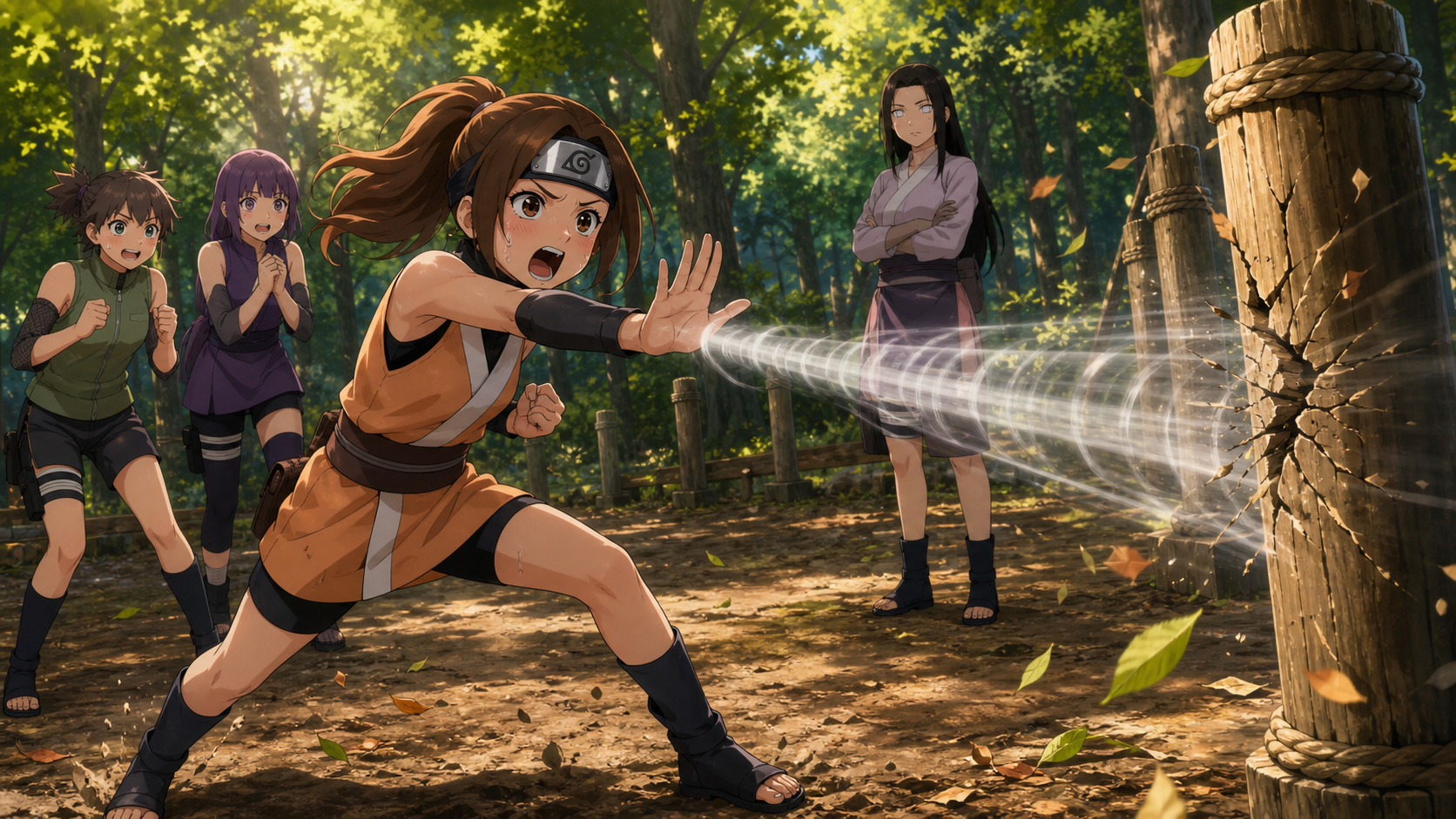
Namida deliberately brings the emotion forward and applies Hanabi's lessons to Calling on Tears. Chakra control, reach, and power finally belong to the technique that needed them most.
The sound narrows toward the gang leader instead of flattening every person in range. Namida does not erase her emotional nature. She gives that nature direction.
A focused scream frees everybody
The directed blast strikes the leader and breaks his concentration on the Earth Release. Sumire and Wasabi can move again. The merchants keep the historical document.
Namida's victory is tactical and personal at the same time. She protects the clients, avoids striking her friends, and proves that her strongest ability can answer a real battlefield need.
Nue and Wasabi finish the remaining gang
Sumire summons Nue, and the disappearance of the summon alerts Hanabi that the girls have encountered trouble. Wasabi and Nue attack the remaining criminals as they attempt to flee.
The finish belongs to the team. Namida creates the opening and saves everyone from the trap. Her friends convert that opening into control of the battlefield.
The second scream proves mastery is unfinished
Namida tries to use Calling on Tears again after spending too much chakra. Her concentration fails, and the wide blast knocks everybody out. Hanabi correctly concludes that her student still has a long way to go.
That mistake protects the episode from a fake perfect ending. Namida learned aim, not unlimited stamina. She must understand chakra cost and know when one successful strike is enough.
Team 7 hears a different victory story
Team 15 meets Team 7 again, and the familiar hearing problem returns. This time Namida can explain that her scream protected her teammates before the final overuse flattened them.
The distinction matters to her. Earlier, the technique ended the fight while making everyone collateral damage. Now the first controlled use was a deliberate rescue. Failure remains, but the shape of the failure has changed.
Namida's name does not have to be an insult
Namida means tears, and the episode builds the title around that identity. She spends much of the story wishing tears were not central to her power. By the end, the name carries discipline alongside emotion.
Sensitive characters are often told that strength begins when they stop reacting. Namida becomes stronger by learning what the reaction can do, where the force should go, and who must remain outside the line of fire.
Hanabi teaches the student she actually has
Hanabi never asks Namida to imitate Wasabi's speed or Sumire's bond with Nue. She identifies Namida's specific weakness and builds drills around control, distance, and force.
That approach makes her a good team leader. Strict training serves the student's real ability rather than the teacher's preferred personality. Hanabi expects Namida to grow without demanding that she become less recognizably Namida.
Friendly fire makes Namida's fear responsible, not ridiculous
Namida does not reject the scream because somebody teased her. She has evidence that uncontrolled range can injure Wasabi and Sumire while they stand beside her. A power that stops enemies by disabling allies is not ready for casual use.
That concern shows judgment. The mistake comes when shame pushes her to abandon the technique before exploring safer distance, aim, warning signals, and team positioning.
Responsibility should lead to accommodation and practice, not disappearance. Namida needs a method that protects her teammates while preserving the power capable of saving them.
Losing hearing changes how the whole team must plan
Wasabi and Sumire temporarily lose hearing after the first blast. The episode treats the effect as comic shock, but the mission consequence is serious. Verbal commands, warnings, and coordination can vanish in one attack.
Team 15 needs visual signals, safe zones, and a clear expectation for when Namida may use the scream. Those adjustments do not punish Namida. They make the team resilient enough to work with a technique everyone now understands better.
Accommodation belongs to group planning. The person with the unusual ability should not carry every adaptation alone.
Water Release looks respectable because nobody is afraid of the beginner version
Namida reaches for a conventional technique that feels controllable and shinobi-like. The choice offers relief from being known as the girl whose crying becomes a weapon.
The weak Water Release cannot meet the mission need simply because the technique looks more dignified. Respectability becomes another trap when Namida values how the skill appears over what the skill can currently do.
Learning new jutsu remains useful. Replacing a powerful ability solely to avoid embarrassment lets other people's comfort choose her arsenal.
Sumire gives advice without making herself the model Namida must copy
Sumire understands what living beside dangerous power feels like. Nue can protect the team and become a threat when chakra hunger or fear outruns control. She could easily turn that experience into a lecture about superior discipline.
Instead, Sumire suggests working with the power Namida already possesses. She offers comparison, not hierarchy. The message is that danger can be managed through knowledge and relationship rather than denied until everybody feels comfortable.
That support respects Namida as a teammate who needs tools, not a problem the calm girl must fix.
Hanabi trains the conditions around the scream
Hanabi does not waste time telling Namida to become less emotional. She studies the mechanics: breath, chakra concentration, distance, aim, pressure, and recovery.
That approach separates tears from failure. Crying may activate the technique, but control depends on what Namida does with the energy after activation. Emotion begins the process without dictating the result.
The drills make improvement measurable. A heavier target at greater distance tells Namida more than vague encouragement ever could.
Wasabi's teasing and loyalty occupy the same friendship
Wasabi is blunt enough to worsen Namida's embarrassment and loyal enough to train beside her, defend her, and trust the technique when the gang returns.
The friendship works because Wasabi is not polished into a perfect support system. She can be impatient, loud, and still present when Namida needs practical help.
The episode should let that tension remain. Loyalty does not erase careless words, and careless words do not automatically erase years of showing up.
Taking the shuriken proves courage before the scream proves power
Namida protects Sumire with her body before she knows whether the improved technique will work under pressure. That choice matters because courage cannot be measured only by successful jutsu.
She acts while frightened, gets hurt, and remains engaged in the rescue. The scream that follows is not a sudden personality replacement. The technique grows from the same protective instinct that placed her in the shuriken's path.
Namida does not become brave after crying. She cries because she has already chosen to stay.
The second uncontrolled scream keeps progress honest
After the focused blast saves the team, another scream reminds everyone that one successful use is not mastery. The joke lands because Namida has earned enough dignity for a mistake to remain a mistake rather than her entire identity.
Training must continue. Distance, fatigue, injury, surprise, and relief can all affect control. The episode gives her a victory without pretending that a single crisis completed the work.
That unfinished state matches the best Naruto growth. A breakthrough changes the next practice session. A breakthrough does not end practice.
Final reaction
Boruto Episode 96 takes a comic side character and gives her problem real weight. Namida can hurt friends while trying to save them. Shame makes her chase a replacement technique, and weak Water Release teaches her that respectable-looking safety is not automatically useful. Hanabi brings structure. Sumire brings experience with dangerous power. Wasabi brings loud, practical loyalty. Together they help Namida return to the ability she feared with better judgment.
The last uncontrolled scream is funny, but the joke no longer reduces her to tears. Namida aimed correctly when the team needed her most, freed her friends, and protected the First Hokage document. She earned progress through work and still has weaknesses worth training. Team 15 feels stronger because the episode lets all four women contribute to that growth.
Sources and lawful viewing
Official episode reference: Naruto Official episode guide
Licensed episode route: Crunchyroll licensed series page