
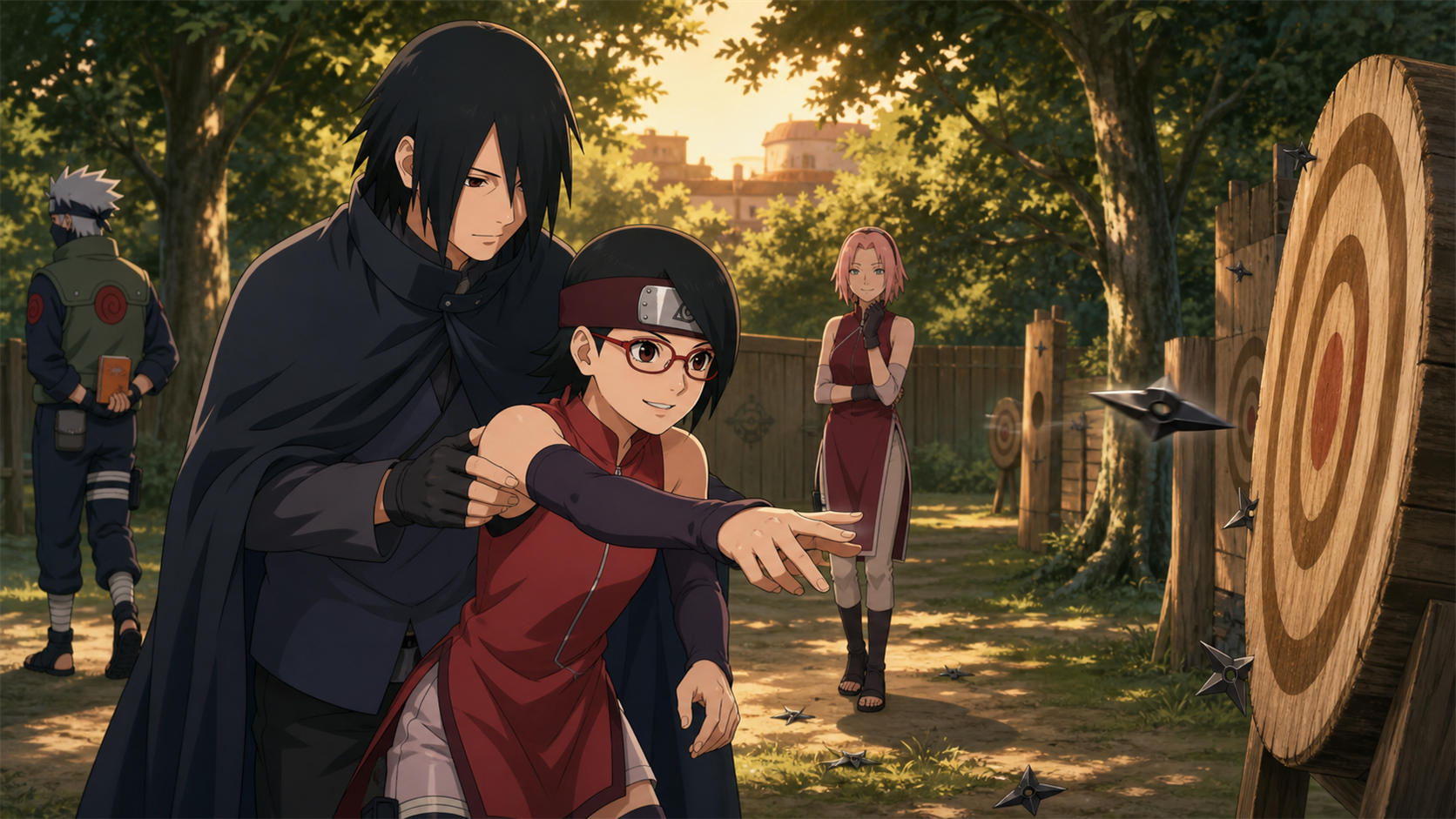
Tactics for Getting Along With Your Daughter
Sasuke knows how to read a battlefield. Sarada needs him to stop following somebody else's script and pay attention to the daughter standing in front of him.
Series: Boruto: Naruto Next Generations
Episode: 95 · Tactics for Getting Along With Your Daughter
Arc: Naruto Shinden
Release: 2019-02-24
Previous: Episode 94 · A Heaping Helping! The Eating Contest!
Directory: All 293 Boruto episodes
Bottom line
Boruto Episode 95 gives Sasuke Uchiha one of the most frightening assignments of his adult life: spend an ordinary holiday afternoon with his daughter. Sasuke can track enemies across dimensions, read a battlefield in seconds, and carry the weight of Konoha's ugliest history without asking anybody to make the burden smaller. None of those skills tell him what Sarada wants from her father on Parent and Child Day. He arrives home with love, guilt, and absolutely no practical plan. Kakashi makes the situation worse by offering courtship advice from Make Out Tactics. Sakura rescues Sasuke from the romance-novel foolishness by explaining what Sarada actually said. The episode finally lets father and daughter stop performing a generic version of closeness and return to the language they genuinely share: shuriken, training, ambition, and the quiet pride of being understood by another shinobi. Sarada does not need a festival routine copied from strangers. She needs Sasuke to know her well enough to meet her where she already stands. Boruto reaches the same conclusion with Naruto. The best Parent and Child Day gift is not a purchased object or staged memory. Both children ask their fathers to train, and both fathers finally give their children focused time without making the children compete with the rest of Konoha for attention.
Sasuke comes home after the holiday has already started
Sasuke returns to Konoha while Parent and Child Day fills the streets. Families are eating, shopping, taking pictures, and trying every event the village prepared. The holiday looks almost aggressively cheerful beside a man whose family memories include a coup, a massacre, a brother he loved and hated, and a father whose approval never came easily.
Boruto finds Sasuke before Sarada does and explains the celebration. Sasuke has not planned for the holiday because ordinary village life still happens beyond the edges of his long missions. His absence protects Konoha, but protection does not automatically create familiarity at home.
Boruto tells Sasuke where Sarada went
Boruto knows Sarada has been moving through the festival and gives Sasuke enough information to begin searching. Their exchange carries an amusing reversal. Boruto usually sees Sasuke as the impressive teacher who understands him better than Naruto does. Today Boruto has to explain basic family life to that same legendary shinobi.
The contrast does not make Sasuke fraudulent. A person can be brilliant in one relationship and lost in another. Sasuke understands Boruto through training because student and teacher have clear roles. Father and daughter come with years of missed mornings, unfinished questions, and affection neither Uchiha says comfortably.
Fugaku and Itachi shaped Sasuke's idea of a father
The holiday brings Sasuke's childhood back through memories of Fugaku and Itachi. Fugaku was a clan leader, police captain, father, and political figure whose private affection often disappeared behind expectations. Young Sasuke wanted his father's attention and measured himself against Itachi because achievement seemed like the surest road toward recognition.
Adult Sasuke has enough distance to remember the pain without reducing Fugaku to one emotion. Fugaku loved his sons. The Uchiha crisis, clan duty, and his own reserve made that love difficult for a child to read. Sasuke now faces the uncomfortable possibility that love can remain real while a daughter still experiences the father as absent.
Sarada wanted time, not a grand performance
Sarada spends the day looking for something simple. She wants her father present and interested. Sasuke hears the broad request but does not know the small details that turn shared time into her time. A festival offers dozens of ready-made activities, which should help. Instead, every option gives him another chance to copy somebody else's family.
The episode understands a familiar parental mistake. Adults sometimes panic after missing time and try to repair the gap through one perfect outing. Children usually notice the panic. Sarada would rather have an honest hour with Sasuke than watch him force himself through a script he barely understands.
Sasuke tries festival bonding like a mission checklist
Sasuke approaches the holiday with the concentration he would bring to reconnaissance. Find the objective. Gather intelligence. Select a tactic. Execute. The method works against enemy movement because enemies do not need him to relax and talk naturally.
Sarada can feel every calculated step. Sasuke's effort matters, and her embarrassment does not erase that effort. Still, affection becomes awkward when every gesture arrives from a manual instead of their relationship. She wants her father, not a highly trained operative impersonating a cheerful festival dad.
Kakashi should never be anybody's romance adviser
Kakashi finds Sasuke struggling and offers advice drawn from Make Out Tactics. The former Sixth Hokage has read those books across wars, missions, memorial visits, and nearly every inappropriate public setting available. His loyalty to the series does not make the material a parenting guide.
The joke works because Sasuke listens with deadly seriousness. He needs help badly enough to consider a romance novel as field intelligence. Kakashi sees a social problem, reaches for his favorite text, and forgets that Sarada is Sasuke's child rather than a date who needs to be impressed.
Generic tactics make Sasuke look less like himself
Following borrowed advice pushes Sasuke toward behavior Sarada does not recognize. The result feels false because closeness depends on memory and attention. A gesture that delights one person can embarrass another. A line that works in a book can sound absurd coming from a father who usually communicates through one raised eyebrow and a quiet correction of fighting form.
Sarada is not rejecting affection. She is rejecting affection translated through somebody else's fantasy. Her discomfort tells Sasuke that good intentions do not excuse ignoring the person directly in front of him.
Sakura understands both sides without babying either one
Sakura finishes work and returns to a family situation shaped by two reserved Uchiha trying not to admit they are disappointed. She does not tell Sarada to accept any clumsy gesture because her father came home. She also does not mock Sasuke for needing help. Sakura provides the missing context.
Sarada had talked about eating takoyaki and spending time together. Those details matter because Sakura listened. Sasuke learns that successful family time is built from knowledge gathered during ordinary conversations, not from a universal tactic pulled out during an emergency.
Sakura carries the household history Sasuke keeps missing
Sakura knows Sarada's habits, moods, school concerns, friendships, and current ambitions because she remains physically present. Sasuke's missions are necessary, yet necessity does not give him the daily information Sakura accumulates. The episode lets that imbalance remain visible without turning the marriage into a simple villain story.
Sakura becomes the bridge because she has spent years translating love across absence. Her advice is practical: stop trying to act like another father and connect through something Sasuke and Sarada already care about.
Sarada chooses shuriken over another forced activity
Sarada plans to practice shuriken with Boruto. Training may sound like work on a holiday, but training is personal for her. She wants to become Hokage. Every correction, repetition, and successful throw belongs to the future she has chosen.
Sasuke finally sees the opening. He does not need to invent a new personality. He can share hard-earned Uchiha skill with a daughter eager to learn. Training offers structure without pretending, and both people understand what focused silence means.
The Uchiha bond lives in attention to small movements
Sasuke guides Sarada's stance, grip, timing, and release. The lesson gives him a reason to watch carefully, and Sarada receives the full attention she wanted from the beginning. A tiny adjustment says more than Kakashi's recycled lines because the correction belongs specifically to her body and her goal.
Sarada can also challenge Sasuke inside this shared language. She is not a passive child receiving a sentimental speech. She throws, learns, tries again, and demonstrates who she is becoming. Sasuke responds to the person before him rather than the daughter imagined during months away.
Training does not excuse Sasuke's absence
One good session cannot replace every missed meal, school event, illness, question, or quiet evening. The episode wisely avoids pretending Parent and Child Day repairs the whole family history. Sasuke still has to leave. Sakura still carries more of the daily parenting. Sarada will still want answers about his choices.
The training session matters because Sasuke begins with honesty. He offers something real and pays attention to Sarada's response. Repeated honest moments could build trust. A festival performance would have given them one photograph and the same old distance.
Sarada recognizes what Boruto actually wants
After finding a better rhythm with Sasuke, Sarada looks at Boruto's frustration with Naruto more clearly. Boruto has spent much of the day watching other families receive the father he wants. Naruto belongs to everybody as Hokage, which often leaves Boruto feeling like the village gets the best parts while home receives leftovers.
Sarada encourages him to say what he wants directly. Her advice grows from the lesson she just lived. Parents may love their children deeply and still miss an obvious request. Children should not carry all responsibility for communication, but Boruto has a chance to name the need instead of testing Naruto through anger.
Naruto apologizes without hiding behind the Hokage title
Naruto meets Boruto after another day of divided attention and offers an apology. The Hokage's work explains his absence. The title does not cancel Boruto's disappointment. Naruto has spent a lifetime wanting family, which makes his struggle especially painful. He achieved the office and household he dreamed about, then discovered that serving one can injure the other.
An apology matters because Naruto acknowledges the cost rather than asking Boruto to admire the sacrifice. Boruto already knows his father is important. He needs proof that his own time matters too.
The gift is kind, but Boruto asks for training
Naruto gives Boruto a present, trying to mark the holiday with something tangible. Boruto accepts the care behind the gift but asks for a training session. The request sounds modest. For him, focused training means Naruto sees his growth, answers his questions, and chooses to remain beside him for a while.
Boruto has watched Sasuke make instruction feel personal. He wants that same direct connection with his own father. Training becomes a language the Uzumaki family can share without requiring Naruto to become a different man.
Both fathers know combat better than conversation
Sasuke and Naruto grew up preparing for conflict. Neither man had a healthy, ordinary father-child routine to copy. Naruto had no parents present. Sasuke lost his family before adolescence and spent years rebuilding his understanding of Fugaku, Itachi, and the clan.
Their children inherit love from men who never learned domestic intimacy through example. That history explains the awkwardness without excusing neglect. Naruto and Sasuke now have to learn skills their own childhoods could not teach them.
Parent and Child Day exposes Konoha's uneven labor
The holiday celebrates parents, yet the festivities also reveal who performs daily care. Hinata, Sakura, Karui, and other mothers know the details behind meals, schedules, moods, clothes, training, and school. Fathers who arrive for one special event can look heroic without carrying the same invisible preparation.
Episode 95 keeps the focus on Sasuke, but Sakura's role prevents the story from pretending his breakthrough appeared alone. She worked, listened to Sarada, understood the failed outing, and gave Sasuke the knowledge he needed. His success rests partly on labor Sakura has been doing all along.
Make Out Tactics becomes the perfect bad manual
Kakashi's book supplies comedy, but the gag also makes the episode's argument plain. No manual can replace knowing another person. Fiction may offer language for feelings, yet copied gestures fail when the reader skips context.
Sasuke wants certainty because missions reward preparation. Parenting rarely offers a clean correct move. Sarada changes, circumstances change, and the same daughter may want conversation one day and quiet practice the next. Knowing her requires ongoing attention rather than one successful tactic.
Sarada is allowed to be embarrassed and grateful
Sarada does not have to react with perfect appreciation merely because Sasuke tries. She can cringe at his borrowed behavior, feel hurt by his uncertainty, and still recognize the love underneath his effort. Those reactions belong together.
The episode gives her enough agency to redirect the relationship. She shows Sasuke which version of time together feels genuine. Their connection improves because he listens to that feedback instead of demanding praise for showing up.
Sasuke's quiet pride lands better than a speech
During training, Sasuke can see Sarada's discipline and potential. He does not need a long declaration about fatherhood. His attention, correction, and willingness to remain beside her carry the emotion. Sarada understands praise through the seriousness he gives her effort.
That restraint fits both characters. A louder emotional scene might satisfy viewers for a minute, but quiet concentration belongs to the Uchiha family on this particular day. The episode finally stops pushing them toward somebody else's version of warmth.
Boruto and Sarada solve the same problem differently
Sarada needs Sasuke to connect through something familiar. Boruto needs Naruto to choose a piece of time that belongs only to them. Both children reject surface-level festival solutions and ask for participation.
Their friendship helps each family. Boruto gives Sasuke information about Sarada. Sarada gives Boruto the push to speak plainly with Naruto. The children are not merely waiting for adults to understand them. They compare experiences, notice what the other cannot see, and carry useful truth across two households.
The episode earns its softness
Parent and Child Day could have become empty fan service built from cute outfits and famous fathers acting awkward. Episode 95 earns the warm ending by letting embarrassment last long enough to reveal the real problem. Sasuke's love was never missing. Knowledge, presence, and practice were missing.
The final training moments feel gentle because nobody claims the families are fixed. Sasuke and Naruto simply make better choices once their children tell them what focused attention should look like. A small honest choice suits a holiday devoted to relationships built through repetition.
Sasuke cannot inherit a healthy fatherhood model from Fugaku
Fugaku loved his family inside a clan structure built from pressure, secrecy, rank, and expectations Sasuke barely understood as a child. Praise arrived through performance. Emotional safety never had enough time to become routine before massacre erased the household.
Sasuke enters fatherhood without ordinary memories to copy. That history explains why affection becomes instruction and observation before becoming conversation.
Explanation is not exemption. Sasuke has access to Sakura, Sarada, Naruto, Kakashi, and years of evidence about what absence costs. A broken model makes learning harder. A broken model does not remove the obligation to learn.
Sarada should not have to translate love into a format Sasuke recognizes
Sasuke understands training, missions, sacrifice, and quiet vigilance. Sarada understands those languages too, but she also wants a father who knows what she likes before a national holiday forces the question.
The child should not carry the full burden of converting emotional needs into combat terminology. Choosing shuriken practice works because Sarada genuinely enjoys the activity, not because every future conversation should require a weapon.
Sasuke needs to expand his vocabulary of care. Sarada should not have to shrink her needs to fit the words he already knows.
Sakura performs the invisible work that makes reunion possible
Sakura knows Sasuke's history, Sarada's expectations, the household schedule, the emotional weather, and the exact moment each person needs honesty instead of defense. That knowledge did not appear for free.
She has maintained the home while Sasuke traveled, answered questions his absence created, and preserved enough trust that father and daughter still want a relationship. The episode uses her insight efficiently, but the family should recognize the labor behind that efficiency.
Sakura is not a bridge that exists naturally between two Uchihas. She is a person doing years of relational work while both of them benefit.
Generic festival bonding fails because attention cannot be outsourced
Sasuke follows borrowed tactics because a checklist feels safer than risking a specific mistake. The result becomes more awkward than honest failure would have been.
No manual can tell him which activity Sarada wants, what embarrassment looks like on her face, or how she responds when praise arrives too loudly. Those answers require memory built through presence.
The comedy works because Sasuke can read enemy movement faster than he can read his daughter. Fatherhood asks him to study without treating Sarada like a target.
Training becomes intimate when Sasuke pays attention to Sarada
Shuriken practice is not meaningful simply because both characters are Uchiha. The scene works because Sasuke watches Sarada's form, understands the adjustment she needs, and responds to the person in front of him.
The same activity could become cold if used to avoid conversation or measure worth. Here, Sarada chooses the setting, Sasuke follows her lead, and pride emerges from shared concentration.
Training becomes family time because attention changes the purpose. The technique is familiar. The presence is new.
Naruto's apology matters because authority cannot replace availability
Naruto has legitimate Hokage duties and a village that depends on him. Boruto still experiences each missed promise as a father choosing work over their relationship.
Apologizing without hiding behind the title tells Boruto that the hurt counts even when the absence had a public reason. Naruto does not need to pretend the job was meaningless. He needs to stop treating importance as an automatic defense.
Boruto asking for training gives Naruto a clear way to respond. The request is not permission to return to autopilot. Focused time means the Hokage has to arrive as a father.
Sarada and Boruto ask for attention without asking their fathers to become identical
Sarada wants Sasuke to connect through the skills and history they share. Boruto wants Naruto to stop compensating with gifts and spend direct time teaching him.
Both children reject performance, but their preferred connection remains personal. The episode does not produce one universal parenting tactic after mocking Kakashi's manual.
Listening is the common method. The actual activity depends on the child, which is exactly why a generic book could never solve the problem.
Final reaction
Boruto Episode 95 is funny because Sasuke treats fatherhood like an unfamiliar mission and Kakashi responds with the worst possible intelligence source. The comedy never erases Sarada's hurt. She has a father she admires, a father who loves her, and a father who remains absent enough to misunderstand a simple afternoon. All three facts can coexist.
Sakura gives the episode its practical center. She knows that Sasuke cannot repair distance by copying a romance novel. Sarada gives the episode its direction by choosing training over theater. Boruto carries the lesson home by asking Naruto for the same kind of undivided attention. The parents do not become perfect. They become present, specific, and teachable. For these families, that is a meaningful Parent and Child Day.
Sources and lawful viewing
Official episode reference: Naruto Official episode guide
Licensed episode route: Crunchyroll licensed series page