
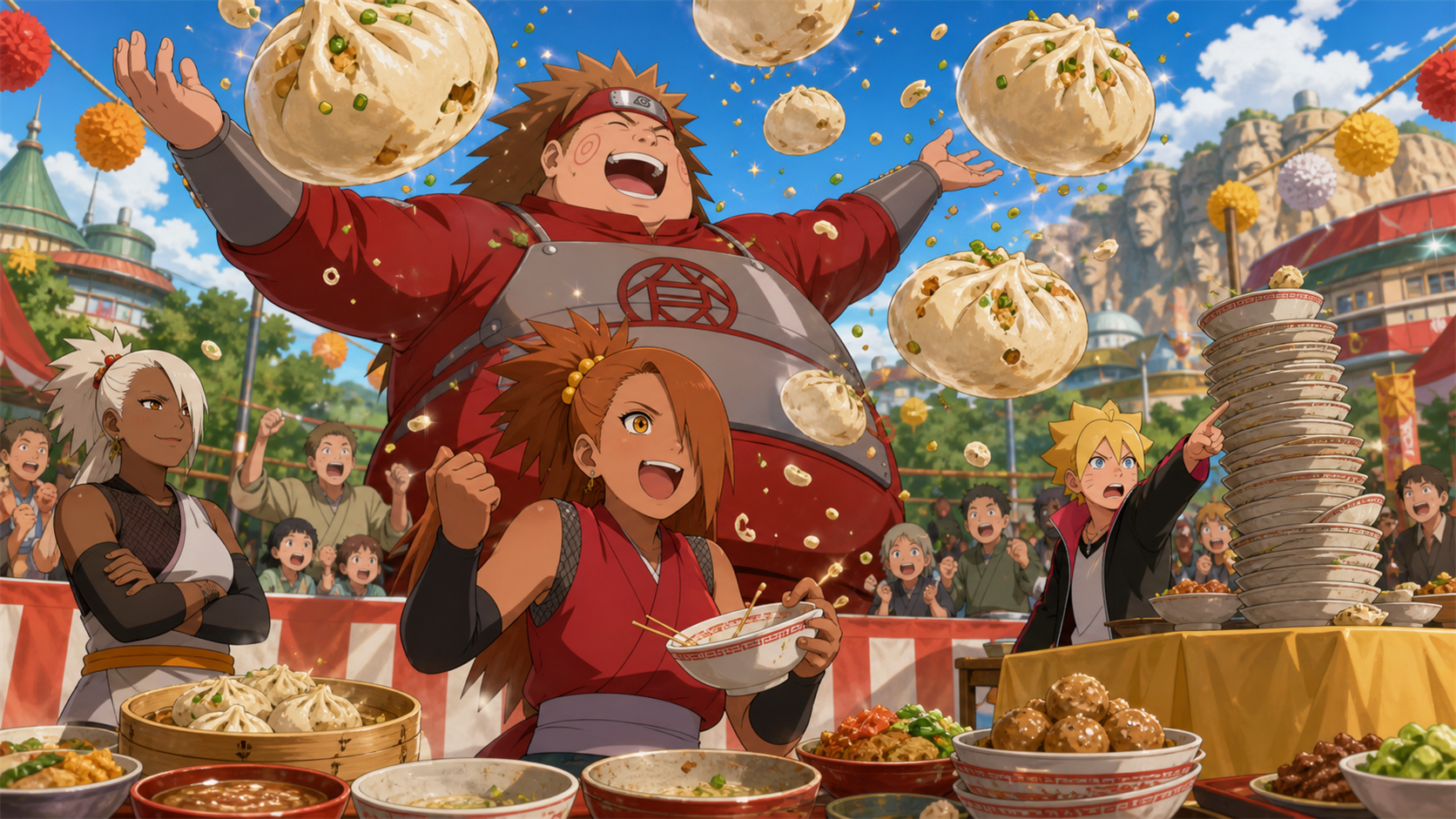
A Heaping Helping! The Eating Contest!
Choji thinks eating can prove why Karui married him. The contest only works when he remembers that food, labor, and family joy were supposed to be shared.
Series: Boruto: Naruto Next Generations
Episode: 94 · A Heaping Helping! The Eating Contest!
Arc: Naruto Shinden
Release: 2019-02-17
Previous: Episode 93 · Parent and Child Day
Directory: All 293 Boruto episodes
Bottom line
Boruto Episode 94 wraps a ridiculous eating contest around a painfully ordinary marriage argument. Chōji eats the snacks Karui bought for both of them, asks her to replace the food he consumed, and gets thrown out of the house with Chōchō. Chōchō decides an eating contest can prove her father is still the man Karui married, which is already funny because competitive consumption caused the argument. The contest organizers make everything worse by rigging bowls against the Akimichi, fearing that Chōji will bankrupt the sponsoring restaurant by winning a year of free food. Boruto spots the cheating. Chōchō and Chōji rediscover that food means connection when shared, not when one person empties the cupboard alone. Then the frightened organizer escalates through Mochi Release and sends giant dumplings across the arena, giving Chōji the chance to save everyone by doing what he does best on an absurd scale. Karui is not won back by appetite alone. She responds to Chōji protecting people, listening to Chōchō, and remembering that the pleasure of food was always tied to sharing with her. The family does not need Chōji to become thinner, cooler, or somebody else's version of masculine. The family needs him to stop treating communal snacks and emotional labor as automatically replenished resources.
The conspiracy begins before the family arrives
Local restaurant owners discuss the Parent and Child Day contest with dread because Chōji Akimichi might enter. The prize, a year of unlimited Ankorodō sweet bean soup with dumplings, becomes financially terrifying when the customer can eat at Akimichi scale.
The fear could have led to a sensible prize limit. Instead, adults begin planning public humiliation. Comedy villains love making accounting problems into crimes.
Chōji channel-surfs through the holiday announcement
At home, Chōji watches television, changes channels, and keeps eating. Parent and Child Day passes through the room as background noise while his attention stays on snacks.
The scene makes him look comfortable rather than malicious. Comfort becomes the problem because other people keep maintaining the comfort he barely notices.
Karui bought those snacks to share
Karui discovers that Chōji ate the food she purchased for both of them. The conflict is not really about chips. He consumed a shared plan without checking and then asked her to replace the supply.
Her anger comes from being treated like the household refill function. Chōji experiences snacks as available. Karui remembers the shopping, intention, and anticipation attached to them.
Chōchō asks why her parents married
Watching the argument, Chōchō asks Karui why she chose Chōji. Karui cannot produce a clean romantic answer in the middle of irritation.
That hesitation alarms Chōchō because children often interpret one bad moment as evidence about the whole relationship. She decides the marriage needs proof immediately.
Getting thrown out is not the lesson yet
Karui sends Chōji and Chōchō away after Chōji asks her to buy more chips. He receives the consequence without understanding the underlying labor.
Chōchō understands enough to know he needs to show Karui something different. Her solution is wonderfully misguided: prove character through eating more.
Boruto walks into an Akimichi family strategy meeting
Father and daughter encounter Boruto and explain the situation. He becomes the outside observer who can see both the comedy and the stakes.
Boruto knows what parental disappointment feels like, but he also knows public stunts rarely replace the conversation a family avoids.
The contest looks like a perfect redemption stage
Chōchō spots the Parent and Child Day eating contest advertisement and imagines Chōji winning in front of Karui. His legendary appetite can become heroic evidence instead of the reason he is sleeping elsewhere.
The plan appeals to Chōji because the repair appears to require no new skill. He can eat his way back into the house.
Konoha turns family time into bracket competition
Parents and children across the village enter, including pairs who do not look like professional eaters. Sai and Inojin, Rock Lee and Metal, Shikamaru and Shikadai all bring different family dynamics to the same table.
The bracket makes Parent and Child Day visible, but also encourages families to perform closeness through victory. Nobody can simply enjoy lunch anymore.
The Dōtonbori pair provides convenient rivals
The Dōtonbori team matches the Akimichi pace and boasts through the rounds. Their confidence gives Chōchō a visible opponent while the real opposition hides among the organizers.
Rivalry is easier to understand than a system quietly changing the conditions beneath the bowls.
Shikamaru and Shikadai advance through efficiency
The Nara pair survives the rounds without trying to imitate Akimichi volume. Their presence reinforces that family teams can solve the same contest through different rhythms.
Shikadai has just returned from Iwagakure. A silly competition beside his father becomes part of the ordinary life the previous episode promised.
Karui watches a performance she never requested
Karui reaches the audience and questions the entire spectacle. She did not ask Chōji to win a trophy. She wanted him to respect something they planned to share.
Chōchō's strategy is loving but translates her mother's need into a challenge her father prefers.
The shallow bowls expose adult cheating
An organizer supplies the Dōtonbori pair with shallower bowls so their portions look equal while requiring less food. The trick exploits presentation.
Cheating through bowl depth is hilariously petty and genuinely unfair. The contestants agreed to compete on visible rules. The adults altered the measurement because they disliked the likely winner.
Boruto checks the container, not only the food
Boruto notices the suspicious bowls and swaps or exposes them. His role fits the child who has spent the series learning that tools and appearances can hide an advantage.
He does not need to enter the contest to affect the outcome. Watching carefully protects the people doing the work.
Chōchō cannot finish everything alone
During the final stretch, Chōchō reaches a limit. The girl proud of her appetite confronts the same truth her father ignored at home: food meant for two people becomes a burden when one person has to manage everything.
The physical gag carries the family metaphor without becoming subtle, and subtlety would be wasted on a dumpling tournament.
Karui shouts the missing point
Karui reminds them that good food is meant to be shared. Her line gives Chōji the actual answer behind the snack argument.
Sharing means leaving some for another person, noticing their anticipation, and participating in replenishment. Eating beside somebody is not enough when their portion disappears first.
Chōji and Chōchō recover as a team
Father and daughter find a new rhythm once the contest becomes shared effort instead of Chōji's solo demonstration. Chōchō does not need him to prove that she should admire him. She needs him to participate with her.
The team works because both appetites count and both people remain visible.
The organizer chooses ninjutsu over accepting defeat
Once the bowl scheme fails, the desperate cook uses Mochi Release to create an impossible wave of dumplings. Financial anxiety becomes a public safety event.
The escalation is nonsense, but the motive remains recognizable. Someone frightened by a fair outcome keeps changing the rules until the attempt to avoid loss creates a larger loss.
Giant dumplings finally give Chōji a heroic appetite problem
Enormous dumplings threaten contestants and spectators. Chōji expands, catches the food, and eats through the danger while converting calories into chakra.
For once, eating more is exactly the responsible answer. Context saves the talent from becoming a punchline.
Chōji protects the crowd instead of his pride
The decisive action is not about humiliating rivals or impressing Karui through volume. He protects families who came for a holiday event.
Karui sees the qualities behind the appetite: courage, generosity, and willingness to use his body for others.
Karui remembers the man inside the habit
The episode does not claim that one rescue deletes Chōji's selfish snack behavior. The crisis reminds Karui why the relationship contains more than the irritation of one afternoon.
Love can survive annoying habits while still requiring those habits to change.
Chōchō should not manage the marriage alone
Chōchō spends the day engineering a reconciliation between her parents. Her plan works because comedy protects everyone, but children should not become household relationship managers.
Chōji and Karui need to speak directly after the contest. Winning gives them a better mood, not a substitute for conversation.
The Akimichi body is power, appetite, and culture
The episode lets Chōji and Chōchō enjoy food without framing appetite as a moral failure. The problem is not eating. The problem is cheating, hoarding, and ignoring another person's share.
Their family techniques convert calories into chakra. Food is part of ability, pleasure, and identity. Respecting that context matters more than making them fit a generic health lecture.
Boruto becomes the fairness witness
Boruto's attention to the bowls ensures the Akimichi are judged on the actual contest. He uses suspicion productively without stealing the family's conclusion.
Chōchō and Chōji still have to eat, cooperate, and respond when the dumplings attack. Boruto clears the hidden thumb from the scale.
Parent and Child Day reveals different families
Episode 93 focused on a father trying to become present for a daughter. Episode 94 focuses on a daughter trying to remind her parents why their partnership works.
The holiday does not produce one model of family connection. Each household brings a different mess into public celebration.
Shino and the holiday toy connect the comedy
Boruto notices Shino with a Kurama doll in the audience, carrying the toy chaos from Naruto and Himawari's search into the next family story. The village holiday has become a web of small objects and private meanings. One family spends the morning chasing a plush. Another spends the afternoon trying to repair a marriage through bowls.
Shino's quiet presence is funny because the adult Academy teacher looks like another collector caught in the retail event. The detail also keeps Konoha feeling inhabited. Episodes do not occur in sealed rooms. People from one story wander through another person's day with souvenirs, gossip, and their own reasons for showing up.
Winning does not restock the cupboard
The contest gives Chōji a public chance to show courage, but the private repair still waits at home. Shared snacks will need replacing. Karui deserves an apology that names the specific problem. Chōji should be the person visiting the shop this time.
That imagined follow-through matters because anime comedy often ends once the angry wife smiles. Karui's anger was not irrational noise blocking Chōji's fun. She named a pattern where her effort became invisible. Chōji can remain the joyful eater Karui married while becoming more attentive to what belongs to both of them. Love does not require removing appetite. Love requires remembering who else expected a portion.
Shared food carries an agreement even when nobody labels the shelf
Karui bought snacks for the household and expected to share them. Chōji sees available food and follows appetite without checking who purchased the food or who still expected a portion.
The problem is not that married people need formal contracts for every bag. The problem is a repeated assumption that someone else's planning will refill whatever disappears. Karui performs the shopping, remembers the family, and then discovers that her own share never survived long enough to become hers.
Consent applies to ordinary resources too. Sharing once does not create permanent permission to consume everything first.
Chōchō becomes a marriage mediator because the adults leave the gap open
Chōchō loves both parents and wants proof that their relationship remains strong after the argument. She should not need to design the repair, coach Chōji, or translate Karui's disappointment into a heroic challenge her father will accept.
Children often enter family conflicts because silence feels more frightening than responsibility. Chōchō believes a public victory can restore the marriage because the adults have not yet shown her what a direct apology looks like.
Her intervention is funny and emotionally believable. The repair still belongs to Chōji and Karui.
Karui did not marry Chōji because he could win an eating contest
Chōchō asks why her parents married and receives an episode-long demonstration instead of a useful answer. Appetite may have been part of the man Karui loved, but appetite alone does not build a partnership.
Karui remembers loyalty, courage, warmth, and the man willing to place himself between danger and other people. The eating contest matters only when Chōji stops performing consumption and uses his strength to protect the crowd.
The episode recovers the answer accidentally. Karui loves a whole person whose appetite can express joy, culture, and care when attention accompanies the food.
The Akimichi relationship with food is not a disposable fat joke
Food supports the clan's techniques, communal rituals, family identity, and pleasure. Chōji's body is not a visual punishment for eating. His size and appetite connect directly to a power system the franchise has repeatedly shown as disciplined and formidable.
Comedy becomes cheap when every bite invites the audience to treat him as uncontrolled. Episode 94 works better when eating becomes skill, stamina, teamwork, and eventually public protection.
Chōji still behaves selfishly with the shared snacks. Criticizing that choice does not require treating his body or appetite as the moral failure.
Konoha turns family connection into another public performance
Parent and Child Day creates time for relationships, then the village fills that time with merchandise, contests, crowds, and opportunities to compare one family against another.
The eating bracket gives Chōji and Chōchō a shared activity, but the public stage also lets them avoid the private conversation waiting at home. Winning becomes attractive because a trophy looks easier than naming a household pattern.
Family time can include spectacle. Spectacle cannot perform the apology after everybody leaves.
Shikamaru and Shikadai show that efficiency can be intimacy
The Nara pair approaches the contest with planning, timing, and minimal wasted motion. Their style contrasts with the Akimichi emphasis on capacity without presenting one family as more loving.
Shikamaru recognizes how Shikadai thinks, and Shikadai works comfortably inside that rhythm. The strategy itself becomes evidence of attention built through repeated time together.
Their advancement reminds the episode that parent-child connection has no single correct volume. Some families bond through shouting and giant dumplings. Others bond through quietly solving the bracket.
Cheating works because the organizer controls what spectators can see
Shallow bowls reduce the challengers' food while preserving the appearance of equal portions. The trick turns a rigged system into a story about personal failure.
Boruto checks the container because the visible result does not match the physical evidence. That habit matters beyond one contest. Fairness requires inspecting rules, materials, and incentives rather than assuming the winner proves the system worked.
The organizer's later use of ninjutsu reveals the same entitlement. When control of the rules stops guaranteeing victory, he changes reality instead of accepting the outcome.
Karui's anger does not need softening to become legitimate
Anime family comedy often gives the wife a burst of anger, lets everyone call the reaction scary, and skips the behavior that produced the anger. Karui deserves better than becoming the obstacle between Chōji and another meal.
She purchased something with both people in mind and found that consideration was not returned. The anger identifies unequal attention inside an otherwise loving marriage.
Karui can love Chōji and remain furious. Affection does not require smiling quickly enough to protect him from discomfort.
Chōji protects the crowd through the same appetite that caused conflict
The giant dumplings turn consumption into emergency response. Chōji expands, catches the threat, and uses the body everyone has been watching for comedy to prevent injury.
The reversal does not mean eating all the shared snacks was secretly good. The same trait can function differently depending on context, consent, and purpose.
Appetite used without attention creates resentment. Appetite disciplined toward protection becomes Akimichi strength. Chōji's growth comes from learning which situation he is actually in.
Chōchō cannot finish the challenge for both parents
Chōchō reaches her limit and needs Chōji to respond as a teammate. That moment works inside the contest and echoes the family problem outside the contest.
A child cannot supply enough effort to repair a marriage on behalf of two adults. Chōchō can speak, ask questions, and reveal what the conflict does to her sense of security. She cannot consume the entire emotional workload.
Chōji and Karui must finish the private part together after the public competition ends.
An apology needs replacement and changed behavior
Chōji recognizing Karui's hurt is the beginning of repair. The next steps should remain wonderfully ordinary: replace the snacks, ask before finishing shared food, remember Karui while shopping, and notice the pattern before Chōchō has to announce another family emergency.
Grand gestures feel emotionally efficient because one dramatic act can close an episode. Household trust grows through repetition instead. Karui needs evidence that consideration will survive after the crowd, trophy, and giant dumplings disappear.
The practical follow-through does not make the marriage less romantic. Remembering another person's portion is one of the small ways love becomes visible on a normal day.
Chōji also has an opportunity to show Chōchō what repair looks like between adults. He can apologize directly, replace what he consumed, and avoid making his daughter responsible for persuading Karui to forgive him. That example will teach more about marriage than any story built around one spectacular contest victory.
Quick reaction
Episode 94 is ridiculous, and I mean that affectionately. A marriage argument about shared snacks becomes a village eating bracket, a shallow-bowl conspiracy, and a Mochi Release emergency requiring giant Chōji to save the crowd by eating the threat. The comedy works because the emotional problem remains ordinary. Karui did not need Chōji to prove that his appetite was impressive. She needed him to remember that something purchased for them belonged to both of them. Chōchō understands the importance of the relationship but chooses the solution most flattering to her father. The contest eventually teaches the right lesson through an absurd route: food is joy when shared, strength when used to protect, and resentment when one person assumes somebody else will keep replacing what he consumes. Chōji earns Karui's smile through more than volume. He becomes attentive to the people at the table.
Sources and lawful viewing
Official episode reference: Naruto Official episode guide
Licensed episode route: Crunchyroll licensed series page