
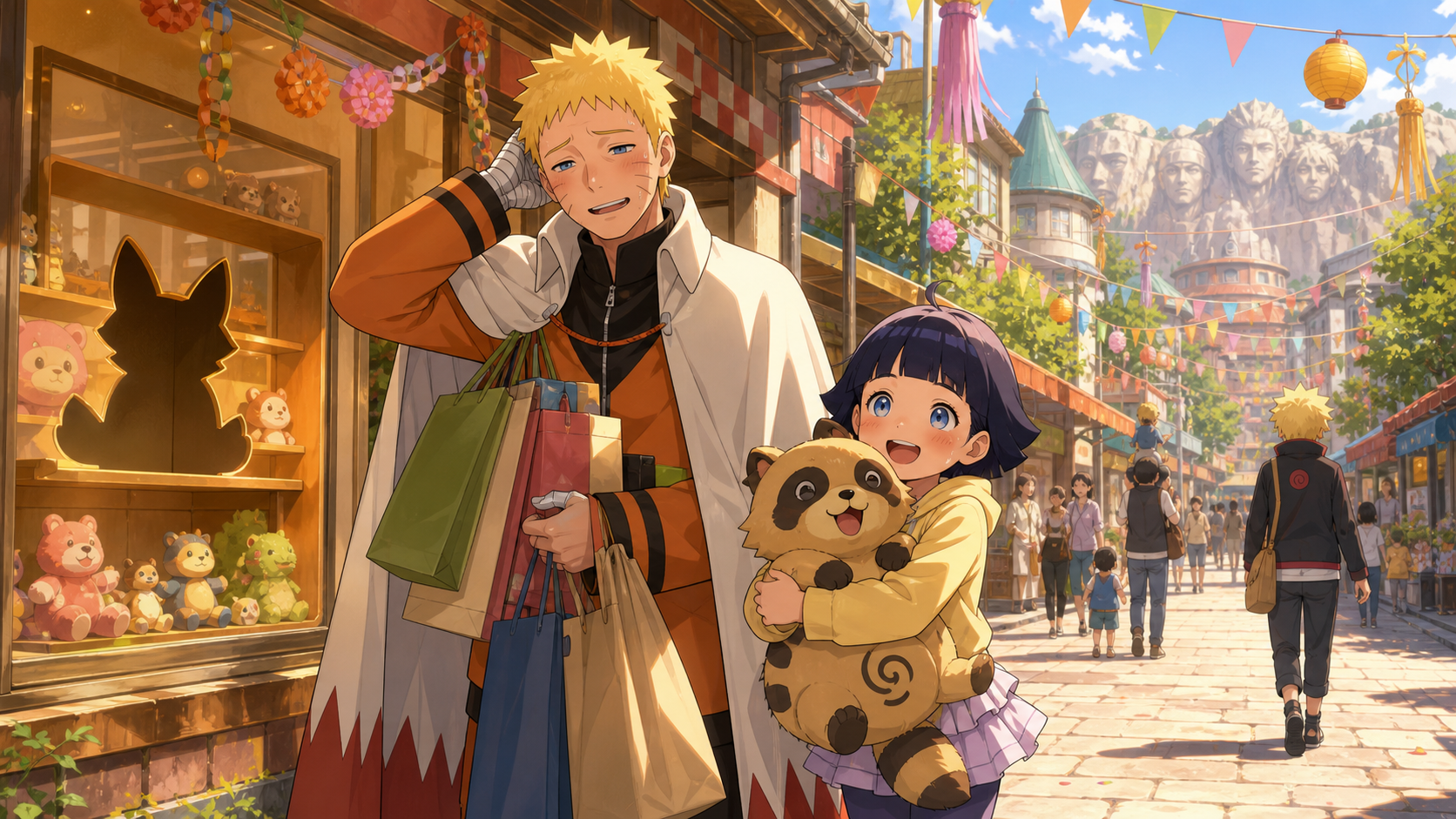
Parent and Child Day
Naruto thinks the holiday depends on finding the right plush. Himawari remembers the parent who stayed beside her after every shop said no.
Series: Boruto: Naruto Next Generations
Episode: 93 · Parent and Child Day
Arc: Naruto Shinden
Release: 2019-02-10
Previous: Episode 92 · A New Ordinary
Directory: All 293 Boruto episodes
Bottom line
Boruto Episode 93 gives Naruto a village holiday designed to solve a problem his family has been living for years: important work keeps eating the time parents promise their children. Naruto finishes an all-night stack of approvals, comes home exhausted, and still follows Himawari across Konoha searching for a sold-out limited Kurama plush. Boruto quietly gives his sister the day by claiming he wants to train. That generosity deserves more attention than the episode gives him. He wants time with Naruto too. He has simply learned to step aside when Himawari's disappointment feels more urgent. Naruto spends the day mistaking a Shukaku toy for the fox she requested, racing Kiba, confronting a shinobi who abandoned a mission for the same plush, and slowly discovering that the perfect purchase matters less than the shared effort. Himawari lets the other father keep the last toy for his son and embraces the accidental Shukaku instead. The holiday succeeds because she gets Naruto's attention, not because consumer scarcity produces the correct souvenir. The episode is warm and funny, but the warmth does not erase the underlying problem. Naruto had to work through the night to qualify for one day with his children. A holiday can reveal family labor. A holiday cannot replace structural change.
Konoha invents a holiday for a peace-era problem
Parent and Child Day exists because modern Konoha finally recognizes that parents need protected time with their children. That sounds obvious until you remember the world Naruto inherited. Earlier generations often lost parents to missions and war before anyone could argue about work-life balance.
Peace changes what a village is allowed to notice. Survival is no longer the only family goal. Presence matters.
Naruto and Shikamaru know the village changed
Naruto and Shikamaru watch the holiday announcement and reflect on how different shinobi life has become. Their childhoods were shaped by absent or dead parents, clan expectations, and emergency.
The holiday represents progress, but both men are now adults whose public responsibilities can reproduce absence through bureaucracy instead of battle.
Shikamaru tries to clear Naruto's schedule
Shikamaru intends to protect Naruto's day off. The plan collapses when shopkeepers arrive with forms requiring Hokage approval.
The requests may be mundane, but mundane work still consumes hours. Naruto's office has become a bottleneck because too many decisions wait for one signature.
Naruto works all night to earn one morning
Naruto completes the paperwork instead of pushing the burden onto tomorrow. By the time he reaches home, exhaustion is visible.
The effort is loving and unsustainable. His family receives a body that technically arrived while rest remains somewhere else.
Boruto is happy before choosing to leave
Boruto genuinely wants Naruto home. Their relationship has improved since the Chūnin Exams, and the excitement shows that the desire for ordinary father-son time never disappeared.
He sees how long Himawari waited and decides to give her priority. The choice is kind. The choice also reveals how often Boruto calculates which family member can afford to ask for Naruto.
Training becomes Boruto's polite excuse
Boruto says he is going to train alone. Naruto is confused, but the excuse lets Boruto leave without turning generosity into a performance.
Older siblings often create space by pretending they do not need anything. Adults should not mistake that performance for absence of need.
Himawari waited on the floor
Himawari fell asleep waiting for Naruto. The image contains the entire family problem without a speech. She trusted he would come and tried to remain awake long enough to receive the day.
Naruto sees the cost of delay in a child curled up near the promise.
The limited Kurama plush becomes the mission
Himawari wants the special holiday version of a Kurama toy. Naruto treats the request like a mission objective: locate target, obtain target, make child happy.
That approach is familiar and slightly wrong. Parenting cannot always be solved through successful acquisition, but the search gives them time together.
Naruto confuses Kurama with Shukaku
Naruto buys or considers the wrong tailed-beast toy, confusing the requested fox with a tan Shukaku plush. The joke works because Naruto knows both beings personally and still fails the toy-store test.
Himawari notices the difference immediately. Children are experts in the objects adults dismiss as minor.
Sold out means the whole village had the same idea
Every shop has families chasing the same limited release. Parent and Child Day becomes a retail event as quickly as a family event.
The scarcity creates comedy, but the episode quietly asks whether a holiday about presence has been redirected toward proof purchased in a bag.
Kiba enters with the prize everyone wants
Kiba has managed to obtain a toy, which immediately turns him into competition and information. Akamaru's presence adds another layer of family history because their bond has lasted across generations of the series.
Naruto approaches the problem with the intensity of someone who has fought gods and cannot accept defeat by plush inventory.
The abandoned mission changes the joke
They discover that another shinobi left his assignment to chase the limited toy. The action looks irresponsible because responsibility does not disappear on a holiday.
The father's desperation is still understandable. He wants to avoid disappointing his son and has confused the object with proof of love.
Himawari gives away the victory
Himawari allows the other father to keep the Kurama plush for his child. She does not make the choice because her desire was fake. She wanted the toy all day.
Her compassion becomes meaningful because something real is surrendered. She recognizes another child waiting at the end of the mission.
The Shukaku plush becomes hers through memory
Himawari accepts the accidental Shukaku toy and begins loving the gift connected to the day she spent with Naruto. The wrong object gathers the right memory.
Meaning is not manufactured at the store. Relationship changes what the object carries.
Naruto's effort matters even when the plan fails
He does not obtain the requested toy. He does remain beside Himawari through every failed shop, wrong purchase, and detour.
Children often remember whether an adult stayed engaged after success became unlikely. Naruto keeps trying without handing the disappointment to a shadow clone.
No shadow clone can substitute for this day
The Uzumaki family has already experienced Naruto using clones to cover obligations, including the birthday disaster that damaged Boruto's trust. Episode 93 keeps the real Naruto physically present.
That choice is the actual gift. Exhaustion makes presence imperfect, but at least the person sharing the day is not a temporary copy waiting to vanish.
Himawari does not punish an exhausted father
Himawari responds with patience far beyond what the adults deserve to expect from a child. She notices Naruto's effort and lets the day remain joyful.
Her gentleness should not become justification for overworking him again. A forgiving child still deserves a reliable parent.
Boruto's sacrifice stays mostly offscreen
The episode follows Naruto and Himawari, leaving Boruto's solo day at the edge. That absence mirrors his choice. He made room and then disappeared from the family frame.
I want the adults to notice. Generosity from a child should be thanked, not silently absorbed as convenience.
Hinata's labor holds the holiday together
Even when the plot centers Naruto outside the home, Hinata remains part of the family structure that makes his long hours survivable. Parent and Child Day should include the parent whose everyday labor rarely receives a ceremonial return.
The village celebrates busy workers coming home. Families also depend on the person who managed everything while they were gone.
Naruto knows orphanhood, not ordinary parenting
Naruto grew up without parents to model daily routines, apologies, shopping trips, or divided attention between siblings. Becoming Hokage fulfilled a public dream without automatically teaching private practice.
He learns parenting in front of the children affected by each mistake. Love gives him motivation, not instant skill.
Himawari makes the holiday less transactional
By giving up the last Kurama plush, Himawari refuses the idea that the day must end with the rarest object. She values another child's relationship with a father she does not know.
The choice turns the holiday back toward people after the shopping district spent hours turning people toward merchandise.
The Shukaku joke has a future tenderness
Himawari's affection for the Shukaku plush begins as a consolation and becomes a genuine preference. The wrong tailed beast gains a place in the Uzumaki home.
That detail fits Naruto's entire story. Labels assigned at the beginning do not determine the relationship that develops later.
Parent and Child Day cannot be only one day
The holiday creates protected time, which matters. Families cannot survive on one official permission slip for attention.
Naruto needs systems that distribute Hokage work, boundaries that protect evenings, and habits that do not require national celebration before he comes home awake.
Konoha's peace should include family time
Naruto fought for a world where children would not carry the same loneliness he did. Safe streets and fewer wars are part of that promise.
Parents being present for ordinary days belongs to peace too. Otherwise the village removes battlefield absence and replaces the gap with endless work.
Boruto's maturity should not become invisibility
Boruto giving Himawari the day shows growth from the child who once demanded every piece of Naruto's attention. Growth does not mean he has stopped needing his father.
Naruto should eventually give him a day without requiring Boruto to compete, explode, or quietly volunteer to disappear.
A family holiday reveals who manages disappointment
Naruto begins the day believing that his job is to prevent Himawari from being disappointed. The sold-out plush makes that impossible. His better job becomes staying beside her while disappointment changes shape. They keep searching, laugh at the Shukaku mistake, encounter another desperate parent, and reach a choice no successful purchase could have taught.
Himawari ultimately manages everybody's feelings. She reassures Naruto by accepting the wrong toy, protects the other child by surrendering the right one, and preserves the holiday by focusing on the time they shared. Her kindness is lovely. Adults should notice how much emotional work the youngest person performed.
Boruto manages disappointment too. He leaves before Naruto must divide the day. Hinata manages the home around Naruto's absence and exhaustion. Naruto works hardest in the visible chase, but the family has already been arranging itself around his limited availability.
That is why the episode lands beyond the cute toy hunt. A good family day is not one where children hide every unmet need so the parent can feel successful. Naruto earns the warmth through effort and presence. The next stage is learning to see the needs nobody voiced.
Naruto earns one morning by spending the previous night at work
Shikamaru clears the schedule, but Naruto pays for the opening through exhaustion. The arrangement creates family time by pushing his body harder rather than changing the workload that keeps consuming him.
That solution can work once. Repeating the pattern would give Himawari a father who is physically present and barely awake, while Naruto learns that rest is the price of affection.
Konoha needs staffing, delegation, and boundaries sturdy enough that family time does not always arrive as recovery from an all-night shift.
Boruto leaves before anybody can choose against him
Boruto recognizes Himawari's anticipation and gives Naruto an easy path by saying he has training. The gesture is generous and painful because nobody asked him whether he also wanted time with his father.
Children who adapt early can become invisible precisely because they appear capable. Boruto's independence lets adults treat his need as smaller, even when the independence developed around repeated disappointment.
His sacrifice deserves more than admiration. Naruto and Hinata need to notice the pattern before Boruto decides that asking is selfish.
Himawari waits because she still believes Naruto will come
The image of Himawari on the floor carries the episode before the plush hunt begins. She has organized hope around a promise and remains close enough to the door that arrival can become immediate.
Her trust makes Naruto's effort meaningful. The same trust creates responsibility. A child waiting sweetly is not proof that absence causes no harm.
Naruto cannot control every village emergency. He can communicate, keep realistic promises, and make sure Himawari does not spend every special morning wondering whether work has won again.
A sold-out toy turns the mission from acquisition into parenting
Naruto begins with a measurable objective: locate the limited Kurama plush and deliver success. Sold out removes the clean victory and leaves him with a disappointed child.
That is where parenting begins. Himawari needs company, honesty, humor, and permission to feel disappointed without protecting Naruto from the feeling.
Finding the toy would have been convenient. Staying engaged when the toy cannot be found gives the day emotional value beyond the purchase.
Himawari gives away the prize because empathy outruns possession
When another child wants the same plush, Himawari sees the person rather than the scarcity. She can surrender the object because the day with Naruto already gave her something the toy was meant to represent.
The choice is beautiful and should not become an expectation that kind children always yield. Himawari deserves possessions, preferences, and moments when adults protect her turn.
Generosity matters because she chooses freely, not because the youngest girl exists to resolve every conflict gracefully.
The Shukaku mistake becomes valuable through shared memory
Naruto buys the wrong tailed-beast plush because exhaustion and unfamiliar merchandise defeat the man who can identify battlefield threats across a nation. The mistake is funny without making the gift meaningless.
Himawari keeps Shukaku because the plush records the day: Naruto's confusion, their search, the surrendered Kurama, and the time they spent together. Memory changes the object's value.
The wrong toy becomes right after the relationship supplies context. Shopping alone could never manufacture that attachment.
Hinata's labor makes Naruto's visible effort possible
Hinata manages the home, knows the children's expectations, carries the routine during Naruto's absence, and creates enough stability that one special day can feel special instead of desperate.
The episode follows Naruto because the exhausted Hokage chasing a plush is the louder story. Hinata's quieter work remains the structure underneath the chase.
Family repair cannot become Naruto's heroic side mission while Hinata continues every ordinary responsibility without recognition or rest.
Orphanhood explains Naruto's blind spots without making them permanent
Naruto never experienced ordinary parents, scheduled family outings, shared shopping, or the small disappointments children bring home. He learned love from mentors, teammates, teachers, and a village that accepted him slowly.
That history leaves him without a childhood model for routine fatherhood. Naruto knows how devastating total abandonment feels. He has less practice recognizing the quieter hurt created by a parent who loves deeply and arrives inconsistently.
He can learn because Himawari and Boruto keep showing him the missing information. Listening must become as serious as any Hokage briefing.
Shadow clones cannot absorb relational responsibility
Naruto can delegate tasks through clones, but his family has already learned that a duplicate does not carry the same meaning as the person choosing to show up.
Efficiency solves paperwork. Presence tells a child that the relationship outranked another demand for a specific stretch of time. A clone may help create that stretch, but the original Naruto must inhabit the result.
The episode wisely keeps him beside Himawari through the failed search. No substitute can receive the memory on his behalf.
The holiday exposes a workplace problem the village must solve
Parent and Child Day recognizes that peace-era adults need protected family time. A banner and shopping event do not help if critical workers remain unable to leave their desks.
Shikamaru can clear one schedule through personal effort, but public institutions should not depend on one exhausted adviser covering another exhausted leader. The village needs systems that survive ordinary human limits.
Peace should produce more than fewer funerals. Peace should let the people who protected the future participate in the future's daily life.
Kiba's competition shows how scarcity turns parents into performers
Kiba enters the search carrying the prize everyone wants and the confidence of an adult who believes obtaining the object proves successful care. The abandoned mission undercuts that performance. A toy cannot compensate for leaving the actual child or responsibility behind.
Naruto nearly falls into the same trap. The Kurama plush becomes so important that failure threatens to define the entire day. Himawari keeps redirecting attention toward the relationship while adults treat retail scarcity like a shinobi emergency.
The joke works because many parents know the panic of attaching love to one sold-out object. The healthier lesson is not that gifts are shallow. Gifts mean more when the child does not have to lose the parent inside the search.
Naruto needs separate relationships with both children
Boruto stepping away gives Himawari rare undivided attention, but the family cannot rely on one sibling disappearing whenever the other sibling has a need. Naruto must know them separately as well as together.
Himawari should not receive focused time only because Boruto sacrifices his place. Boruto should not receive attention only when a crisis makes his anger impossible to ignore. Each child needs ordinary access that does not compete through urgency.
Parenting both children fairly will not mean identical activities or perfectly equal minutes. Fairness means neither child must become easier to overlook so the other can be seen.
Himawari's kindness needs adults who protect her from overusing kindness
Himawari reassures Naruto, yields the plush, and transforms the wrong purchase into a treasured memory. Those choices show emotional intelligence far beyond her age.
The adults should admire that capacity without depending on the capacity. A kind child can become the person who swallows disappointment because everybody praises how gracefully she handles disappointment.
Naruto's next lesson is to ask what Himawari wanted before accepting her reassurance as the whole answer. Kindness should remain a gift she offers, not the family role she must perform.
Quick reaction
Episode 93 is adorable because Himawari can turn a failed shopping mission into a treasured Shukaku plush, and Naruto's exhausted confusion is genuinely funny. The episode also makes me protective of Boruto. He sees his sister waiting and removes himself from the day before anyone has to choose between them. That is loving, but a child should not always be the person solving the parent's scarcity. Naruto succeeds because he stays physically present, follows Himawari's interest, and accepts that the wrong toy can become right through memory. He does not succeed because one holiday fixes the family schedule. Parent and Child Day is a beautiful start. The real measure comes afterward, when no banner is hanging and Himawari or Boruto still needs their father before the paperwork ends.
Sources and lawful viewing
Official episode reference: Naruto Official episode guide
Licensed episode route: Crunchyroll licensed series page