
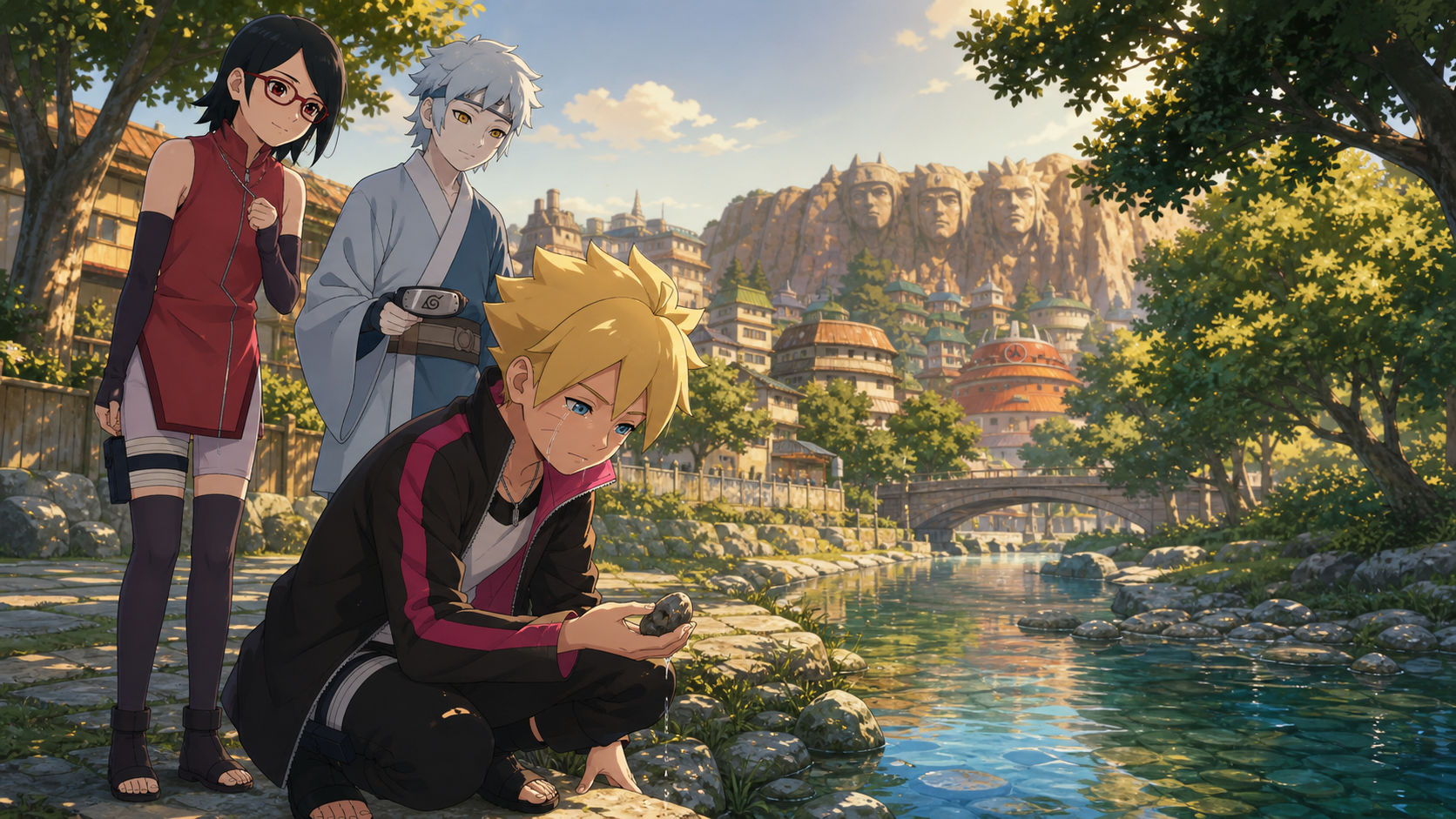
A New Ordinary
Team 7 comes home to consequences, memorials, and a rank temporarily taken away. A river stone proves that grief waited for an ordinary afternoon.
Series: Boruto: Naruto Next Generations
Episode: 92 · A New Ordinary
Arc: Mitsuki Disappearance Arc
Release: 2019-02-03
Previous: Episode 91 · Ohnoki's Will
Directory: All 293 Boruto episodes
Bottom line
Boruto Episode 92 understands that coming home is not the same as returning to normal. Mitsuki rides in a separate train car under Sai and Konohamaru's supervision. Boruto and Sarada lose their genin status because friendship did not give them permission to abandon Konoha procedure. Inojin carries Akkun's death quietly while Shikadai tries to keep him company. Ōnoki's funeral fills with villagers whose lives were shaped by both his leadership and his final mistake. The episode allows consequences to exist without turning punishment into rejection. Mitsuki answers for secrecy. Boruto and Sarada surrender their forehead protectors. Konohamaru offers to accept responsibility as their teacher. Kurotsuchi and Akatsuchi later arrive to thank the children and remind Konoha that rules are supposed to serve reality, not erase the truth. Team 7 regains its rank, but nobody becomes the person who left. Mitsuki builds small memorials for the Fabrications. Boruto says farewell to Garaga. A stone in the river makes him cry because Ōnoki's heart-stone lesson arrives after the old man can no longer see the result. The new ordinary is ordinary life with grief, accountability, and a larger understanding of each other carried inside.
The Thunder Train home is not a victory ride
The Konoha genin return by train while Naruto remains in Iwagakure for Ōnoki's funeral. There is no celebration carriage. Everyone is tired, separated, and carrying a different version of what happened.
The modern train once represented Boruto's comfortable era. Now the same technology carries children home from an occupation, artificial-life crisis, and Kage death. Peace has infrastructure. Peace does not prevent consequence.
Mitsuki rides in another car
Sai and Konohamaru supervise Mitsuki in a separate railcar. Boruto wants to talk to him, but the village needs facts before friendship gets privacy.
The separation feels harsh after everything Team 7 survived. The decision is still reasonable. Mitsuki withheld information, infiltrated a foreign crisis, and holds knowledge about an illegal project that almost destabilized Iwagakure. Care cannot replace debriefing.
Inojin returns without Akkun
Shikadai tries to distract Inojin from Akkun's death. The gesture is small and correctly imperfect. Nothing entertaining can replace the friend Inojin left behind.
Inojin may struggle to explain why a little Akuta mattered so much. The relationship lasted briefly and began in dangerous circumstances. Grief does not become smaller because other people had less time to witness the bond.
Ōnoki's funeral belongs to an entire village
Naruto stays for the funeral alongside the Five Kage, senior Iwagakure figures, and ordinary villagers. The crowd prevents Ōnoki's legacy from being reduced to the final arc.
He led through wars, protected the village for decades, made disastrous choices, and died correcting one of them. Public mourning can hold gratitude and anger at the same time.
Boruto and Sarada return to worried homes
Their families receive children who left without permission and returned from a conflict adults barely understood in time. Relief does not cancel fear or anger.
Boruto and Sarada made brave choices. They also made their families wonder whether they were alive. The episode refuses to use heroism as a coupon that pays every emotional debt.
Naruto wants to praise them and cannot
Naruto understands why Boruto and Sarada followed Mitsuki. As a former child who broke rules for friends, he probably understands too well. Hokage responsibility cannot stop at personal sympathy.
Sai and Shikamaru remind him that leaving the village without authorization carries serious consequences. A leader who ignores rules whenever his son has a good reason creates a different kind of danger.
The forehead protectors come off
Boruto and Sarada lose their genin qualification and leave their forehead protectors behind. The physical surrender makes the punishment visible.
The rank was earned through training and examination. Losing the symbol hurts because their actions were connected to the values a shinobi is supposed to carry. Courage and insubordination are not opposites.
Sarada fears Mitsuki will be blamed for everything
Sarada worries that Konoha may force Mitsuki out or that he may choose to leave. Her concern reflects the unresolved evidence. Mitsuki helped save Iwagakure, but his silence pulled friends into danger.
She also understands that belonging can feel fragile for somebody whose origin already makes adults suspicious. One crisis can turn curiosity into permanent mistrust.
Boruto chooses faith again
Boruto believes Mitsuki will return to them. His faith is no longer based only on refusing the word traitor. He has seen Mitsuki choose, deceive, grieve, protect, and come back.
The confidence feels more mature because Boruto now knows that trusting Mitsuki will not always mean predicting him correctly.
Sai and Konohamaru ask the necessary question
During the debriefing, they ask why Mitsuki did not inform anyone. The question has no comfortable answer. A warning could have protected his classmates, but a warning might have exposed the plan before he reached Kū.
Mitsuki chose operational secrecy and accepted the possibility of being misunderstood. The village needs to evaluate that choice without pretending the result alone makes every method acceptable.
Garaga ends the contract himself
While Boruto sleeps, Garaga contacts him mentally. Mitsuki's return means the terms of their agreement are complete. The enormous snake does not linger as a convenient permanent weapon.
Garaga decides where the relationship ends. That autonomy is exactly why the bond mattered against Kirara's puppet control.
The farewell respects a difficult friendship
Boruto and Garaga exchange final words without transforming into sentimental best friends. They argued, tested each other, and cooperated when trust mattered.
Some relationships change a person without becoming permanent. The goodbye is not failure. Completion can be honest.
Mitsuki builds memorials alone
After the debriefing, Mitsuki creates small memorials for the Fabrications. He does not ask Konoha to approve the grief or simplify the people being remembered.
Kakō, Kokuyō, Kirara, Sekiei, and Kū made different choices. Mitsuki's mourning does not declare them innocent. The memorials acknowledge that their brief lives mattered.
Boruto finds Mitsuki before he disappears again
Boruto and Sarada search after learning the debriefing has ended. The urgency carries the fear that Mitsuki may leave before anyone can say what needs to be said.
Finding him at the memorials reveals where his mind remained. He came home physically while part of him stayed with the friends who could not.
Mitsuki apologizes without erasing his will
Mitsuki apologizes for the hurt he caused. The apology does not become a promise never to make an independent choice again.
That balance matters. Accountability should repair relationships, not train Mitsuki back into obedience.
Boruto gives Ōnoki's lesson back to Mitsuki
Boruto remembers Ōnoki and tells Mitsuki that a will can have many sides. Questions, contradictions, and changes do not prove emptiness.
The lesson has traveled through grief, misuse, and correction before reaching this quiet conversation. Boruto salvages the useful truth without inheriting Ōnoki's certainty.
Sarada arrives in time for the laugh
Sarada joins them and the three share a laugh. The scene is small, which is exactly right. Team 7 does not need another dramatic pledge.
Ordinary laughter becomes evidence that they can remain together while the difficult conversation continues.
Orochimaru watches Mitsuki's development
Orochimaru discusses the journey with Log. Their interest keeps a slightly unsettling edge because Mitsuki's growth is also data to his creator.
Orochimaru gave Mitsuki choices, but fascination can still turn a child's life into an experiment viewed from a distance.
The missing scientist body leaves the door open
Log reports that the body of the scientist behind the Fabrications is missing. Someone may have removed the evidence or the person may not be as finished as assumed.
The detail prevents the arc from sealing every consequence inside Ōnoki's death. Dangerous knowledge survives creators and crises.
The official news becomes smaller than lived truth
Team 7 hears the public account of Iwagakure while walking through Konoha. A broadcast must compress the crisis into understandable facts.
They carry the uncompressed version: Akkun's name, Sekiei's fist, Kozuchi's memorial, Kū's stolen heart, and Ōnoki's final light.
A river stone breaks Boruto open
Boruto thinks he sees a heart stone in the water. The object pulls Ōnoki's lesson into the ordinary Konoha afternoon, and tears arrive.
Grief often waits until danger ends. Boruto did not have time to cry while fighting Kū. A wet stone creates the first safe opening.
Konohamaru offers to share responsibility
Konohamaru wants to accept consequences as Team 7's teacher. He was not present when they left, but leadership means refusing to treat children's mistakes as isolated from adult guidance.
The offer also tells them they are not being discarded. Their sensei remains part of the team even while rank is uncertain.
Kurotsuchi arrives with evidence rules cannot ignore
Kurotsuchi and Akatsuchi visit Konoha to thank the genin personally. The Tsuchikage whose village was saved provides authoritative context for actions Konoha can only judge from inside its own procedures.
She does not ask Naruto to pretend they obeyed orders. She explains what their disobedience accomplished for another village.
Iwagakure calls them shinobi before Konoha does
Kurotsuchi says Iwagakure will always consider them shinobi. The statement separates title from conduct. Boruto, Sarada, Mitsuki, and their friends acted with courage, loyalty, and responsibility even while violating Konoha rules.
Naruto understands the message because shinobi identity was never only paperwork in his own life.
Team 7 gets the rank back
Boruto and Sarada regain genin status. The reversal is not proof that punishment was fake. New evidence changes the decision.
A healthy system should be capable of revision. Consistency does not require ignoring context once context arrives.
The next mission is the new ordinary
Team 7 prepares to work together again. The ordinary routine returns through assignments, village streets, and shared movement.
Nobody resets. Mitsuki knows his will can lead away and back. Boruto knows faith can coexist with hurt. Sarada knows caution can protect friendship. Their next mission begins with more truth than the last one.
Ordinary life becomes part of the repair
The episode does not send Team 7 directly into another giant confrontation. Walking through the village, hearing a broadcast, visiting friends, and waiting for a decision all matter because the arc was built around created people who never received ordinary time. Kakō discovered excitement only in battle. Kokuyō learned about a heart while dying. Sekiei reached friendship during physical collapse. Akkun found a name shortly before sacrificing himself.
Mitsuki returns to routines those friends never had. The contrast should not become guilt that prevents him from living. Ordinary days are the future they were denied and the future Ōnoki claimed to protect. Remembering them can include accepting the next mission, laughing with teammates, and allowing familiar streets to feel safe again.
Boruto's river tears belong to that repair. Safety gives the body permission to notice what survival postponed. Sarada standing nearby and Mitsuki remaining with them do not fix the loss. Their presence keeps Boruto from carrying the memory alone.
The train separates Mitsuki before any hearing begins
Mitsuki rides apart from Boruto and Sarada because returning home does not automatically restore Team 7. The physical distance makes the institutional uncertainty visible before anyone announces consequences.
He left without explanation, aided people attacking Iwagakure, and placed his teammates inside a pursuit they did not understand. He also protected lives, exposed the conspiracy, and returned by choice.
The separate car holds all of those truths without deciding which truth cancels the others. Accountability begins with refusing the easy reunion scene.
Removing the forehead protectors is consequence without final condemnation
Konoha cannot ignore that genin abandoned orders and crossed borders during a political crisis. Taking the rank acknowledges damaged trust and the danger created by acting without authorization.
The punishment remains reversible, which matters. A system that can only expel or excuse has no room for evidence, context, repair, or growth.
Team 7 loses status while the village investigates. The consequence becomes a pause in authority rather than a declaration that the children no longer belong.
Naruto cannot let pride erase his responsibility as Hokage
Naruto understands why Boruto, Sarada, and Mitsuki acted. He also knows the village needs rules that survive personal sympathy and famous parents.
Praising them immediately would tell every younger shinobi that a good outcome can retroactively authorize any method. Condemning them without listening would repeat the arc's habit of treating created narratives as complete truth.
Naruto has to hold fatherly relief, Hokage responsibility, and respect for what Team 7 accomplished at the same time. The discomfort proves the decision matters.
Mitsuki's apology does not require surrendering his independent will
Mitsuki recognizes that silence hurt Boruto and Sarada. He can apologize for withholding information, attacking Boruto, and forcing his friends to follow a trail built from uncertainty.
He does not apologize for needing an answer that came from somewhere beyond Boruto. That distinction protects the entire purpose of the journey.
Repair becomes possible when Mitsuki owns harmful choices without declaring his search for autonomy a mistake. Friendship should change how he communicates, not return him to obedient orbit.
Boruto chooses faith after learning faith needs evidence and boundaries
Boruto defended Mitsuki with almost no information because he believed their bond revealed the truth. The arc punished that certainty repeatedly.
At the end, Boruto still believes in Mitsuki, but the belief has changed. He knows Mitsuki can leave, make painful choices, care about people Boruto distrusts, and keep parts of himself private.
Faith becomes less about predicting every decision and more about remaining available for honest repair after prediction fails.
The memorials refuse to divide the Fabrications into easy categories
Mitsuki builds individual markers because Kakō, Kokuyō, Sekiei, and the others did not share one personality or one moral record. Some protected him. Some manipulated him. Some died while changing. All were created for a project that denied them ordinary futures.
Memorializing them does not excuse the people they injured. The markers reject the idea that wrongdoing makes a life too inconvenient to remember.
Mitsuki understands their contradictions because he spent the arc asking whether creation determines personhood. The memorials answer that personhood survives moral complexity.
Inojin returns without Akkun and receives no clean consolation
Akkun was small, strange, briefly alive, and emotionally real to Inojin. The village may describe the Fabrications as enemies, but that label cannot explain the creature who learned a name, sought affection, and sacrificed himself.
Inojin's grief deserves room even though the relationship was short. Duration does not decide whether attachment counted.
The episode lets absence remain visible. Akkun does not return as a souvenir or joke. Inojin has to carry a bond that most adults around him never witnessed.
Kurotsuchi changes the ruling by bringing external evidence
Konoha initially judges Team 7 from orders violated and facts available inside the village. Kurotsuchi arrives representing the people whose lives the genin helped save.
Her evidence does not make the original concern foolish. Her evidence makes revision necessary. Institutions earn trust when they can change a decision after the record changes.
Restoring the ranks shows accountability working as a process rather than pride defending the first verdict.
Iwagakure calling them shinobi repairs more than a title
The recognition comes from the village that suffered the crisis, lost Ōnoki, and saw the Fabrication project turn grief into attempted control. Those witnesses understand what Team 7 risked and what their intervention prevented.
Konoha defines shinobi through authorization and rank. Iwagakure speaks from lived rescue. Neither definition should stand alone.
The restored status carries meaning because institutional judgment finally includes testimony from the people affected by the mission.
Boruto's tears arrive after safety because survival postponed them
During the crisis, Boruto keeps moving from fight to pursuit to rescue. The river stone creates a quiet sensory link to Ōnoki and gives grief somewhere to surface.
Crying after returning home does not mean the earlier composure was false. Bodies often delay emotional processing until immediate danger ends.
The scene lets Boruto become a child again without reducing what he survived. Sarada and Mitsuki remain close enough that grief does not turn into another secret mission.
Garaga ends the contract without pretending the bond was simple
Garaga joined Boruto through suspicion, argument, and a shared interest in whether betrayal determines every future relationship. Their contract was never soft companionship.
Ending the agreement respects Garaga's independence. Boruto cannot collect every ally permanently because the alliance mattered during one journey. Garaga chooses when the shared purpose has finished.
The farewell also gives Boruto evidence that separation does not always equal betrayal. A relationship can end honestly, preserve what both parties learned, and remain meaningful without forced continuation.
Konohamaru shares responsibility instead of protecting his authority
Konohamaru could frame the crisis as three genin disobeying while their jonin leader remained outside the decision. Instead, he recognizes that leadership includes the conditions under which a team believed secrecy and unauthorized pursuit were necessary.
Sharing responsibility does not erase the genin's choices. Konohamaru acknowledges that command is relational. A leader cannot claim every success and isolate every failure inside younger subordinates.
That stance gives Team 7 a model for repair. Accountability can move upward as well as downward, and authority becomes more credible when the person holding rank accepts scrutiny.
The missing scientist body prevents closure from becoming certainty
The unresolved body leaves a factual gap after the emotional ending. Team 7 may be home, ranks may return, and memorials may stand, but the conspiracy's complete record remains unfinished.
That uncertainty matters because ordinary life often resumes before every answer arrives. People still eat, train, report for missions, and grieve while an investigation remains open.
The new ordinary is not denial. The characters accept enough safety to live without pretending that safety supplied perfect knowledge.
Quick reaction
Episode 92 earns the word ordinary by refusing to make ordinary mean untouched. The train runs. Families wait. Reports are filed. Ranks are removed and restored. Friends laugh beside memorials. Boruto cries over a river stone because grief finally finds a quiet place to land. I love that Mitsuki apologizes without surrendering the will he spent the arc discovering. I love that Konoha imposes consequences and later revises them when Kurotsuchi brings evidence from the people actually saved. Most of all, I love the small memorials. The Fabrications do not disappear into a villain count. Mitsuki remembers them as individuals, including the ones whose choices hurt people. A new ordinary is not a clean slate. Team 7 walks forward carrying names, mistakes, and a deeper obligation to let each other be complicated.
Sources and lawful viewing
Official episode reference: Naruto Official episode guide
Licensed episode route: Crunchyroll licensed series page