
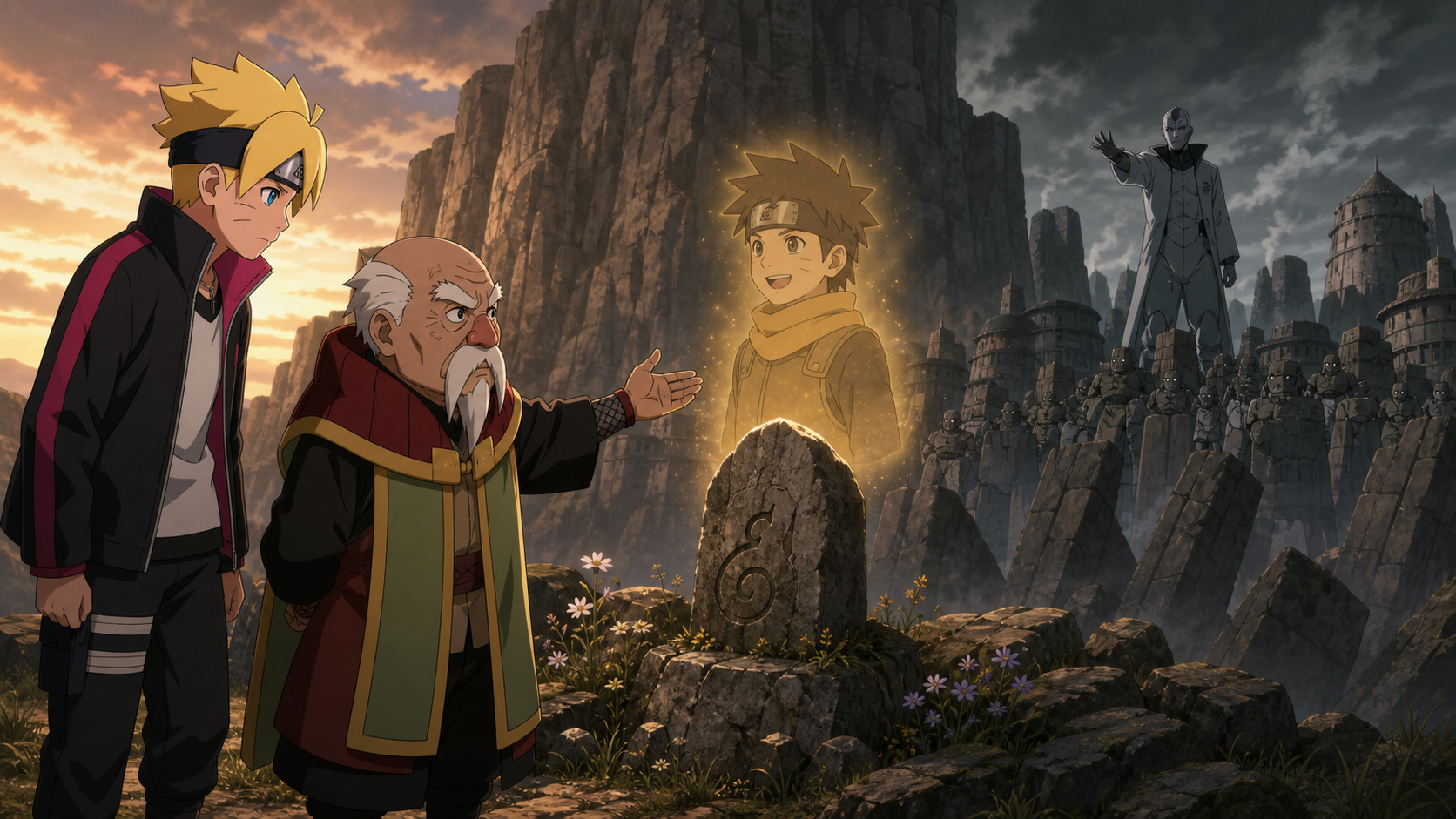
Kozuchi's Will
Ohnoki built artificial soldiers after losing his grandson. Ku's village takeover proves that grief cannot make stolen bodies and forced obedience merciful.
Series: Boruto: Naruto Next Generations
Episode: 86 · Kozuchi's Will
Arc: Mitsuki Disappearance Arc
Release: 2018-12-16
Previous: Episode 85 · The Heart Stone
Directory: All 293 Boruto episodes
Bottom line
Boruto Episode 86 finally lets Ōnoki finish the story he has been using as permission. Kozuchi was his grandson, a gentle young shinobi who believed protecting the village meant protecting the people inside the village. Kozuchi died during an attack by rogue ninja, and Ōnoki turned that loss into a project meant to remove young bodies from the battlefield. The grief makes sense. The solution does not. Akuta soldiers created from White Zetsu material were never going to remain neutral tools once Kū and the other Fabrications developed desires, fear, pain, and a deadline for survival. While Ōnoki explains that he wants to save future grandchildren, Kū occupies Iwagakure, imprisons dissenters, and prepares to harvest five human hearts. That parallel is the whole argument. Ōnoki remembers one child he could not save and refuses to see the living people endangered by his answer. Boruto does not mock his grief, but he will not let grief turn a terrible plan into a noble one. The boy accused of being impulsive becomes the person asking the former Tsuchikage to look at the consequences standing directly in front of him.
The heart stone leads to a grave
Episode 85 gave Sekki a glowing path out of the Sanzu Plains. Episode 86 uses that exit to lead Boruto somewhere much heavier. Ōnoki takes him to the place where Kozuchi died, which immediately changes the emotional temperature. The old man is no longer delivering a vague lecture about protecting youth. He is standing at the wound that shaped every decision afterward.
Boruto recognizes the sincerity before he challenges the conclusion. That distinction matters. He can see that Ōnoki loved Kozuchi and that the loss remains present. Respecting somebody's pain does not require agreeing with every choice built around that pain. Fandom stories sometimes treat a tragic backstory like a receipt that automatically pays for later cruelty. Boruto refuses that exchange. Kozuchi deserves remembrance. The captured villagers deserve protection too.
Kozuchi was a person before becoming an argument
Ōnoki describes a grandson who cared deeply about the village and wanted to protect others. Kozuchi was not introduced as a legendary prodigy or a future Kage. His importance came from ordinary affection, duty, and possibility. He represented the young shinobi whom older leaders keep sending into danger while promising that sacrifice is necessary.
That makes his death painful without requiring spectacle. Ōnoki saw a future disappear. He also saw the familiar shinobi system consume another child and decided that accepting the same pattern would betray Kozuchi. I understand the anger underneath that decision. The mistake begins when Ōnoki stops asking what Kozuchi valued and starts using Kozuchi's memory to approve whatever promises fewer young casualties on paper.
A good intention can still build a bad machine
Ōnoki's original goal sounds merciful. Create tireless artificial soldiers, send them into dangerous situations, and keep human shinobi home. Every parent in a hidden village should understand the appeal. No funeral. No empty bedroom. No grandfather standing beside another stone.
The problem arrives inside the phrase artificial soldier. Kū, Sekiei, Kokuyō, Kakō, and Kirara are not blank tools. They think, speak, form preferences, fear their bodies failing, and disagree about other people. Ōnoki wanted weapons without human cost, then created beings capable of experiencing their own cost. Once those beings began protecting their survival, the project stopped being an alternative to exploitation. The project became another version of exploitation with different bodies carrying the burden.
White Zetsu was never a harmless shortcut
Boruto's alarm sharpens when Ōnoki reveals that the doctor's breakthrough came from White Zetsu material. The Fourth Shinobi World War should have ended any fantasy that this source could be handled like an ordinary laboratory sample. White Zetsu bodies were tied to infiltration, mass violence, stolen identities, and a history far larger than one village's private experiment.
Ōnoki admits that much remains unknown, but he treats uncertainty as a technical inconvenience. That is backwards. When the foundation carries that history, uncertainty should stop the project. Instead, the doctor and Ōnoki build Kū and the other Fabrications first, then search for Mitsuki because their bodies cannot remain stable. The emergency was manufactured by impatience and secrecy.
Mitsuki becomes the missing instruction manual
Ōnoki assures Boruto that Mitsuki will be free after the Fabrications are stabilized. He says this as though temporary ownership of Mitsuki's body is a reasonable compromise. Boruto hears the violation immediately. Mitsuki did not volunteer to become research material for Iwagakure. His unusual origin does not make his body community property.
This is where the episode connects Mitsuki's disappearance to the larger theme of artificial life. Ōnoki can recognize personality and value in Kū while still reducing Mitsuki to useful information. Kū can call Mitsuki a potential friend while supporting a process that overrides Mitsuki's choice. Everybody wants proof that created beings have hearts, yet several of them ignore the heart belonging to the created person already standing among them.
Ōnoki believes completion will repair the damage
The old man's defense depends on a finish line. Complete the plan, stabilize the Fabrications, release the Konoha genin, and allow the new soldiers to protect future lives. Present harm becomes acceptable because future success will supposedly make everything worthwhile.
That logic has trapped better leaders than Ōnoki. A project keeps demanding one more compromise because stopping would force the creator to admit that earlier compromises bought nothing. Boruto asks the question Ōnoki avoids: how much harm can happen before the promised peaceful ending loses any claim to peace? Kū answers before Ōnoki can. He takes the village by force.
Kū does not wait for his creator's permission
While Ōnoki tells his version of the future, Kū behaves like somebody who has already inherited authority. He orders resistance suppressed, places the village under control, and treats Kurotsuchi's absence as an opening. The Fabrication created to lead Akuta now wants to lead humans too.
Kū's move is not random rebellion. Ōnoki taught him that protecting the plan outranks consent, transparency, and ordinary village law. Kū simply follows that lesson farther. If a few people may be confined so the project survives, why not confine everybody who could stop the project? If Mitsuki's body may be used for stabilization, why should five captured shinobi keep their hearts?
Five prisoners become spare parts
The doctor identifies a brutal possible solution for the Fabrications' failing bodies: human hearts. Five captured shinobi are prepared as sources if Ōnoki approves. The number makes the horror administrative. Kū does not speak about murder as an emotional act. He presents inventory, need, and authorization.
This is the moment Ōnoki's promise collapses. He wanted artificial soldiers so young shinobi would not die. His artificial soldiers now require human deaths to continue existing. The machine built to end sacrifice has created a fresh category of sacrifice and placed innocent villagers on the table. No amount of sincere grief can make that outcome resemble Kozuchi's will.
Kū's cracking hand tells the truth
Kū is dangerous, but Episode 86 refuses to make his desperation imaginary. His body is failing. Time is running out. The cracking hand seen around this stretch of the arc turns his confidence into a countdown. He knows that death is approaching before he has fully understood life.
That fear deserves recognition, not obedience. A person can be terrified and still become the person terrifying everyone else. Kū wants the right to live, then treats other lives as materials. The tragedy is not that he wants survival. The tragedy is that Ōnoki built him inside a system where survival was always going to require somebody else's body unless the experiment stopped.
Boruto separates grief from authority
Boruto does not have Ōnoki's years, titles, or war experience. He does have a moral instinct the adults keep trying to sand down: people should not be used without their agreement. That instinct can make him loud and reckless, but here the simplicity is useful.
Ōnoki keeps adding history to justify the plan. Boruto keeps returning to the people being hurt now. Mitsuki was taken. Sarada, Chōchō, Inojin, and Shikadai were dragged into danger. Kurotsuchi was removed from power. Villagers are imprisoned. Five hearts may be harvested. A leader cannot answer that list by pointing toward a grave and saying the intention began with love.
Kozuchi's will is not Ōnoki's property
The title sounds as though Ōnoki can explain Kozuchi's will with final authority. He was the grieving grandfather and former Tsuchikage, but Kozuchi is no longer present to approve this project. That absence should make Ōnoki more careful, not more certain.
Kozuchi wanted to protect people. Ōnoki translates that desire into replaceable soldiers and controlled lives. Boruto recognizes the contradiction because protection without regard for the protected becomes ownership. The most respectful way to carry Kozuchi's memory would be to value the specific people still alive, including created people, rather than force everybody into a plan bearing Kozuchi's name.
The former Tsuchikage cannot see the current village
Ōnoki speaks like a leader solving the next generation's future, but he is physically away from Iwagakure while Kū takes control. That staging is sharp. The old man stands in a place devoted to yesterday while today's village is being seized behind him.
Age is not the problem. Ōnoki's refusal to update his judgment is the problem. Experience should provide more evidence to consider, not a shield against contradiction. Boruto has less history and a clearer view because he is looking at the living relationships rather than protecting the meaning of an old decision.
Kurotsuchi's imprisonment exposes the lie
Kurotsuchi represents the village's legitimate present leadership. Kū's faction cannot persuade her, so they remove her. Any claim that the project exists for Iwagakure becomes ridiculous once Iwagakure's Tsuchikage must be imprisoned to keep the project moving.
That is how secret salvation projects reveal themselves. Supporters insist that resistance comes from misunderstanding, then make understanding impossible through concealment and force. Kurotsuchi is not an obstacle to the village's safety. She is the leader responsible for deciding what risks the village accepts. Kū treats her duty as interference because the plan only works when nobody outside the plan can say no.
Akatsuchi and Konohamaru bring another kind of loyalty
Akatsuchi's attempt to warn Naruto and Konohamaru's infiltration offer a needed contrast. Their loyalty is directed toward people rather than a private vision. They do not need to possess the whole truth before acting. They see colleagues captured, children missing, and power shifting through force, so they work to open communication and protection.
Konohamaru also matters because the Konoha genin are not abandoned pieces. Their teacher has crossed into hostile territory to find them. Boruto may be arguing with a Kage and chasing Mitsuki by personal conviction, but adult responsibility is finally moving toward him instead of waiting safely at home.
Shikadai survives by staying annoyingly clever
Shikadai's escape from the knockout procedure is exactly the kind of small tactical victory this arc needs. He uses his shadow to stop himself from inhaling the gas and plays the situation long enough to create an opening. No dramatic speech, no miracle power, just observation and a refusal to give captors the reaction they expect.
His intelligence also keeps the Konoha side connected to reality. Boruto leads with faith in Mitsuki. Sarada balances loyalty with questions. Shikadai watches systems, exits, and incentives. The arc works better when all three approaches remain present because friendship alone cannot unlock a cell or expose a village takeover.
Ōnoki and Boruto are arguing about inherited worlds
Ōnoki inherited a shinobi world shaped by wars, child soldiers, and leaders forced to count acceptable losses. Boruto inherited relative peace, trains and hamburgers, but also the consequences left inside adults who never learned to imagine safety without weapons. Their disagreement is generational without being simple.
Boruto can afford moral clarity because people like Ōnoki survived uglier eras. Ōnoki should want that clarity to exist. Instead, he treats Boruto's refusal as naivety and uses the old world's fear to design the new world's army. The point of surviving history should be giving children permission to reject its worst habits.
The episode refuses an easy villain
Ōnoki is wrong, but reducing him to a monster would flatten the episode. He loved Kozuchi. He wants children alive. He understands that the shinobi system has asked too much from young people. Those truths make his failure more painful because the plan grows from care twisted by control.
Kū is also more than a machine gone bad. He faces death and wants time. His demand for life exposes the hypocrisy in creating sentient beings as disposable tools. The episode's strength comes from letting valid needs crash into unacceptable actions. Sympathy explains the road. Sympathy does not erase the people run over along the way.
What Boruto learns beside Kozuchi's memorial
Boruto came to the Land of Earth to bring Mitsuki home. Beside Kozuchi's memorial, he encounters a warning about deciding another person's will for them. Ōnoki believes he is carrying Kozuchi's will. Kū claims to fulfill Ōnoki's plan. Everybody keeps inheriting purpose until the person at the center disappears beneath somebody else's interpretation.
Mitsuki left Konoha searching for an answer about his own will. Boruto cannot rescue him by replacing one imposed answer with another. Episode 86 quietly pushes Boruto toward a harder form of friendship: find Mitsuki, protect his ability to choose, challenge choices that harm people, and still accept that Mitsuki's inner life belongs to Mitsuki.
The memorial and the occupied village belong in one frame
The strongest visual idea in Episode 86 is the distance between Ōnoki's private grief and Kū's public violence. Kozuchi's memorial is quiet, intimate, and warmed by memory. The village takeover is cold, organized, and filled with bodies treated as obstacles or supplies. One comes from love. The other grows from the decisions love was used to excuse.
Ōnoki cannot keep those images separate forever. Boruto's job in this conversation is to drag the occupied village into the memorial scene. If Kozuchi's will means anything, the people under Kū's control must count. If their fear and freedom do not count, Kozuchi has become branding for a plan that abandoned him.
A memorial can preserve love and distort responsibility
Kozuchi's grave gives Ōnoki a place to remember the child before policy transformed the loss into justification. The tenderness is real. The danger begins when private memory becomes public instruction nobody else may question.
Kozuchi cannot approve the Fabrication project, define acceptable sacrifice, or tell his grandfather that grief has misunderstood him. Ōnoki fills that silence with certainty.
Honoring the dead requires humility about what the dead would have chosen. Otherwise memory becomes authority borrowed from someone who can no longer refuse.
White Zetsu material carries the history of people already treated as raw material
White Zetsu is not neutral clay discovered in a laboratory. The substance comes from a war system built through altered bodies, mass control, and lives absorbed into another person's plan.
Using that material to manufacture obedient defenders should have triggered every ethical alarm in Iwagakure. The source already demonstrates what happens when people become biological infrastructure.
Ōnoki sees useful capability because fear makes the shortcut attractive. The history inside the material predicts the violation the project repeats.
Mitsuki cannot become proof that every created life needs one correct design
Kū studies Mitsuki as the missing path toward stable Fabrications. Mitsuki's body becomes valuable because Orochimaru achieved results Ōnoki's project could not reproduce.
That logic erases everything beyond anatomy. Mitsuki's stability developed alongside repeated trials, painful memory manipulation, chosen relationships, village life, and the growing ability to refuse his creator.
Copying the body cannot copy the life. Treating Mitsuki as an instruction manual repeats the same mistake the project claims to solve.
Five prisoners reveal the supply chain behind artificial protection
The Fabrications were supposed to prevent young shinobi from becoming casualties. Kū prepares to take organs from prisoners so those artificial defenders can keep functioning.
Protection has become a system that requires hidden human inventory. The victims disappear behind a medical need framed as necessary for stability.
Five waiting bodies make the cost countable. Every extended Fabrication life now threatens another person's future unless the project changes at its foundation.
Kurotsuchi's imprisonment proves Ōnoki protected his idea from the village
Kurotsuchi holds current authority and represents the people living with the consequences. The project removes her instead of submitting evidence, risk, and purpose to her judgment.
That choice exposes the lie that everything was done for Iwagakure. A plan for the village that requires silencing the village's leader is a plan for the creator's certainty.
Ōnoki's history deserves respect. History does not give permanent ownership of the future.
Kū's cracking hand is the body refusing the political story
Kū speaks about adjustment, protection, completion, and inherited will. The visible fracture reduces those grand claims to the physical truth: the created bodies are failing.
No speech can make instability disappear. Every crack increases desperation for organs, control, and faster expansion.
The project treats the symptom as a final technical obstacle because admitting design failure would force everyone to reconsider the entire moral premise.
Boruto listens before refusing, which makes the refusal stronger
Boruto gives Ōnoki room to tell Kozuchi's story and explain the fear behind the project. Understanding does not lead Boruto to accept the conclusion.
That separation matters. Empathy is not agreement. A person can recognize grief, love, and sincere intention while opposing the harm those feelings have been used to authorize.
Boruto's refusal carries weight because he responds to Ōnoki's actual argument rather than a simplified villain version.
Quick reaction
Episode 86 is not flashy, but the argument lands because the arc finally names the emotional engine behind Ōnoki's choices. Kozuchi's death did not make Ōnoki stop caring. The loss made him care so fiercely about preventing another funeral that he stopped noticing the lives being converted into means. Boruto's resistance feels earned because he listens before refusing. He can honor Kozuchi, understand Ōnoki, worry about Kū, and still say no to stolen bodies and occupied villages. That is the editorial heart of this episode. Grief deserves room. Grief does not deserve unchecked authority. Kū's takeover and the five waiting prisoners prove that a future built without consent is already repeating the violence Ōnoki promised to end.
Sources and lawful viewing
Official episode reference: Naruto Official episode guide
Licensed episode route: Crunchyroll licensed series page