
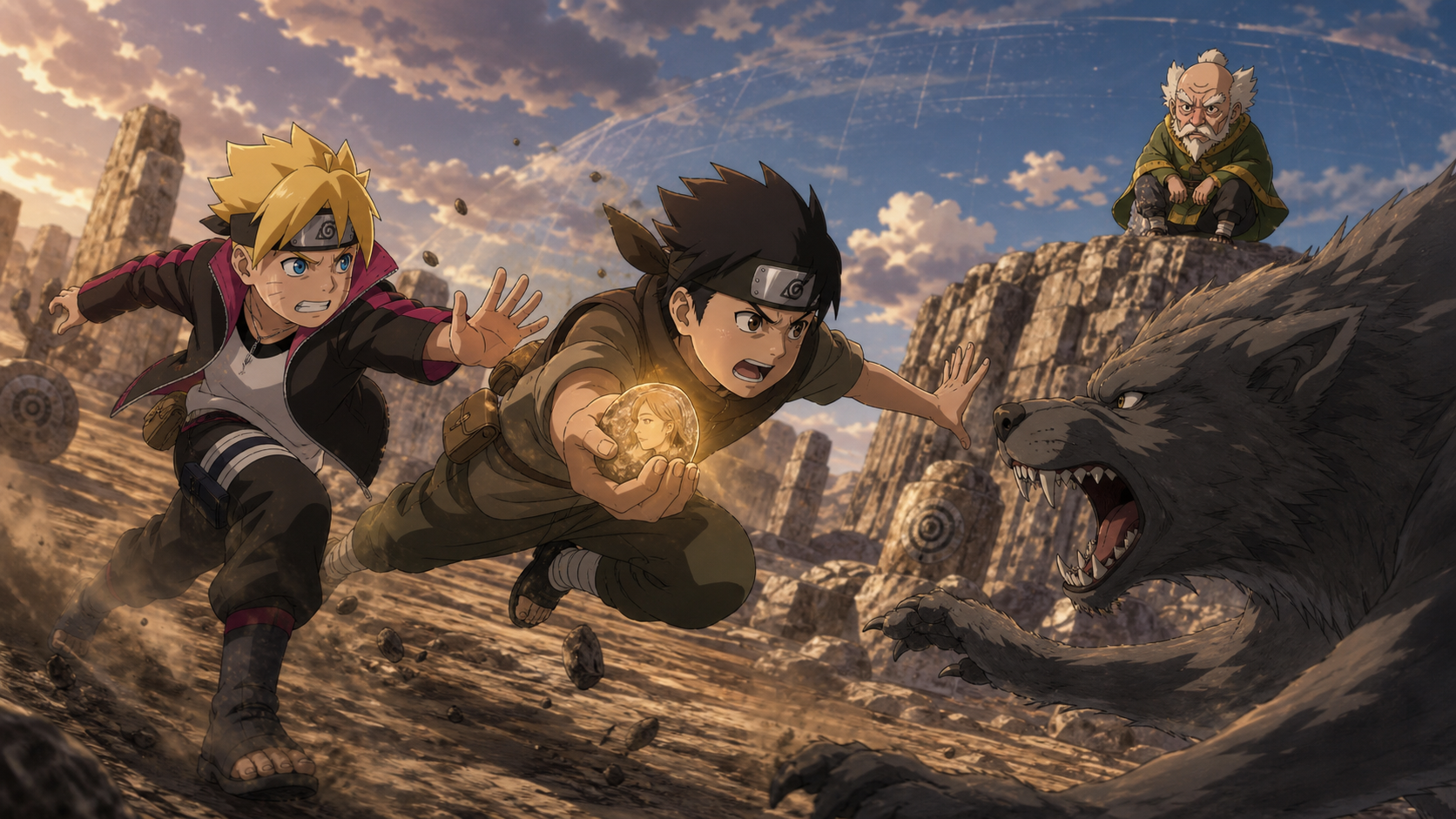
The Heart Stone
Sekki thinks he needs a stone to prove his grandmother was right about him. A giant wolf and Boruto's improvised launch reveal the will he was already carrying.
Series: Boruto: Naruto Next Generations
Episode: 85 · The Heart Stone
Arc: Mitsuki Disappearance Arc
Release: 2018-12-09
Previous: Episode 84 · Ohnoki's Thoughts, Ku's Thoughts
Directory: All 293 Boruto episodes
Bottom line
Boruto Episode 85 gives the heart stone to Sekki, not Boruto, and that choice saves the episode from becoming another story where the famous protagonist collects somebody else's tradition as a prize. Sekki came to the Sanzu Plains because he failed early in the Chūnin Exams and wants to honor the grandmother who believed in him. Boruto only wants an exit. Ōnoki pairs them because Sekki's success can open the barrier, but the old man's convenient plan accidentally creates the right lesson. Sekki finds his will while protecting Boruto from a giant wolf with the clumsy-looking, chakra-free strike everybody underestimated. The ordinary rock in his hand takes on the memory of his grandmother and becomes his heart stone. Boruto does not receive a matching souvenir. He receives proof that another person's purpose cannot be copied, rushed, or chosen through superior talent. Outside the training ground, the episode gets much darker. Kū learns that stabilizing the Fabrications may require human hearts, Shikadai escapes a procedure by using his shadow against knockout gas, Akatsuchi tries to reach Naruto, and Konohamaru infiltrates the village. One boy finds a stone through love. Kū starts considering how many human bodies his promised future will cost.
Boruto is searching for an exit, not a revelation
Boruto begins the episode tearing through rocks because the barrier has trapped him away from Mitsuki and the rest of the group. Ōnoki already warned that a heart stone appears when somebody faces personal will. Boruto treats the task like a scavenger hunt with terrible directions.
That attitude is completely understandable. His friends may be injured or captured, Kū controls the village, and every hour inside the Sanzu Plains gives the Akuta more time. Reflection feels like a luxury when somebody you love may need help.
The barrier does not care. Boruto can search faster, complain louder, and turn over every pebble in the basin. Urgency cannot manufacture the inner answer Ōnoki's tradition demands.
Sekki arrives carrying his own failure
Sekki is one of the Genbu Three from the recent Chūnin Exams. His team failed early, and the experience has lodged inside him as proof that he may not deserve the future his grandmother imagined. He comes to the training ground on purpose, unlike Boruto, because finding a heart stone may help him understand what kind of shinobi he can become.
The contrast matters. Boruto entered the plains by accident and has already proven himself in battles that reached beyond the Chūnin Exams. Sekki is a local genin struggling to trust one technique and one private promise. The episode refuses to make Boruto's larger résumé the answer to Sekki's smaller-looking pain.
Sekki's problem belongs to Sekki. That is why his victory lands.
Sekki still sees Ōnoki as a hero
Sekki recognizes the former Tsuchikage and assumes Ōnoki must be inside the training ground for some noble reason. Boruto could expose the Akuta project, Kū, and the old man's role in one furious sentence. He chooses not to.
Boruto later tells Ōnoki that explaining the truth would not help Sekki at that moment. The restraint is surprising after two episodes of demanding answers. Boruto understands that Sekki came here to face his own doubt, and dropping a village-level betrayal on him would turn that search into another adult crisis.
The silence does not protect Ōnoki forever. Boruto simply refuses to use Sekki's trust as a weapon during a vulnerable moment.
Ōnoki turns Sekki into their way out
Ōnoki tells Sekki that Boruto will help him find the heart stone. Quietly, he tells Boruto that Sekki's stone can lead all three of them through the barrier. The plan is practical and slightly shameless. Ōnoki turns mentorship into an escape route without telling Sekki the full reason.
Still, Boruto and Sekki do need each other. Sekki knows the tradition but lacks confidence. Boruto has confidence for an entire squad but cannot recognize the lesson because his mind is fixed on leaving. One boy needs somebody to believe the search can succeed. The other needs a reason to stop making the search about himself.
Ōnoki has made worse decisions this week.
The grandmother gives the stone emotional weight
Sekki is not looking for abstract enlightenment. His grandmother cared for him, encouraged him, and gave his ambition a human shape. He wants to repay that love by becoming the shinobi she believed he could be.
That motivation could become another burden if Sekki treats her memory as a grade he must pass. The episode gradually changes the memory from pressure into support. His grandmother did not need a famous technique or a perfect exam record before loving him. Sekki is the one attaching shame to her hope.
The eventual stone resembles her because his will is not separate from that relationship. Love helped him choose a direction without choosing every step.
Sekki's technique looks weak until the rock breaks
Sekki demonstrates a physical strike that does not require chakra. Boruto dodges easily and initially has little reason to respect the move. Then he notices the damage Sekki left in the rock.
That reveal is classic Naruto. A technique can look awkward, slow, or unimpressive until the right situation exposes what the user actually built. Sekki's problem is not a total lack of ability. He lacks delivery, timing, and faith under pressure.
Boruto has the opposite problem. He owns several ways to create an opening and enough confidence to try them before anybody asks. Pairing the boys starts making tactical sense before either recognizes the partnership.
Ōnoki's back gives Sekki a familiar job
When Ōnoki's back gives out, Sekki rubs the old man's back the way he once helped his grandmother. The moment is small, funny, and important. Sekki stops performing as a failed Chūnin candidate and does something he already knows how to do well.
Care is not a shinobi technique, but the action reconnects him with the relationship behind his search. He remembers himself as useful without needing an examiner to announce the result.
Ōnoki also receives care from a young shinobi while arguing that the new generation has become weak. Sekki's kindness is not battlefield power. The old man still needs that strength.
The First Tsuchikage's words travel through Ōnoki
When Sekki begins losing resolve, Ōnoki repeats guidance once given to him by the First Tsuchikage. Hidden Stone tradition survives because one person passes a hard-earned lesson to another, not because a monument or title keeps the words alive by itself.
This is the version of legacy Ōnoki should have trusted. He feared that young shinobi could not survive, so he built artificial replacements. Sekki shows that an elder can protect the future by teaching, correcting, remembering, and letting a young person make the final choice.
Mentorship is slower than manufacturing an army. Mentorship also allows the student to become somebody the teacher did not design.
The wolf turns doubt into a decision
Boruto and Sekki leave to collect water and encounter a giant wolf. The danger removes the luxury of rehearsing confidence. Sekki either acts with the technique he doubts or watches the attack reach them.
Boruto sees the missing piece. Sekki has enough striking power but needs speed and placement. Boruto supplies the launch, propelling him toward the wolf so the chakra-free blow can land cleanly.
The teamwork feels satisfying because neither boy becomes a sidekick. Boruto cannot use his normal ninjutsu inside the barrier. Sekki cannot create the opening alone. The solution belongs to the space between their abilities.
Sekki finds the stone while protecting someone
The stone in Sekki's hand becomes his heart stone during the fight. He does not find the answer while staring at the ground or trying to impress Ōnoki. He recognizes the stone while choosing to protect Boruto.
That choice connects his grandmother's care, his own technique, and the shinobi he wants to become. The stone takes on a likeness of his grandmother because her memory has stopped functioning as an exam and started functioning as a reason.
Sekki thought he needed proof that he deserved her faith. The rescue shows that her faith was already helping him act.
The glowing path opens for all three
Sekki's heart stone glows, and other stones illuminate a route through the barrier. His personal discovery creates a path that Boruto and Ōnoki can also use.
That does not make the stone less personal. A private conviction can guide other people without becoming a command they must copy. The image quietly answers the Fabrication problem outside the plains. Ōnoki tried to create one purpose for many lives. Sekki finds one purpose for himself, and the result still helps a community.
Shared benefit does not require identical will.
Kū learns what survival may cost
At the base, the doctor reports that Mitsuki's juinjutsu blocks the information they need. Replicating the more stable technology may require a human heart for every Fabrication.
Kū understands that Ōnoki would never approve killing people to preserve the artificial beings. The problem forces the project's hidden value system into the open. The Fabrications were created to spare human lives. If their continued existence requires human hearts, the mission and survival collide.
Kū's desperation is real. So is the horror of treating unwilling people as replacement parts.
Sekiei watches friends begin to fail
Sekiei stays beside Mitsuki while Kirara and Kakō deteriorate. The Fabrications' physical crisis is no longer a future possibility. Bodies are failing around him while the one visitor with related creation technology stands nearby.
His gratitude toward Mitsuki carries more weight in that room. Sekiei wants a friend, but he also knows Mitsuki may represent survival for everybody he knows. Genuine affection and desperate hope can exist together.
Mitsuki has to decide how much help he can offer without letting Kū turn his body into a blueprint or another person's heart into medicine.
Shikadai refuses to become a silent patient
The doctor prepares Shikadai for a procedure and uses knockout gas. Shikadai prevents himself from inhaling enough by controlling his body with his shadow technique and escapes.
The scene is a reminder that the scattered Konoha team has not become helpless while Boruto sits inside the barrier. Shikadai observes, waits, and uses the exact amount of technique needed to keep his mind clear.
Boruto attacks problems through motion. Shikadai survives this one by appearing still. The contrast is why their team works.
Akatsuchi reaches for outside help
Akatsuchi tries to leave Iwagakure and inform Naruto about the crisis. The Akuta pursue him before he can escape cleanly, but Konohamaru arrives and saves him.
Konohamaru's appearance closes the distance between the children's unauthorized pursuit and Konoha's official response. Their teacher is finally inside the operation, and he can combine Akatsuchi's local knowledge with the evidence Konoha has gathered.
The rescue also gives Ōnoki's former student an ally who has not been compromised by Kū's control of the Stone village.
Kū moves from secrecy toward takeover
Kirara's genjutsu control is weakening, Kontsuchi is regaining consciousness, and the hidden operation cannot remain hidden much longer. Kū decides to take direct control of Iwagakure.
The choice confirms that his version of protection has become rule. He no longer trusts the village to agree with the plan, so he will force the village to live inside the plan. Every secret army eventually reaches this question: what happens when the people being protected say no?
Kū's answer is to remove their ability to answer.
Ōnoki still believes there is more to show
After the barrier opens, Ōnoki maintains that his plan remains sound and tells Boruto there is more he needs to see. The stubbornness is maddening. Sekki has just demonstrated a better model of inherited will directly in front of him.
Ōnoki may believe seeing Kozuchi's story will make Boruto understand the project. Boruto already understands the grief. The missing piece is whether Ōnoki can understand the lives created by his response.
Showing Boruto another reason cannot erase the consequences waiting in the village.
Boruto does not need the stone to validate his will
Boruto enters the barrier looking for an exit and treats the heart-stone story like another obstacle wrapped in old-man philosophy. The episode never forces a glowing object into his hand to prove that he cares.
His actions already reveal commitment. He protects Sekki, challenges Ōnoki, searches for Mitsuki, and keeps moving while the official story remains incomplete.
Letting Sekki find the stone prevents the test from becoming a universal spiritual checkpoint. Different people recognize purpose through different evidence.
Sekki begins from shame because ordinary skill looks small beside legend
Sekki sees Ōnoki as a heroic standard and measures his own technique against Particle Style, impossible endurance, and a lifetime of village history.
That comparison makes a useful rock strike look embarrassing before the strike has a chance to matter. Young shinobi can mistake spectacle for worth when every lesson celebrates the largest technique in the room.
Sekki needs a situation where judgment, timing, and care reveal value that raw scale cannot measure.
The grandmother's memory gives the stone a family life before a symbolic life
The heart stone is not valuable because a monument or leader assigned a price. A grandmother connects the object to story, place, and the belief that purpose becomes visible through action.
That domestic transmission matters. Will travels through people telling children what mattered, not only through official speeches about village duty.
Sekki carries family memory into the test. The stone glows after he makes the meaning his own.
Ōnoki's back creates care work inside the escape
The legendary former Tsuchikage cannot complete the route without help. Sekki carries, steadies, and protects him while Boruto handles other physical demands.
Caregiving is not a side task interrupting the adventure. The group escapes because younger bodies adapt around an elder's limits without treating the elder as disposable.
That cooperation exposes the cruelty of Ōnoki's replacement logic. Vulnerability can create shared responsibility rather than justify manufacturing someone easier to spend.
The First Tsuchikage's words work because Sekki gets room to interpret them
Ōnoki passes down an old lesson, but the lesson does not arrive with one mandatory career or predetermined sacrifice. Sekki has to discover what the words mean while making a choice.
Guidance offers language. Experience supplies personal meaning. That sequence respects the young person's will.
The Fabrication project reverses the sequence by assigning purpose before the created lives can encounter enough of the world to form their own interpretation.
The wolf makes protection immediate enough to cut through self-doubt
Sekki can debate whether his technique is impressive until another person is in danger. The wolf removes performance anxiety by creating a need larger than reputation.
He acts with the skill available, not the skill he wishes would look heroic. The rock breaks because the strike finally carries complete commitment.
Purpose appears through attention to someone else, not through staring inward until certainty arrives.
Finding the stone while protecting someone changes the entire test
Sekki does not earn the heart stone by defeating Boruto, impressing Ōnoki, or reproducing a legendary technique. The stone responds while he uses ordinary ability in service of another life.
That outcome defines strength through relationship and choice. Talent matters, but talent becomes will when directed toward a reason the person accepts.
Ōnoki witnesses the model he claimed to want for the next generation and still struggles to recognize how completely the model contradicts his project.
Kū treats blocked survival as permission to take from others
The Fabrications are failing, and Kū learns that stable continuation may require human organs. Fear of death is understandable. Turning prisoners into spare parts is not.
The crisis reveals what assigned purpose cannot solve. Kū wants to live after the project gave him too little time, and the desire expands beyond obedience.
Personhood makes the fear real. Personhood also makes the choice to sacrifice unwilling people accountable.
Sekiei watches mortality become policy
Sekiei has formed bonds, asked questions, and begun imagining a future just as the created bodies reveal how little future remains. Kū answers the terror with acquisition and control.
Sekiei's reaction matters because not every Fabrication interprets survival the same way. Shared origin does not produce one moral response.
Watching friends fail teaches him grief before anyone has given him a stable life in which to process grief.
Shikadai refuses the role of passive rescued patient
Shikadai has injuries and limited freedom, but he continues observing, planning, and looking for ways to communicate. Being captured does not eliminate judgment.
The refusal matters because allies may be tempted to reduce him to someone who needs extraction. Shikadai can need rescue and contribute to the rescue at the same time.
Agency survives vulnerability when other people leave room for the vulnerable person to act.
Akatsuchi's loyalty protects Ōnoki without endorsing every decision
Akatsuchi cares for Ōnoki and understands the old man's importance to Iwagakure. Reaching outside help recognizes that personal loyalty cannot contain the growing crisis.
Support becomes more honest when Akatsuchi refuses to hide harm for the sake of reputation. Protecting Ōnoki from immediate danger and protecting the village from Ōnoki's project can become the same action.
Loyalty that never permits contradiction would only reproduce the obedience Ōnoki expected from the Fabrications.
Quick reaction
Episode 85 belongs to Sekki, and I love that Boruto does not find his own heart stone beside him. Sekki's ordinary-looking strike, his grandmother's memory, Boruto's launch, and the wolf attack turn one pebble into something earned. The episode also makes Ōnoki's mistake look even worse without giving Boruto a speech. Ōnoki passes the First Tsuchikage's words to Sekki and watches a young person discover personal will through guidance. That is the future he should have built. Instead, Kū is considering human hearts because the artificial lives created to replace young shinobi were never given stable bodies. One glowing stone opens a path through the barrier. Kū responds to his own blocked path by preparing to take the entire village.
Sources and lawful viewing
Official episode reference: Naruto Official episode guide
Licensed episode route: Crunchyroll licensed series page