
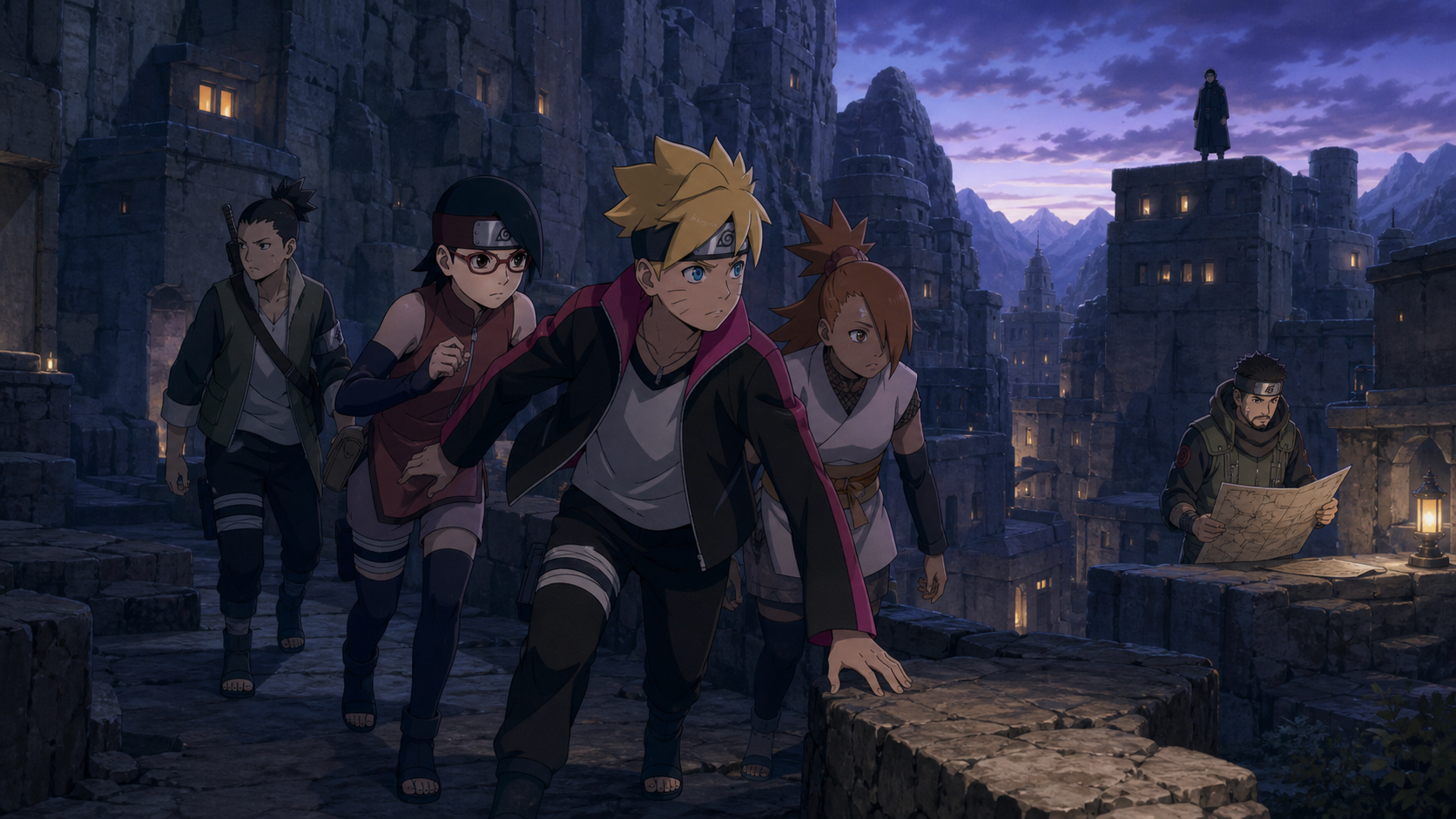
Infiltrating the Hidden Stone Village
The easiest infiltration in the shinobi world leads Boruto straight to the grandfather behind the problem, while Inojin and Akkun quietly give the episode its heart.
Series: Boruto: Naruto Next Generations
Episode: 82 · Infiltrating the Hidden Stone Village
Arc: Mitsuki Disappearance Arc
Release: 2018-11-18
Previous: Episode 81 · Boruto’s Wish
Directory: All 293 Boruto episodes
Bottom line
Boruto Episode 82 gets four runaway genin into the Hidden Stone Village through a water pipe, lets Chōchō’s stomach nearly expose the whole mission, and then acts surprised when the old man they came to trust is standing beside the people hunting them. I laughed at the infiltration because the security is ridiculous. I also liked the episode more on replay because the easy entry is part of the warning. Iwagakure looks calm enough for children to wander through, yet the village’s leader is missing, Akatsuchi is following strangers instead of confronting them, and Ōnoki already knows far more than he admits. Normal life has become camouflage.
The best material belongs to Inojin and Akkun. Inojin stays behind because one tiny Akuta has decided that he is safe, and the episode lets that bond grow through food, imitation, a burial and a name. No speech about souls can do as much work as Akkun copying Inojin’s hands after watching him bury a dead creature. Meanwhile, Konohamaru finally volunteers to go after his students. Thank you. A teacher entering the search should not feel like a plot twist, but Team 7 has spent enough time running around the Land of Earth without him that his decision lands anyway.
Episode 82 works as a transition chapter with actual character meat. The comedy sometimes makes the Hidden Stone look embarrassingly easy to breach, and Ōnoki’s final reveal depends on Boruto trusting the exact elder who has been connected to this mystery from the start. Still, the episode gives the Mitsuki Disappearance Arc a sharper problem. Boruto is no longer chasing only Mitsuki. He has walked into another village’s family fight, and the grandfather at the center has been building something he refuses to explain.
Episode file
“Infiltrating the Hidden Stone Village” is Boruto: Naruto Next Generations Episode 82 and part of the Mitsuki Disappearance Arc. The episode first aired in Japan on November 18, 2018. The official Naruto episode guide places Boruto, Sarada, Shikadai and Chōchō inside Iwagakure while Inojin remains with the young Akuta. Konoha also loses contact with the advance search party and prepares another team, with Konohamaru volunteering for the mission.
That setup matters because the episode splits responsibility three ways. Boruto’s group keeps moving without permission. Inojin accepts care for a creature that the shinobi system treats as disposable. Konohamaru chooses to follow after the adults finally realize how far the children have gone. None of those threads solves the crisis, but each thread asks what loyalty looks like when orders, friendships and basic common sense stop lining up.
The infiltration is funny until you think about why nobody stops them
Boruto, Sarada, Shikadai and Chōchō reach the Hidden Stone and find the main entrance suspiciously quiet. Their answer is to crawl through the village’s water system. Naturally. Nothing says “we come in peace” like four foreign shinobi slipping through public infrastructure because the front gate feels too easy. Shikadai understands the risk, Sarada watches their surroundings, and Boruto keeps the group moving because waiting has never been his favorite skill. Chōchō mostly wants food, which becomes both the joke and the reason they get useful information.
The sequence is light, but the lack of resistance bothered me more the second time. These kids have crossed into a major hidden village during a leadership crisis. Kurotsuchi has disappeared. Konoha’s scouts have gone silent. Ku and the Fabrications are already operating around Iwa. Yet four recognizable Leaf genin can climb out of a pipe, walk the streets and ask questions about a former Tsuchikage. The village is either painfully unprepared or somebody wants them to keep walking.
Akatsuchi’s distant surveillance supports the second reading. He notices the group and follows them, but he does not sound an alarm. Boruto thinks the team is being sneaky. Sarada and Shikadai are competent enough to avoid obvious attention. Akatsuchi still knows exactly where they are. The episode turns the children’s confidence into a quiet joke at their expense, then leaves us wondering whether Akatsuchi is protecting them, studying them or making sure they reach a planned destination.
Chōchō’s stomach does what the mission plan cannot
Chōchō’s hunger draws attention, pushes the group into a restaurant and cracks open the search for Ōnoki. The joke is very Chōchō: everyone else is carrying the weight of international trespassing, and her body refuses to pretend that teenagers can run forever without eating. I will take that over another speech about determination. Food remains one of the few things in this arc that feels stubbornly normal.
The restaurant owner adores Ōnoki, so the group leans into their connection with the former Tsuchikage. Their admiration is not fake. Boruto met Ōnoki during the Five Kage Summit visit and remembers the old man as blunt, strange and important. That small relationship gives the children a route that rank and official permission could not. The owner points them toward Ōnoki’s home because affection opens doors faster than interrogation.
Chōchō also keeps the group from becoming four copies of the same worried face. Sarada carries the tactical concern. Shikadai notices patterns and asks whether Kokuyō really represents Iwagakure. Boruto pushes toward Mitsuki. Chōchō watches people, complains, eats and refuses to turn the mission into sacred suffering. Her comedy can become repetitive when the writing stops at “Chōchō is hungry,” but Episode 82 uses hunger to move the plot and reveal how ordinary residents still talk about Ōnoki. That is a better use of the gag.
Akatsuchi knows more than he says
The group reaches Ōnoki’s home and finds Akatsuchi waiting. For longtime Naruto viewers, his return carries history. Akatsuchi served beside Ōnoki and Kurotsuchi during the Fourth Shinobi War, so his presence immediately connects Boruto’s current mystery to the Stone leadership we already know. He is not a random guard who happens to recognize some Leaf children.
Akatsuchi reveals that Naruto warned him Boruto’s group might arrive. That detail is funny and frustrating. Naruto understands his son well enough to predict the destination, yet Konoha still cannot stop Boruto from crossing another national border. Parent and Hokage are pulling Naruto in opposite directions again. He can anticipate Boruto’s heart, but the office keeps responding after the boy has already acted.
We also learn that Kurotsuchi has disappeared and that the public story does not explain what is happening. The village keeps functioning while the current Tsuchikage is missing. That should set off every alarm in Shikadai’s head. He notices that the Hidden Stone looks normal and concludes that Kokuyō probably belongs to a secret group rather than the official village forces. Shikadai is right to separate the people walking through the market from the attackers who took Mitsuki. He is also missing the family connection underneath the operation.
Akatsuchi leads the group toward the old quarter, where Ōnoki is staying. I kept watching Akatsuchi’s face on replay because his choices are careful. He does not hand the children to security. He does not tell them everything. He brings them to the one person they came to see. His loyalty to Ōnoki and concern for Kurotsuchi are about to collide, and Episode 82 leaves him standing directly between those loyalties.
Ōnoki is exactly the wrong person to trust, which is why Boruto trusts him
Boruto’s faith in Ōnoki makes emotional sense. Ōnoki is a former Kage who knows Naruto, knows the history of the villages and treated Boruto warmly before. Boruto sees an elder with enough authority to cut through secrecy. He does not see the man’s old habits clearly enough. Naruto: Shippuden introduced Ōnoki as a leader shaped by war, suspicion and the ugly bargains villages made to survive. Naruto helped change him, but peace did not erase the fear underneath his decisions.
The meeting begins warmly. Ōnoki is glad to see the children. Then Boruto explains why they came, and the old man shuts the door on their request. That turn hurts because Ōnoki does not need time to understand the situation. He already understands. His refusal is not confusion or caution. His refusal protects his own plan.
Ku arrives with the Akuta and stands beside Ōnoki, exposing the relationship that the arc has been circling. The children did not find a neutral elder who can rescue Mitsuki. They found the father figure behind the Fabrications. Ku’s use of family language matters more than a generic villain entrance. Ōnoki has created a new generation and tied their existence to his judgment. Mitsuki’s artificial body now looks less like a curiosity and more like an answer the Fabrications desperately need.
The episode ends before Ōnoki explains the entire project, which is the correct choice. His presence changes the question from “Who took Mitsuki?” to “What did Ōnoki build, and what did he tell himself to make the choice acceptable?” That second question belongs to Naruto’s world. The franchise has always been interested in adults who turn children into tools while insisting that necessity left no alternative.
Inojin and Akkun quietly steal the episode
While the others infiltrate Iwa, Inojin remains in the cave with the small Akuta. Leaving him behind is practical because Akkun is attached to him and cannot join a covert trip through the village. The separation also gives Inojin room to make a choice without Shikadai’s strategy, Chōchō’s jokes or Boruto’s urgency filling the scene.
Akkun finds a dead animal, and Inojin buries the body. The gesture is simple. Inojin does not dismiss death because the animal is small, and he does not treat the Akuta’s reaction as meaningless because Akkun was manufactured. Akkun watches, learns and copies. That imitation carries more emotional force than the arc’s repeated arguments over whether artificial beings have wills. A creature that recognizes loss, watches a ritual and tries to repeat the care shown by another person is doing more than following a combat command.
Inojin also lets the little Akuta choose a name. “Akkun” is not grand, but ownership of a name is huge for a being created as part of a disposable group. Inojin does not assign a serial number or demand proof of intelligence first. He offers choices and accepts the answer. The scene shows respect before anyone has settled the scientific question.
I like Inojin more every time this arc gives him quiet work. He inherited sensory and communication techniques from Ino and artistic jutsu from Sai, but his best trait here is neither power. He pays attention. Sai spent much of his early life learning emotions from books and observation. Inojin meeting a creature that is also learning how people behave creates a lovely echo without forcing a speech about his father.
Konohamaru finally follows his students
Back in Konoha, the adults lose contact with the first search team and decide to send more people into the Land of Earth. Konohamaru volunteers. My immediate reaction was relief followed by irritation: yes, their jonin instructor should be part of the effort to recover Team 7. The story has kept him away long enough that ordinary responsibility feels heroic.
Konohamaru’s decision still matters. Mitsuki, Boruto and Sarada are not names on a mission board to him. He trained them, watched their weaknesses and helped shape the team. He has also spent this arc learning how little control an instructor has once students decide friendship outranks orders. Going after them is partly duty and partly guilt.
The next step must give Konohamaru more than worried running. Boruto has already crossed the border. Sarada has taken on leadership under pressure. Mitsuki has chosen a path nobody understands. Konohamaru needs to meet those choices as a teacher, not only as backup muscle. Naruto grew up with adults arriving late or failing him completely. The sequel should know better than to repeat that pattern without examining the cost.
What changed every time I replayed the episode
On the first watch, I focused on the reveal. Ōnoki standing beside Ku is the episode’s loudest moment, and the image reframes the entire search. The grandfather Boruto expects to solve the problem has his hands inside the problem.
On the second watch, Akatsuchi became more interesting. His surveillance turns the infiltration into a guided walk. He knows Naruto expects the children, knows Kurotsuchi is missing and knows where Ōnoki can be found. Every delay and omission starts to look intentional. Akatsuchi may not understand the whole project, but he is already deciding which loyalty gets his protection.
On the third watch, Inojin and Akkun became the center. The burial and naming scene provides the emotional argument that Ōnoki’s project lacks. Ōnoki talks through creations, strategy and purpose. Inojin treats one created life as a particular being with preferences. The difference is care without ownership.
The comedy also became more useful on replay. Chōchō’s hunger is not subtle, and the water-pipe entry makes the Stone’s security look foolish. Both choices keep the episode from becoming a gray hallway of exposition. Boruto’s team still feels like a group of children who are improvising, getting lucky and trusting personal connections. That texture makes the final trap believable because their success was never the same thing as control.
What works
The episode balances three locations without losing the main line. The Hidden Stone material moves the mystery forward. Inojin gives the Akuta conflict a heart. Konoha brings Konohamaru back into the search. Each thread advances a different relationship rather than repeating the same information.
The character division also works. Shikadai analyzes the village. Sarada stays alert. Boruto supplies momentum. Chōchō gets them fed and accidentally gets them a lead. Inojin handles the fragile creature nobody else can reach. No giant fight is needed for the group’s personalities to stay visible.
Ōnoki’s reveal earns attention because the franchise already gave him a complicated history. A random scientist would turn the Fabrications into another laboratory problem. Ōnoki brings the political memory of the Hidden Stone, the damage of earlier wars and the fear that peace may not last. I do not approve of his choices, but I understand why this specific man could convince himself that manufactured soldiers are protection.
What does not work
The Hidden Stone security is hard to defend. Peace explains fewer guards, not an open route through critical water infrastructure while the Tsuchikage is missing. The episode needed one stronger indication that Akatsuchi or Ku deliberately allowed the children to enter. Without that signal, Iwagakure looks incompetent at the exact moment the arc wants the village to feel controlled from the shadows.
The restaurant sequence leans on strangers sharing information too easily. The owner’s love for Ōnoki makes the conversation charming, but four unfamiliar kids asking for a former Kage’s home should attract more suspicion. A line showing that the owner recognized them from the Five Kage visit, or that Akatsuchi quietly approved the answer, would close that gap.
Konohamaru’s return arrives late. The adult search plot has repeated meetings and reports while the children crossed countries, fought Fabrications and followed Mitsuki toward Iwa. Episode 82 finally moves the teacher, but the story has to make his presence count. Another stretch of Konohamaru chasing footprints would waste the emotional setup.
The group enters Iwagakure as children carrying incomplete evidence
Boruto, Sarada, Shikadai, Chōchō, and Inojin have survived enough danger to trust their instincts. They still enter another hidden village without authorization, a complete map of the conspiracy, or adult protection.
The infiltration succeeds partly because Iwagakure remains a functioning home rather than a fortress expecting foreign genin. Ordinary residents see hungry children, not an international incident.
That gap gives the mission charm and danger. The same openness that helps the children search could let the secret force move through public life unnoticed.
Akatsuchi's caution protects information and delays rescue
Akatsuchi recognizes that something inside the village is wrong and cannot reveal every suspicion to children he has only just encountered. His caution makes sense inside a takeover where authority may already be compromised.
Silence also leaves the children walking toward Ōnoki without the warning Akatsuchi is best positioned to provide. Protecting information can become another way younger people inherit danger adults understood first.
The episode needs that tension. Akatsuchi is not foolish or uncaring. He is operating inside uncertainty while the cost of waiting keeps rising.
Akkun receives care before proving strategic value
Inojin names Akkun, worries about the small body, and creates a grave because the connection mattered before anyone knew whether Akkun could help the mission.
That sequence separates relationship from utility. Akkun does not earn tenderness through combat strength, intelligence, or a dramatic rescue. Vulnerability is enough to invite care.
The contrast with Ōnoki's project becomes brutal. One child sees a created being and asks how to honor a short life. One elder sees created beings and asks how their deaths can spare somebody else.
Konohamaru's pursuit must become accountability when he arrives
Following the students is necessary, but locating them cannot be the end of the adult storyline. Konohamaru needs to confront why Team 7 believed they had to cross borders without him and why Mitsuki expected independent answers to require disappearance.
The children own their disobedience. Their leader owns the communication, trust, and supervision conditions surrounding that disobedience.
Rescue should include protection, consequences, and an honest review of how the team reached this point.
Ōnoki changes the mission from locating a victim to confronting a creator
Boruto expects an elder capable of exposing the force manipulating Mitsuki and Iwagakure. Finding Ōnoki at the center turns the trusted authority into part of the evidence.
The reveal does not prove Mitsuki lacks agency. The reveal makes agency harder to read because created beings, assigned purpose, grief, and secret authority now shape the choices around him.
Boruto can no longer solve the arc by defeating strangers and bringing Mitsuki home. He has to understand what a revered protector created, why Mitsuki stayed, and which harms cannot be excused by the word family.
Final take
“Infiltrating the Hidden Stone Village” is a setup episode with enough personality to avoid feeling like a loading screen. The water-pipe break-in is silly. Chōchō weaponizes lunch. Shikadai starts pulling apart the difference between Iwagakure and the secret force operating inside the village. Akatsuchi plays a careful game. Konohamaru finally gets moving. Then Ōnoki turns Boruto’s safest connection into the most dangerous room in the arc.
Inojin and Akkun give the episode its soul. Their small scenes ask whether created life earns care before power, usefulness or perfect speech. Inojin answers with a grave and a name. Ōnoki answers with an army and a plan. That contrast is the reason Episode 82 matters beyond the cliffhanger.
Boruto came to the Hidden Stone looking for an elder who could cut through the lies. He found an elder who built the lie and called the result family. Now the arc has to make Ōnoki explain himself without flattening him into a cackling villain. His fear, pride and history should make the choice understandable. Nothing in that history should make the damage acceptable.
Sources and lawful viewing
Official episode reference: Naruto Official episode guide
Licensed episode route: Crunchyroll licensed series page