
Boruto’s Wish
Boruto sleeps through the debate, Garaga crashes his perfect Team 7 dream, and Inojin accidentally becomes the safest person in one tiny Akuta’s world.
Series: Boruto: Naruto Next Generations
Episode: 81 · Boruto’s Wish
Arc: Mitsuki Disappearance Arc
Release: 2018-11-11
Previous: Episode 80 · Mitsuki’s Friend
Directory: All 293 Boruto episodes
Bottom line
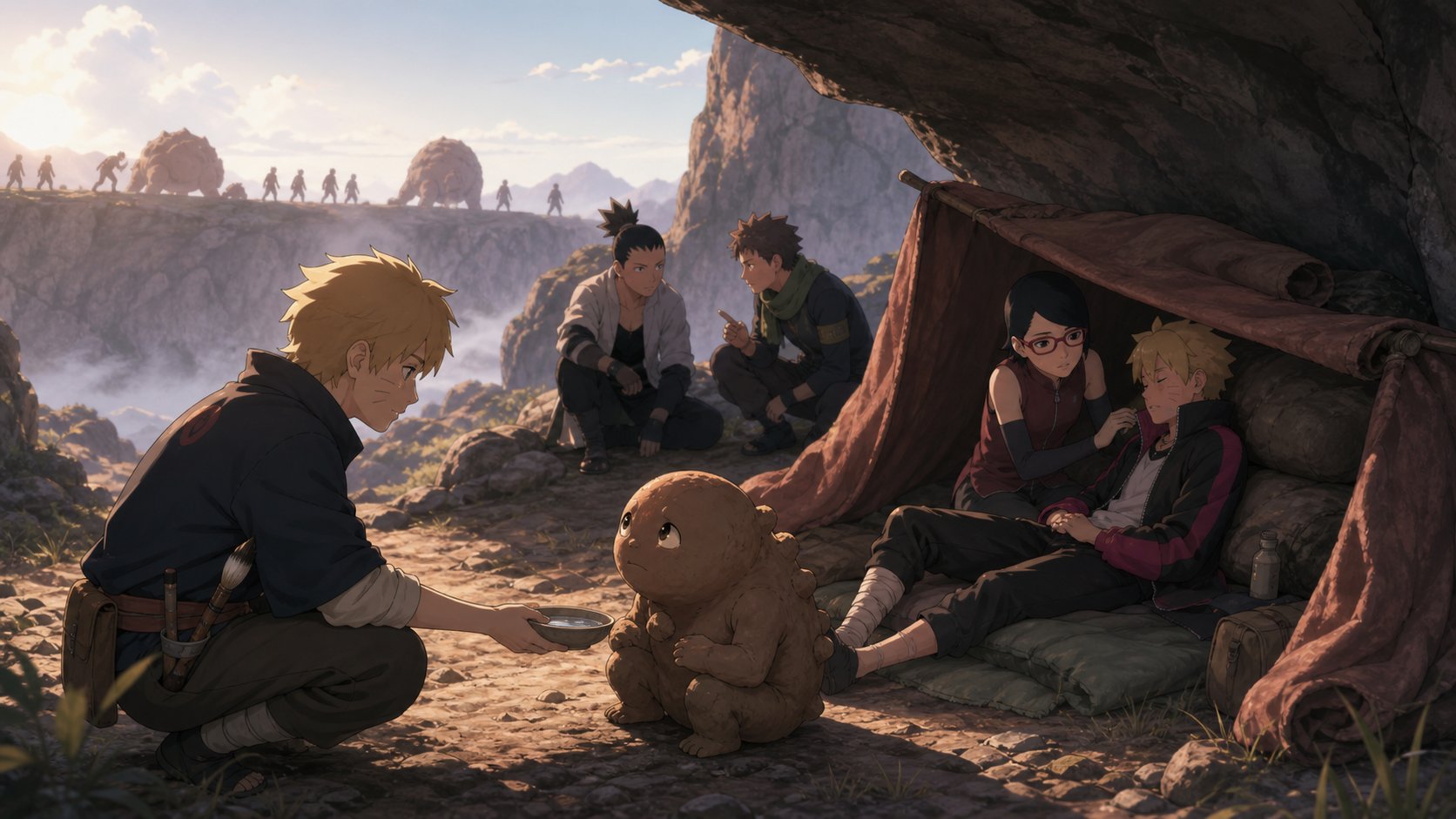
Boruto Episode 81 puts the main character to sleep and somehow gives Inojin the best material. That is not an insult. Boruto needs the pause after Mitsuki knocks him unconscious, and Inojin needs a story that lets his tenderness show without turning him into a smaller copy of Ino or Sai. The little Akuta attaches itself to him, chases animals, gets scolded and keeps coming back. The creature looks like a lump of animated dirt with the survival instincts of a puppy and the timing of a toddler. I was done the second the tiny thing looked at Inojin like he had personally invented safety.
The episode is slower than the chapters around this one, and some viewers will call the dream sequence padding. I understand the complaint. Boruto dreams about the version of Team 7 he wants, Garaga crashes the fantasy, and the answer is still “keep chasing Mitsuki.” We did not need twenty minutes to learn that Boruto is stubborn. The dream does clarify what kind of stubbornness is driving him. He is no longer pretending Mitsuki did not hurt him. Boruto chooses to pursue the truth while admitting that his friend may reject him again.
The title says “Boruto’s Wish,” but the episode belongs just as much to the wishes nobody can say cleanly. Sarada wants Boruto awake and Team 7 restored. Shikadai wants enough evidence to justify continuing a mission that could get all of them punished. Inojin wants a harmless creature to remain harmless. The Akuta wants to stay near the first person who offered gentle care. None of those wishes comes with a guarantee, and that uncertainty gives a quiet episode some weight.
Episode file
“Boruto’s Wish” is Boruto: Naruto Next Generations Episode 81 and part of the Mitsuki Disappearance Arc. The episode first aired in Japan on November 11, 2018. Boruto remains unconscious after Mitsuki’s attack while Sarada, Shikadai, Inojin and Chōchō decide whether to return to Konoha or continue toward the Land of Earth. One damaged Akuta reforms and becomes attached to Inojin. Inside Boruto’s dream, Garaga forces him to stop hiding inside a painless version of Team 7.
The episode gives us three practical decisions. The group must choose whether Mitsuki is still worth following. Shikadai must decide whether the small Akuta is a threat, evidence or both. Boruto must wake up and name what he actually wants after the friend he came to rescue attacked him. The plot barely moves on a map, but the characters redraw their reasons for moving.
Mitsuki’s hit lands after the fight is over
Sarada watches Mitsuki strike Boruto and leave with Kokuyō’s group. Her face carries the confusion that Boruto cannot process while unconscious. Mitsuki did not miss. He did not make a private signal that only Team 7 could understand. He hit Boruto hard enough to end the argument and kept walking. Whatever hidden plan viewers may suspect, Sarada has to deal with the action in front of her.
That distinction matters because Boruto has spent the arc turning faith into evidence. He believes Mitsuki cannot truly abandon them, so every hostile choice becomes another clue pointing toward coercion or secret sacrifice. Friendship can motivate a search. Friendship cannot erase what happened. Episode 81 finally lets the pain enter the conversation through Boruto’s body. The ache follows him into the dream even when his mind tries to rebuild a happy Team 7.
Sarada’s first instinct is to return to Konoha and report what they know. She has a point. They are injured, outside the village without permission and near another nation’s border. The enemies are stronger than expected. Her caution is not cowardice. Sarada is reading the difference between loyalty and a group suicide pact.
Shikadai refuses to treat the Akuta as a side problem
Shikadai weighs the danger differently. The group has found living weapons operating around the Land of Earth, and one of those beings has just reconstructed itself after damage. Returning home may protect the team, but leaving without learning more could abandon a threat that reaches beyond Mitsuki. He wants evidence, and the small Akuta has become evidence with legs.
This is one of Shikadai’s better leadership moments because he does not make the choice sound glamorous. Continuing is troublesome, dangerous and likely to make their punishment worse. He still sees a larger problem forming. The peace their parents fought for depends on hidden villages sharing enough information to stop secret armies before those armies become wars. A group of artificial fighters moving outside official control is exactly the kind of mess adults will dismiss until somebody attacks a village.
Shikadai also refuses to destroy the small Akuta merely because the larger ones attacked them. He watches current behavior. The creature is curious, attached to Inojin and not showing the aggression they saw before. That judgment is practical rather than sentimental. A living example can prove that the Akuta exist and may help them understand how the creatures work.
Inojin accidentally becomes somebody’s mother
Inojin and Chōchō scout the area while Boruto rests. The little Akuta follows Inojin with immediate, ridiculous devotion. Chōchō notices the attachment and reacts with the exact energy the scene needs. Nobody asked Inojin whether he wanted a clay baby. The clay baby has already decided.
Inojin tries to entertain the creature by drawing birds for the Akuta to chase. That goes well until the Akuta targets a rabbit. His response is important. He stops the attack and sets a boundary instead of punishing the creature for having instincts he helped activate. The Akuta is learning from him in real time. Inojin discovers that cute does not mean harmless and dangerous does not mean incapable of learning.
The relationship also fits Inojin specifically. Sai had to study emotion after Root trained ordinary human connection out of him. Ino reads minds, carries family knowledge and notices changes other people miss. Their son meets a being whose feelings are still forming and responds with observation, annoyance and care. He does not deliver a philosophy lecture. He feeds the creature, watches what the creature does and keeps the Akuta close enough to understand.
The little Akuta is cute, but the episode keeps the danger visible
The Akuta’s design does a lot of work. The larger versions resemble crude soldiers built from earth. This one is small, unstable and expressive enough to make the group hesitate. The visual difference encourages affection, which is useful and slightly manipulative. Of course viewers are more willing to question the enemy label when the creature looks like a lost pet.
Episode 81 earns that manipulation by keeping the teeth in the scene. The Akuta reforms after damage. The creature chases prey. Nobody knows whether Ku or another Fabrication can control the little being. Shikadai’s choice to keep the Akuta nearby is calculated risk, not proof that every clay soldier is secretly sweet.
The stronger point is individuality. A common origin does not produce identical behavior. Mitsuki came from Orochimaru’s laboratory and still became his own person. The Fabrications call themselves created beings, but Sekiei, Kokuyō and the small Akuta already respond to the world differently. Boruto’s generation keeps meeting people whose birth or construction was decided by powerful adults. The moral question begins after creation: who gets to choose what that life becomes?
Boruto builds the dream he wants, then Garaga wrecks the fantasy
Inside Boruto’s unconscious mind, Team 7 is whole again. Mitsuki has not left. The village feels safe. Boruto can stay inside a version of friendship where the attack never happened. Then Garaga arrives with all the warmth of an angry demolition crew.
Garaga is the right character to break the fantasy because betrayal defines his own history. He made a wager with Boruto over Mitsuki’s loyalty and expects the boy to face the result. Garaga has no patience for soft explanations. From his perspective, Mitsuki has already proven the point: trust gets you hurt, and anyone pretending otherwise is running from the lesson.
The dream chase can feel repetitive because Boruto’s answer has been obvious for several episodes. He will not abandon Mitsuki. What changes is his reason. At first, Boruto pursues a friend he assumes must be secretly innocent. After Garaga corners him, Boruto recognizes the dream and the pain Mitsuki caused. He wakes with the same goal but less fantasy. He wants to hear Mitsuki’s answer directly, even if that answer hurts.
Garaga gives better advice than he intends
Garaga thinks he is teaching Boruto that betrayal proves friendship foolish. Boruto hears a different lesson. If he keeps chasing only the Mitsuki he remembers, he will never learn why the real Mitsuki left. The wish for Team 7 to return cannot replace a conversation with the person who broke the team.
I like that Boruto thanks Garaga. Their relationship is built on irritation, pride and a bet neither one wants to lose. Garaga does not become a cuddly mentor because he helped. He remains a bitter giant snake who would enjoy saying “I told you so” from the top of a mountain. Boruto takes the useful piece and leaves the cynicism behind.
The scene also creates a small bridge back to Naruto’s own history with summons. Naruto often learned from creatures who did not respect village rank or family reputation. Garaga talks to Boruto as the reckless kid in front of him, not as the Hokage’s son. That bluntness reaches him when speeches from adults would probably bounce off.
Sarada and Shikadai should not have to wait for Boruto’s vote
When Boruto wakes, Shikadai asks what he thinks they should do next. The group then follows his decision to continue. This bothered me. Sarada has already made a reasonable case for returning. Shikadai has identified a wider security threat. Inojin is now responsible for an unknown creature. Chōchō has traveled and fought beside them. Four conscious people do not need the injured boy to become a committee.
Boruto is central because Mitsuki is his teammate and the search began with his refusal to stay home. Central does not mean sole authority. The series sometimes confuses protagonist status with leadership competence. Shikadai is the chunin in the group. Sarada wants to become Hokage and has repeatedly shown tactical judgment. Their voices should shape the decision rather than orbit Boruto’s resolve.
The final choice makes sense as a group choice. They have evidence of a serious threat, a route into the Land of Earth and a possible ally in Ōnoki. The scene would be stronger if the episode let each person consent to the risk on screen. Friendship stories work better when everybody has agency, not when one determined boy supplies enough agency for the room.
Ōnoki looks like the perfect answer because Boruto remembers only the invitation
Boruto decides to seek Ōnoki, recalling the former Tsuchikage’s invitation to visit if he ever came to the Land of Earth. On paper, the plan is smart. Ōnoki knows the region, understands hidden-village politics and has enough status to investigate without treating Leaf genin as ordinary trespassers.
The choice also reveals Boruto’s blind spot. He remembers the friendly grandfather from the summit visit. He does not fully carry Ōnoki’s history from Naruto: Shippuden. The old man helped save the world, but he also led Iwagakure through years of suspicion, mercenary deals and war. Peace changed his outlook without erasing every fear that shaped him.
Viewers already know the arc is pulling toward Stone leadership. Mitsuki’s artificial body, the Fabrications, Kurotsuchi’s disappearance and Ōnoki’s scientific interest are too closely aligned for the visit to remain friendly. Boruto’s plan feels hopeful because he trusts a personal connection. The same trust is about to walk the group into the center of the operation.
What changed every time I replayed the episode
On the first watch, the episode felt like a pause inserted between Mitsuki’s attack and the Hidden Stone. The dream repeats Boruto’s determination, and the group ends by choosing the destination viewers already expect. I understood why people called the chapter slow.
On the second watch, Inojin’s scenes changed the balance. His bond with the Akuta introduces the emotional question that will make the rest of the arc hurt. The Fabrications are no longer one gray enemy category. A tiny creature can learn, attach, hunt, obey and seek comfort. Those contradictions give the created beings more life than another exposition dump could.
On the third watch, Sarada’s position became the most sympathetic. She watched Mitsuki attack Boruto, carried him to safety and still had to argue that returning home might be reasonable. Her caution is treated as an obstacle to the adventure when the episode should recognize caution as part of leadership. Boruto’s wish matters. Sarada’s fear and judgment matter too.
Garaga also improved on replay. His interruption is funny because he invades Boruto’s perfect dream like a debt collector. The giant snake is cruel, but he makes Boruto face the wound instead of sleeping inside denial. Sometimes the friend who helps is the friend who yells at you from inside your own subconscious. Apparently.
What works
Inojin and the Akuta work. Their scenes are specific, funny and quietly sad because viewers can already sense how fragile this attachment will be. The episode gives Inojin a role nobody else in the group could fill the same way.
Garaga works as Boruto’s unwanted truth teller. His bitterness prevents the dream from becoming sentimental Team 7 filler. Boruto cannot simply announce that friendship conquers betrayal. He has to acknowledge the betrayal and choose what comes next.
The debate over returning to Konoha also works as a reminder that the mission has consequences. These children are not on an approved rescue operation. Every mile creates more danger, more political risk and a larger punishment waiting at home. The episode is strongest when that weight stays visible beneath the cute Akuta scenes.
What does not work
The pacing drags in the dream because Boruto’s conclusion is predictable. A tighter sequence could preserve Garaga’s challenge, the false Team 7 and the physical reminder of Mitsuki’s blow without circling the same choice for so long.
The group gives Boruto too much control after he wakes. Sarada and Shikadai have already done the hard work of assessing evidence while he was unconscious. Asking for his view is fair. Treating his answer as the deciding vote undercuts the other characters.
The episode also postpones medical reality. Boruto wakes after a serious hit and immediately resumes an unauthorized cross-country pursuit. Naruto has healers, field medicine and consequences for injuries when the plot wants them. Here, recovery mostly means opening his eyes. A few more signs of lingering pain or limits would make Mitsuki’s attack feel less temporary.
Boruto waking does not reset the group's judgment
Sarada, Shikadai, Chōchō, and Inojin spent his unconscious hours comparing evidence, protecting the camp, and deciding what risks remained acceptable. Boruto's return adds an important voice. His return does not erase the work already done.
The group needs a decision built from everyone who will carry the consequences. Friendship with Mitsuki gives Boruto emotional knowledge. Sarada's caution, Shikadai's analysis, and the others' observations give the pursuit necessary boundaries.
Leadership becomes weaker when concern for the loudest friend turns consultation into a final vote.
A serious hit should remain present after Boruto opens his eyes
Mitsuki strikes Boruto hard enough to end the confrontation and leave him unconscious. Waking should not make pain, disorientation, or possible injury disappear because the plot needs travel.
Lingering limits would strengthen the emotional wound. Boruto is not only processing rejection; his body carries evidence that Mitsuki chose force to protect the departure.
Care should include checking whether Boruto can continue safely, not accepting determination as a medical clearance.
Akkun becomes an individual through repeated small choices
The little Akuta follows Inojin, seeks safety, responds to care, and develops behavior that exceeds the category enemy unit. No single action proves a complete human-like mind.
The pattern is enough to demand caution before treating the creature as disposable. Moral attention can begin before scientific certainty reaches a final label.
Inojin offers food, protection, and a name because the life in front of him appears capable of fear and attachment. Care becomes the responsible response to uncertainty.
Garaga recognizes the danger inside Boruto's perfect reunion
Boruto dreams of Team 7 restored exactly as he remembers the team. Garaga attacks the fantasy because betrayal taught him that another person's choice can permanently alter a relationship.
The snake's cynicism is not the whole truth. The warning remains valuable. Wanting Mitsuki back can become a refusal to meet the person Mitsuki became while away.
Boruto must search for Mitsuki without demanding that rescue return the old arrangement untouched.
Ōnoki appears trustworthy because memory edits out uncertainty
Boruto remembers the former Tsuchikage as a respected elder who invited him to visit and spoke with the weight of history. That memory makes Ōnoki feel like a safe authority inside an unfamiliar village.
Respectable history cannot function as current evidence. Boruto knows almost nothing about the project, the Akuta, or which officials remain free to act.
Seeking Ōnoki is reasonable. Treating the legend as proof before asking questions would repeat Boruto's mistake with his idealized Mitsuki.
A wish can guide the search without deciding the answer
Boruto wants Mitsuki alive, safe, and willing to return. The wish gives him a reason to keep moving after pain, uncertainty, and Garaga's challenge.
The wish cannot determine whether Mitsuki regrets leaving, how he understands Boruto, or what conditions any reunion will require. Those answers belong to Mitsuki.
Friendship becomes more mature when Boruto protects the possibility of an answer he does not prefer.
Final take
“Boruto’s Wish” will not satisfy viewers waiting for a fight or a major answer. The episode stays in one emotional holding area while Boruto sleeps, his friends debate and a clay creature falls in love with Inojin. That sounds skippable until the Akuta starts behaving like an individual and Garaga forces Boruto to admit that his ideal Team 7 is gone.
Inojin carries the hour. His care is funny because he never volunteered to become a parent, and moving because he responds to the creature in front of him instead of the category attached to its body. Shikadai sees evidence. Chōchō sees the absurdity. Sarada sees the danger. Inojin sees somebody following him because nobody else feels safe.
Boruto wakes with a wish, not an answer. He still wants Mitsuki back. The important change is that he can no longer claim friendship guarantees the ending. He chooses to find Ōnoki and keep moving because he needs Mitsuki’s truth, even if that truth breaks the version of Team 7 waiting inside his dream. That is enough movement for a quiet episode, though the next chapter needs to reward the patience.
Sources and lawful viewing
Official episode reference: Naruto Official episode guide
Licensed episode route: Crunchyroll licensed series page