
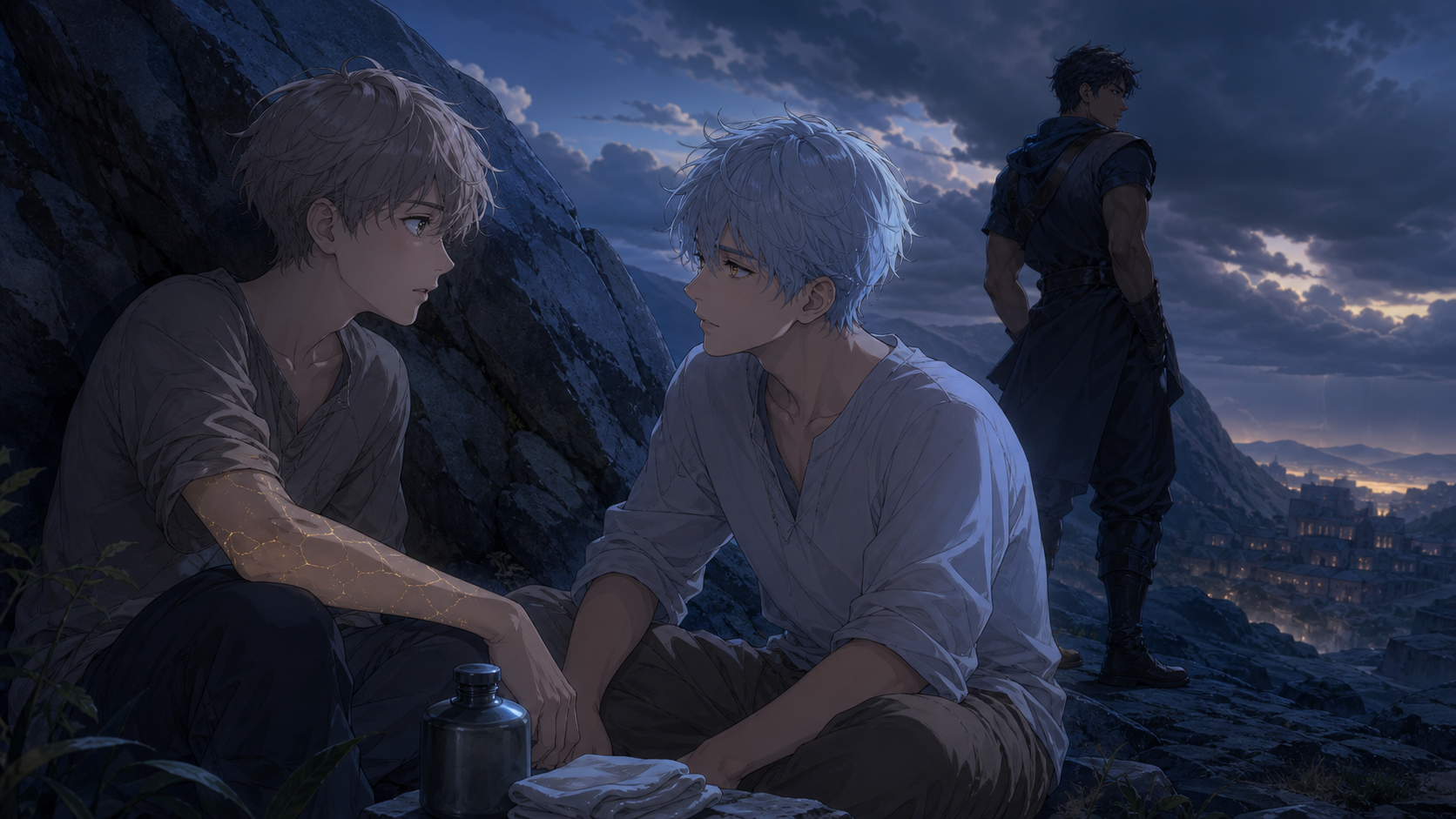
Mitsuki’s Friend
Sekiei asks Mitsuki what human life feels like, protects his secret, and calls him a friend while Ku turns the search for artificial hearts into a coup.
Series: Boruto: Naruto Next Generations
Episode: 80 · Mitsuki’s Friend
Arc: Mitsuki Disappearance Arc
Release: 2018-11-04
Previous: Episode 79 · Reunion with Mitsuki
Directory: All 293 Boruto episodes
Bottom line
Boruto Episode 80 finally lets Mitsuki talk to somebody who understands what “created” feels like without already deciding what Mitsuki should become. Sekiei is curious, sick, dangerous and painfully young. He asks about humans because his makers gave him a mission, a failing body and almost no ordinary life. Mitsuki answers with the calm voice that makes him sound certain even when he is still sorting through the question himself. Their friendship is real. Their situation is also a trap built by people who know Sekiei’s body will keep him dependent.
The episode works because Mitsuki does not spend the entire time talking about Boruto. He talks about eating, sleeping, laughing, feeling pain and the strange daily habits that make human life more than a body type. Sekiei listens like somebody hearing that existence can include choices beyond becoming useful and dying on schedule. Then he discovers that Mitsuki left a message for Boruto and chooses to keep the secret. That decision is small, reckless and fully his own.
Meanwhile, Ku attacks Kurotsuchi and demands that she step down as Tsuchikage. The story is no longer pretending that the Fabrications are wandering experiments with unclear goals. They are staging a coup, controlling access to Ōnoki and moving against Iwagakure’s elected leadership. Sekiei’s sweetness cannot soften that fact. The episode’s tension comes from holding both truths at once: the artificial young man beside Mitsuki deserves care, and the organization keeping him alive is using created lives to seize a village.
Episode file
“Mitsuki’s Friend” is Boruto: Naruto Next Generations Episode 80 and part of the Mitsuki Disappearance Arc. The episode first aired in Japan on November 4, 2018. Mitsuki continues traveling with Kokuyō and Sekiei after attacking Boruto. Sekiei’s body begins deteriorating, so Kokuyō leaves to bring help. During that wait, Sekiei asks Mitsuki about human life and learns more about the night Mitsuki left Konoha. In Iwagakure, Kurotsuchi visits her ailing grandfather and is attacked by Ku’s group.
Episode 80 is light on action after the fight in Episode 79, but the quiet is useful. Mitsuki reveals more through conversation than he did through the attack. Sekiei shows that the Fabrications already have different wants and loyalties. Kurotsuchi’s capture turns the personal mystery into a political takeover.
Mitsuki chose the road, but he did not surrender his plan
The episode returns to the night Mitsuki left Konoha. Sekiei, Kokuyō and Kirara meet him outside the village and explain that Ku wants Mitsuki brought to the Land of Earth alive. Mitsuki has received Sekiei’s letter and decides to follow because the group may lead him to the person who can answer his questions about will, creation and choice.
That flashback matters after Episode 79. Boruto sees Mitsuki attack him and assumes the friend he knows has disappeared behind coercion or deception. Episode 80 confirms that Mitsuki made a choice while also protecting a private objective. He incapacitates the gate guard instead of killing him and leaves one of his snakes behind to carry a message to Boruto. Mitsuki is not mindlessly obeying Ku. He is controlling what information each side receives.
Kokuyō’s suspicion is justified from his perspective. Mitsuki is an unknown artificial human with ties to Konoha, Orochimaru and Team 7. Letting him walk into the heart of their operation without testing him would be foolish. Sekiei keeps arguing for him, partly because Mitsuki fascinates him and partly because he wants the possibility that another created being can choose friendship.
Sekiei’s body turns every choice into a countdown
Sekiei’s condition worsens as they travel. The cracking and physical failure make the Fabrications’ central problem visible: they have power, consciousness and desire, but their bodies cannot sustain ordinary life. Ku’s promised “hearts” are supposed to solve that limitation. Until then, every Fabrication lives on borrowed time and controlled maintenance.
Kokuyō leaves to find help, placing Mitsuki alone with Sekiei. The decision shows how desperate the condition has become. Kokuyō distrusts Mitsuki, yet he has to rely on him because Sekiei cannot safely move. Medical dependence forces a moment of trust that ideology never would.
Sekiei’s failing body also explains some of his loyalty without excusing everything he does. Ku is father, commander and access point to survival. Obedience inside that arrangement cannot be separated from fear of physical collapse. Sekiei can sincerely love his family and still be trapped by the family structure.
“Tell me about humans” is a heartbreaking request
Sekiei asks Mitsuki to explain human life. The question sounds enormous because nobody gave him the smaller experiences that would answer such a question naturally. He does not have years of meals, school arguments, errands, bad jokes, chores and relationships. He has training, missions and a body that keeps failing.
Mitsuki answers from his own incomplete experience. He describes people through what he has observed around Team 7 and Konoha. That makes the exchange more interesting than a human teaching a machine how emotions work. Mitsuki was also created in a laboratory. Orochimaru designed scenarios to push him toward a choice and then released him into the village with information still controlled by his parent.
Neither boy owns a clean definition of humanity. Sekiei wants the ordinary life Mitsuki has touched. Mitsuki wants to know whether his own choices belong to him. Their conversation becomes a mirror with different cracks on each side.
Sekiei does not need to become human to become a person
The episode sometimes uses “human” as shorthand for complete life, and that language can flatten the question. Sekiei already feels pain, fear, curiosity, loyalty and affection. His artificial body does not make those experiences rehearsals for personhood.
What he lacks is freedom and time. The Fabrications were built for a project, told that hearts will complete them and kept inside Ku’s version of family. Sekiei assumes ordinary humans possess something he must acquire. Mitsuki’s presence quietly challenges that belief. He was made too, and his humanity grows through choices and relationships rather than a magical organ that awards moral status.
This is where the arc gets more interesting than another “evil clone” story. Created beings can be responsible for harm without becoming less alive. Their makers can exploit them without erasing their agency. Personhood does not guarantee innocence. Personhood means each one deserves to be judged as an individual.
Mitsuki tells the truth and Sekiei chooses the secret
Sekiei presses Mitsuki about what happened when he left Konoha. Mitsuki admits that he spared the gate guard and left a snake carrying information for Boruto. That confession could expose him as a traitor to Ku’s group. Sekiei now has evidence that Mitsuki joined them with another purpose.
He keeps the secret.
That is the moment their friendship becomes more than curiosity. Sekiei does not simply like Mitsuki because they share an origin. He makes a choice that protects Mitsuki at personal risk. When help arrives, Sekiei speaks for him instead of reporting the message. The Fabrication who supposedly needs humans to explain friendship already understands loyalty, discretion and sacrifice.
The choice will hurt later because secrets create debt and expectation. Sekiei believes the bond is mutual. Mitsuki cares for him, but Mitsuki is also using access to reach Ku and uncover the operation. Both facts can exist together. A relationship formed during an infiltration does not become fake automatically, though betrayal remains built into the road ahead.
Mitsuki’s calm is doing too much hiding
Mitsuki’s face and voice stay controlled while Sekiei deteriorates. That restraint fits him, but the episode risks making his compassion look clinical. He helps, listens and shares information without showing the kind of panic another character might display.
The control is not absence of feeling. Mitsuki grew up under observation, tests and carefully staged choices. He learned to watch before speaking. Team 7 gave him room to enjoy ordinary connection, but crisis sends him back toward the old habit of revealing only what is necessary.
Sekiei recognizes something warm underneath that distance. He calls Mitsuki a friend because Mitsuki stays when leaving would be safer. That reading matters more than a dramatic speech. Mitsuki’s care appears in presence, not performance.
Kokuyō sees danger where Sekiei sees possibility
Kokuyō returns with Kirara and Kakō, bringing help for Sekiei while continuing to question Mitsuki’s motives. His distrust keeps the episode from turning the group into instant friends. He understands that Mitsuki followed voluntarily but may still be working against them.
Kokuyō’s role is harder and less charming than Sekiei’s. He protects the group through suspicion, strength and strict loyalty to Ku. Sekiei protects one relationship by withholding information. Those different responses prove the Fabrications are not interchangeable soldiers even before anybody receives a promised heart.
Kirara and Kakō add more personality to the unit, though Episode 80 gives them less room. The important point is the family dynamic. Ku has created children with different temperaments and then organized them around a mission that demands obedience. Calling them family does not make the power equal.
Kurotsuchi walks into a coup hiding inside her own village
In Iwagakure, Kurotsuchi visits Ōnoki while trying to understand the threat Naruto warned her about. She is already under pressure because foreign genin are moving toward the Land of Earth and unexplained attackers are operating near the border. Then Ku and Kakō strike.
Ku demands that Kurotsuchi step down as Tsuchikage. That demand clears away the mystery surrounding the operation’s political goal. The Fabrications are not simply seeking a cure. Ku wants control of the village, and Kurotsuchi’s authority stands in his way.
Kurotsuchi fights, but the attackers capture and seal her. I wanted more from the confrontation. She is the Fourth Tsuchikage, a veteran kunoichi and one of the strongest people in Iwa. A quick defeat helps establish Ku’s threat, yet the scene risks weakening her to make the villains look efficient. The story needs to remember that Kurotsuchi is more than a hostage linking Ōnoki to the plot.
Ōnoki’s absence says almost as much as Ku’s attack
Kurotsuchi comes to see her grandfather because his health has declined, and the attack happens around that family access. Ōnoki is supposedly frail and removed from office, but every road in the arc keeps leading back to him. Ku’s command structure, the artificial bodies and the seizure of Iwa are too large to exist beside the former Tsuchikage without his knowledge.
The episode does not reveal the full connection yet. That restraint works because Ōnoki carries enough history for suspicion to feel earned. He survived multiple wars, made ugly compromises and later fought to protect the alliance. A man terrified of another generation dying could convince himself that expendable artificial soldiers are mercy.
That possible motive would be understandable and still horrifying. Protecting young shinobi by creating a separate class of disposable life only moves the graveyard somewhere easier to ignore.
Friendship is not the same thing as agreement
Sekiei calls Mitsuki a friend even though Mitsuki does not share Ku’s goal and keeps secrets from the group. The episode is strongest when friendship creates space for difference rather than instant loyalty.
Boruto’s version of friendship has become demanding during this arc. He wants Mitsuki returned, explained and restored to Team 7. Sekiei asks questions and accepts that Mitsuki may have private motives. His approach looks gentler, though the surrounding operation still limits Mitsuki’s freedom.
Mitsuki needs both relationships for different reasons. Boruto represents ordinary life, spontaneous affection and the future he built in Konoha. Sekiei represents recognition from someone whose body and origin resemble his own. Choosing one does not automatically erase the other. The real test is whether either friend can hear an answer he does not want.
What changed every time I replayed the episode
On the first watch, Sekiei’s condition controlled my attention. The cracking body and urgent wait make every conversation feel temporary. His excitement about friendship is painful because viewers can see how little time his body may allow.
On the second watch, Mitsuki’s confession became the key. He tells Sekiei about sparing the guard and leaving the snake, which means he trusts Sekiei with the truth before he trusts Boruto with an explanation. Sekiei’s decision to hide that information becomes the first clear act he takes for a relationship outside Ku’s orders.
On the third watch, Kurotsuchi’s capture felt less like a side plot and more like the episode’s warning. Sekiei and Mitsuki are discussing what makes a person while Ku is removing a person from power through force. His movement speaks about hearts and family while treating Kurotsuchi’s will as an obstacle.
The slower pace also improved on replay because the episode lets silence carry some of Mitsuki’s conflict. He is not an expressive character. Forcing a loud confession would feel wrong. The risk is that viewers may read restraint as emptiness, so Sekiei’s open curiosity gives the scene the emotion Mitsuki will not display.
What works
Mitsuki and Sekiei work because they are similar without becoming copies. Both were created. Mitsuki has lived among people, while Sekiei has lived inside a mission. Their conversation reveals the difference experience makes without declaring one more human than the other.
Sekiei keeping Mitsuki’s secret works as character development and plot tension. The choice proves his agency, deepens the friendship and creates a future point of betrayal. We know Mitsuki has another purpose. Sekiei chooses to believe the care is still real.
The political thread works because Ku’s demand gives the arc a concrete danger. Kurotsuchi’s capture turns artificial-life philosophy into a village emergency. These characters are not debating personhood in a safe room. People are being attacked while they search for answers.
What does not work
Kurotsuchi’s defeat is too compressed. A Tsuchikage should not become a sealed hostage without the episode showing more of the strategy, power difference or surprise that made the capture possible. Ku needs to look dangerous without making Kurotsuchi look careless.
The episode sometimes treats Sekiei’s wish to understand humans as proof that artificial life begins outside personhood. His behavior already disproves that premise. The writing is better when the “heart” represents stability and opportunity rather than a badge that will make him real.
Mitsuki’s controlled performance can also keep viewers too far away. A few more visual signs of conflict after Sekiei protects his secret would strengthen the relationship without changing his quiet personality.
Sekiei's failing body gives Kū leverage over every future choice
Sekiei can ask questions, form friendships, and imagine another life, but the body keeps turning time into pressure. Kū controls access to the promised repair and therefore controls the conditions under which Sekiei may continue existing.
That dependency distorts consent. Agreeing with the mission is never fully separate from needing the mission's leaders to keep him alive.
Medical care should expand choice. Here, care is withheld until obedience makes the patient useful.
Asking about humans already proves Sekiei can imagine beyond assigned purpose
Sekiei's curiosity reaches outside the information required for the next task. He wants stories, relationships, emotional language, and a sense of how another person understands the world.
The question does not reveal emptiness waiting to become human. The question reveals a mind capable of recognizing missing experience and seeking more.
Personhood appears in the desire to learn, not in reaching a biological category somebody else approves.
Mitsuki tells the truth because strategic deception has reached a moral limit
Mitsuki entered the group with a hidden purpose and maintained enough trust to move toward Kū. Sekiei's direct openness makes continued manipulation harder to justify.
Telling the truth risks the mission, Boruto's safety, and Mitsuki's own position. Remaining silent would use Sekiei's friendship as cover without allowing Sekiei to choose whether the relationship survives the truth.
Honesty gives Sekiei agency at the exact moment honesty makes Mitsuki vulnerable.
Sekiei protecting the secret is a choice, not proof that Mitsuki is right
Sekiei decides not to expose Mitsuki immediately. The decision protects a friend and creates consequences for the mission Sekiei previously served.
Friendship does not mean Sekiei fully understands or endorses Team 7, Konoha, or every hidden intention. He chooses the relationship enough to create time.
That limited protection feels more real than instant ideological conversion. A bond can change one action before changing an entire worldview.
Mitsuki's quiet expression should not be mistaken for limited conflict
Mitsuki controls posture, voice, and visible reaction because observation has been part of survival since Orochimaru's tests. Calm lets him keep information from people who want to define him.
The same calm makes emotional truth difficult for friends to read. Sekiei takes a risk without receiving the kind of reassurance a more expressive character might offer.
Mitsuki's growth will require choosing when control protects autonomy and when control leaves another person carrying uncertainty alone.
Kurotsuchi's capture confirms the project no longer answers to Iwagakure
The current Tsuchikage cannot approve, stop, or publicly examine the force operating inside her village. Removing her gives Kū room to describe the takeover as protection.
The project has crossed from secret defense into authority maintained through detention. Any remaining claim that the work serves the village must confront the village leader being held by that work.
Security without accountable leadership becomes control wearing the village symbol.
Ōnoki's absence leaves grief-shaped authority operating without correction
Ōnoki created the conditions, gave Kū purpose, and then vanished from the room where purpose became takeover. His absence lets subordinates interpret his will while residents absorb the consequences.
A revered founder can remain powerful through instructions even when physically absent. That power becomes dangerous when nobody knows whether correction is possible.
The episode makes the empty space around Ōnoki feel like another character: the authority everyone invokes and nobody can question directly.
Final take
“Mitsuki’s Friend” gives the Mitsuki Disappearance Arc the conversation the story needed. Mitsuki meets a created person who does not know Team 7, Orochimaru or Konoha’s expectations. Sekiei meets somebody whose life proves that origin does not have to dictate purpose. They talk, Mitsuki tells a dangerous truth, and Sekiei decides friendship means protecting that truth.
The sweetness comes with a blade underneath. Sekiei’s body is failing. Ku controls the promised cure. Mitsuki is hiding a mission. Kurotsuchi has been captured. Every relationship is growing inside somebody else’s plan.
Sekiei does not need Mitsuki to teach him how to become a person. He needs time, medical stability and freedom to discover who he is when Ku is not assigning the next task. Mitsuki does not need another person to declare his will genuine. He needs room to choose without turning every choice into proof for Orochimaru, Boruto or the Fabrications. Their friendship matters because each one briefly gives the other that room. The tragedy waiting ahead is that the adults who built this crisis have no intention of leaving the room open.
Sources and lawful viewing
Official episode reference: Naruto Official episode guide
Licensed episode route: Crunchyroll licensed series page