
The Super Beast Scroll Slump!!
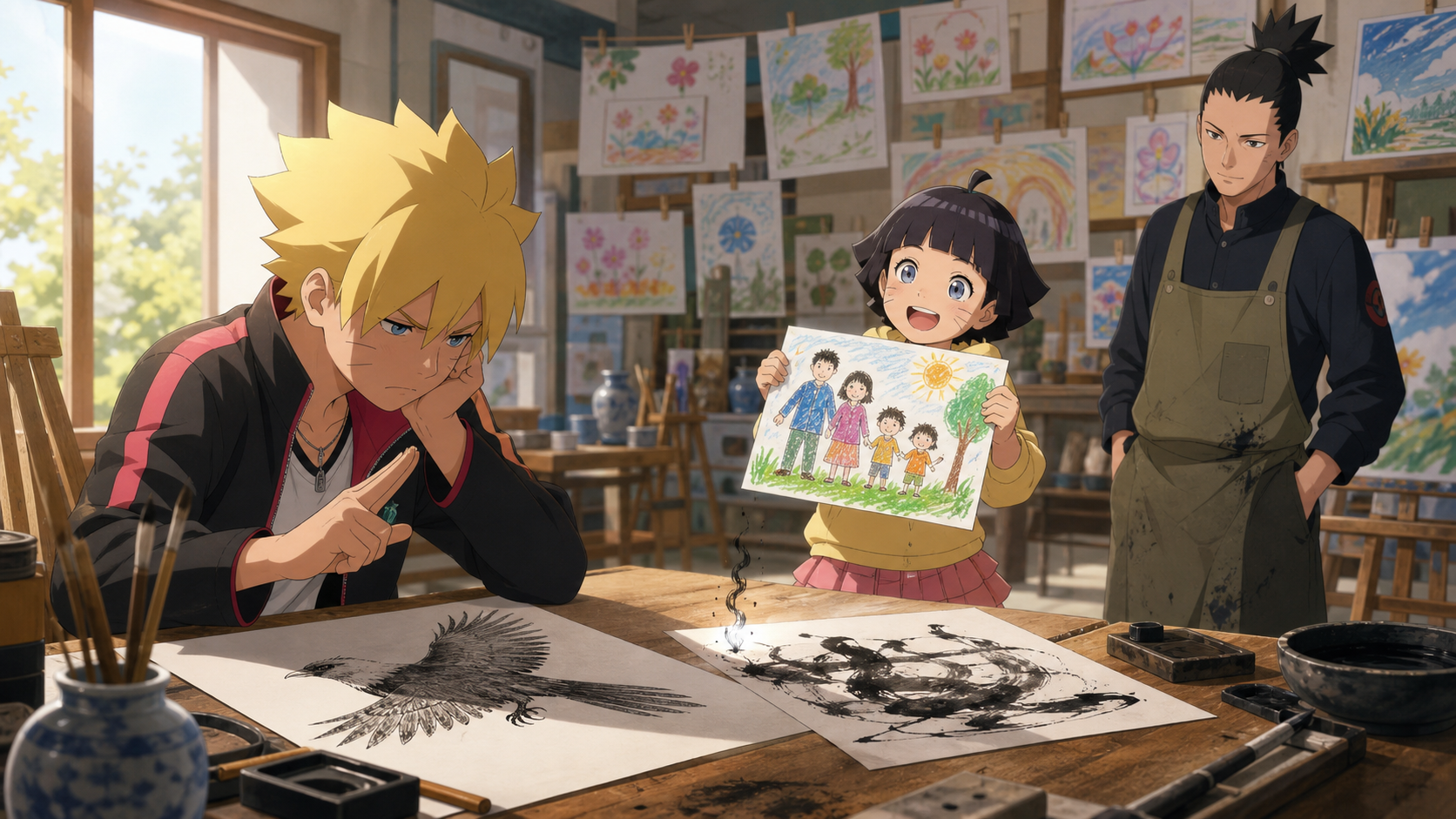
Inojin’s copied ink beasts collapse, Himawari’s family picture defeats his polished landscape, and one drawing worth saving gives Super Beast Scroll a pulse again.
Series: Boruto: Naruto Next Generations
Episode: 33 · The Super Beast Scroll Slump!!
Arc: Academy Daily Life
Release: 2017-11-15
Previous: Episode 32 · The Quest for Souvenirs!
Directory: All 293 Boruto episodes
Bottom line
Boruto Episode 33 gives Inojin the most artist-specific crisis possible: he can draw beautifully, understands the jutsu, inherited Sai’s technique, and suddenly cannot make one ink creature live. The failure begins because he tries to streamline Super Beast Scroll with photocopies before the graduation exam. Efficient. Prepared. Completely dead on arrival. The copied beasts crumble, and soon even fresh drawings refuse him.
Sai knows the problem but will not hand over a sentence Inojin can repeat without understanding. He sends his son into an art contest, watches Himawari’s bright family picture beat Inojin’s technically polished landscape, and later brings her into the Academy as a tiny guest teacher. Inojin gets angry, abandons drawing for Mind Transfer, fails there too, and nearly throws away his art supplies. The answer finally arrives when Himawari’s picture blows toward the water. Inojin wants to save that specific drawing because the picture matters to her. Purpose returns before technique does. His ink bird lives because he has remembered why a line should move.
Inojin opens with a shortcut that sounds responsible
Graduation exams are coming, so Inojin prepares photocopies of his drawings in advance. He reasons that carrying ready-made creatures will save time during combat. From a tactical standpoint, the plan is not foolish. Shinobi survive by reducing delays.
Sai’s concern appears before the jutsu fails because he recognizes what Inojin has removed. Super Beast Scroll is not a storage cabinet full of interchangeable animals. The act of drawing is part of the chakra, attention, and intention that give the creature form.
The copied beasts crumble before they can attack
Chōchō and Shikadai spar with Chōji while Inojin tests his prepared copies. The ink creatures begin to move, then collapse before landing an attack. His clever optimization has produced paper without presence.
The failure would be easier to accept if the copies simply lacked chakra. Instead, the technique starts and dies in front of him. Inojin can see the shape he expected and watch that shape refuse to become useful.
A fresh drawing fails too
Inojin tries drawing by hand after the copies collapse. The new creature also breaks apart. Now the problem cannot be blamed on the printer alone.
That second failure turns irritation into fear. A shortcut can be discarded. Losing access to a family technique feels like losing proof that he belongs to the lineage he has been casually carrying.
Sai refuses to give him a mechanical answer
Inojin goes to Sai for help. Sai explains that the copies caused the initial problem but refuses to finish the lesson for him. He believes a verbal answer will not restore the jutsu because Inojin would only imitate the explanation.
This is Sai parenting through the exact subject he understands best. He grew up trained to erase feeling and learned to recover emotion through bonds and drawing. He knows somebody else cannot manufacture that recovery for Inojin.
Sai sends his son to a children’s art contest
Sai suggests that Inojin enter an art competition. Inojin hears busywork because he wants chakra troubleshooting, not crayons and judging tables. Sai sees a chance to separate drawing from combat performance.
The contest forces Inojin to make an image that exists only to be looked at. No opponent. No mission utility. No beast required to move. If drawing has become only a delivery system for jutsu, the blank space outside combat may expose the loss.
Inojin enters halfheartedly and still expects to win
Inojin submits a polished landscape. His confidence rests on visible skill. He understands perspective, line, detail, and control better than most children entering the contest.
That confidence is not delusion. He is technically excellent. The episode does not need to pretend otherwise for Himawari’s victory to matter. Inojin’s problem is not that he draws badly. His problem is that he has started treating technical superiority as the whole purpose of drawing.
Himawari wins with a picture of Naruto
Himawari’s drawing is bright, direct, and full of affection for her father. The composition cannot match Inojin’s polish, but the judges respond to the feeling immediately available on the page.
Her victory annoys Inojin because the standards he trusts appear to have been discarded. He sees simpler lines and assumes the result must be favoritism rather than communication.
Inojin blames the Hokage connection
Inojin wonders whether Himawari won because she is Naruto’s daughter. The accusation is petty, believable, and useful. A child who has just lost confidence will often protect the ego by discrediting the result.
The irony is sharp because Inojin also comes from one of Konoha’s most connected families. Sai works directly with the Hokage. Ino leads critical sensory operations and belongs to an old clan. He is not an outsider exposing inherited privilege. He is a talented child scrambling for a reason that does not require him to question himself.
Sai asks him to compare the drawings
Sai tells Inojin to look at how his landscape differs from Himawari’s picture. He does not say that realism is bad or childish art is pure. He asks his son to notice what each work carries.
Inojin studies the images and still cannot find an answer. Technique is easy to compare. Intention is harder because intention does not sit in one measurable corner of the page.
Sai brings art into the Academy
Sai visits as a guest lecturer because shinobi may need to draw maps and sketch people of interest during missions. The lesson begins with practical purpose, which should make Inojin comfortable.
Then Sai asks the students to sketch Chōchō. Art becomes observation under pressure, and the class produces exactly the chaotic results one expects when Chōchō is both model and critic.
Chōchō as a model was always going to become an event
Chōchō does not simply sit there while classmates draw. She brings opinions, poses, and absolute faith that the page should recognize her greatness. The assignment gets personality before anybody makes a mark.
Her presence also prevents the episode from drowning in Inojin’s seriousness. Creative crisis feels enormous from inside. Chōchō reminds the room that drawing can still be funny, social, and gloriously unserious.
Boruto’s terrible sketch becomes a threat to Inojin’s worldview
Sai suggests that Boruto might be able to use Super Beast Scroll based on his drawing. Inojin is appalled because Boruto’s picture looks awful by his standards.
The suggestion is not proof that craft means nothing. Sai is showing that willingness and intention can sometimes animate a rough line while empty perfection remains still. Boruto’s drawing wants to do something, even if the anatomy has filed a complaint.
Inojin’s creatures can barely leave the paper
Inojin tries the jutsu during class. His drawings struggle to rise and collapse almost immediately. Failing in front of Sai was frightening. Failing before classmates turns the fear into humiliation.
Chōchō notices how unusually upset he becomes. Inojin normally protects himself with a sharp tongue and effortless competence. The slump has reached the part of his identity that makes sarcasm feel safe.
He decides to become a Yamanaka instead
Inojin shrugs and says he will focus on his mother’s jutsu. The pivot sounds practical. He belongs to two powerful lineages, so why keep fighting one technique when another inheritance is available?
The choice also carries avoidance. He is trying to outrun the vulnerable part of drawing by selecting a skill that feels more technical and less personal. Inojin treats lineage like a menu because committing to one path means risking failure inside that path.
Mind Transfer does not become an instant escape hatch
During Academy training, Inojin joins Chōchō and Shikadai against Metal, Denki, and Iwabee. He briefly takes Iwabee’s body through Mind Transfer, but limited practice allows Iwabee to break free.
The failure is important. Inojin cannot replace years of neglected training with a surname and one burst of determination. Ino’s technique deserves the same respect Sai’s technique does.
Denki’s team earns the win
Once Iwabee escapes, his team counterattacks. Chōchō hands Inojin his art supplies, trying to return the tool he knows best. Inojin hesitates long enough for Metal to strike, and Shino declares Iwabee’s group the winner.
The scene leaves Inojin stranded between identities. Mind Transfer is not ready. Super Beast Scroll feels unavailable. Hesitation becomes the only technique he can reliably perform.
Ino and Sai talk like parents who know the problem is real
Sai discusses the slump with Ino. Their concern gives the episode a warm family center. Neither parent treats Inojin’s failure as shameful, but neither dismisses the loss as a mood that will disappear without attention.
Ino knows what Yamanaka training demands. Sai knows what drawing once meant to a boy raised without ordinary emotional language. Together they understand that Inojin is not choosing between parents. He is trying to decide whether either inheritance belongs to him beyond convenience.
Sai’s next guest teacher is Himawari
Sai brings Himawari into the Academy to teach the art lesson. Boruto’s little sister walks into the room as the contest winner, and the students immediately adore her. Boruto receives the unique humiliation of having his baby sister become his teacher.
The setup is funny, but Sai’s purpose is serious. Himawari draws because drawing makes her happy, especially when she draws somebody she loves. She does not need to theorize about emotion. Her relationship with the page remains uncomplicated.
Himawari is delighted by living drawings
Sumire tells Himawari that Inojin can make drawings move. Himawari lights up and asks him to demonstrate. Her excitement is not based on ranking his skill. She simply thinks living pictures sound wonderful.
Inojin refuses because he believes his drawings no longer work. The refusal shows how far the slump has spread. He cannot even borrow enthusiasm from somebody who wants nothing from him except delight.
Inojin brings an empty page to a joyful lesson
While classmates draw, Inojin produces nothing. Himawari’s uncomplicated pleasure makes his block more visible because she is not trying to beat him.
The blank page becomes a standoff. Inojin knows how to fill the space, but every possible line now feels like evidence in a case against him. Avoiding the mark feels safer than watching another creature die.
He prepares to throw away the supplies
At home, Inojin gathers his drawing materials to discard them. The decision is dramatic because he is a child, but the pain underneath the drama is real. Keeping the tools means keeping the expectation alive.
Ino questions him rather than letting the gesture pass as casual cleanup. She knows those supplies connect her son to years of family memories, not only combat practice.
An old family drawing interrupts the goodbye
Inojin finds one of his earliest pictures, a drawing of himself with Ino and Sai. The image lacks his current technical control. The feeling is unmistakable.
The discovery gives him evidence that he once drew before he learned to judge every line. His younger self was not trying to demonstrate inheritance. He was trying to hold his family together on paper.
Inojin asks Himawari to teach him
Inojin returns to Himawari and asks for help. The request costs him pride because she is younger, less technically trained, and the person whose contest victory he dismissed.
Himawari has no formal method to offer. She draws because she enjoys drawing and loves her subjects. Her inability to package that instinct becomes part of the lesson. Inojin cannot copy a formula for sincerity.
The failed jutsu blows her picture away
Inojin tries again, and the collapsing technique sends Himawari’s drawing into the air. The page drifts toward the water. Suddenly a drawing matters for a reason unrelated to his reputation.
Himawari cares about that picture. Losing the page would hurt her. Inojin stops treating animation as proof that he remains talented and starts wanting one creature to move so he can protect something another person made with love.
Purpose reaches the ink before confidence does
Inojin recognizes the difference between his recent work and Himawari’s. Her drawings carry emotion because she knows why she chose the subject. His recent creatures became efficient shapes detached from attention.
The realization is not “draw badly but feel hard.” Craft remains his strength. Emotion gives that craft direction. The jutsu needs both the practiced hand and a reason for the hand to care.
The ink bird finally lives
Inojin draws and animates a bird that flies out to save Himawari’s picture. The recovery works because the creature has a specific job connected to somebody beside him.
Watching the bird hold together feels better than a giant battle victory. The technique has stopped being an inherited demonstration and become communication again.
Himawari asks him to animate her picture
After seeing the recovery, Himawari wants her own drawing brought to life. Inojin accepts. Her simple picture moves through his chakra, combining her affection with his skill.
That collaboration rejects the false competition established by the art contest. Himawari does not replace Inojin as the “real” artist. Inojin does not prove her work inferior. Their approaches meet and create something neither child could make alone.
Sai reveals his favorite drawing
Inojin shows his parents that Super Beast Scroll has returned. Sai then reveals that his favorite work is Inojin’s childhood family picture.
For Sai, that drawing carries everything he once believed he could never have: a name, a wife, a child, and affection drawn without an order behind the line. No polished landscape could compete with the history inside that page.
Ino’s reaction completes the family scene
Ino sees her son recover a relationship with art rather than merely recover a combat tool. Her warmth matters because Inojin’s two inheritances do not need to fight for ownership of him.
He can learn Yamanaka techniques and still draw. He can honor Sai without becoming a copy. The family works because each person brings an enormous personality and somehow makes room for the others.
Himawari is not precious about the vanished picture
Inojin apologizes because animating Himawari’s drawing made the image disappear from the paper. She decides she will simply draw another picture and make Naruto even happier.
That response is the freedom Inojin lost. Himawari values the act and the person more than preservation of one perfect object. She can make another line because drawing has not become a verdict about who she is.
RaeRae’s take
Inojin accusing a children’s art contest of Hokage-family favoritism because Himawari beat him is exactly the kind of petty little spiral I want from a character episode. He was wrong, wounded, talented, jealous, and still kind enough to ask the child he dismissed for help. That is a person, not a lesson-plan mascot.
Sai also got me. This man learned emotion by drawing faces into an empty book, then grew into a father who recognizes when his son’s beautiful lines have stopped carrying anybody. Showing Inojin the old family picture at the end was not a trick answer. That page is Sai’s whole impossible life. Of course the ink moved again when Inojin remembered that drawing can reach somebody.
Inojin inherits two clan techniques and still needs a reason to claim either one
Inojin's frustration becomes sharper because talent has never been the problem. He grew up between two powerful family traditions. Sai's Super Beast Scroll turns art into movement and reconnaissance. Ino's Mind Transfer carries the Yamanaka clan's history of communication, infiltration, and battlefield coordination. Most students would be thrilled to possess either route. Inojin treats both as available tools and assumes choosing between them should be simple.
The episode refuses that easy inheritance. A technique learned from a parent is not automatically a personal calling. Inojin can reproduce Sai's controlled lines without sharing Sai's relationship to drawing. He can attempt Mind Transfer without developing the concentration and emotional discipline Ino spent years building. Bloodline access opens a door. Practice, purpose, and experience decide whether he can walk through.
That tension makes his decision to abandon art understandable rather than petulant. Inojin believes a failed technique proves he chose the wrong side of the family. Switching to Mind Transfer promises a clean identity and an escape from the shame of disappointing Sai. When the second technique also resists him, he loses the fantasy that inheritance can choose on his behalf. He has to ask what he wants to communicate and whom he wants to reach.
Sai teaches through restraint because his own childhood offered no healthy model
Sai could demonstrate the jutsu, correct Inojin's brushwork, or reveal the emotional answer immediately. He refuses because the missing element cannot be copied. That restraint is remarkable for a man raised by Root, an institution that trained children to obey technique while suppressing attachment. Sai knows better than most that flawless execution without human purpose can produce a very efficient emptiness.
His teaching sometimes looks unnecessarily cryptic. Sending a frustrated teenager into a children's art contest is the kind of parental move that could become humiliating fast. Sai keeps the exercise useful by avoiding ridicule. He asks Inojin to compare the drawings instead of declaring Himawari morally superior. He later invites Himawari into the Academy because her delight reveals a relationship to art that Inojin has stopped noticing.
The old family drawing completes the lesson without turning Sai into a lecturer. That page records the life Sai once could not imagine: affection, belonging, a wife who knows his silences, and a son capable of arguing with him. Sai's favorite drawing is not his most technically accomplished image. His favorite carries the greatest human consequence. Inojin finally understands because the evidence belongs to their family, not an abstract rule about artistic passion.
Himawari wins because she draws the person she knows, not the office he holds
Himawari's picture of Naruto matters because her image is personal. The Seventh Hokage has monuments, official portraits, press photographs, and an entire village trained to recognize his public face. Himawari draws her father. Her picture does not need Inojin's polish because the relationship gives every choice a point of view.
Inojin initially reduces the victory to favoritism and the Hokage name. That reaction protects his pride. If judges rewarded status, his technique remains superior and no self-examination is necessary. Sai asks him to look again because the difference is visible. Inojin's landscape shows control. Himawari's picture shows attention to a specific person.
Her lack of possessiveness later strengthens the lesson. Himawari cares when the drawing blows away, but she does not treat the paper as a sacred trophy. The joy came from making the picture and sharing the feeling. Inojin risks himself to save the page because her joy has finally given his technique a destination. The ink bird succeeds before his confidence returns, which proves purpose can lead skill instead of waiting for perfect certainty.
The art slump gives the new generation a quieter version of Sai's original wound
Sai entered Naruto unable to name ordinary emotions and used drawing as one of the few routes back toward human connection. Inojin begins from the opposite position. He has a loving family, friends, emotional vocabulary, and artistic training. His problem is not suppressed feeling. His problem is treating expression like a completed assignment.
That generational reversal shows what healing can and cannot pass down. Sai gave his son the safety and instruction Sai never received. He cannot give Inojin a finished relationship to art. Every generation still has to discover why inherited practices matter in a new life. Inojin's crisis is smaller than Sai's Root trauma, and the smaller scale is evidence that the family changed. The emotional question remains real.
Sources and lawful viewing
“The Super Beast Scroll Slump!!” is Boruto: Naruto Next Generations Episode 33. The episode follows Inojin’s failed photocopy shortcut, Himawari’s art-contest victory, his unsuccessful turn toward Mind Transfer, Sai’s Academy lesson, and the family drawing that restores Super Beast Scroll.
Official episode reference: Naruto Official episode guide
Licensed episode route: Crunchyroll licensed series page